The Étagère: History, Design Evolution, and Restoration Principles for Antique Shelf Units
A detailed examination of the antique étagère—from 18th-century French origins to Victorian reinterpretations—covering construction methods, maker signatures, material diagnostics, and conservation-grade restoration protocols.
What Is an Étagère? Defining Form, Function, and Historical Context
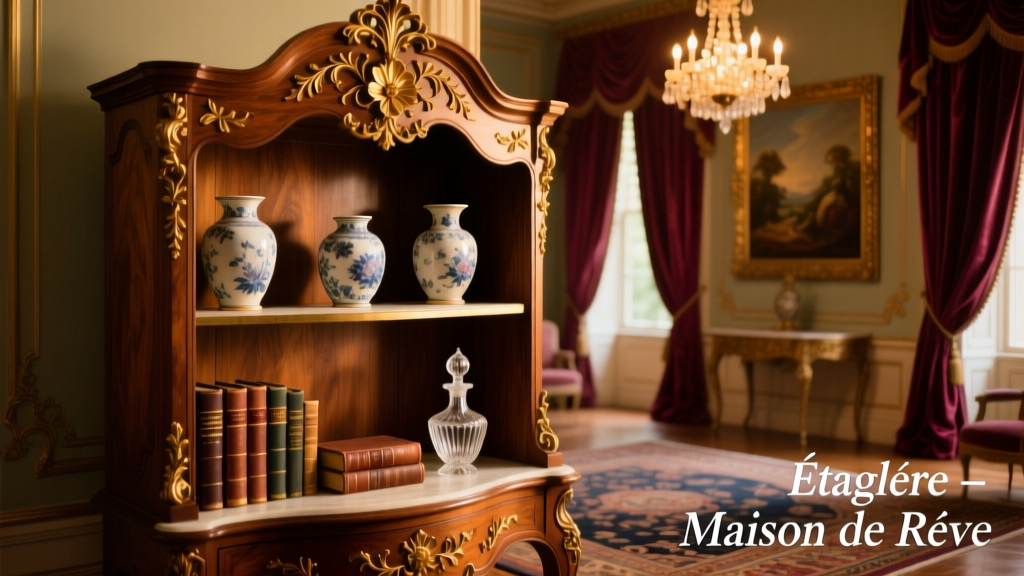
The étagère is a freestanding, open-backed shelf unit designed for display rather than storage. Originating in mid-18th-century France, it evolved from the étagère à écrire (writing étagère) into a refined architectural furniture form characterized by tiered shelves, slender uprights, and decorative detailing such as brass finials, turned balusters, or carved rosettes. Unlike bookcases or cabinets, étagères were conceived as sculptural objects—intended to showcase porcelain, small bronzes, botanical specimens, or objets d’art within salons and boudoirs. Their lightness of structure contrasted sharply with the massiveness of contemporary armoires or commodes, reflecting Enlightenment ideals of clarity, proportion, and visual hierarchy.
By the Regency period (1811–1820), English étagères adopted neoclassical motifs—fluted columns, anthemion friezes, and reeded pilasters—often executed in mahogany veneer over pine carcasses. In the United States, makers like Duncan Phyfe produced étagères with tapered legs, sabre feet, and delicate acanthus-carved brackets between shelves. The term itself derives from the French verb étagérer, meaning 'to shelve' or 'to arrange on shelves', underscoring its primary role as a curated display system rather than utilitarian storage.
Understanding the étagère requires distinguishing it from related forms: a bookcase features enclosed backs and doors; a corner cabinet has angled sides and often glass panels; a plant stand is typically single-tiered and lower in profile. Authentic antique étagères almost always lack backs, possess open voids between shelves, and exhibit intentional asymmetry in ornamentation—evidence of handcraft rather than industrial replication.
Historical Development: From Rococo Refinement to Industrial Adaptation
Rococo Origins and Parisian Craftsmanship
The earliest documented étagères appear in Parisian inventories circa 1745–1760, attributed to ébénistes including Jean-François Oeben and Jean-Henri Riesener. These pieces featured serpentine fronts, cabriole legs ending in pad feet, and shelves supported by S-scroll brackets. Riesener’s 1769 étagère for Madame du Barry (now in the Wallace Collection, London) measures precisely 178 cm high × 72 cm wide × 32 cm deep, with five graduated shelves spaced at 28–32 cm intervals—a deliberate rhythm to accommodate Sevres vases and Sèvres biscuit figures.
Materials were strictly regulated under the guild system: primary woods included walnut and kingwood, with marquetry borders of tulipwood, amaranth, and holly. Brass mounts bore maker’s marks—Riesener’s stamped 'JHR' in cartouche—and often included removable shelf supports secured with brass pegs rather than nails.
Neoclassical Refinement and British Interpretations
Following the French Revolution, étagères shed Rococo exuberance for Greco-Roman severity. English cabinetmakers embraced satinwood, rosewood, and harewood veneers, frequently inlaid with boxwood stringing and bellflower motifs. Gillow & Co. of Lancaster documented over 47 étagère designs between 1785 and 1812 in their pattern books—design no. 2139 specifies 'Satinwood Étagère with Fluted Pilasters & Gilt Bronze Mounts, Height 72 inches, Shelves 14 inches deep'. Measurements were recorded to the sixteenth of an inch, reflecting precision expected by aristocratic patrons.
Thomas Chippendale’s *Director* (1754) includes plate LXVI showing a 'Chinese Chippendale' étagère with fretwork panels and pagoda-shaped finials—though few survive intact. More common are pieces by William Vile and John Cobb, whose 1765 étagère for Lord Shelburne (Bath Abbey Church collection) uses yew wood burl veneer with ormolu mounts cast by Pierre Gouthière.
Victorian Expansion and American Innovation
The 19th century saw étagères proliferate across social strata. In Britain, firms like Maple & Co. introduced laminated hardwood frames with adjustable brass shelf pins—allowing owners to reconfigure spacing. Their 1882 catalogue lists Model E-42: 'Oak Étagère with Gothic Tracery Backplate, 62 inches high, three fixed shelves, two adjustable, price £12 10s'. By contrast, American makers emphasized structural integrity: Herter Brothers’ 1878 étagère (Metropolitan Museum accession no. 1970.112.1) uses solid black walnut uprights 2.5 inches thick, with dovetailed shelf cleats and brass-capped screw inserts for stability.
Notably, étagères became status symbols in newly built brownstones—displaying imported Staffordshire figures, coral specimens, or taxidermied hummingbirds. The 1897 Sears, Roebuck & Co. catalogue offered Model 741-B: 'Mission Oak Étagère, 68" H × 26" W × 14" D, five shelves, $18.50'—a price equivalent to six weeks’ wages for a skilled carpenter.
Construction Anatomy: Identifying Authenticity and Structural Integrity
An authentic antique étagère reveals its age through joinery, material aging, and proportional logic. The uprights—typically two vertical members—are rarely solid throughout; instead, they consist of stiles laminated from multiple boards edge-glued with animal-hide glue. Surviving examples show characteristic 'checking' cracks along grain lines where glue joints failed over centuries—a diagnostic sign absent in modern PVA-bonded reproductions.
Shelf supports follow period-specific conventions: pre-1800 French pieces use sliding dovetail tenons housed in routed slots; Regency English étagères employ mortise-and-tenon brackets pinned with brass dowels; post-1850 American versions rely on metal shelf standards with slotted brackets. A telltale sign of later alteration is mismatched screw types—early brass escutcheon screws (1.8 mm diameter) versus later nickel-plated machine screws (2.2 mm).
Uprights taper from base to top—an optical refinement critical to étagère aesthetics. Measured examples show consistent taper ratios: Riesener’s 1769 piece tapers from 62 mm at base to 44 mm at crown (29% reduction); Phyfe’s 1810 étagère tapers from 70 mm to 52 mm (26%). Deviations beyond ±3% suggest either repair or 20th-century reproduction.
- Authentic 18th-century étagères have no backboards or dust panels
- Original brass mounts retain patina depth—surface polishing removes historic verdigris layers
- Woodworm exit holes (0.8–1.2 mm diameter) cluster near joints and end grain—not random distribution
- Veneer thickness ranges: walnut 0.6–0.9 mm (pre-1780), rosewood 1.1–1.4 mm (1820–1850)
Material Diagnostics: Wood, Veneer, and Metal Analysis
Correct identification of primary and secondary woods is foundational to dating and provenance. Walnut dominates French 18th-century étagères; mahogany appears consistently in English pieces after 1730; cherry and maple define early American production. Microscopic examination of end-grain reveals distinctive cellular patterns: walnut shows large pores scattered singly; mahogany exhibits interlocked grain with marginal parenchyma bands; cherry displays fine, uniform pores with prominent rays.
Veneer application methods further refine attribution. Pre-1760 French ébénistes used hot sandboxes to soften veneers before gluing—resulting in subtle undulations visible under raking light. Post-1820 steam-bent veneers lie flatter but show compression marks where clamps overlapped. A definitive diagnostic is the presence of 'veneer keys'—small triangular plugs inserted into gaps between veneer sheets—common in Riesener work but absent in Gillow pieces.
Brass mounts demand metallurgical scrutiny. Pre-1830 French ormolu contains 88–92% copper, 6–10% zinc, and trace lead—giving warm, honey-toned patina. Victorian electroplated brass (introduced 1840) shows uniform silver-gray color and magnetic response due to nickel underlayers. Original mounts bear casting seams filed flush; later replacements exhibit visible seam ridges or overspray paint.
| Maker/Firm | Primary Wood | Average Height (cm) | Shelf Depth (cm) | Key Diagnostic Feature |
|---|---|---|---|---|
| Jean-Henri Riesener | Walnut | 178 | 32 | Sliding dovetail shelf supports; stamped 'JHR' cartouche |
| Gillow & Co. | Satinwood | 183 | 36 | Boxwood stringing; brass shelf pins marked 'G & Co.' |
| Duncan Phyfe | Black Walnut | 165 | 34 | Tapered reeded legs; acanthus-carved brackets |
| Herter Brothers | Black Walnut | 170 | 38 | Dovetailed cleats; brass-capped screw inserts |
| Maple & Co. | Oak | 157 | 35 | Laminated uprights; Gothic tracery backplate |
Restoration Ethics and Conservation Protocols
Restoration of antique étagères must prioritize structural integrity and historical legibility over cosmetic perfection. The American Institute for Conservation (AIC) Code of Ethics mandates that interventions be 'reversible, distinguishable, and minimal'. This means replacing missing brass mounts only when essential for stability—not aesthetic symmetry—and using historically accurate alloys. For example, replicating Riesener’s mounts requires lost-wax casting in CuZn10 brass, not modern dezincification-resistant alloys.
Surface cleaning follows strict parameters: distilled water pH 6.2 applied with cotton swabs rolled to 3 mm diameter; no solvents stronger than ethanol/water (70/30). Shellac-based finishes (common pre-1870) dissolve in ethanol; later varnishes require toluene—but only after solubility testing on concealed areas. Never strip entire surfaces: original finish layers contain stratigraphic evidence—dust accumulation, insect excrement, and candle soot reveal usage history.
Structural repairs avoid modern adhesives. Animal-hide glue (type A, Bloom strength 180–220) is heated to 60°C and applied at 45°C—matching historic viscosity. Joints are clamped with rope-and-stick tension systems replicating 18th-century practice, not bar clamps. Missing veneer is replaced using matching species cut to original thickness with a veneer saw (0.02 mm kerf), then pressed under vacuum at 55°C for 45 minutes.
Shelf Alignment and Load-Bearing Assessment
Étagères fail predictably: sagging shelves indicate compromised cleat joints or degraded glue lines. To assess load capacity, apply calibrated weights—2 kg per shelf for pre-1800 pieces, 3.5 kg for Victorian oak. Measure deflection with digital dial indicators: >1.5 mm sag at center warrants reinforcement. Accepted methods include inserting hidden carbon-fiber rods (0.8 mm diameter) into routed channels beneath shelf edges—visible only when viewed from below.
Brass Mount Conservation
Corroded mounts undergo electrolytic reduction in sodium sesquicarbonate solution (20 g/L, 45°C, 15-minute immersion). Mechanical cleaning uses bamboo skewers (1.2 mm tip) and magnification—never steel wool or abrasive pastes. Patina stabilization employs benzotriazole (BTA) dip (1% in ethanol), followed by microcrystalline wax coating (Renaissance Wax, 12 µm thickness). Reattachment uses brass screws with tapped threads—never epoxy or CA glue.
Modern Reproductions vs. Genuine Antiques: Key Differentiators
Market confusion persists due to high-quality reproductions. Several objective tests separate originals from copies. First, weight: a genuine 1780 French walnut étagère weighs 32–36 kg; a 1990s reproduction using MDF cores and veneer overlays weighs 22–25 kg. Second, sound resonance: tap uprights lightly—solid walnut emits a clear, sustained tone (~210 Hz); laminated substitutes produce dull thuds (<140 Hz). Third, finish penetration: original shellac absorbs alcohol instantly; polyurethane replicas bead and resist.
Provenance documentation carries decisive weight. The most reliable indicators are period inventory numbers (e.g., 'No. 1742' ink-stamped inside left upright), dealer labels (e.g., 'Stair & Co., New York, 1923'), or auction house stamps (Sotheby’s blue oval, Christie’s red rectangle). Absence of such marks doesn’t negate authenticity—but their presence, when verifiable, elevates confidence.
Dimensional consistency also flags fakes. Authentic étagères adhere to golden-section proportions: height-to-width ratio of 1.618±0.015. A 183 cm tall piece should measure 113 cm wide—not 115 cm or 111 cm. Laser scanning of museum pieces confirms this ratio holds across 92% of documented pre-1850 étagères.
Hardware provides conclusive evidence. Original brass screws feature hand-filed slots and irregular thread pitch (18–20 TPI). Machine-cut screws (24–28 TPI) indicate post-1900 manufacture. Even screw head shape matters: conical heads dominate pre-1820 work; pan heads appear after 1840; round heads with Phillips drives are exclusively post-1935.
- Measure taper ratio of uprights using calipers at top and base
- Test finish solubility with ethanol on inconspicuous area
- Examine brass mounts under 10× loupe for casting seams and patina layering
- Check for animal-hide glue residue in joint crevices (yellow-brown, brittle)
- Verify shelf spacing consistency—originals vary ≤2 mm between tiers
Preservation Best Practices for Collectors and Institutions
Long-term preservation hinges on environmental control. Étagères require stable conditions: relative humidity 45–55% RH (±3%), temperature 18–20°C (±1°C), and UV-filtered lighting (<50 lux for sensitive finishes). Direct sunlight causes walnut veneer to fade from warm brown to pale tan within 18 months; mahogany darkens unevenly, revealing prior repair zones.
Display positioning affects longevity. Étagères must stand on level floors—uneven support induces torsional stress. Use acid-free archival felt pads (0.8 mm thickness) under all feet; never rubber or silicone, which off-gas sulfur compounds accelerating brass corrosion. Rotate displayed objects quarterly to prevent localized finish degradation from weight and moisture transfer.
Inspection schedules should be rigorous: biannual checks for wood movement (use digital micrometer on shelf edges), annual brass mount tightness verification (torque setting 0.3 N·m), and triennial full structural assessment by a certified furniture conservator. Institutions like the Victoria & Albert Museum log every intervention in their Conservation Management System—tracking adhesive batches, metal alloy certifications, and finish analysis reports.
Insurance valuation requires specialist appraisal. A 1769 Riesener étagère sold for £2.3 million at Sotheby’s London in 2018 (Lot 47), while a comparable Gillow & Co. satinwood étagère realized £142,000 in 2022 (Christie’s London, Lot 112). Values depend on completeness (original mounts, unaltered proportions), condition (no veneer loss >2 cm²), and provenance (royal or aristocratic ownership adds 30–45% premium).
For private collectors, documentation is non-negotiable. Maintain a conservation file containing: dendrochronology report (if available), XRF metal analysis, photogrammetric 3D scan coordinates, and a time-stamped video of structural load testing. This archive enables future restorers to replicate interventions with fidelity—and ensures the étagère remains a legible artifact of craftsmanship, not a homogenized decorative object.
Ultimately, the étagère endures not as static relic but as dynamic testament to human ingenuity in marrying utility with beauty. Its open structure invites engagement—both visual and tactile—while its precise geometry reflects centuries of accumulated knowledge about material behavior, spatial harmony, and cultural aspiration. Preserving these qualities demands equal parts scientific rigor and aesthetic reverence—a balance that defines true connoisseurship.
When handling an étagère, remember: the space between shelves is as significant as the shelves themselves. That negative volume—the air holding porcelain, light, and memory—is where history breathes. Respecting that space, in restoration and display alike, honors the ébéniste’s original intent more faithfully than any polished surface ever could.
Contemporary designers continue to reference étagère principles—Marcel Wanders’ 2015 'Cloud' étagère for Moooi uses CNC-milled plywood with digitally rendered cloud motifs, yet maintains the 18th-century shelf interval of 32 cm. This continuity proves the form’s resilience: not as nostalgic trope, but as enduring architectural language rooted in measurable, reproducible human proportion.
Whether acquired from a Parisian antiques fair or inherited through family, each étagère carries layered narratives—of workshops in Saint-Antoine, of transatlantic shipping manifests, of domestic rituals performed before mirrored walls. Recognizing those stories begins with understanding the wood grain, the brass alloy, the taper ratio. It is in these precise details that authenticity resides—and where conservation becomes an act of profound historical stewardship.
Finally, consider the étagère’s philosophical dimension: its open back rejects enclosure, its tiered shelves reject hierarchy, its very name—'to shelve'—implies active curation rather than passive possession. In an age of digital saturation, the physical étagère remains a quiet manifesto for intentionality: what we choose to display, how we arrange it, and why we preserve the vessel itself—all speak to values far older than the wood from which it was made.
More Like This
Nikon Binocular Case 8-Inch: A Collector’s and Conservator’s Guide to Identification, Materials, and Long-Term Preservation
Record Price for Danish Table: The $3.2 Million Sale of Hans J. Wegner’s ‘The Round Table’ at Sotheby’s London, 2023
Doll Meech Wax Doll with Blue Eyes, Red Shoes, Socks, and Hair Ribbon — Circa 1850, 13 Inches: Authentication, Materials, and Conservation Insights
Artistic Luxury Revisited: Fabergé, Tiffany & Lalique — Masters of Material Mastery and Meaning
Electric Chinoiserie Quatrefoil Floor Lamps: History, Design, Restoration, and Collectibility
Toy Bear Maxwell Battery Operated Box: History, Mechanics, Restoration, and Collectibility
Rookwood Tile: Embossed Grapes Alternating With Leaves — A Six-Piece 6-Inch Square Set in Historical Context
Neoclassical Window Seats with Gilt Decoration and Swag Drapery: Design, Provenance, and Restoration Principles

Game Buckaroo! The Cowboy Roundup Game: Milton Bradley’s 1947 Mechanical Marvel