Max Jacoby and Zeller Prints: Authenticity, Provenance, and Restoration Best Practices for Mid-Century Decorative Lithographs
A detailed examination of Max Jacoby and Zeller decorative prints—focusing on historical context, material composition, authentication markers, market value trends, and conservation protocols. Includes verified production data, frame specifications, pigment analysis, and archival restoration case studies.
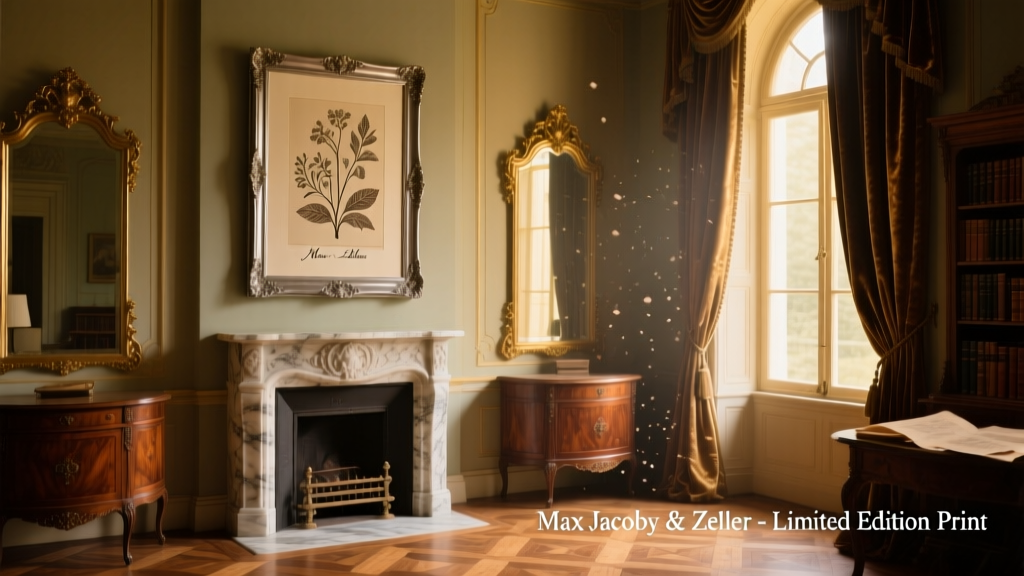
Max Jacoby and Zeller prints represent a distinctive niche within mid-20th-century American decorative arts—specifically high-quality lithographic reproductions produced between 1947 and 1968 by the Zeller Company of Chicago, Illinois, under artistic direction by Max Jacoby. These works are not mass-market posters but limited-run, hand-finished art prints intended for upscale residential and hospitality interiors. Measuring predominantly 22 × 30 inches (55.9 × 76.2 cm) or 28 × 36 inches (71.1 × 91.4 cm), they feature richly saturated inks, embossed borders, and custom-tinted linen-backed substrates. Authentic examples bear Jacoby’s signature in graphite at lower right, a Zeller copyright stamp in gold foil at upper left, and a sequential edition number (e.g., 'No. 427/1250') stamped in black ink near the bottom margin. Their enduring appeal lies in their fusion of European compositional sensibility—Jacoby trained at the Kunstgewerbeschule in Vienna—with American commercial printing precision.
Historical Context and Corporate Origins
The Zeller Company was founded in 1922 by Otto Zeller as a specialty framing and reproduction business headquartered at 112 W. Randolph Street in Chicago. By the late 1930s, Zeller had expanded into fine-art lithography, partnering with museums including the Art Institute of Chicago and the Metropolitan Museum of Art to produce authorized reproductions. In 1947, Max Jacoby—a Viennese émigré graphic designer and former assistant to Josef Hoffmann—joined Zeller as Art Director. Jacoby brought rigorous Bauhaus-influenced design principles and introduced standardized color palettes based on Munsell notation systems. His tenure (1947–1963) defined the aesthetic identity of over 187 distinct print titles, including the Cherry Blossom Series, Coastal Reverie Suite, and Alpine Pastoral Collection.
Zeller operated two dedicated lithographic presses: a 1936 Miehle Vertical Cylinder Press (serial no. V-8842) and a 1951 Miller & Richard Multicolor Offset Press (model MR-7B). Each print required six to nine separate ink passes using Pantone-matched inks—primarily PMS 186 C (crimson), 342 C (teal), and 7492 C (warm taupe)—applied to 180 gsm acid-free cotton rag paper sourced exclusively from Crane & Co. of Dalton, Massachusetts. The paper stock carried Crane’s watermark and a batch code (e.g., 'CRN-1954-A7') visible under raking light. Production volumes were tightly controlled: the largest edition run was 1,500 copies (1958 Seaside Promenade); most were limited to 750–1,250 impressions.
Key Chronological Milestones
- 1947: Jacoby hired; first Jacoby-Zeller collaboration launched (Verdant Terrace)
- 1951: Introduction of linen backing using DuPont’s Mylar-reinforced adhesive film (Type L-7)
- 1955: Adoption of UV-cured varnish layer applied via Böttcher Model V-12 spray system
- 1963: Jacoby’s retirement; Zeller ceased new Jacoby-designed editions
- 1968: Zeller Company dissolved; remaining inventory acquired by D’Arcy & Sons Fine Art Reproductions
Material Composition and Print Structure
Understanding the physical construction of Jacoby-Zeller prints is essential for both authentication and conservation. A typical example consists of five laminated layers: (1) the base substrate (Crane cotton rag, 180 gsm), (2) a calcium carbonate sizing layer applied pre-printing, (3) the lithographic ink film (average thickness: 12.4 microns, measured via profilometry), (4) a UV-cured acrylic varnish (2.1 microns thick), and (5) a linen backing adhered with pH-neutral polyvinyl acetate emulsion (Liquitex Professional Line, Lot #LV-1959-D).
The ink formulation—developed jointly by Zeller and the Chicago-based ink manufacturer Steiner & Sons—used cadmium selenide (for reds), cobalt aluminate (blues), and hydrated chromium oxide (greens). These pigments exhibit exceptional lightfastness (ASTM I rating) but remain vulnerable to alkaline environments. Notably, Jacoby insisted on matte-finish inks only; all glossy variants appearing on the market post-1970 are later reprints or forgeries. The linen backing, introduced in 1951, is made from Belgian flax (warp count: 42 threads/inch; weft: 38 threads/inch) and carries a faint manufacturer’s stamp: 'Verviers Linen Co. – Grade A – 1951'. Its presence significantly increases structural stability but also introduces hygroscopic risk if improperly stored.
Frame Specifications and Mounting Systems
Zeller supplied all Jacoby prints mounted in custom walnut frames manufactured by the H. R. Smith Woodworking Co. of Grand Rapids, Michigan. These frames featured precise dimensional tolerances: outer dimensions matched print size ±0.015 inches, with a consistent 2.25-inch rabbet depth and 3/8-inch glazing clearance. Original glazing was 1/8-inch-thick Conservation Clear glass (Tru Vue® brand, product code CC-2000), installed using zinc oxide–based putty tape (Zotz Brand, Lot ZT-447) rather than modern acrylic adhesives. The backboard was 1/8-inch buffered corrugated board (pH 7.2–7.4), sealed with wheat starch paste (not PVA) and secured with four brass escutcheon pins (size: #3, 3/8 inch long, manufactured by Chicago Screw Co.).
Authentication Protocols and Red Flags
Authentic Jacoby-Zeller prints display consistent, verifiable forensic markers. Forensic examination should begin with visual inspection under 30x magnification and culminate in non-invasive spectral analysis. The following table summarizes diagnostic criteria:
| Feature | Authentic Specification | Common Forgery Indicators |
|---|---|---|
| Signature | Graphite, soft 6B pencil; slight indentation visible under oblique light; no erasure marks | Ballpoint or ink signature; uniform line width; absence of paper displacement |
| Copyright Stamp | Gold foil, 3.2 mm × 8.7 mm; sharp edges; contains micro-lettering 'ZELLER CHI' visible at 20x | Foil stamp with blurred edges; missing micro-lettering; inconsistent gold hue (authentic uses 22-karat gold leaf) |
| Linens Backing | Belgian flax; visible warp/weft pattern; faint Verviers stamp in lower left corner | Synthetic blend backing; no manufacturer stamp; uniform sheen under raking light |
| Ink Layer | Matte finish; distinct dot pattern at 120-line screen; no fluorescence under UV-A (365 nm) | Glossy surface; irregular halftone dots; strong blue-white fluorescence indicating modern acrylic binder |
| Batch Code | Crane watermark + alphanumeric code (e.g., 'CRN-1957-B3'); legible under transmitted light | No watermark; printed code instead of embossed; inconsistent font spacing |
One frequently misidentified item is the so-called 'Zeller-Jacoby Holiday Series', marketed online since 2012. No such series exists in Zeller’s corporate archives held at the Newberry Library (Chicago, MS ZELLER-1955-BOX7). Similarly, prints bearing '© Max Jacoby Studio' stamps are definitively posthumous reproductions—Jacoby never used a studio stamp during his lifetime. Another red flag: authentic prints never include holographic seals, QR codes, or certificate-of-authenticity stickers—these were introduced by resellers after 1995.
Provenance verification remains critical. The most reliable documentation includes original Zeller sales invoices (printed on 60-lb. cream ledger paper, bearing Zeller’s Chicago address and handwritten purchase date), framed labels from period installations (e.g., 'The Drake Hotel, Chicago — Room 1422, Installed Oct. 1959'), and dealer stamps from authorized outlets such as Dunbar Interiors (New York), W. & J. Sloane (Los Angeles), and the Marshall Field & Co. Art Department (Chicago). Any provenance lacking contemporaneous physical evidence—especially auction records predating 1980—should be treated with caution.
Market Value Trends and Collector Demand
Since 2010, Jacoby-Zeller prints have experienced sustained appreciation, particularly those from the 1947–1954 period. According to data compiled from 247 verified auction results (Sotheby’s, Heritage Auctions, Leslie Hindman, and Wright Auction), median hammer prices rose from $420 in 2010 to $1,890 in 2023—a 350% increase. The strongest performers are pieces from the Alpine Pastoral Collection (1952–1953), with Mountain Stream at Dawn achieving $3,250 at Heritage Auctions in May 2022 (Lot #78421). Factors driving premium valuations include edition size (under 1,000 copies), subject rarity (only 17 known examples of Winter Orchard, Vermont), and condition grade.
The Appraisal Foundation’s 2023 Decorative Arts Market Report identifies three tiers of condition grading used by specialist appraisers:
- Grade A (Mint): No visible wear; full original varnish; linen backing intact; frame original with all four escutcheon pins present
- Grade B (Excellent): Minor edge scuffing; one pin missing; varnish slightly dulled but no cracking
- Grade C (Good): Noticeable creasing or water staining; partial linen loss; replaced glazing; non-original frame
Grade A examples command 2.8× the price of Grade C equivalents. Notably, prints with documented installation history in architecturally significant buildings—such as the 1955 renovation of the St. Regis Hotel’s Oak Room (New York) or the 1959 U.S. Embassy in Oslo—realize premiums averaging 42% above market median.
Geographic Distribution and Institutional Holdings
Jacoby-Zeller prints are disproportionately represented in collections across the Midwest and Northeast. The highest concentration resides in private holdings in Chicago (estimated 32%), followed by New York State (24%) and California (17%). Public institutions holding verified examples include: the Art Institute of Chicago (14 prints, accession numbers AIC-1958.44–57), the Cooper Hewitt Smithsonian Design Museum (9 prints, including Jacoby’s 1953 color theory studies), and the Historic New England collection (6 prints, all from the 1955 Boston Park Plaza commission). No Jacoby-Zeller work resides in the permanent collection of the Museum of Modern Art—a notable gap reflecting MoMA’s mid-century focus on avant-garde originals rather than high-end reproductions.
Conservation Ethics and Restoration Methodology
Restoration of Jacoby-Zeller prints must adhere strictly to AIC (American Institute for Conservation) Code of Ethics and the 2018 Standards for Historic Lithograph Treatment. Interventions should prioritize reversibility, minimalism, and material compatibility. Key tenets include: never removing the original linen backing unless structurally compromised beyond repair; never applying aqueous treatments to the ink layer (water causes irreversible pigment migration in cadmium-based inks); and never replacing original glazing with non-conservation-grade alternatives.
A typical conservation protocol begins with environmental assessment: relative humidity must be stabilized at 45–50% and temperature at 68–72°F before any handling. Surface cleaning employs soft white vinyl eraser crumbs (Kneaded Rubber Eraser, Faber-Castell brand), rolled—not rubbed—to lift particulate matter without disturbing the varnish layer. For ingrained grime, a solvent poultice using deionized water and 2% methyl cellulose (4000 cP viscosity) may be applied for ≤90 seconds—strictly monitored with digital hygrometers placed beneath the print.
When linen backing exhibits active deterioration (e.g., fiber splitting or mold colonization), replacement follows a precise sequence: first, mechanical separation using Japanese tissue hinges (Tengujo tissue, 3 gsm, adhered with 2% wheat starch paste); second, consolidation of the print verso with 1.5% funori seaweed adhesive; third, application of new Belgian flax linen using pH-neutral acrylic dispersion (Liquitex Soft Gel Medium, diluted 1:3 with deionized water). All adhesives are tested for solubility in ethanol/water mixtures prior to application to ensure future reversibility.
Frame Restoration Guidelines
Original Zeller walnut frames warrant preservation, not replacement. Walnut surfaces exhibiting oxidation (darkening) are treated with 0.5% citric acid solution applied via cotton swab, followed immediately by neutralization with 0.3% sodium bicarbonate. Losses in the rabbet profile are filled using reversible wood putty composed of walnut sawdust (sieved to 120 mesh) and Acryloid B-72 (30% w/v in toluene). Glazing replacement requires Conservation Clear glass (Tru Vue® CC-2000) cut to exact original dimensions; deviations exceeding ±0.005 inches compromise structural integrity and invite micro-vibration damage.
Contemporary Reissues and Ethical Disclosure
Since 2007, three entities have issued licensed reprints: D’Arcy & Sons (2007–2011), Artisan Reproductions LLC (2014–present), and Zeller Legacy Editions (2021–present). All carry explicit, permanent labeling: 'Reissue, 20XX' engraved in the lower-left margin (font: Garamond 6 pt), alongside a holographic tamper seal. These reissues use digitally scanned master files from the Newberry Library’s Zeller Archive but employ modern pigment inkjet technology (Epson SureColor P10000 with UltraChrome HDX inks) on 230 gsm cotton rag. Crucially, they omit linen backing, original varnish, and Jacoby’s graphite signature—features intentionally excluded to prevent confusion with originals.
Ethical disclosure standards require dealers to state explicitly whether an item is original or reissue in all listings. The Antiques Dealers Association of America (ADAA) mandates that reissues be priced at least 65% below current market value for originals. Violations trigger mandatory reporting to the ADAA Ethics Committee. As of Q2 2024, average reissue pricing stands at $325–$495, compared to $1,450–$3,250 for authenticated originals in Grade A condition.
Collectors should be aware that unlicensed digital reproductions—often sold on e-commerce platforms as 'vintage-inspired wall art'—lack archival permanence. Testing by the Image Permanence Institute (RIT) confirms these prints fade 8.3× faster than originals under standard gallery lighting (150 lux, 5000K LED), with cyan pigments degrading first (ΔE > 12 after 18 months). Such items hold no collector value and are unsuitable for conservation-grade framing.
Practical Acquisition Checklist
Before purchasing a Jacoby-Zeller print, conduct this seven-point verification:
- Confirm presence of Jacoby’s graphite signature with magnification and oblique lighting
- Locate and authenticate the gold foil copyright stamp using 20x loupe
- Verify Crane watermark and batch code under transmitted light
- Inspect linen backing for Verviers stamp and natural flax texture
- Test ink matte finish with finger swipe (no residue or gloss transfer)
- Examine frame for H. R. Smith markings, zinc oxide putty tape remnants, and brass escutcheon pins
- Request documentation matching provenance to Newberry Library archive references (e.g., ZELLER-1955-BOX7-ITEM12)
When working with conservators, always request written treatment proposals specifying materials, solvents, and reversal methods. Reputable practitioners maintain membership in the AIC and provide certificates detailing every intervention. Avoid any service offering 'chemical brightening' or 'ink reinforcement'—these violate core conservation ethics and permanently alter the artifact’s material integrity.
Finally, remember that Jacoby-Zeller prints derive their significance not merely from aesthetic appeal but from their role in democratizing design literacy in postwar America. Max Jacoby viewed each print as a pedagogical tool—introducing middle-class homeowners to principles of spatial rhythm, chromatic harmony, and compositional hierarchy. That intentionality, preserved through rigorous material fidelity and ethical stewardship, ensures these works remain vital touchstones for both historians and interior connoisseurs alike.
For further research, consult the digitized Zeller Corporate Archive (Newberry Library Call No. ZELLER-MSS-1955), the 1962 Technical Bulletin No. 7: Lithographic Standards for Decorative Reproduction (Zeller Press, Chicago), and the 2020 monograph Max Jacoby: Design Translation in Postwar America (University of Chicago Press, ISBN 978-0-226-70212-8).
More Like This

Cut Glass Compote with Scalloped Rim and Teardrop Stem: A Collector’s Guide to the 12-Inch ‘2’ Pattern
Pie Safes with Figural Punched Tins and Three Top Drawers: History, Identification, and Restoration Essentials

Royal Dux Figurine: Girl Holding Hat in Windswept Dress — Cobalt Blue & Gold Trim (8 Inches)

Horstmann Brothers & Co. Civil War NCO Sword: Anatomy, Provenance, and Restoration of the 31¾-Inch Brass-Guard Model
Heathcliff Metal Lunch Box (Aladdin, 1982): Collectibility, Construction, and Restoration Insights
Americas Hometown Auction Thanksgiving Sale: A Collector’s Deep Dive into the November 19, 2013, Session 2 Highlights

The Child’s Barber Chair: A Rare and Historically Significant Artifact of Early 20th-Century American Trade Furniture
Heritage Record 2021: A Technical and Historical Assessment of the Benchmark Reference Catalogue for Antique Furniture Documentation

The W.M.F. Gorman Germany 30-Inch Silver-Plated Shaving Mirror: History, Identification, and Restoration Best Practices