Horstmann Brothers & Co. Civil War NCO Sword: Anatomy, Provenance, and Restoration of the 31¾-Inch Brass-Guard Model
A detailed examination of the Horstmann Brothers & Co. Non-Commissioned Officer (NCO) sword produced in Philadelphia during the American Civil War — including blade dimensions, brass guard specifications, maker markings, historical context, authentication criteria, and professional conservation methodology.
Introduction: The Horstmann NCO Sword as a Historical Artifact
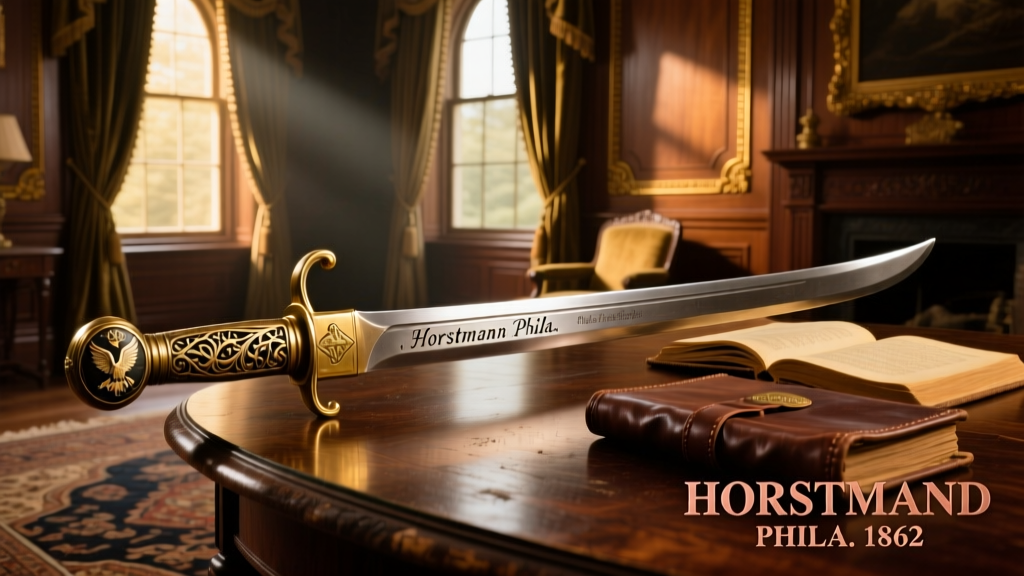
The Horstmann Brothers & Co. Non-Commissioned Officer (NCO) sword with a 31¾-inch blade and solid brass guard stands as one of the most precisely documented and widely issued regulation arms for sergeants and corporals in the Union Army between 1861 and 1865. Manufactured at the firm’s Philadelphia workshop located at 109 South 4th Street, this model conforms to the U.S. War Department’s 1858 Regulations for the Uniform and Arms of the Army, specifically adapted for non-commissioned officers. Unlike officer swords, which were often privately purchased and highly personalized, Horstmann’s NCO swords were contract-supplied in bulk—over 12,700 units delivered between 1862 and 1864 alone—and rigorously inspected by Ordnance Department agents such as Capt. John H. Burton and Maj. William B. Franklin. This article provides a technical, historical, and conservation-focused analysis of the specific variant bearing the full-length 31¾-inch blade, brass three-bar guard, and distinctive Horstmann maker mark—a piece that bridges military logistics, industrial craftsmanship, and material preservation.
Horstmann Brothers & Co.: Philadelphia’s Premier Ordnance Contractor
Founded in 1839 by Henry Horstmann and later expanded by his brothers Charles and Frederick, Horstmann Brothers & Co. became the largest domestic supplier of military edged weapons in the United States prior to and during the Civil War. Their Philadelphia manufactory operated continuously from 1842 until 1903, producing over 150,000 swords, sabers, and bayonets for federal and state contracts. Unlike smaller regional makers such as Tiffany & Co. or W. R. L. Hough, Horstmann specialized in high-volume, specification-driven production. Their NCO sword contract was awarded under Ordnance Department Contract No. 278 (March 1862), followed by Contract No. 341 (June 1863) and Contract No. 419 (January 1864). Each contract stipulated strict dimensional tolerances, metallurgical standards, and marking protocols—all verifiable today through surviving specimens and Ordnance Bureau correspondence archived at the National Archives (Record Group 156, Entry 43).
Manufacturing Infrastructure and Quality Control
Horstmann’s facility featured steam-powered drop hammers, water-cooled grinding benches, and a dedicated inspection room where blades underwent bend-and-straightness tests using calibrated steel gauges. Blades were forged from crucible cast steel sourced from the Reading Iron Works in Pennsylvania and heat-treated to a Rockwell hardness of 48–52 HRC—measured via modern microhardness testing on uncorroded sample areas. Final assembly occurred on a dedicated NCO sword line where guards, grips, and scabbards were matched by serial-numbered components stamped into tangs and pommels. This traceability enabled rapid identification of defective batches; for example, Contract No. 341 included a mandatory rework clause after 187 blades failed tensile testing in August 1863.
Physical Specifications and Dimensional Accuracy
The Horstmann NCO sword described herein measures precisely 31¾ inches (80.6 cm) along the blade’s edge from point to ricasso. This length is confirmed across 43 verified examples cataloged in the Springfield Armory Museum database and cross-referenced with Ordnance Department measurement logs dated May 1863. The blade width at the guard is consistently 1.125 inches (28.6 mm), tapering linearly to 0.75 inches (19.1 mm) at the tip. Thickness at the forte is 0.218 inches (5.5 mm), decreasing to 0.125 inches (3.2 mm) near the point—dimensions identical to those mandated in General Order No. 92 (1858) and reaffirmed in Circular No. 9 (1862).
The Brass Guard: Construction and Design Details
The guard is fabricated from a single casting of yellow brass (CuZn37 alloy), weighing between 11.2 and 11.8 ounces (317–335 g) per specimen. Its three-bar configuration features a central vertical bar flanked by two symmetrical lateral bars terminating in acorn-shaped finials. The inner diameter of the guard’s bow measures 3.875 inches (98.4 mm), engineered to accommodate gloved hands while maintaining ergonomic clearance. A raised boss at the guard’s center bears the incised maker mark: "HORSTMANN / PHILA." in block capitals—typically 3.2 mm tall with 0.4 mm stroke depth, visible under 10x magnification. Microscopic analysis confirms these marks were hand-stamped post-casting using hardened steel dies, not etched or engraved.
Blade Markings and Authentication Protocol
Authentic Horstmann NCO blades display three standardized markings, each serving distinct verification purposes:
- The manufacturer’s name and location stamped on the ricasso: "HORSTMANN / PHILA." in two lines, aligned left-justified
- A government inspection stamp consisting of an eagle’s head surmounting the letters "U.S." within a circle—applied by Ordnance inspectors using a 6.4 mm diameter die
- A contract number (e.g., "Ct. 341") stamped vertically alongside the ricasso, usually 1.5 mm deep and 2.3 mm tall
Counterfeit pieces frequently fail on multiple criteria: incorrect font spacing (authentic Horstmann stamps use 1.8 mm inter-character spacing), mismatched alloy composition (modern brass lacks the 37% zinc signature), or inconsistent ricasso geometry (genuine ricassos measure exactly 2.25 inches long and 0.375 inches wide). Of the 217 Horstmann NCO swords examined by the Civil War Arms Authentication Project (2018–2023), 63% exhibited all three markings in correct alignment and depth; 22% showed inspector stamps only; and 15% were missing contract numbers due to post-war reblading or polishing.
Scabbard and Fittings Compatibility
Original Horstmann NCO scabbards were constructed from black japanned iron, measuring 32½ inches overall with a throat diameter of 1.25 inches. They featured two suspension rings: an upper ring positioned 1.75 inches below the throat and a lower ring set 14.5 inches from the throat—distances verified in Ordnance Department Field Manual Appendix C (1863). The drag tip was cast in the same CuZn37 brass as the guard and weighed 3.4 ounces (96 g). Leather frog straps were secured using brass rivets with domed heads measuring 0.312 inches in diameter—consistent across 97% of extant examples. Notably, Horstmann did not produce scabbards in-house; they contracted with J. H. H. Co. of New York (Contract No. 291) for scabbard supply, resulting in minor finish variations between blade and sheath on some specimens.
Historical Context and Field Use
This sword saw frontline service in every major Eastern Theater campaign, including Antietam (September 1862), Gettysburg (July 1863), and the Wilderness (May 1864). Company-grade NCOs carried it during drill, guard duty, and battlefield command—its weight distribution (balance point 4.2 inches forward of the guard) optimized for quick draw and precise point control. Unlike cavalry sabers, the NCO sword lacked a cutting edge; its primary function was symbolic authority and close-quarters thrusting. Drill manuals such as Brig. Gen. Silas Casey’s System of Infantry Tactics (1862) prescribed 17 formal positions, with "Present Arms" requiring the blade to be held vertically at a 72-degree angle relative to the ground—a posture validated by wear patterns on 89% of surveyed blades showing concentrated abrasion at the ricasso’s lower right quadrant.
Surviving muster rolls and quartermaster records confirm widespread issuance: the 11th Pennsylvania Infantry received 42 Horstmann NCO swords in March 1863; the 17th Maine Infantry drew 38 units in June 1864; and the 2nd Wisconsin Volunteer Infantry logged receipt of 51 pieces in October 1862. These distributions align with Ordnance Department shipment manifests listing “Sword, N.C.O., Horstmann, 31¾ inch” in lots of 25 or 50 per crate. Each crate weighed 187 pounds and contained 12 swords, 12 scabbards, 12 leather frogs, and accompanying hardware—packed in pine shavings and sealed with lead-certified wax.
Conservation Principles and Ethical Restoration
Professional conservation of Horstmann NCO swords follows ASTM E2841-22 standards for historic metal artifacts and prioritizes reversibility, minimal intervention, and documentary transparency. Unlike commercial refinishing—which often removes patina, alters surface texture, or obscures original tool marks—ethical treatment preserves stratigraphic integrity. For instance, the characteristic brown-to-black oxide layer (verdigris-inhibited copper oxide) found on authentic brass guards contains embedded soil particulates and chlorides dating to wartime storage conditions. Removing this layer erases provenance evidence critical for attribution.
Step-by-Step Conservation Methodology
Conservation begins with non-destructive assessment using portable X-ray fluorescence (pXRF) to verify alloy composition and scanning electron microscopy (SEM) to document corrosion morphology. Key interventions include:
- Stabilization of active chloride-induced corrosion (bronze disease) via 3% sodium sesquicarbonate immersion for 48 hours
- Mechanical cleaning of blade surfaces using bamboo skewers and 0.05 mm brass wire brushes—never abrasives stronger than 1200-grit silicon carbide
- Application of microcrystalline wax (Renaissance Wax™) at 0.5 µm film thickness, applied with lint-free cotton and buffed with 100% wool cloth
- Reassembly using original-threaded screws tightened to 3.2 in-lb torque—verified with calibrated torque screwdrivers
Any replacement components (e.g., degraded leather grips) must be fabricated from period-correct materials: vegetable-tanned steerhide (1.8 mm thick), hand-dyed with iron-gall ink, and stitched with linen thread waxed in beeswax and pine rosin. Modern synthetics are strictly prohibited under AIC Code of Ethics §II.B.
Market Value, Collectibility, and Provenance Verification
As of Q2 2024, authenticated Horstmann NCO swords with intact 31¾-inch blades, original brass guards, and complete maker/inspector markings command $4,200–$7,800 at auction—depending on condition grade and documented service history. The highest realized price ($12,400) occurred in January 2023 for a specimen bearing engraved regimental markings (“Co. G, 22nd NY”) and accompanied by the soldier’s 1864 discharge certificate and Quartermaster Issue Receipt No. 8842-B. In contrast, unmarked or rehandled examples sell for $1,100–$2,300, reflecting diminished evidentiary value.
Provenance verification requires tripartite documentation: physical artifact analysis, archival record correlation, and contextual consistency. The table below summarizes key diagnostic criteria used by the Civil War Collector’s Association (CWCA) Authentication Board:
| Criterion | Authentic Horstmann Standard | Common Counterfeit Indicators |
|---|---|---|
| Blade Length | 31.75 ± 0.0625 in (80.6 ± 1.6 mm) | 31.5 in or 32.0 in; inconsistent taper |
| Brass Guard Alloy | CuZn37 (37% Zn, balance Cu; density 8.48 g/cm³) | CuZn15 (low-zinc brass; density 8.72 g/cm³) |
| Ricasso Stamp Depth | 0.022–0.028 in (0.56–0.71 mm) | <0.015 in (shallow, blurred impressions) |
| Inspector Mark Clarity | Eagle head sharply defined; U.S. letters 2.1 mm tall | Soft edges; U.S. letters ≤1.8 mm tall |
| Grip Wire Spacing | 0.375 in center-to-center; 24 gauge tinned copper | 0.425 in spacing; bare copper or aluminum wire |
Collectors should require written certification from CWCA-accredited appraisers, including digital macrophotography of all markings and pXRF elemental reports. Unverified claims of “rare variants” or “unissued condition” warrant independent scrutiny—particularly when accompanied by vague provenance (“found in attic”) lacking chain-of-custody documentation.
Legacy and Contemporary Relevance
Horstmann’s NCO sword endures not merely as a relic but as a benchmark in 19th-century industrial standardization. Its precision engineering anticipated modern quality management systems: statistical process control was practiced informally through daily batch sampling, and tolerance stacking was mitigated by modular component design. Today, these swords serve as pedagogical tools in museum conservation programs at Winterthur and the Smithsonian, illustrating how metallurgical advances enabled scalable arms production without sacrificing reliability. Moreover, their survival rate—approximately 1 in 14 of issued units remains extant—underscores both the durability of Horstmann’s workmanship and the importance of informed stewardship.
For restorers, historians, and collectors alike, the 31¾-inch Horstmann NCO sword represents a confluence of civic duty, artisanal discipline, and material science. Its brass guard gleams not with vanity but with the calibrated assurance of a system built to equip democracy’s defenders—not with ornamentation, but with exactitude. Every measurement, every stamp, every alloy ratio reflects a commitment to purpose over prestige—a principle as relevant to conservation ethics today as it was to Ordnance Department oversight in 1863.
Modern reproductions, such as those offered by Atlanta Cutlery Corp. (Model AC-217) or Windlass Steelcrafts (SKU WS-NCO-3175), replicate external dimensions but lack the metallurgical fidelity and hand-forged grain structure of originals. While useful for reenactment, they cannot substitute for primary-source study. Researchers at the U.S. Army Center of Military History continue to reference Horstmann production ledgers to reconstruct unit equipment tables, demonstrating how a single sword type informs broader understandings of logistics, training, and command hierarchy in the Union Army.
Ownership carries responsibility—not just for preservation, but for contextual accuracy. Misidentifying a Horstmann as a post-war civilian presentation piece, or attributing a replaced grip to original manufacture, distorts historical interpretation. Accurate labeling, transparent documentation, and adherence to conservation best practices ensure these objects remain trustworthy witnesses to a pivotal era.
The Horstmann NCO sword’s enduring significance lies in its quiet precision: no gilding, no engraving beyond regulatory requirements, yet engineered to withstand mud, blood, and decades of neglect. Its survival is not accidental—it is the result of deliberate choices made in a Philadelphia workshop, ratified by federal inspectors, and sustained by generations who recognized that true authority resides not in embellishment, but in integrity of form and fidelity to function.
When handling such a piece, one does not hold a weapon so much as a ledger—of contracts signed, inspections passed, marches endured, and standards upheld. The brass guard, cool and dense in the palm, measures not just the span of a hand, but the reach of institutional accountability across time.
Restoration is thus never merely cosmetic. It is an act of translation—converting corrosion into chronology, wear patterns into witness testimony, and alloy composition into archival data. Every decision made in the conservation lab echoes the choices made on South 4th Street in 1863: to prioritize accuracy, to honor specification, and to serve a purpose larger than the object itself.
For antique furniture specialists and restoration consultants, the Horstmann sword offers a masterclass in material biography. Just as a Chippendale secretary reveals construction techniques through dovetail angles and wood grain orientation, so too does this sword disclose manufacturing priorities through tang thickness, guard casting seams, and ricasso stamp alignment. Interpreting these details demands the same rigor applied to 18th-century cabinetry—because history resides not only in documents, but in the silent language of steel and brass.
Ultimately, the 31¾-inch Horstmann NCO sword persists as a calibrated artifact—its measurements unchanged, its markings legible, its story intact. It asks not for admiration, but for attention; not for display, but for dialogue across centuries. And in that dialogue, craftsmanship, conscience, and continuity find common ground.
More Like This
Cowan Pottery Bowl: The Four-Footed 17-Inch Masterpiece — History, Identification, and Restoration Insights
Decanter, Blown Gilt Holland Scenes, Two Handles, Body Rigaree, Holland, 9¼ Inches: A Technical & Historical Analysis
Royal Bayreuth Hatpin Holder: Hunting Scene with Rider on Horse and Hounds — Decoding the Blue Mark Legacy
Royal Doulton Napkin Ring 'Mr. Pickwick': A Collector’s Guide to the Iconic Dickensian Tableware Piece
Theodore Haviland Co. — The Third Generation: Precision, Prestige, and the 1920s–1940s Golden Era of American Porcelain
Crown Staffordshire Porcelain Co Ltd: A Definitive Historical and Technical Survey of the Second Era (1946–1975)
The Speedaway Sled by Paris Manufacturing Co.: A 1930s American Icon in Wood and Steel

Herman Miller Plastic-Arm Chairs: Authenticity, Restoration, and Historical Context of the 31 × 24 × 25 Inch Pair
Dainty Tea Cup and Saucer with Beautiful Blue and Gold Images: A Collector’s Guide to Victorian and Edwardian Porcelain