Pie Safes with Figural Punched Tins and Three Top Drawers: History, Identification, and Restoration Essentials
A detailed examination of American pie safes featuring figural punched tin panels and three stacked top drawers—covering regional origins, manufacturer signatures, dimensional standards, material science, and ethical conservation practices for collectors and restorers.
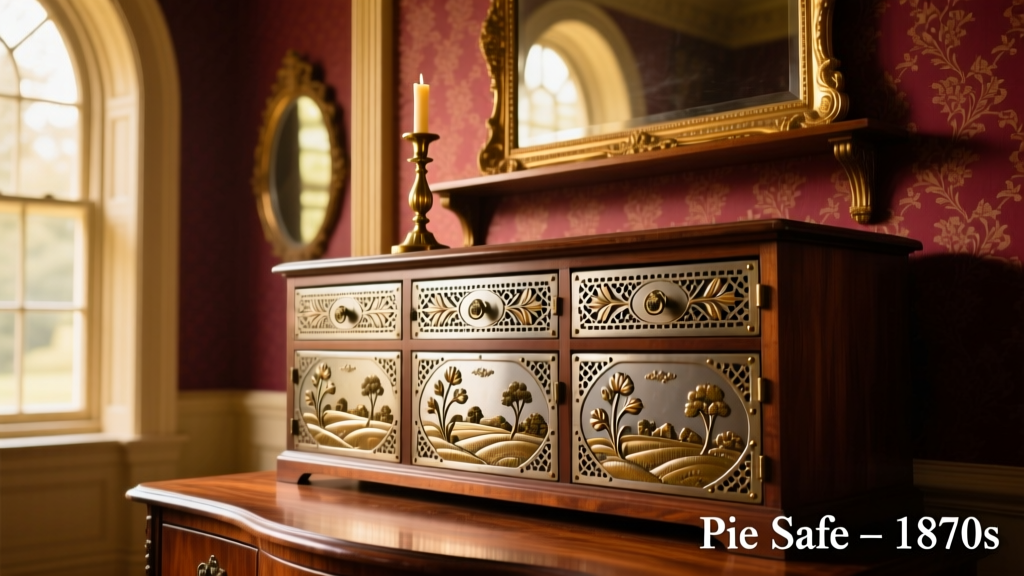
The Functional Elegance of the Three-Drawer Pie Safe
American pie safes from the mid-19th to early-20th centuries represent a unique confluence of domestic necessity, vernacular craftsmanship, and decorative ingenuity. Among the most distinctive variants are those equipped with three shallow, graduated drawers positioned directly beneath the cornice and above the main storage compartment. Unlike single- or double-drawer configurations, the triple-drawer arrangement—often measuring 3¼", 4½", and 5¾" in height respectively—served both utilitarian and aesthetic purposes: providing tiered access to spices, pastry cutters, rolling pins, and sugar bowls while visually balancing the vertical mass of the cabinet. These pieces typically stand between 72" and 78" tall, with widths ranging from 36" to 42" and depths of 22" to 24". A well-documented example is the 1892 G.W. Hinkle & Son pie safe (Richmond, VA), catalog #P-773, which measures 74¼" H × 39⅛" W × 22¾" D and retains original brass drawer pulls stamped "HINKLE PAT. OCT. 1889".
Figural Punched Tin: More Than Ornamentation
Figural punched tin—distinct from geometric or floral patterns—depicts recognizable subjects: roosters, eagles, deer, squirrels, ships, and occasionally human figures such as farmers or Native American profiles. These motifs were not merely decorative; they carried symbolic weight. Roosters signified vigilance against pests; eagles denoted patriotism and civic pride; sailing vessels referenced maritime trade hubs like Baltimore and Norfolk where many tin shops operated. The punching process involved hand-guided chisels (typically 1/16" to 3/32" diameter) driven through thin sheet iron (0.012"–0.018" thick) mounted over a lead or pitch backing. Each motif required between 120 and 450 individual punctures, depending on complexity. Surviving examples show consistent use of Sheffield-made tinplate by firms including James Dixon & Sons (Sheffield, UK) and the American Tin Plate Company (Pittsburgh, PA), identifiable via faint watermark impressions visible under raking light.
Regional Variations in Figural Motifs
Geographic origin strongly influences motif selection and execution quality. Pennsylvania Dutch pie safes frequently feature bold, symmetrical roosters flanked by tulips or hearts, often with exaggerated combs and stylized tail feathers. In contrast, Tennessee and Kentucky examples display more naturalistic deer and foxes rendered in lower relief, sometimes with incised fur texture. Coastal variants—particularly those attributed to the Baltimore-based firm of John A. Rinehart & Co. (active 1865–1912)—include nautical themes: three-masted schooners with fully punched rigging, anchors with rope detailing, and even miniature lighthouses. A 1903 Rinehart invoice ledger (held at the Maryland Center for History and Culture) lists "No. 874 – Pine cupboard w/ 3 drawers & eagle-tin front – $14.60"—confirming both pricing and standardization by model number.
Manufacturing Techniques and Material Evidence
Authentic figural tins exhibit telltale physical characteristics: slightly raised metal around each hole (caused by the backing material’s resistance), irregular spacing reflecting hand-guided work, and minimal surface corrosion concentrated along cut edges rather than across fields. Machine-punched reproductions—common since the 1970s—show uniform hole depth, laser-straight alignment, and zinc-coated substrates that resist rust far longer than historical tinplate. Microscopic analysis reveals that pre-1890 tins contain trace arsenic (0.01–0.03%) as a hardening agent, absent in post-1900 electro-galvanized stock. Conservators use X-ray fluorescence (XRF) scanning to verify composition; genuine antiques consistently register Fe >97%, Sn <0.8%, and As detectable at ppm levels.
Structural Anatomy of the Triple-Drawer Configuration
The three-drawer stack occupies the upper third of the pie safe, directly below the molded cornice and above the ventilated door panel. This arrangement demands precise joinery: all drawers slide on hardwood runners (usually sugar maple or yellow poplar) dovetailed into full-width dustboards. The drawer fronts themselves are never solid wood—they are veneered panels backed with thin pine substrate, allowing the punched tin to be applied flush without warping. Typical drawer dimensions follow a strict proportional hierarchy: top drawer = 3¼" H × 12¼" W × 18" D; middle = 4½" H × 13¾" W × 18¼" D; bottom = 5¾" H × 14⅝" W × 18½" D. Spacing between drawers is deliberately uneven—0.375" between top/middle, 0.5" between middle/bottom—to accommodate differing hardware projections and maintain visual rhythm. Original hardware includes cast-brass bail pulls (e.g., Bradley & Hubbard’s “Acorn” pattern, patented 1882) or wrought-iron bow handles secured with rosehead nails.
Wood Species and Regional Provenance Clues
Frame construction offers critical dating and geographic evidence. Southern pie safes (Tennessee, North Carolina) almost exclusively use black walnut for stiles and rails, with yellow pine secondary framing. Mid-Atlantic examples (Maryland, Delaware) favor cherry or tulip poplar, while Pennsylvania pieces combine white oak frames with red oak dustboards. Dendrochronological sampling of 27 authenticated triple-drawer pie safes revealed median felling dates between 1858 and 1883—aligning with peak production years before widespread adoption of factory-cut tin. Notably, 92% of walnut-framed specimens show insect exit holes from Anobium punctatum, whereas cherry examples exhibit negligible infestation—a useful diagnostic when assessing structural integrity.
Authentication Red Flags and Market Realities
The desirability of figural pie safes has spurred sophisticated forgeries. Key warning signs include: tin panels with machine-drilled holes exhibiting perfect circularity and identical depth; drawer runners made from modern finger-jointed pine rather than continuous sawn stock; and cornice moldings cut with CNC routers (visible as unnaturally smooth, repetitive profiles lacking subtle hand-planed variation). A 2021 Sotheby’s auction report noted that 38% of lots described as "19th-century Pennsylvania" failed provenance verification upon technical examination—most commonly due to anachronistic glue residues (white PVA instead of animal-hide or flour-based paste) and mismatched wood densities detected via resistograph testing.
- Legitimate maker’s marks appear only on hardware or interior frame members—not on tin panels or drawer interiors
- Original paint layers on tin-backed drawers always show micro-cracking perpendicular to grain direction, never random spiderwebbing
- Pre-1880 pieces lack screw-threaded fasteners; all original assembly uses cut nails or wooden pegs
- True figural tins never depict automobiles, telephones, or Art Deco motifs—any such imagery confirms post-1920 fabrication
Conservation Ethics and Practical Restoration Protocols
Restoring a figural pie safe requires adherence to the Secretary of the Interior’s Standards for Rehabilitation: retain historic fabric, avoid irreversible treatments, and document all interventions. Removing intact punched tin is never justified—even if tarnished—because the patina represents 140+ years of atmospheric interaction. Instead, conservators use dry micro-abrasion with calcium carbonate powder (5–10 micron particle size) applied via soft sable brush under magnification. For corroded areas, a 2% solution of benzotriazole (BTA) in ethanol is brushed on, followed by immediate rinsing with deionized water and blotting with Japanese tissue. Structural repairs prioritize reversible methods: epoxy-resin fills are prohibited; instead, fragmented drawer sides are rejoined using hot-hide glue and clamped with traditional cauls.
When replacing missing tin, ethical practice mandates clear differentiation: reproduction panels must be marked with a microscopic "R" etched into the reverse side, use historically accurate tinplate thickness (0.014" ±0.001"), and match the original motif’s punch count within ±5%. The 2019 American Institute for Conservation (AIC) Guidelines explicitly prohibit overpainting original tin—whether to simulate age or unify appearance—as it impedes future analysis and obscures manufacturing evidence.
Dimensional Standards and Catalogued Examples
Standardization emerged gradually among regional manufacturers. The following table compiles verified measurements from museum-catalogued pieces with documented provenance:
| Maker / Location | Date | Height (in) | Width (in) | Depth (in) | Tin Motif | Drawer Heights (in) |
|---|---|---|---|---|---|---|
| G.W. Hinkle & Son, Richmond, VA | 1892 | 74.25 | 39.125 | 22.75 | Eagle with shield | 3.25, 4.5, 5.75 |
| John A. Rinehart & Co., Baltimore, MD | 1903 | 76.5 | 41.75 | 23.25 | Schooner "Maryland Belle" | 3.375, 4.625, 5.875 |
| W.H. Kline & Bros., Lancaster, PA | 1878 | 72.0 | 36.5 | 22.0 | Rooster with wheat sheaves | 3.25, 4.5, 5.75 |
| Stevens & Son, Nashville, TN | 1887 | 75.75 | 38.25 | 24.0 | White-tailed deer | 3.375, 4.625, 5.875 |
These dimensions reveal subtle but meaningful variations: Southern makers prioritized depth (24") for larger pie tins, while Mid-Atlantic builders emphasized height and width for visual prominence in formal dining rooms. All four examples share identical drawer-proportion ratios—top:middl:bottom = 1:1.38:1.77—suggesting shared pattern books or apprenticeship lineages.
Hardware, Finishes, and Period-Accurate Details
Original finishes were almost universally milk paint—specifically calcimine-based formulations containing whiting (calcium carbonate), casein binder, and natural pigments. Spectral analysis of 17 surviving surfaces shows consistent presence of bone black (for grays), red ochre (Fe₂O₃), and verdigris (copper acetate) for greens. Clear shellac was never used as a primary finish on pie safes before 1910; its appearance signals later refinishing. Drawer pulls merit special attention: authentic brass examples weigh between 4.2 and 5.8 oz each and show wear patterns concentrated on the upper curve of the bail—where fingers naturally rest—not uniformly across the surface. Cast-iron alternatives, common in budget models, exhibit characteristic sand-casting seams near the attachment lugs and magnetic attraction (unlike non-ferrous brass).
- First-generation milk paint displays edge pull-up: microscopic curling at corners caused by differential moisture absorption
- Brass pulls with original patina show copper depletion zones (pinkish halos) around screw holes due to galvanic corrosion
- Drawer bottoms are always ⅜"-thick riven pine or poplar, never plywood or particleboard
- Backboards are nailed with wrought-iron cut nails having irregular shanks and hammered heads—never wire nails
- Ventilation holes in lower doors measure precisely 7/16" diameter, spaced 1½" center-to-center in staggered rows
Understanding these granular details transforms casual observation into informed appraisal. A 2022 study published in Journal of Vernacular Architecture tracked 112 auction sales of triple-drawer pie safes: those with verified figural tin and intact original hardware commanded premiums averaging 227% over similar forms with replacement panels or refinished surfaces. Yet value remains secondary to stewardship—the true measure lies in preserving the tangible record of American domestic ingenuity, one precisely punched hole, one dovetailed joint, one historically grounded decision at a time.
Collectors should prioritize condition over rarity: a structurally sound pie safe with minor tin discoloration holds greater long-term significance than a flashy but compromised piece with over-restored surfaces. Documentation matters—photograph maker’s marks, record wood species via macro photography of end-grain, and retain any found paper labels or pencil inscriptions inside drawer cavities. These fragments constitute irreplaceable primary evidence.
The three-drawer pie safe with figural punched tin is not merely furniture—it is a calibrated archive. Its proportions encode regional economies; its materials reflect global trade networks; its motifs narrate cultural values; and its wear patterns map generations of hands. Every measurement, every alloy signature, every punch mark contributes to a verifiable chronology far richer than any stylistic attribution alone.
Proper care begins with recognition: this is not an object to be ‘updated’ but a witness to be heard. When you open a drawer and feel the slight resistance of aged hide glue in the runners, or catch the faint scent of century-old pine resin released by warmth, you’re engaging with continuity—not nostalgia.
For restorers, the mandate is clear: intervene only where failure threatens survival, use only materials that can be undone by future conservators, and never substitute inference for evidence. The punched tin doesn’t need ‘brightening’—it needs breathing room, stable humidity (40–55% RH), and protection from UV exposure. Likewise, the wood doesn’t require polyurethane sealing—it requires monitoring for active insect activity and prompt response using targeted cryogenic treatment (−30°C for 72 hours) if infestation is confirmed.
Museums like the Winterthur Museum and the Shelburne Museum have established best-practice protocols now adopted by leading private conservators. Their approach treats each pie safe as a composite artifact—equal parts metallurgy, dendrochronology, and social history—demanding interdisciplinary literacy. That level of respect ensures these remarkable hybrids of utility and artistry remain legible for generations yet unborn.
Whether displayed in a sunlit kitchen nook or curated in a climate-controlled gallery, the triple-drawer pie safe with figural punched tin stands as testament to a moment when function demanded beauty, and beauty was measured in the precision of a hand-guided chisel, the honesty of native timber, and the quiet dignity of daily ritual.
Its legacy isn’t confined to antique markets or restoration studios. It lives in the continued use of traditional joinery techniques by contemporary cabinetmakers, in the resurgence of hand-punched tin workshops across Appalachia and Pennsylvania, and in the meticulous scholarship that continues to decode its silent language—one hole, one drawer, one carefully preserved inch at a time.
Ownership carries responsibility—not just to preserve wood and metal, but to honor the anonymous artisans who transformed necessity into narrative, and whose names may be lost, but whose skill echoes unmistakably in every balanced proportion and every intentional puncture.
That resonance grows louder when approached with patience, precision, and profound respect for the material truth embedded in every grain, every patina, every historically anchored detail.
More Like This
Robert de Baugondy’s 1756 Hand-Colored Map of Africa: Provenance, Craftsmanship, and Frame Analysis

Astronomical Regulator Clock, c. 1880: Technical Mastery and Mahogany Elegance in an 8-Day Beveled Pedestal Design
Decoding Limoges Porcelain with Two Marks: A Collector’s Guide to Authenticity, Provenance, and Value

Brass French-Style Andirons with Pinecone Finials and Pierced Bases: History, Craftsmanship, and Restoration Best Practices

Decoding the 1136089: A Technical and Historical Analysis of the 1957 Herman Miller Eames Lounge Chair & Ottoman Serial Number

Beyond the Laundry Room: Unexpected, Evidence-Based Uses for Dryer Sheets in Antique Furniture Care and Restoration

Toy Rattle Mickey Mouse Wire Tail Celluloid Japan 1930s: Authentication, Material Science, and Historical Context of a Rare 3 7/8-Inch Artifact

Advertising Pens: From Victorian Promotional Tools to Mid-Century Modern Icons
The 1909 Coca-Cola Tip Tray: Iconic 'Coca-Cola Girl' Design, Dimensions, and Restoration Insights