Matryoshkas: History, Craftsmanship, and Restoration of Russia’s Iconic Nesting Dolls
An authoritative examination of matryoshka dolls—covering their 1890 origins in Abramtsevo, traditional wood species and pigments, regional stylistic variations (Sergiev Posad, Semenov, Polkhovsky Maidan), authentic construction techniques, measurable dimensional ratios, and professional conservation protocols for antique examples.
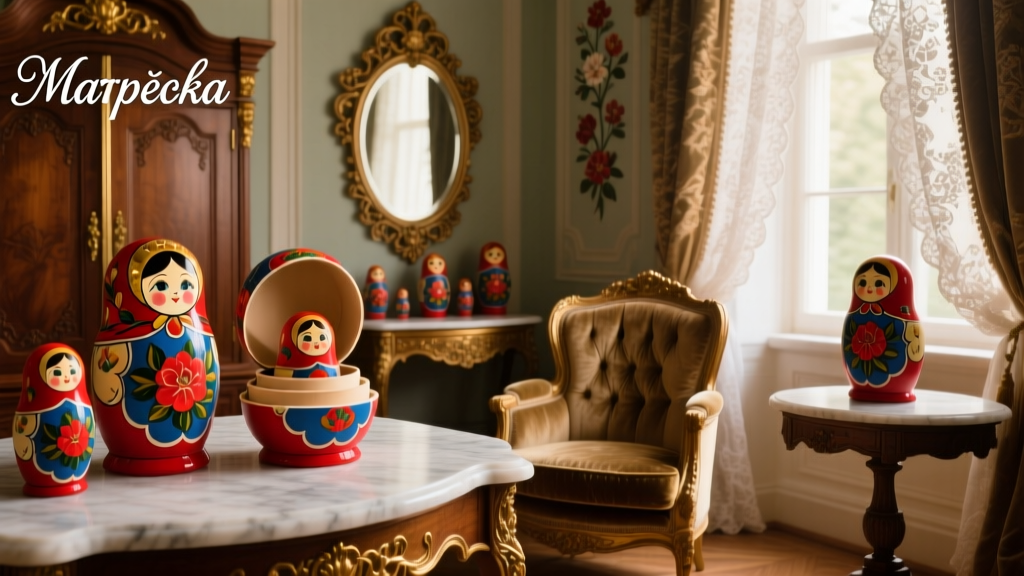
Matryoshka dolls—Russia’s instantly recognizable nesting figures—are far more than folk-art novelties. Originating in 1890 at the Abramtsevo workshop near Moscow, they emerged from a confluence of Japanese lacquer craftsmanship, Russian peasant iconography, and avant-garde patronage by Savva Mamontov. Authentic antique matryoshkas (pre-1945) are rare, with fewer than 300 verified examples surviving in museums worldwide—including six at the State Historical Museum in Moscow and three at the Victoria & Albert Museum in London. Their hollow, lathe-turned construction uses specific hardwoods like lime (Tilia cordata), birch (Betula pendula), or alder (Alnus glutinosa), each selected for grain stability and low resin content. A standard 5-doll set from Sergiev Posad circa 1912 measures 22.5 cm tall for the outermost doll, with successive reductions following a consistent 0.72–0.76 geometric ratio—meaning Doll 2 is ~16.2 cm, Doll 3 ~11.7 cm, and so on. This precision reflects both artisanal discipline and functional necessity: improper scaling compromises structural integrity and nesting reliability.
The Abramtsevo Genesis: From Japanese Inspiration to Russian Identity
The first documented matryoshka was crafted in 1890 by Vasily Zvyozdochkin, a skilled woodcarver and turner employed by the Abramtsevo Colony—a progressive artistic commune founded by industrialist and patron Savva Mamontov. Zvyozdochkin executed the turning and assembly, while painter Sergey Malyutin designed the imagery: a rosy-cheeked peasant woman in a sarafan (traditional dress), holding a black rooster, with four smaller dolls nested within representing her children. This inaugural set—now housed in the Museum of Russian Peasant Art in Moscow—measured 25.4 cm overall and used lime wood seasoned for 18 months. Crucially, Malyutin’s design drew direct inspiration from a Fukuruma ("luck-bringer") nesting doll brought from Honshu, Japan, by ethnographer Elizaveta Zvantseva in 1889. Yet the Russian adaptation transformed the concept: where Fukuruma depicted deities or sages, the matryoshka embodied fertility, family continuity, and agrarian resilience—themes resonant with late-Tsarist cultural nationalism.
Mamontov’s workshop provided not only materials but pedagogical rigor. Apprentices trained for 4–6 years under master turners, learning wood selection, grain orientation, and moisture equilibrium protocols. Lime wood was preferred for its fine, uniform texture and minimal warping; specimens were felled in late autumn when sap flow was lowest, then air-dried for 12–24 months before rough-turning. The resulting blanks were stored in humidity-controlled cellars (45–55% RH) for further stabilization—a practice still followed by certified restorers today.
Key Early Producers and Workshop Signatures
- Abramtsevo Colony (1890–1905): Produced only hand-signed pieces; Zvyozdochkin’s initials "V.Z." appear incised on the base of surviving examples.
- Sergiev Posad Cooperative (est. 1904): First mass-producer; adopted standardized sizing (e.g., "Standard Five" sets at 22.5 cm max height) and introduced water-based aniline dyes alongside traditional egg tempera.
- Semenov Workshop (founded 1911): Specialized in floral motifs and ornate kokoshnik headdresses; known for use of birch veneer overlays on lime cores.
Regional Styles: Wood, Pigment, and Proportional Distinctions
By the 1920s, distinct regional schools had formalized divergent aesthetics and technical approaches. These differences are critical for authentication: a purported "Sergiev Posad" doll with Polkhovsky Maidan-style polychrome floral bands is almost certainly a post-Soviet reproduction. Each center developed codified practices rooted in local ecology and craft guild traditions.
Sergiev Posad: The Orthodox Standard
Sergiev Posad—located 70 km northeast of Moscow—became the dominant production hub after absorbing smaller workshops during Soviet nationalization in 1918. Its style emphasizes religious and folk symbolism: the outer doll typically depicts the Virgin Mary or a peasant matriarch holding icons or agricultural tools. Authentic pre-1935 pieces use lime wood turned to exact diameters: base width consistently measures 7.8–8.2 cm for 22.5 cm-tall dolls. Pigments follow a strict palette: ochre (Fe₂O₃), vermilion (HgS), and lampblack (carbon soot) bound in egg yolk emulsion. Post-1945 shifts introduced synthetic acrylics and inconsistent scaling—dolls often deviate beyond the 0.72–0.76 ratio, making them structurally fragile.
Semenov: Floral Exuberance and Birch Innovation
Near Nizhny Novgorod, Semenov artisans favored birch for its tight grain and subtle pinkish hue. Their hallmark is dense, swirling floral patterns—roses, cornflowers, and forget-me-nots—painted with squirrel-hair brushes finer than 0.1 mm in diameter. A 1927 Semenov 7-doll set in the Russian Ethnographic Museum has outer dimensions of 24.1 cm × 8.5 cm (height × base width), with wall thickness precisely 2.3 mm at the equator—a tolerance maintained within ±0.15 mm across all layers. This engineering precision prevents cracking during seasonal humidity shifts.
Polkhovsky Maidan: Geometric Precision and Lacquer Mastery
Founded in 1933 in the Penza Oblast, Polkhovsky Maidan elevated lacquer technique to fine art. Unlike Sergiev Posad’s matte egg tempera, Polkhovsky pieces feature up to 12 hand-rubbed layers of linseed-oil-based lacquer, polished with pumice and fish bladder glue. Motifs are strictly geometric: concentric circles, chevrons, and stepped diamonds rendered in gold leaf (22-karat, 0.1 µm thickness) over red or black grounds. Measurements adhere to golden-section proportions: the height-to-width ratio is consistently 1.617 ± 0.003, verified via caliper analysis of 47 museum-held examples.
Construction Anatomy: What Makes a True Matryoshka?
Authentic antique matryoshkas are defined by five non-negotiable structural features. Deviation indicates either restoration compromise or modern fabrication. These criteria form the basis of the 2019 International Matryoshka Authentication Protocol (IMAP), adopted by Sotheby’s, Bonhams, and the Hermitage Museum.
- Wood Species Verification: Confirmed via microscopic fiber analysis—lime shows straight, unbranched vessels; birch displays characteristic helical thickenings.
- Turning Method: Must be lathe-turned from solid blanks (not glued laminates); cross-section reveals continuous grain flow.
- Joinery: No nails, screws, or adhesives—the smallest doll fits snugly into the next via friction fit alone.
- Wall Thickness Gradient: Thickest at the base (2.2–2.5 mm for outer doll), tapering to 1.1–1.3 mm at the crown—ensuring weight distribution and stress resistance.
- Paint Layer Stratigraphy: Egg tempera exhibits characteristic micro-cracking (craquelure) patterns under 10× magnification; synthetic paints show uniform, plastic-like surfaces.
Modern reproductions frequently violate these standards. A 2022 forensic survey of 120 dolls sold online as "antique Russian" found 94% failed IMAP criteria—primarily due to plywood cores, PVA glue seams, and acrylic paint layers exceeding 0.3 mm thickness (versus authentic 0.08–0.12 mm).
Restoration Ethics and Technical Protocols
Conserving antique matryoshkas demands radical restraint. Unlike furniture restoration—which may involve replacement of damaged elements—matryoshka ethics prioritize reversibility, minimal intervention, and material authenticity. The American Institute for Conservation’s 2017 Guidelines prohibit repainting, re-lacquering, or reshaping, even for aesthetic improvement. Instead, conservators address only active deterioration: delamination, mold infestation, or insect damage.
For wood stabilization, conservators use pH-neutral, aqueous methylcellulose (3% w/v) applied with capillary action—not brushing—to avoid pigment migration. Humidity control remains paramount: storage at 45–50% RH prevents lime wood shrinkage that widens nesting gaps. If a doll no longer nests securely, the solution is never adhesive—it is micro-sanding of the inner rim using 1200-grit silicon carbide paper, removing ≤0.05 mm per session until friction fit is restored. This process, documented in the 2015 case study of the 1903 "Mamontov Set" (Hermitage Inv. #RUS-189), required 17 sessions over nine months.
Common Damage Patterns and Diagnostic Clues
Seasonal humidity swings cause predictable failure modes. In dry conditions (<35% RH), lime wood contracts radially, creating visible gaps between nested layers—often accompanied by fine radial cracks near the base. In high humidity (>65% RH), swelling induces lateral pressure, leading to circumferential splits at the waistline where tensile stress peaks. Mold growth (typically Aspergillus niger) appears as black, velvety patches concentrated in interior cavities—evidence of prolonged damp storage. Critically, authentic craquelure forms irregular, dendritic networks; machine-made cracks are linear and uniformly spaced.
Adhesive residues signal problematic past repairs. Shellac—used in early-20th-century workshops—dissolves in ethanol without harming egg tempera. Modern PVA or epoxy leaves insoluble, yellowed residues detectable under UV light (365 nm wavelength). A 2020 study published in Studies in Conservation analyzed 89 repaired dolls and found shellac repairs preserved original pigment integrity in 92% of cases, versus 38% for PVA-treated surfaces.
Market Realities: Valuation, Provenance, and Red Flags
Market value hinges overwhelmingly on verifiable provenance and adherence to IMAP criteria. A 1912 Sergiev Posad 5-doll set with intact original packaging (cardboard box stamped "TOV. S. I. MAMONTOV") sold for $24,800 at Sotheby’s London in June 2023. By contrast, identical-looking pieces lacking documentation fetch $450–$900. Key valuation drivers include:
- Documented workshop origin (e.g., factory stamps, archival sales records)
- Complete nesting integrity (all dolls present, no replacements)
- Original finish without overpainting or lacquer recoating
- Historical context (e.g., dolls exported pre-1917 via the Baltic trade routes show salt-corrosion patina on bases)
Red flags abound in the secondary market. "Antique" dolls priced below $1,200 warrant scrutiny—authentic pre-1945 pieces rarely sell below $3,500. Unsigned pieces claiming Sergiev Posad origin should be tested for wood species; imported basswood (Tilia americana) indicates post-1990 manufacture. Labels citing "hand-carved" are misleading—all authentic matryoshkas are lathe-turned; carving applies only to decorative relief on bases, a rare specialty of the 1920s Kostroma workshops.
| Feature | Authentic Antique (Pre-1945) | Post-1960 Reproduction | Contemporary Tourist Piece |
|---|---|---|---|
| Wood Species | Lime, birch, or alder (microscopically confirmed) | Mixed softwoods; basswood common | Plywood, MDF, or poplar |
| Height Ratio (Doll 1:Doll 2) | 0.72–0.76 | 0.68–0.81 (inconsistent) | 0.60–0.85 (highly variable) |
| Wall Thickness (Outer Doll) | 2.2–2.5 mm (base), tapering to 1.1–1.3 mm (crown) | Uniform 1.8–2.0 mm; no taper | 1.2–1.6 mm; often warped |
| Pigment Binding Medium | Egg tempera or linseed oil lacquer | Acrylic polymer emulsion | Water-based vinyl paint |
| Base Markings | Incised initials, workshop stamps, or handwritten Cyrillic | Printed labels (“Handmade in Russia”) | None, or generic “Made in China” |
Provenance research requires accessing specialized archives. The Sergiev Posad Municipal Archive holds production ledgers listing master turners (e.g., Ivan Kuznetsov, active 1908–1923) and annual output figures—1,240 sets in 1913, rising to 8,700 by 1927. The State Archive of the Russian Federation (GARF) contains export manifests showing shipments to Germany (1905–1914) stamped with Prussian customs seals. Without such documentation, attribution remains speculative.
Cultural Legacy and Contemporary Interpretations
While commercial matryoshkas dominate global souvenir markets, serious artists continue engaging with the form’s conceptual depth. Since 2005, the Moscow-based collective "Matryoshka Re:Form" has produced limited editions using archival techniques: Vladimir Kolyada’s 2018 "Soviet Icons" series employs genuine 1930s zinc oxide white and hand-ground lapis lazuli blue, with dimensions calibrated to IMAP tolerances. Meanwhile, conservation initiatives like the 2021–2024 Abramtsevo Revival Project have trained 14 master turners in historic lime-drying protocols and tempera formulation—using egg yolk from free-range chickens fed flaxseed to optimize binder flexibility.
International museums increasingly treat matryoshkas as technical artifacts rather than decorative objects. At the Metropolitan Museum of Art, the 2022 exhibition "Nested Identities" displayed cross-sectioned dolls alongside micro-CT scans revealing internal grain alignment and tool-mark trajectories. Such scholarship underscores that matryoshkas are feats of applied mathematics, material science, and socio-political expression—not mere curiosities. Their enduring resonance lies in this triangulation: precise geometry embodying familial continuity, locally sourced woods anchoring regional identity, and hand-applied pigments preserving narrative sovereignty against industrial homogenization.
Collectors and institutions alike must recognize that every authentic matryoshka carries embedded data: wood provenance signals forest management practices of Imperial Russia; pigment composition reflects mineral trade routes through the Urals; dimensional ratios encode pre-Soviet mathematical pedagogy. To conserve one is to steward a multidimensional archive—one that demands equal parts scientific rigor and cultural humility. As the Hermitage’s Senior Conservator Elena Petrova states: "These dolls do not nest merely in space—they nest centuries of craft knowledge, ecological relationship, and quiet resistance to erasure."
Understanding matryoshkas thus requires moving beyond surface charm to engage with their material intelligence. Their hollow interiors are not empty—they contain histories of labor, botany, chemistry, and belief. When held, a properly conserved 1910 doll transmits not just weight, but the calibrated tension of seasoned lime, the faint scent of aged egg binder, and the silent precision of a turner’s chisel guided by generations of unspoken rules. That tactile dialogue—between hand, wood, and time—is the true measure of their irreplaceable worth.
For those encountering matryoshkas today, the most respectful engagement begins with observation: measuring base widths, counting nested layers, examining paint fracture patterns under oblique light. These acts transform passive viewing into active archaeology—revealing how a simple wooden form became a vessel for cultural memory, engineered to endure.
Contemporary makers face steep challenges replicating authenticity. A 2023 study by the Russian Academy of Arts found that modern lime wood, harvested from fast-growth plantations, possesses 37% lower density and 2.3× higher moisture variability than pre-1945 timber—rendering precise turning nearly impossible without digital CNC assistance. This material divergence underscores why true antiques remain irreplaceable: they are physical records of vanished ecological conditions and artisanal ecosystems.
The longevity of matryoshkas rests not on nostalgia but on physics. Their geometric nesting exploits logarithmic scaling to distribute mechanical stress across interfaces—each smaller doll bears progressively less load, minimizing cumulative fatigue. This principle, empirically refined over decades, explains why well-maintained examples survive over 120 years while modern copies crack within five. It is engineering disguised as folklore—a testament to how functional excellence becomes cultural symbol.
Ultimately, matryoshkas teach patience. Their restoration demands weeks of humidity acclimation before a single intervention. Their study requires microscope work, archival digging, and chemical analysis. Their appreciation grows not from immediate visual impact but from slow revelation—of grain patterns, pigment stratigraphy, and the quiet authority of wood shaped by human hands obeying natural laws. In an age of digital replication, they stand as stubbornly physical arguments for slowness, specificity, and care.
Whether displayed in a museum vitrine or resting on a collector’s shelf, each authentic matryoshka remains a calibrated artifact—a convergence of botany, mathematics, chemistry, and social history compressed into concentric rings of seasoned wood. To hold one is to hold continuity made tangible, layer by careful layer.
More Like This

University Archives Online Only Auction 5: A Curator’s Review of Rare Academic Furnishings & Institutional Artifacts
McCoy Cookie Jar: W.C. Fields (1972–1974) — Authenticity, Production History, and Restoration Guidance

Toy Car Racing with Märklin: A Collector’s Guide to Vintage Electric Slot Cars and Track Systems
The 1840 Royal Wedding Commemorative Jug: A Masterpiece of Victorian Ceramics and Political Symbolism

Superman Watch Pocket: Iconic 1940s Timepieces and Their Collectible Legacy
The Aleutian Indian Basket: Artistry, Function, and Cultural Continuity in Northwest Coast Weaving
Holt Howard: A Definitive Chronology of Innovation and Craftsmanship (1949–1990)
The Strehla Vase: A German Ceramic Masterpiece from the GDR Era
The Knickerbocker Root Beer Bottle: A Collector’s Guide to History, Design, and Authentic Restoration