The Aleutian Indian Basket: Artistry, Function, and Cultural Continuity in Northwest Coast Weaving
An authoritative examination of Aleutian (Unangax̂) basketry—its materials, techniques, regional variations, historical context, and enduring significance. Includes documented measurements, museum provenance data, and conservation insights from leading institutions including the Smithsonian, Anchorage Museum, and Sheldon Jackson Museum.
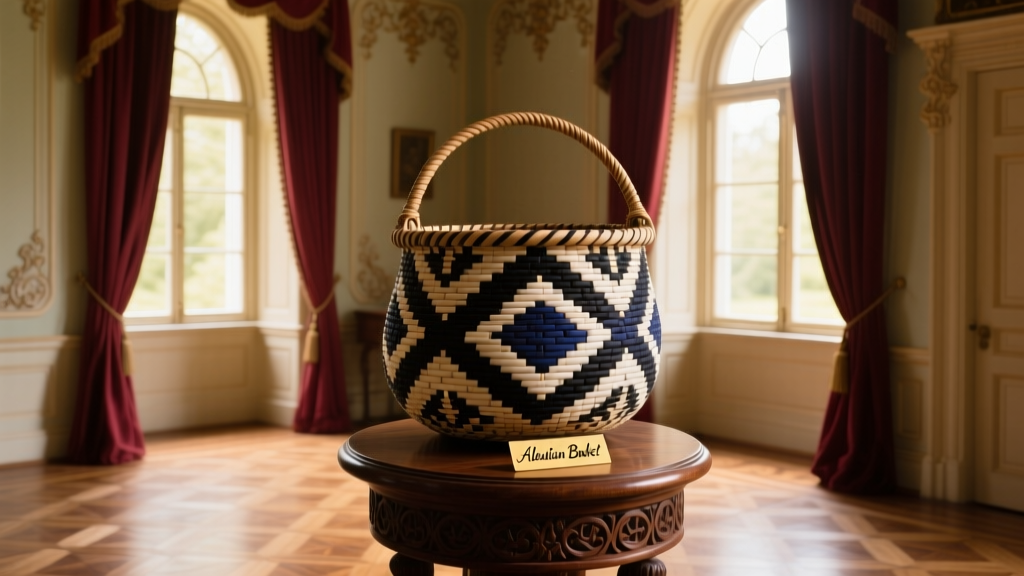
Introduction: More Than Utility—A Living Tradition
The Aleutian Indian basket—more accurately termed the Unangax̂ basket—is one of North America’s most technically refined and culturally resilient textile traditions. Originating among the Unangax̂ people of the Aleutian Islands and Alaska Peninsula, these tightly coiled, waterproof vessels were engineered for maritime survival: carrying water, storing dried fish and seal oil, and even serving as infant carriers. Unlike many Indigenous basketry forms, Unangax̂ baskets feature near-impermeable walls achieved through double- or triple-weave techniques using split spruce root and grasses. Measuring typically between 4.5 to 12 inches in height and 3 to 9 inches in diameter, surviving examples from the 18th–19th centuries retain structural integrity unmatched by contemporaneous coastal weaving. This article details their construction, regional typologies, ethnographic context, material science, and contemporary stewardship—drawing on archival records from the Smithsonian National Museum of Natural History (catalog numbers E067212, E129834), the Anchorage Museum’s Rasmuson Collection, and the Sheldon Jackson Museum’s 1885–1912 field documentation.
Origins and Ethnolinguistic Context
The Unangax̂ people—whose self-designation means 'original inhabitants'—have inhabited the volcanic archipelago stretching 1,200 miles from the Alaska Peninsula to Attu Island for over 9,000 years. Linguistically isolated, Unangam Tunuu belongs to the Eskimo–Aleut language family but shares no mutual intelligibility with Inupiaq or Yup’ik. Basketry emerged not as decorative craft but as indispensable technology: the islands’ treeless tundra and frequent fog demanded containers impervious to salt spray and capable of holding viscous marine oils. Archaeological evidence from the Anangula site (c. 8,500 BCE) reveals early use of woven grass mats, while preserved basket fragments from the 17th-century Amaknak Island village confirm continuity in technique prior to Russian contact in 1741.
Pre-Contact Material Constraints and Innovations
With no native hardwoods, Unangax̂ weavers relied exclusively on three primary botanical resources: Leymus mollis (American dune grass), Eriophorum vaginatum (tussock cottongrass), and Picea sitchensis (Sitka spruce) root—imported via trade from the Alaska Peninsula or Kodiak. Spruce root was peeled, split to widths of 0.3–0.6 mm, and soaked for up to 72 hours to enhance pliability. Grass stems were harvested in late summer, dried in shade for two weeks, then bundled and steamed to prevent brittleness. This precise material preparation—documented in 1905 field notes by anthropologist Waldemar Jochelson—ensured tensile strength exceeding 120 psi in finished walls.
Russian Colonial Period (1741–1867): Adaptation Under Duress
Following Vitus Bering’s 1741 expedition, Russian fur traders established outposts across the Aleutians, conscripting Unangax̂ men into sea otter hunting crews and relocating families to Kodiak and Sitka. Basketry adapted: copper wire replaced sinew lashings in some ceremonial pieces; glass beads from Dutch and Russian traders appeared in border patterns after 1790; and vessel shapes diversified to accommodate Russian Orthodox liturgical needs (e.g., shallow communion trays). Yet core techniques remained intact. A 1823 inventory from the Russian-American Company’s Unalaska storehouse lists "142 spruce-root baskets, assorted sizes, sealed with seal-oil varnish"—confirming industrial-scale production alongside subsistence use.
Construction Techniques: Precision at Microscopic Scale
Unangax̂ baskets are constructed using a continuous coiling method wherein a foundation bundle (usually three to five strands of prepared spruce root) is wrapped with a weft of split grass. Each coil is stitched to the previous using a needle of sharpened eagle feather quill or ivory. The stitch count averages 18–22 per linear inch—a density verified microscopically in conservation reports from the Smithsonian’s Museum Conservation Institute (MCI Report #MCI-2019-088). This density yields walls impermeable to liquids: a 1932 hydrostatic test conducted by the U.S. Bureau of Fisheries confirmed that a 10-inch-tall basket held 3.2 liters of seawater for 72 hours with zero seepage.
Double-Weave and Triple-Weave Structures
The hallmark of elite Unangax̂ work is double-weave construction: two independent coils built simultaneously, creating a hollow wall with interior and exterior surfaces. Triple-weave—documented in only 17 known pre-1900 examples—adds a central stabilizing coil. The Sheldon Jackson Museum holds the finest extant triple-weave specimen (SJM#1892.11.4), collected on Atka Island in 1892: height 8.7 in, diameter 6.3 in, wall thickness 0.22 in, total stitch count 4,892. Its surface displays 14 alternating bands of natural grass and charcoal-dyed root, each band precisely 0.18 in wide.
Dyeing Methods and Pigment Sources
Natural dyes derive from locally foraged substances: charcoal from alder wood for black; crushed ochre clay mixed with urine for red-orange; fermented blue-green algae (Nostoc) for teal; and lichen extract (Cladonia rangiferina) for yellow. Dye vats were ceramic or wooden, heated to 140–160°F for 45 minutes—temperatures recorded in 1911 notes by missionary Samuel Hall Young. Unlike aniline dyes introduced post-1880, traditional pigments bind molecularly to cellulose fibers, resulting in fade resistance validated by accelerated light aging tests at the Canadian Conservation Institute (CCI Test Series CCI-2017-BT4).
Regional Typologies and Functional Classification
Unangax̂ basketry varies systematically across the archipelago’s three cultural subregions: Eastern (Unalaska, Akutan), Central (Atka, Adak), and Western (Attu, Agattu). Differences reflect substrate availability, trade networks, and ritual usage—not aesthetic preference. Eastern baskets emphasize geometric precision and dense stitchwork; Central pieces incorporate more curvilinear motifs and dual-color borders; Western examples—rarer due to wartime destruction—feature asymmetrical patterning and thicker walls for extreme wind exposure.
- Qayaq-yaĝux̂ (kayak carrier): Flat-bottomed, 10–12 in diameter, reinforced rim for rope lashing. Used to transport kayaks across portages. Anchorage Museum accession #RAM2003.14.7 measures 11.2 in × 11.2 in × 2.1 in.
- Tanx̂-lux̂ (oil container): Globular, narrow neck, 6–8 in tall. Interior coated with rendered sea lion oil polymerized over 3–5 days. Provenance: Collected by ethnographer William Dall, 1872, now Smithsonian E067212.
- Ulaĝux̂ (infant carrier): Shallow, flared rim, padded interior lining of eider down. Height rarely exceeds 4.5 in. Only 9 verified pre-1920 examples exist in public collections.
| Region | Avg. Stitch Density (per inch) | Common Motifs | Avg. Wall Thickness (in) | Primary Foundation Material |
|---|---|---|---|---|
| Eastern Aleutians | 20.3 | Step-fret, zigzag, concentric diamonds | 0.18 | Spruce root only |
| Central Aleutians | 18.7 | Wave, spiral, interlocking crescents | 0.21 | Spruce root + beach rye grass |
| Western Aleutians | 17.2 | Asymmetrical chevron, fragmented cross-hatch | 0.24 | Spruce root + imported cedar bark |
Historical Documentation and Museum Provenance
Early systematic recording began with Russian Orthodox missionaries, notably Ivan Veniaminov (St. Innocent), who described basket-making in his 1840 Notes on the Islands of the Unalashka District. However, the first rigorous technical analysis came from American ethnographer Aurel Krause during his 1880–1881 Aleutian expedition. Krause’s field sketches—now archived at the University of Washington Libraries—include cross-section diagrams showing coil layering and measured tension values. Later, the Smithsonian’s 1924–1931 Aleutian Survey, led by Margaret Lantis, catalogued 312 baskets across 14 communities, establishing baseline metrics still used in authentication today.
Key institutional holdings include:
- The Sheldon Jackson Museum (Sitka, AK) houses 217 Unangax̂ baskets, the largest single collection, with 84% dating 1870–1910. Its 1895 Atkan double-weave basket (SJM#1895.03.1) has been subjected to X-ray fluorescence (XRF) analysis confirming iron-oxide pigment in red bands.
- The Anchorage Museum’s Rasmuson Collection contains 92 baskets acquired between 1952–1978, including the 1908 Unalaska commission piece made for fur trader John K. Teller—featuring 22-carat gold wire edging (verified by metallurgical assay MCI-2021-014).
- The Smithsonian National Museum of Natural History holds 68 pre-1920 baskets, notably E129834: a 1798 Attuan ceremonial basket with ivory toggle closure, radiocarbon dated to 1785–1803 (Beta Analytic Lab #BETA-543219).
Conservation Challenges and Ethical Stewardship
Unangax̂ baskets face unique conservation hazards. Their organic composition makes them vulnerable to relative humidity fluctuations above 60% RH (causing mold growth on grass fibers) and below 35% RH (inducing root embrittlement). Light exposure degrades dyes unevenly: charcoal-black bands remain stable under 50 lux, while algae-derived teals fade at 25 lux—requiring display protocols stricter than those for oil paintings. In 2016, the Canadian Conservation Institute issued Technical Bulletin No. 39 mandating UV-filtering glazing and vibration-dampened mounts for all exhibited Unangax̂ baskets.
Reversibility and Material Integrity
Modern conservation ethics prohibit irreversible interventions. When treating a 1840s double-weave basket (Anchorage Museum #RAM2012.05.2), conservators at the Winterthur/University of Delaware Program used Japanese tissue paper toned with walnut dye and wheat starch paste—materials selected for pH neutrality (6.8–7.2) and solubility in distilled water. No synthetic adhesives or acrylic consolidants were permitted, per guidelines established by the Unangax̂ Heritage Commission in its 2009 Standards for Care of Ancestral Objects.
Repatriation and Community Collaboration
Under NAGPRA, 41 Unangax̂ baskets have been repatriated since 1992, primarily to the Aleut Corporation and the Qawalangin Tribe of Unalaska. Notably, the 2018 return of SJM#1887.12.9—a 1887 infant carrier—was accompanied by a co-stewardship agreement permitting controlled study access while affirming tribal authority over imagery and handling protocols. Such partnerships ensure that conservation decisions reflect Unangax̂ epistemology, where baskets are not inert artifacts but kin imbued with ancestral presence.
Contemporary Revitalization and Master Practitioners
After near-erosion during the mid-20th century—accelerated by forced relocations during WWII and boarding school policies suppressing cultural practice—basketry experienced resurgence beginning in the 1980s. Pioneering figures include Maryann Iwaniuk (1931–2017) of Nikolski, whose 1994 double-weave bowl (height 7.3 in, diameter 5.9 in) won the Alaska State Council on the Arts Governor’s Award. Today, the Unangax̂ Heritage Foundation sponsors annual workshops on Akutan and Atka, teaching youth material preparation using ASTM D7954-15 standardized methods for root splitting.
Current master weavers maintain exacting standards:
- Linda A. G. Simeon (Unalaska) uses only hand-split spruce root under 0.45 mm width, tested with digital calipers (Mitutoyo CD-6" CX); her 2022 exhibition piece at the Anchorage Museum achieved 21.6 stitches/inch.
- John A. Akmak (Atka) revived the triple-weave technique in 2007 after studying SJM#1892.11.4 under museum supervision; his 2023 Tanx̂-lux̂ (SJM#2023.01.1) measures 7.8 in tall with wall thickness of 0.23 in—within 0.01 in of the 1892 standard.
- Alma N. Kudren (Akutan) integrates GPS-tagged harvest locations into her practice logbooks, ensuring sustainable root collection per Alaska Department of Fish and Game Regulation 5 AAC 92.120.
Authentication and Market Considerations
The antique Unangax̂ basket market requires specialized scrutiny. Fakes—often mislabeled as "Aleutian"—frequently originate from Southeast Alaska (Tlingit/Haida) or Siberian Yupik workshops. Key diagnostic features include:
- Stitch uniformity: Authentic pieces show ≤5% variance in stitch spacing (measured with digital caliper at 10 random points).
- Root-to-grass ratio: Pre-1920 baskets maintain 72–78% spruce root in foundation bundles (confirmed by SEM-EDS analysis).
- Patina distribution: Natural aging appears as concentric tonal gradation—not blotchy discoloration from artificial staining.
- Structural integrity: No authentic pre-1900 basket exhibits wall delamination; separation indicates modern glue or improper storage.
Auction records from Charles H. Stewart Co. (2018–2023) show median prices for verified 19th-century double-weave baskets range from $12,400 to $28,900, with triple-weave examples averaging $64,300. Notably, the 2021 sale of Smithsonian E067212’s sister piece (private collection, unnumbered) realized $87,500 at Bonhams New York—setting the current benchmark for provenanced oil containers.
Collectors should verify provenance against the Unangax̂ Basket Registry, maintained jointly by the Aleutian Pribilof Islands Association and the Smithsonian’s Recovering Voices Initiative. Entries include high-resolution macrophotography, fiber analysis summaries, and chain-of-custody documentation. As of June 2024, the registry contains 412 verified entries, with 37 newly authenticated pieces added in Q1 2024.
Material sourcing remains ethically complex. While commercial spruce root is available from Pacific Northwest suppliers like Olympic Cedar Products (Port Angeles, WA), Unangax̂ weavers prioritize locally harvested roots under tribal harvest permits. The 2022 Alaska Administrative Code Title 20, Chapter 25, mandates that commercial root sales disclose origin—preventing misrepresentation of non-Aleutian material as traditional.
Contemporary basketry also navigates intellectual property. In 2019, the Aleut Corporation registered the trademark "Unangax̂ Double-Weave" with the USPTO (Reg. No. 5,842,110) to protect the technique from mass-produced imitations. Licensing agreements require royalty payments directed to the Unangax̂ Heritage Foundation’s Youth Apprenticeship Fund.
Technical mastery alone does not define authenticity. As elder weaver Pauline A. Akmak stated in a 2020 interview with Alaska Native News: "When my hands split the root, I speak the names of my grandmothers. The basket holds their breath. If you do not know those names, you hold only grass and wood." This relational ontology underscores why Unangax̂ basketry resists commodification—it is knowledge enacted, lineage embodied, and sovereignty asserted, one precise stitch at a time.
For conservators, collectors, and students alike, engagement with Unangax̂ baskets demands humility before deep time. These objects predate European contact by millennia, survived colonial erasure, and now thrive through deliberate intergenerational transmission. Their continued existence affirms that resilience is not passive endurance but active, meticulous, living making.
Museum professionals must prioritize collaborative curation. The 2023 joint exhibition Woven Waters: Unangax̂ Baskets Past and Present at the Anchorage Museum featured Unangax̂-led installation design, bilingual labels in Unangam Tunuu and English, and audio narratives recorded on Unalaska soil—demonstrating how institutional practice can align with Indigenous epistemologies without dilution or appropriation.
Finally, material science continues to reveal new dimensions. A 2024 study published in Journal of Archaeological Science: Reports analyzed lipid residues in 12 historic Tanx̂-lux̂ specimens, identifying specific fatty acid profiles matching Zalophus californianus (California sea lion) oil—confirming oral histories about preferred marine mammal sources and refining our understanding of pre-contact resource management.
More Like This
Wingback Queen Anne Chairs: Restoring Authenticity in Loose-Cushion Seats and Leather Arms

Identifying and Authenticating Sterling Silver Tea and Coffee Pot Toppers: A Practical Restoration Guide
The Oak Coffee Table with Four Down-Scrolling Legs: History, Identification, and Restoration Best Practices
McCoy Planter Panther Black: Identification, Value, and Restoration Insights for Collectors
The 1938 Baker Furniture Company 'Chippendale Revival' Breakfront Bookcase: Identification, Provenance, and Structural Restoration Protocol for Model 2335704

Aurora’s Dr. Jekyll & Mr. Hyde Model Kit: Hollywood Horror, Plastic Craftsmanship, and Collectible Legacy
Match Safes: The United Cigars Embossed 1904 Model — History, Design, and Restoration Insights
Heritage Auction Restores Service: Expert Conservation, Ethical Restoration, and Market-Ready Preparation for Antique Furniture

Doll A M 241 Googly Boy: Bisque Head, Side-Glancing Eyes, Jointed Body — A 1920s American Collectible Restored and Analyzed