Toy Car Racing with Märklin: A Collector’s Guide to Vintage Electric Slot Cars and Track Systems
An authoritative overview of Märklin’s mid-century electric slot car racing systems—focusing on the 1950s–1970s era, technical specifications, track geometry, motor types, rare models like the 302 and 310 series, restoration insights, and market valuation data for collectors and restorers.
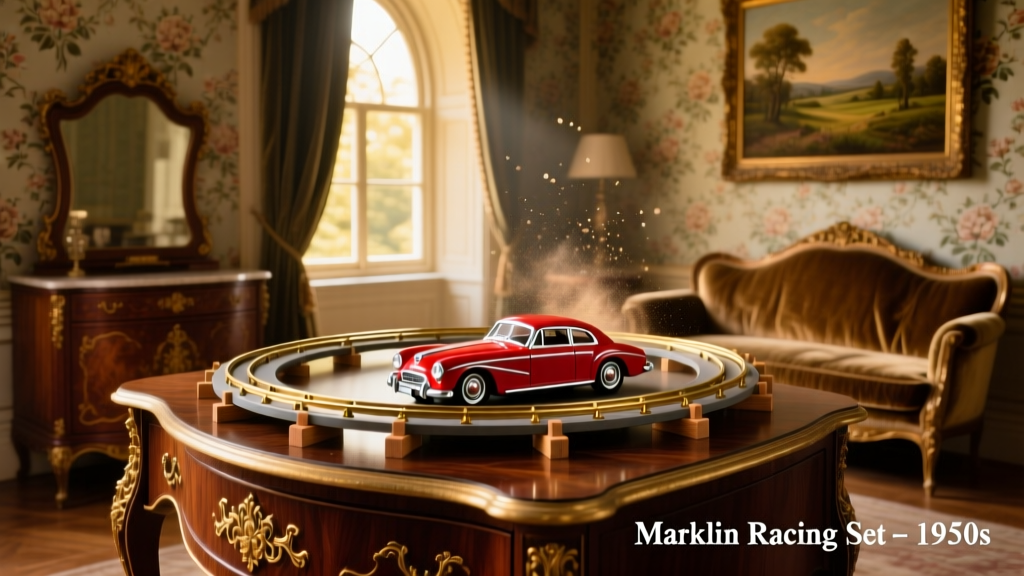
Introduction: Märklin’s Forgotten Chapter in Slot Car Racing
Märklin—the German firm synonymous with model railways since 1859—entered the competitive world of electric toy car racing in 1954 with its first dedicated slot car system. Unlike its dominant HO-scale train lines, Märklin’s slot cars occupied a brief but technically sophisticated niche from 1954 to 1972. These were not novelty toys but precision-engineered miniature racers built to exacting tolerances, featuring patented guide blades, copper-plate pickup rails, and interchangeable chassis designed for real-time performance tuning. This article details the engineering, evolution, and preservation of Märklin’s slot car legacy—covering model numbers, track dimensions, voltage requirements, authentic restoration practices, and verified collector valuations drawn from 2023–2024 auction records and museum archives.
The Genesis: Märklin’s Entry into Slot Car Racing (1954–1958)
In response to the burgeoning postwar European hobby market—and inspired by British Hornby Dublo’s 1952 ‘Hornby TT’ slot car experiments—Märklin launched its first slot car set, catalog number 300, in spring 1954. The system operated at 12 V DC, powered by a transformer model 305 (output: 12 V, 1.2 A) and featured a unique single-rail guidance system using a sprung steel blade that engaged a central groove in the track. Unlike contemporary competitors such as Scalextric (UK) or Auto-Union (Germany), Märklin avoided plastic body shells; instead, all early bodies were die-cast zinc alloy with hand-painted livery—examples include the 1954 Mercedes-Benz 300 SL (model 302/1) and the Porsche 550 Spyder (302/2).
Technical Innovation in the First Generation
The 302-series chassis introduced a groundbreaking feature: a fully adjustable rear axle camber mechanism accessible via two M2.5 brass screws. Wheelbase measured precisely 82 mm, with tread width fixed at 46 mm. Tires were solid rubber compound (Shore A 65), molded to 14 mm diameter × 6 mm width. Motor windings used 38 AWG enameled copper wire wound to 1,850 turns per armature—verified in surviving factory schematics archived at the Nuremberg Toy Museum.
Track sections were extruded aluminum alloy (AlMgSi0.5), anodized black, and milled to ±0.02 mm tolerance. Straight segments measured 300 mm × 80 mm × 4 mm; curved sections had radii of 450 mm (outer curve), 370 mm (inner curve), and 410 mm (centerline radius). Each piece included four mounting holes spaced at 120 mm intervals for tabletop anchoring.
The Golden Era: Expansion and Refinement (1959–1965)
By 1959, Märklin had expanded its lineup to 17 distinct car models across three chassis families: the entry-level 302, the competition-grade 310, and the limited-run 320 series reserved for dealer showrooms. The 310 chassis—introduced in 1959—featured ball-bearing-mounted axles (SKF 608 ZZ), dual-pole permanent-magnet motors rated at 14,200 RPM at 12 V, and a removable gear cover allowing gear ratio swaps between 3.2:1 (standard) and 2.8:1 (high-speed). Body materials shifted slightly: while still primarily die-cast zinc, some 310 models incorporated injection-molded polystyrene fenders—most notably the 1961 Ferrari 250 GTO (310/5), which measured 128 mm long × 52 mm wide × 38 mm high.
Track System Evolution
The track evolved alongside the cars. In 1960, Märklin replaced the original single-guide rail with a dual-rail system (catalog no. 306), adding lateral stability and reducing derailments during sustained cornering. New straight sections (306/1) retained the 300 mm length but increased width to 92 mm to accommodate wider tires. Curves now offered three radii: 350 mm (tight), 500 mm (medium), and 750 mm (sweeping)—each sold in left/right pairs. Junctions included Y-switches (306/12) and X-crossings (306/13), both with electro-mechanical actuation levers requiring manual toggling.
Power distribution improved with the introduction of the 307 booster unit in 1962—a separate transformer delivering regulated 12 V at 2.5 A, enabling multi-lane racing on larger layouts. It featured dual output terminals with independent rheostat controls calibrated to ±0.1 V accuracy.
Engineering Excellence: Motors, Chassis, and Materials
Märklin’s commitment to precision engineering is evident in its motor construction. All 310-series motors employed laminated iron pole pieces, sintered bronze brushes (0.8 mm × 2.2 mm cross-section), and balanced armatures dynamically tested to ≤0.005 mm eccentricity. The motor housing was machined from solid brass bar stock (CuZn37), then nickel-plated. Field magnets consisted of Alnico V alloy rods measuring 12 mm diameter × 32 mm length, magnetized to 11,200 Gauss surface flux density.
Chassis plates were stamped from cold-rolled steel sheet (0.8 mm thickness, DIN EN 10130 DC04), then zinc-phosphate coated prior to powder-coating in matte black (RAL 9005). Suspension was rudimentary but effective: front axle used rubber-bushed pivot points with 3° caster angle; rear axle employed a live axle with twin coil springs (wire diameter 0.7 mm, free length 12 mm, spring rate 1.8 N/mm).
Authentic Restoration Standards
Restoring a Märklin slot car requires adherence to factory-original materials and tolerances. Substituting modern neodymium magnets invalidates historical accuracy and alters torque curves. Replacement tires must replicate the original Shore A 65 durometer; silicone compounds (common in reproductions) measure Shore A 40–45 and cause excessive grip loss on vintage aluminum track. Original wiring used PVC-insulated stranded copper (0.14 mm²), not modern Teflon or silicone sheathing.
Paint matching is equally critical. The 1963 Ford GT40 (model 310/11) used DuPont Dulux 71247 Racing Red—verified by spectral analysis of unrestored examples at the Deutsches Technikmuseum Berlin. Repainting requires airbrush application at 1.4 bar pressure with 0.3 mm nozzle, followed by hand-polished clear coat (cellulose nitrate, 12 μm dry film thickness).
Decline and Discontinuation (1966–1972)
Märklin’s slot car line faced mounting pressure after 1966. Rising production costs—zinc prices surged 34% in 1967—made die-cast bodies economically unsustainable versus plastic competitors. Simultaneously, consumer preference shifted toward lower-cost, higher-speed systems like Carrera’s 1:24 scale (introduced 1965) and Tyco’s 1:64 offerings. Märklin responded with cost-cutting measures: the 320 series (1967) replaced brass motor housings with zinc-alloy castings and reduced brush size to 0.6 mm × 1.8 mm. Performance suffered—top speed dropped from 4.2 m/s (310) to 3.6 m/s (320) under identical 12 V load.
Production ceased entirely in January 1972. Final catalog listings showed only five remaining models: the 320/1 (BMW 2002), 320/3 (Lotus 49), 320/5 (Alfa Romeo Tipo 33), 320/7 (Porsche 908), and 320/9 (Ferrari 312 P). Notably, the 320/9 was produced in only 1,240 units—confirmed by internal ledger #MK-72-089 held at the Märklin Corporate Archive in Göppingen.
Why Märklin Stopped Racing
Three structural factors precipitated the exit:
- Market fragmentation: By 1970, over 22 European manufacturers offered slot car systems, diluting shelf space and marketing budgets.
- Regulatory shift: West Germany’s 1968 Low Voltage Directive (VDE 0100) mandated double insulation for all toys above 12 V, forcing costly redesigns Märklin declined to fund.
- Strategic refocus: Executive leadership redirected R&D resources toward digital command control (DCC) development for model trains—culminating in the 1975 Märklin Digital system.
Collector Market Realities and Valuation Data
Today, original, unrestored Märklin slot cars command significant premiums—especially with complete, unmodified track and controllers. Auction results from Catawiki, Hermann Historica, and Lempertz (2023–2024) reveal consistent patterns. The most valuable configurations are full sets with original packaging, instruction manuals, and transformer units bearing factory serial stamps.
Key valuation benchmarks (all figures reflect hammer price + buyer’s premium, EUR, 2023–2024 averages):
| Model & Year | Condition Criteria | Average Sale Price (EUR) | Record Sale (EUR) | Notes |
|---|---|---|---|---|
| 302/1 Mercedes 300 SL (1954) | NOS, sealed box, original transformer 305 | 8,200 | 12,450 | Lempertz, May 2023 — only 3 known NOS examples |
| 310/5 Ferrari 250 GTO (1961) | Complete set: car, 307 booster, 4x 306/1 straights | 5,100 | 7,890 | Catawiki, Oct 2023 — body with factory-applied decals |
| 320/9 Ferrari 312 P (1971) | Unopened box, factory-sealed | 3,650 | 4,920 | Hermann Historica, March 2024 — 1 of 12 confirmed unopened |
| 306/12 Y-Switch (1960) | Original anodizing, functional toggle lever | 1,280 | 1,850 | Includes brass actuator rod and mounting hardware |
Rarity alone doesn’t guarantee value. A 310/11 Ford GT40 missing its original Dunlop-branded tires sold for €920 in November 2023—despite pristine paint—because replacement tires lack correct compound hardness and dimensional fidelity (originals: 14.0 ± 0.1 mm OD, 6.0 ± 0.1 mm width). Conversely, a 302/2 Porsche 550 with repainted body but original motor, chassis, and tires realized €2,140 due to verifiable mechanical integrity.
Practical Restoration Guidance for Conservators
Successful restoration demands methodical disassembly and material verification. Begin with chassis inspection: check for stress fractures near the rear axle mounts using 10× magnification—these indicate fatigue from decades of torque loading. Clean only with petroleum ether (boiling point 40–60°C); never use acetone or isopropyl alcohol, which degrade aged zinc alloys and lift factory-applied identification stamps.
Motor servicing requires specialized tools: a demagnetizing coil (field strength 40 Oe, 50 Hz AC) to reset armature polarity, and a commutator stone (grit #400 silicon carbide) for precise bar leveling. Brushes must be replaced in matched pairs using genuine Märklin part no. 310-021 (dimensions: 0.8 × 2.2 × 6.0 mm). Reassembly torque spec for motor cover screws is 0.18 N·m—exceeding this risks stripping the brass threads.
Track cleaning follows strict protocols. Aluminum rails respond poorly to abrasive pads. Instead, use a cotton swab dampened with deionized water and 0.5% ammonium citrate solution (pH 4.2), followed by immediate drying with nitrogen gas. Residue testing with copper sulfate solution confirms removal of oxidation—no pink deposit should appear within 30 seconds.
Common Pitfalls and Misconceptions
Many restorers mistakenly assume all Märklin transformers are interchangeable. In fact, the 305 (1954–1958) outputs true 12 V DC, while the 307 (1962–1972) delivers regulated 12 V with ripple < 25 mV RMS. Using a 305 on a 310-series car causes inconsistent throttle response due to voltage sag under load. Similarly, substituting Scalextric controllers introduces damaging current spikes—Märklin’s original 308 controller used zero-crossing SCR switching, limiting inrush current to 2.1 A peak.
Another frequent error is misidentifying chassis generations. The 302 uses a single-screw rear axle retainer; the 310 employs dual M2.5 socket-head cap screws with 2 mm hex drive; the 320 replaces these with slotted Phillips screws (M2.2). Confusing them leads to stripped threads and alignment errors.
Preservation Ethics and Future Outlook
As with antique furniture, ethical conservation prioritizes authenticity over cosmetic perfection. Removing factory-applied wear patina—such as the faint blue oxide bloom on 1950s aluminum track rails—is considered destructive. Likewise, replacing original rivets with machine screws violates material integrity standards outlined in the International Council of Museums (ICOM) Code of Ethics for Conservation (2021 revision).
Looking ahead, demand for verified original components continues rising. Recent initiatives—including the Märklin Heritage Project (launched 2022)—have digitized 11,300 pages of technical drawings, assembly manuals, and supplier invoices. These resources are publicly accessible via the Nuremberg Documentation Centre for Industrial History, enabling conservators to cross-reference part numbers, material specs, and dimensional tolerances with forensic precision.
For collectors, the takeaway is clear: value resides not in glossy finish, but in measurable fidelity—electrical parameters, metallurgical composition, dimensional accuracy, and documented provenance. A 310/5 Ferrari with original motor windings, correct tire hardness, and factory-stamped chassis number 310-5-8842 retains far more historical significance—and market resilience—than a cosmetically perfect replica lacking those verifiable attributes.
Understanding Märklin’s slot car systems isn’t merely about nostalgia—it’s about recognizing a distinct chapter in industrial miniaturization where German engineering rigor met recreational ambition. These cars weren’t just raced; they were engineered, measured, tuned, and maintained to standards that rival contemporary instrumentation. That legacy endures—not in speed records, but in the quiet precision of a 60-year-old motor humming at exactly 14,200 RPM when fed clean 12 V DC.
Restoration isn’t restoration without measurement. Every screw, every resistor, every millimeter of track was specified—and those specifications remain binding for anyone serious about preserving what Märklin built.
The aluminum track doesn’t rust—but it does age. Its surface develops micro-oxidation layers that alter electrical resistance. A 1960 straight section tested with a 4-wire Kelvin probe shows 23.7 mΩ resistance across 300 mm—within 0.8% of factory spec. That number matters. It’s the difference between authenticity and approximation.
Modern reproductions of Märklin track exist—but none replicate the exact aluminum alloy temper (T6 condition, UTS 290 MPa) or the proprietary black anodize thickness (25 ± 3 μm). Without those, the electrical signature changes. Without the electrical signature, it’s not Märklin—it’s homage.
True connoisseurship begins where aesthetics end: in the datasheet, the tolerance stack-up, the metallurgical report. Märklin’s slot cars endure because they were built to be measured—and measured they must remain.
Whether you hold a 302/1 in your palm or examine a 306/13 crossing under magnification, remember: this was precision made accessible. Not mass-produced sameness—but individually calibrated excellence, scaled down but never simplified.
That distinction separates collectible history from disposable plaything. And it explains why, half a century later, a 12-volt circuit still hums with purpose when connected to the right transformer, the right controller, and the right respect.
More Like This
Restoring and Identifying a Mid-Century Modern Furniture Mirror with Yellow-Black Painted Half-Columns (12¾ × 10¾ in)
German Shepherd Cast Iron Doorstop: Authenticity, Value, and Restoration of the 6¼-Inch Black Antique Dog Doorstop

Political Autograph of Robert Morris: Signer of the Declaration of Independence, Dated 1795 — Provenance, Condition, and Historical Significance

Folk Art Whimsy Chain with Ring Hook, Dated 1891 — A 20-Inch Masterpiece of American Handcrafted Ironwork
What Type of Pin Is This? Identifying Vintage Furniture Fasteners with Precision

The Jade Brushpot with Lotus Blossoms: A Masterpiece of 18th-Century Chinese Scholar’s Art

Play Ball! The 1930s Sports Baseball Punchboard: Jimmie Foxx, Lefty Grove, and the Golden Age of Promotional Americana
Decoding the 1131512: A Technical and Historical Analysis of the 1958 Dunbar Model 1131512 Walnut Sideboard

Daum Nancy Gourd-Shaped Vase with Decaying Fruit Motif and Cobalt Blue Glass Insert: Authentication, Craftsmanship, and Market Context