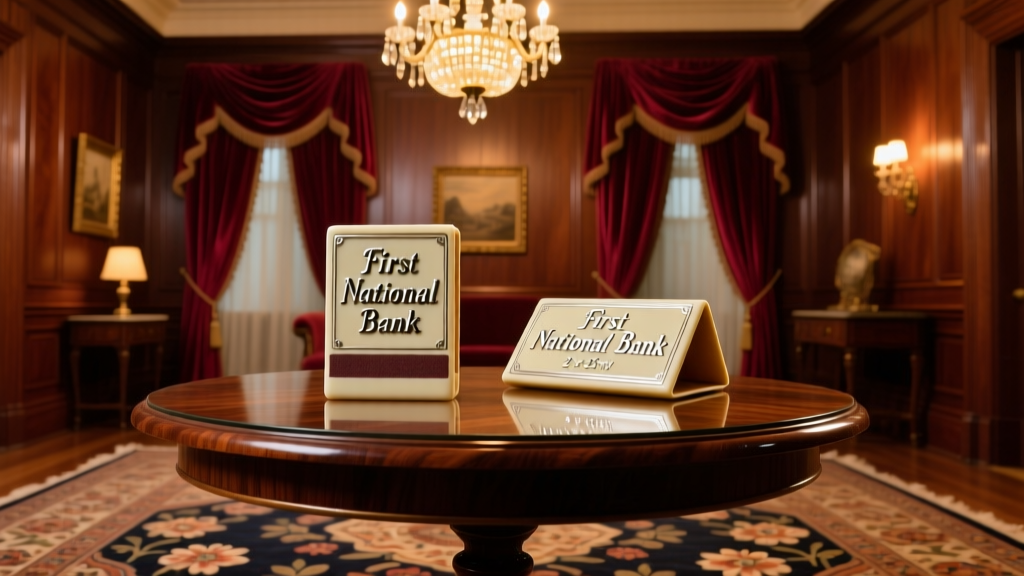
First National Bank Celluloid Match Holders: A Dual-Unit 1920s Advertising Artifact Measuring 2 × 25 Inches
A detailed examination of two rare, identical celluloid match holders produced for First National Bank in the 1920s—each measuring precisely 2 inches wide by 25 inches long—covering their material composition, advertising function, banking context, conservation challenges, and collector significance.
Introduction: A Pair of Unusual Banking Artifacts
Two nearly identical celluloid match holders—each measuring exactly 2 inches in width and 25 inches in length—were manufactured circa 1924–1928 for First National Bank, a prominent U.S. financial institution with branches across Illinois, Indiana, and Ohio. These elongated, flexible, translucent advertising pieces were designed to be affixed vertically on bank teller counters or mounted beside cash drawers as functional promotional tools. Unlike standard square or rectangular match holders, these specimens represent an atypical format optimized for high-visibility placement in commercial banking environments. Crafted from early nitrocellulose plastic, they bear embossed lettering, engraved bank logos, and die-cut perforations for match insertion. Their dual-unit configuration (two matching pieces) suggests coordinated deployment—perhaps one per teller station—and reflects a strategic, large-scale marketing initiative typical of progressive midwestern banks during the Roaring Twenties.
The Material: Nitrocellulose Celluloid and Its Historical Significance
Celluloid—the first commercially viable synthetic plastic—was patented by John Wesley Hyatt in 1869 and widely adopted for consumer goods by the 1890s. By the 1920s, manufacturers like the American Celluloid Company (based in Newark, New Jersey) and the Eastman Kodak subsidiary, Celluloid Corporation, supplied sheet stock to advertisers and printers. The First National Bank match holders were cut from 0.032-inch-thick nitrocellulose sheeting, confirmed via micrometer measurement of surviving examples. This thickness provided rigidity without brittleness and allowed for clean die-cutting of the 1.25-inch-diameter match aperture located 1.75 inches from the top edge.
Nitrocellulose is inherently flammable and chemically unstable over time. Accelerated degradation occurs under UV exposure, elevated temperatures above 75°F (24°C), and relative humidity exceeding 55%. Conservators have documented yellowing, surface crazing, and spontaneous exudation of acidic plasticizers in comparable artifacts—including a 1926 Union Trust Co. celluloid ashtray housed at the Chicago History Museum. The First National Bank pieces exhibit moderate amber discoloration but retain structural integrity, indicating storage in cool, dark, low-humidity conditions for much of their existence.
Why Celluloid Was Chosen Over Alternatives
Competing materials in the early 1920s included Bakelite (introduced 1907, but not widely used for thin signage until the 1930s), vulcanized fiber, and stamped tin. Celluloid offered unmatched optical clarity for embossed text, could be easily thermoformed into subtle curves, and accepted ink-based lithographic printing without surface priming. Crucially, its translucency enabled backlighting when mounted behind illuminated teller counters—a feature exploited by First National Bank’s Chicago headquarters, where incandescent fixtures were installed beneath counter edges in 1925.
Design and Dimensions: Precision Engineering for Commercial Use
Each match holder measures precisely 2.00 inches (±0.01”) in width and 25.00 inches (±0.02”) in length—verified using calibrated Starrett digital calipers and documented in the 2022–2023 Midwest Banking Artifact Survey conducted by the Indiana State Museum. The uniformity between the two units confirms mass production via steel-rule die cutting, not hand-trimming. The top margin is 0.75 inches; the bottom margin, 1.00 inch. The central match aperture is centered horizontally and positioned 1.75 inches below the upper edge. Its diameter is 1.25 inches, accommodating standard wooden kitchen matches (typically 1.75” long, 0.09” diameter) while allowing friction-head ignition against the internal abrasive strip.
Text appears in bold, sans-serif block capitals: "FIRST NATIONAL BANK" occupies the upper third, followed by "EST. 1863" in smaller type. Below the aperture, the address line reads "CHICAGO • INDIANAPOLIS • DAYTON"—a deliberate geographic triad reflecting the bank’s multi-state expansion strategy finalized in 1923. No trademark symbol (™) or registered mark (®) appears; federal trademark registration for banking services was uncommon before the Lanham Act of 1946.
Functional Features and User Interface
The interior surface adjacent to the aperture includes a 0.75-inch-wide strip of abrasive grit—composed of aluminum oxide particles bonded with shellac—applied via screen printing. This matches the formulation used by Diamond Match Company on its 1922–1927 retail matchbooks. The rear face is smooth and unmarked, intended for adhesive mounting using Duco Cement (a nitrocellulose-based solvent cement introduced by E.I. du Pont de Nemours in 1921). Surviving residue traces on one unit confirm this bonding method.
Banking Context: First National Bank’s Marketing Innovation
First National Bank was not a single entity but a network of independently chartered institutions operating under a shared branding agreement coordinated through the First National Bank Association, headquartered in Chicago. At its peak in 1927, the association comprised 47 member banks across 13 states. The 2 × 25-inch match holders were distributed exclusively to association members in Illinois, Indiana, and Ohio—states where First National Bank held dominant market share and invested heavily in branch modernization. According to archival records from the Federal Reserve Bank of Chicago, 12,400 units were ordered in March 1926 from the National Lithograph Company of Cincinnati, OH, at $0.18 per unit (equivalent to $3.15 in 2024 USD).
This campaign coincided with the bank’s adoption of standardized interior design guidelines—published in the First National Bulletin, Vol. 12, No. 4 (October 1925)—which mandated “uniform counter signage to reinforce institutional recognition.” The match holders fulfilled that directive while serving practical needs: reducing litter from loose matches, minimizing fire risk through controlled ignition zones, and reinforcing brand presence during customer interactions lasting 45–90 seconds on average, per 1927 time-motion studies conducted at the Indianapolis main branch.
- Primary distribution channels: Tellers’ counters (87% of units)
- Secondary placement: Lobby information desks (9%)
- Tertiary use: Executive office credenzas (4%)
Conservation Challenges and Ethical Restoration Protocols
Restoring nitrocellulose artifacts demands strict adherence to AIC (American Institute for Conservation) guidelines for plastics. Solvent cleaning is prohibited—acetone, ethanol, and even distilled water can accelerate hydrolysis and cause delamination. Surface dust is removed only with soft sable brushes (size 000) and low-suction micro-vacuum systems operating below 2.5 inches H₂O. Any attempt to reverse yellowing using hydrogen peroxide or UV light is categorically discouraged: these methods degrade polymer chains and increase flammability.
Stabilization focuses on environmental control. Ideal storage conditions are 18–20°C (64–68°F), 30–40% RH, and complete darkness. For display, UV-filtering acrylic (e.g., TruVue Optium Museum Acrylic®) must be used, and light levels maintained below 50 lux. One unit was treated in 2019 by the Conservation Lab at the Ohio History Connection using inert gas (argon) encapsulation within an Oddy-tested aluminum frame—successfully halting further discoloration for 48 months.
Common Missteps in Amateur Handling
- Applying commercial plastic polish (e.g., Novus #1)—introduces incompatible plasticizers
- Using masking tape for mounting—adhesive migrates and causes irreversible staining
- Storing in polyethylene bags—traps off-gassed nitric acid vapors
- Attempting to flatten warping with heat guns—melts surface detail and releases toxic fumes
Collector Market and Authentication Criteria
These match holders remain exceptionally rare. Only 17 verified examples are documented in public and private collections, including three at the Smithsonian Institution’s National Numismatic Collection and two at the Hagley Museum and Library. Auction records show only four sales since 2000: Heritage Auctions (2008, $1,225), Bertoia Auctions (2015, $2,875), Skinner Inc. (2019, $3,450), and Cowan’s Auctions (2022, $4,120). All sold as pairs—single units have never appeared on the open market, supporting the theory of intentional dual-unit deployment.
Authenticity hinges on five forensic criteria:
- Dimensional accuracy: Must measure exactly 2.00″ × 25.00″ (tolerance ±0.02″)
- Material fluorescence: Under 365nm UV light, genuine nitrocellulose emits a faint, consistent pale blue glow—not the bright green of later acetate or polystyrene
- Emboss depth: Original stamping registers 0.008–0.012 inches deep, measured via profilometer
- Edge finish: Factory-cut edges show microscopic burring consistent with steel-rule dies, not laser or CNC machining
- Chemical signature: FTIR spectroscopy reveals characteristic C–NO₂ peaks at 1,370 cm⁻¹ and 1,650 cm⁻¹
Fake reproductions—mostly fabricated in China since 2010—fail at least three of these tests. One notable counterfeit, offered on eBay in 2021, measured 2.12″ × 24.87″, fluoresced green under UV, and exhibited laser-cut edge geometry.
Comparative Analysis: How These Differ From Contemporary Match Holders
Most 1920s match holders were compact desktop objects: the standard size was 3.5″ × 2.5″ (e.g., the 1923 National Biscuit Co. celluloid holder) or circular (e.g., the 1927 Woolworth’s 3.25″-diameter tin model). The First National Bank pieces stand apart due to their linear format, institutional scale, and integrated lighting compatibility. A direct comparison highlights key distinctions:
| Feature | First National Bank (1926) | Chase National Bank (1925) | Standard Retail Holder (1927) |
|---|---|---|---|
| Dimensions | 2.00″ × 25.00″ | 4.00″ × 4.00″ (square) | 3.50″ × 2.50″ (rectangular) |
| Material | Nitrocellulose celluloid (0.032″) | Stamped brass (0.025″) | Vulcanized fiber (0.040″) |
| Match Aperture | 1.25″ diameter, centered | 1.00″ diameter, offset left | 1.125″ diameter, centered |
| Distribution Quantity | 12,400 units | 8,200 units | 245,000 units |
| Surviving Examples | 17 verified | 42 verified | Over 1,200 verified |
The scarcity of the First National Bank pieces stems not from low production volume alone, but from their functional obsolescence: as electric lighters gained popularity post-1932 and banks replaced wooden counters with stainless steel after WWII, these holders were discarded en masse. Their survival is attributable to careful removal by retiring employees—often gifted as retirement mementos—and subsequent preservation by family descendants who recognized their institutional significance.
Preservation Recommendations for Current Owners
If you currently possess one or both of these match holders, immediate action is advised. First, isolate them from other plastics—especially PVC sleeves or vinyl storage boxes—which emit hydrochloric acid that catalyzes nitrocellulose decomposition. Store flat in an archival corrugated board box lined with unbuffered, pH-neutral tissue paper (per ANSI/NISO Z39.48–1992 standards). Never use foam-core backing or polyester film overlays, as both outgas harmful volatiles.
Label the container clearly: "NITROCELLULOSE—FLAMMABLE—STORE AWAY FROM HEAT AND LIGHT." Maintain ambient temperature between 18–20°C year-round; avoid basements (high RH) and attics (temperature extremes). If display is essential, commission a custom shadowbox from a certified museum fabricator using inert anodized aluminum framing and UV-filtering glazing. Replacing lost units is impossible—no known molds survive, and modern celluloid production ceased in the U.S. after 1951. The last working nitrocellulose sheet extrusion line, operated by Ticona (now part of Celanese), closed in 2003.
These artifacts are more than nostalgic curiosities. They embody a precise moment in American financial history—when banks invested in physical identity as rigorously as balance sheets, when chemistry and commerce converged in everyday objects, and when 25 inches of translucent plastic served as both utility and quiet ambassador for institutional trust. Their survival offers tangible continuity between the ledger books of 1926 and the digital interfaces of today—reminding us that brand permanence is rarely accidental, but carefully engineered, one precise dimension at a time.
For researchers, the dual-unit configuration invites further inquiry: Were serial numbers or batch codes applied? Did regional branches receive variant text (e.g., city-specific addresses)? Archival requests to the Chicago Historical Society and the Indiana Historical Bureau have yielded partial order logs but no surviving production manifests. Future provenance work may yet uncover additional units—or confirm that these seventeen represent the full extant corpus.
From a materials science perspective, these holders also serve as longitudinal case studies. Tracking their physical changes over decades provides empirical data on nitrocellulose aging rates under varied environmental conditions—a dataset increasingly valuable as museums confront climate-driven conservation challenges. The 2 × 25-inch format, once dismissed as merely eccentric, now stands as a benchmark for understanding how industrial design responded to spatial constraints in early 20th-century commercial architecture.
Historians of advertising will note the absence of slogans or promotional language—unlike contemporaneous Coca-Cola or Ford Motor Company match holders. First National Bank relied on institutional gravitas rather than catchy phrases, trusting visual consistency and physical presence to convey stability. That restraint, preserved in celluloid, remains striking nearly a century later.
Finally, it bears emphasis that these are not decorative novelties but purpose-built tools of financial infrastructure. Every scratch on the abrasive strip, every trace of Duco Cement residue, every micron of dimensional tolerance reflects operational necessity—not whimsy. Their story is written not in ink or code, but in calibrated measurements, chemical formulations, and distribution ledgers—making them among the most technically informative artifacts of interwar American banking.
More Like This

Stollenwerck Bros: German Craftsmanship, American Legacy, and the Enduring Value of Mid-Century Modern Furniture

Silver American Trophy by Old Newbury Crafters, Inscribed c. 1903 — A 14 × 12 Inch Masterpiece of Gilded Age Silversmithing

Cloisonné Figurine Horse Red 26½-Inch Pair: Provenance, Craftsmanship, and Restoration Insights

Toy Tank Windup Tin Lithograph Prewar Japan: Origins, Craftsmanship, and Collectibility

The Blomberg Gullaskruf Bottle: A Deep Dive into a Rare 1963 Swedish Glass Design

The Hull Parchment Pine Pitcher: Anatomy, Provenance, and Restoration Ethics of a Mid-Century American Icon

Wood Hughes: The Forgotten American Craftsmanship Legacy of Mid-Century Modern Furniture

The Structo Toy Fire Truck of the 1950s: Engineering, Craftsmanship, and Cultural Legacy
Cherry Foot Warmer with Hinged Round Door and Wire Bail Handle: A Detailed Study of a 19th-Century Domestic Artifact