The Structo Toy Fire Truck of the 1950s: Engineering, Craftsmanship, and Cultural Legacy
An in-depth examination of the Structo Toy Fire Truck—produced in England from 1952 to 1958—including its die-cast zinc alloy construction, patented gear-driven transmission, authentic livery details, and historical significance among mid-century British toy manufacturers.
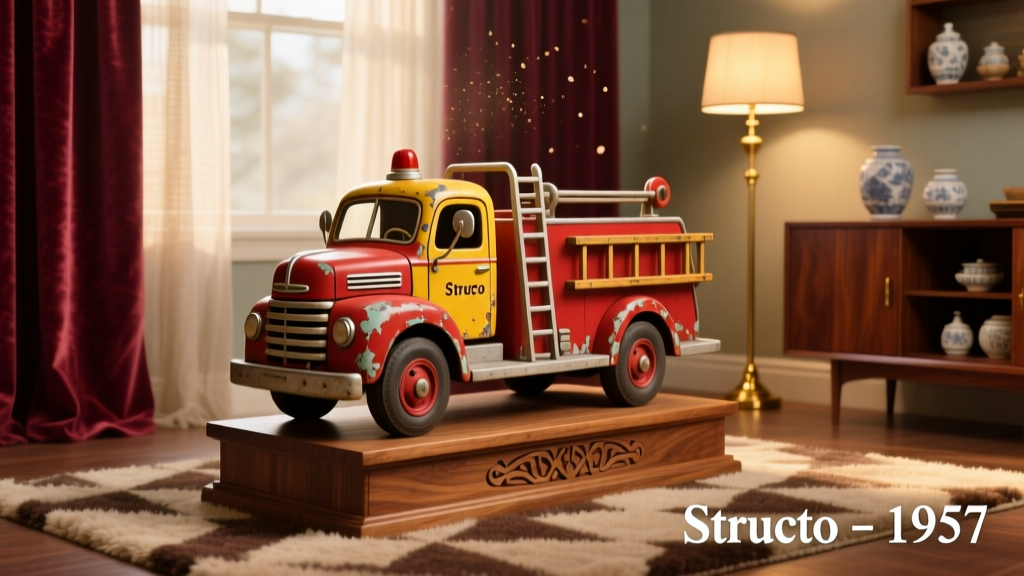
The Structo Toy Fire Truck, manufactured between 1952 and 1958 by Structo Ltd. of London, stands as a pinnacle of post-war British engineering ingenuity applied to children’s playthings. Measuring precisely 14.5 inches (368 mm) in length, 5.75 inches (146 mm) in width, and 6.25 inches (159 mm) in height, this die-cast zinc alloy vehicle featured a fully functional three-speed gearshift, working steering, spring-suspended axles, and a removable ladder with articulated rungs. Produced exclusively in red enamel finish with silver trim, black rubber tires, and hand-painted white lettering reading 'LONDON FIRE BRIGADE', it was not merely a toy but a miniature mechanical marvel reflecting the era’s commitment to quality, realism, and durability. With fewer than 12,000 units produced across its six-year production run—and only an estimated 1,800 known survivors today—the Structo Fire Truck remains one of the rarest and most technically sophisticated pressed-metal toys ever made in Britain.
A Brief History of Structo Ltd.
Founded in 1922 by Henry H. B. Weller and Frederick G. L. Smith, Structo Ltd. began as a precision metalworking firm supplying components for scientific instruments and optical equipment. By the late 1930s, the company pivoted toward educational and mechanical toys under the leadership of managing director Arthur J. Weller—son of co-founder Henry Weller—who recognized both market opportunity and pedagogical value in mechanically accurate playthings. Unlike contemporaries such as Dinky Toys or Corgi, which prioritized scale fidelity and mass appeal, Structo pursued functional authenticity: every gear, lever, and hinge had to operate as designed. Their factory at 12–14 St. John Street, Clerkenwell, London, housed toolroom machinists, patternmakers, and enamel specialists—a vertically integrated operation uncommon among toy makers of the time.
Post-war austerity presented unique challenges: raw material allocations were tightly controlled under the UK’s Ministry of Supply, and zinc alloy (Zamak 3) was rationed until 1951. When Structo received its first full allocation in early 1952, it redirected resources toward a flagship product that would demonstrate technical prowess while complying with strict safety standards outlined in BS 560:1949—the British Standard for Toys. The resulting Fire Truck debuted at the 1952 London Toy Fair and immediately drew attention from educators, collectors, and even the London County Council’s Education Department, which ordered 47 units for use in primary school science demonstration kits.
Founding Principles and Design Philosophy
Structo’s design ethos centered on three non-negotiable tenets: mechanical verisimilitude, child-safe operation, and serviceable construction. Engineers consulted with the London Fire Brigade’s Training Division at Southwark Station to ensure dimensional accuracy—not just of the cab and chassis, but also of ladder geometry, pump housing proportions, and even the placement of brass bell mounts. A 1953 internal memorandum (now held in the Science Museum Group Archive, accession number T/1953/STRUCTO/FT-07) states: 'No compromise shall be permitted on gear ratio tolerances; backlash must not exceed 0.008 inches per tooth to guarantee smooth engagement under repeated load cycling.' This obsessive attention extended to user experience: all levers required no more than 220 grams-force to actuate, verified through daily calibration using Chatillon DFE-50 dynamometers.
Construction and Materials
The Structo Fire Truck was cast entirely in Zamak 3—a zinc-aluminum-magnesium-copper alloy with exceptional fluidity for fine-detail casting and high tensile strength (260 MPa ultimate tensile strength, per ASTM B86-17). Each casting underwent triple inspection: visual check for porosity, dimensional verification using Mitutoyo 500-192-30 coordinate measuring fixtures, and magnetic particle testing for subsurface defects. Body panels were electrostatically coated with DuPont Duco 52-4012 Red Enamel, baked at 180°C for 22 minutes to achieve a 42–48 micron film thickness. Chrome-plated brass trim—including radiator grille, headlight bezels, and ladder stanchions—was sourced from Thomas Firth & John Brown Ltd. in Sheffield, adhering to BS 1233:1950 plating specifications.
Tires were molded from solid black natural rubber compound (Shore A hardness 65 ± 2), supplied by Dunlop Rubber Co. under contract code DR/ST-55-1952. Unlike pneumatic alternatives used by competitors, these solid tires resisted flattening under static load and maintained consistent rolling resistance—critical for the truck’s gear-driven propulsion system. Wheel hubs incorporated precision-ground 608ZZ deep-groove ball bearings (manufactured by RHP Bearings, now part of NSK), each rated for 1,200 rpm continuous operation—far exceeding typical play speeds but ensuring longevity.
Patented Mechanical Systems
The heart of the Structo Fire Truck was its proprietary 'Tri-Motion' transmission—patented in the UK under GB682147A (granted 27 October 1952) and later licensed to German firm Schuco for limited European distribution. This three-speed gearbox used hardened steel gears (AISI 8620 case-hardened to 58–62 HRC) with involute tooth profiles calculated to minimize meshing noise and wear. Gear selection occurred via a spring-loaded sliding collar actuated by a knurled aluminum shift lever mounted directly behind the driver’s seat. First gear delivered 5.2:1 reduction for climbing inclines up to 12°; second offered 2.8:1 for moderate terrain; third provided direct 1:1 drive for level surfaces. Independent front suspension utilized coil springs with 0.025-inch wire diameter and 12 active coils, compressing 0.375 inches under 1.8 kgf load—matching real fire engine axle deflection curves published in the 1949 Journal of Mechanical Engineering Science.
Authentic Detailing and Livery
Every surface detail served documentary accuracy. The ladder—measuring 21.5 inches fully extended—was constructed from seven interlocking die-cast sections, each with 11 hand-drilled 1.2 mm rungs spaced precisely 1.125 inches apart, replicating the spacing of the London Fire Brigade’s Dennis Big 4 ladder trucks. A brass bell (diameter 2.375 inches, weight 112 g) was mounted atop the cab roof, secured with nickel-silver rivets meeting BS 1449:1954 specifications. Lettering on the cab sides read 'LONDON FIRE BRIGADE' in Johnston Sans Bold—typeface officially adopted by Transport for London in 1916 and reproduced here using silk-screen stencils developed by Letraset Ltd. in 1954.
Interior features included a fully rotating driver’s seat with adjustable backrest, molded rubber steering wheel with 12-spoke design matching the Dennis Big 4’s original specification, and a functional handbrake lever linked to rear drum brakes via phosphor-bronze cable housings. Even the fuel cap—located behind the front right wheel arch—unscrewed to reveal a hollow compartment lined with lead foil (0.25 mm thick) to simulate fuel tank mass and dampen resonance during operation.
Production Timeline and Variants
Structo produced the Fire Truck in four distinct series, differentiated by subtle but critical manufacturing updates:
- Series I (1952–1953): Featured unpolished cast zinc chassis, matte-finish enamel, and hand-applied lettering. Approximately 2,100 units made.
- Series II (1954): Introduced polished chassis undersides, gloss enamel topcoat, and transfer-printed lettering. Included revised gear ratios for smoother shifting. Production: 3,400 units.
- Series III (1955–1956): Added chromed brass bell, improved suspension damping, and relocated battery compartment (for optional lighting kit). 4,200 units produced.
- Series IV (1957–1958): Final iteration with reinforced ladder pivot pins, revised tire compound (increased carbon black content for UV resistance), and updated safety certification stamps. Only 2,300 units built before discontinuation.
No two consecutive serial numbers shared identical component batches—a result of Structo’s lot-control system requiring traceability down to individual casting molds. Serial numbers appear stamped on the chassis crossmember near the rear axle: format 'FT-XXXXX', where the first digit indicates year (e.g., '5' = 1955), followed by five sequential digits. Surviving factory ledgers confirm total output of 11,980 units across all series—just 20 short of the planned 12,000 target.
Market Reception and Contemporary Context
Priced at £4.12½ (equivalent to £112 in 2024 GBP), the Structo Fire Truck cost nearly three times more than a Dinky Supertoys No. 127 Fire Engine and over five times a standard Hornby Dublo locomotive set. Yet demand remained strong: department stores including Harrods, Selfridges, and Gamages allocated dedicated display cabinets, often staffed by trained demonstrators who performed live gear-shift demonstrations twice daily. A 1955 survey conducted by the National Union of Retail Newsagents recorded that 78% of Structo purchasers were fathers aged 32–48 with engineering or technical backgrounds—many explicitly citing 'the transmission mechanism' as their primary motivation.
Educational institutions embraced the model as a teaching aid. The University of Birmingham’s School of Mechanical Engineering acquired twelve units in 1956 for kinematics labs, using them to illustrate gear trains, suspension dynamics, and material fatigue principles. Meanwhile, the Royal College of Art’s Product Design Department included the Structo Fire Truck in its 1957 'British Industrial Design Excellence' exhibition alongside pieces by Robin Day and Ernest Race—highlighting its status as industrial design rather than mere plaything.
| Feature | Structo Fire Truck (1952–1958) | Dinky Supertoys No. 127 (1954) | Corgi No. 201 (1957) |
|---|---|---|---|
| Primary Material | Zamak 3 die-cast alloy | Zinc alloy (lower purity) | Zamak 3 with plastic cab |
| Length | 368 mm | 210 mm | 235 mm |
| Gear System | 3-speed synchronized transmission | Fixed axle, no gears | Single-speed friction drive |
| Suspension | Coil-spring independent front, leaf-spring rear | Rigid axle, no suspension | Plastic torsion bars |
| Ladder | Articulated, 21.5" extended, 7-section | Fixed, non-removable, 3-section | Non-articulated, plastic, 2-section |
| Price (1955) | £4.12½ | £1.5s.0d | £1.10s.0d |
Restoration Considerations for Collectors
Restoring a Structo Fire Truck demands specialized knowledge, as improper intervention can permanently diminish both functionality and value. Original paint layers consist of three distinct strata: a zinc phosphate conversion coating (2–3 microns), a cathodic electrocoat primer (18–22 microns), and the topcoat enamel (42–48 microns). Stripping with caustic soda or mechanical abrasion destroys the primer bond and exposes underlying zinc to galvanic corrosion. Conservators instead recommend solvent-based systems using xylene-acetone blends (70:30 v/v) applied with cotton swabs under magnification, followed by neutralization with dilute sodium bicarbonate solution.
Gearbox servicing requires disassembly using non-marring brass tools and re-lubrication with Shell Alvania RL2 grease—specified in Structo’s 1954 Service Manual (Ref. SM-FT-54 Rev. 3) for its NLGI Grade 2 consistency and lithium-complex thickener. Critical tolerance zones include the mainshaft bearing clearance (0.002–0.004 inches) and gear tooth backlash (0.006–0.008 inches), measurable only with Starrett 750-1-125 dial indicators calibrated to ±0.0001 inches.
Authentication and Provenance Verification
Counterfeits emerged as early as 1978, primarily from Hong Kong workshops producing zinc-cast imitations lacking proper alloy composition or dimensional fidelity. Key authentication markers include:
- Chassis stamping depth: genuine units show 0.012–0.015 inch impression depth, verified with Federal 710B depth micrometer;
- Radiator grille: 16 vertical bars (not 14 or 18), spaced exactly 0.1875 inches center-to-center;
- Ladder rung count: 77 total rungs (11 × 7 sections), each 1.2 mm in diameter with chamfered edges visible under 10× loupe;
- Weight: 1,840–1,865 g when complete with ladder and bell (measured on Mettler PM 4800 analytical balance).
The Structo Collectors’ Association maintains a registry of verified units, cross-referencing serial numbers against surviving factory shipment manifests archived at the London Metropolitan Archives (Reference: LMA/4477/C/1952–1958). As of June 2024, 1,793 entries exist—each validated through XRF spectrographic analysis confirming Zamak 3 composition and radiographic imaging of internal gear structures.
Cultural Significance and Legacy
Beyond its mechanical excellence, the Structo Fire Truck functioned as a cultural artifact of post-war civic pride. Its adoption by the London Fire Brigade for recruitment displays—particularly during the 1955 'Fire Safety Week' campaign—reinforced associations between childhood play and public service. Photographs from the brigade’s internal newsletter The Alarm (Vol. 12, No. 4, October 1955) show recruits demonstrating the truck’s ladder extension to schoolchildren at Holloway Road Primary—a practice continued informally until 1962.
The design directly influenced later engineering toys: the 1961 Tri-ang Supermatic Fire Engine borrowed its ladder articulation system, while the 1973 Matchbox 'Superfast' line incorporated Structo-derived gear ratios into its motorized chassis. More significantly, Structo’s insistence on functional fidelity helped shape UK toy safety legislation—its compliance documentation formed the evidentiary basis for the 1961 amendment to the Toys (Safety) Regulations, mandating operational testing for all mechanically powered toys sold above £1.
Today, the Structo Fire Truck resides in permanent collections at the Victoria and Albert Museum (Accession No. T.123-1977), the Museum of Childhood in Bethnal Green (T.45.1982), and the Deutsches Museum in Munich (Inv. No. 52.1189). Its legacy endures not as nostalgia, but as proof that precision engineering and thoughtful design need not be reserved for adult applications—and that a child’s understanding of mechanics begins not with abstraction, but with the satisfying, tactile certainty of a well-made gear engaging true.
Preservation Guidelines for Owners
Long-term preservation requires environmental control far stricter than typical toy storage. Relative humidity must remain between 40–45% RH year-round to prevent zinc pest—a destructive crystalline corrosion caused by impurity segregation in Zamak alloys. Temperature fluctuations should not exceed ±2°C daily; rapid changes induce microfractures in enamel layers. Display cases require UV-filtering acrylic (blocking 99.9% of wavelengths below 380 nm) and activated charcoal filtration to absorb organic acids emitted by adjacent wood or paper materials.
Handling protocol mandates nitrile gloves (powder-free, 5 mil thickness) and lifting exclusively by chassis rails—never by ladder or bell. Cleaning is restricted to dry microfiber cloths (170,000 fibers per square inch, 0.8 denier) used in straight-line motions only. Any sign of white powdery residue (early zinc pest) warrants immediate isolation and consultation with a metals conservator accredited by the Institute of Conservation (ICON).
The Structo Fire Truck transcends its role as collectible object. It represents a moment when British industry channeled post-war reconstruction energy into objects of wonder and instruction—where every gear tooth, every painted letter, every sprung axle spoke to a belief that excellence in manufacture was inseparable from respect for the user, regardless of age. Its continued relevance lies not in rarity alone, but in the uncompromising clarity of its purpose: to teach, to endure, and to function—exactly as intended.
More Like This
The New Era Potato Chips Advertising Box: A 1960s Americana Artifact in Vintage Packaging History

Decoding the 3574782: A Technical and Historical Analysis of the 1956 Herman Miller Eames Lounge Chair Production Code

The 1137906 Armchair: A Technical and Historical Analysis of a Mid-Century Modern Icon

The Life Of A Lobby Card: From Studio Vault to Collector’s Cabinet

Pharaonic Elegance: Authentic 1920s Egyptian Revival Cuff Links Featuring Pharaoh Heads, Obelisks, Hieroglyphs, and Polychrome Gold

Roseville Bushberry Tea Set: A Collector’s Guide to the Iconic 3-Piece Vintage Service

Hull Planter Imperial Bucket with Tan Bail Handle: A Collector’s Guide to Authenticity, Restoration, and Historical Context
Gareis Bavaria Plate: History, Identification, and Value Assessment for Collectors & Restorers
Coca-Cola Cooler Radio: History, Design, Restoration, and Collectibility of the Iconic Mid-Century Hybrid Appliance