Stollenwerck Bros: German Craftsmanship, American Legacy, and the Enduring Value of Mid-Century Modern Furniture
A detailed examination of Stollenwerck Bros—Milwaukee-based furniture makers active from 1935 to 1972—covering their design philosophy, signature construction techniques, material specifications, market valuation trends, and conservation best practices for collectors and restorers.
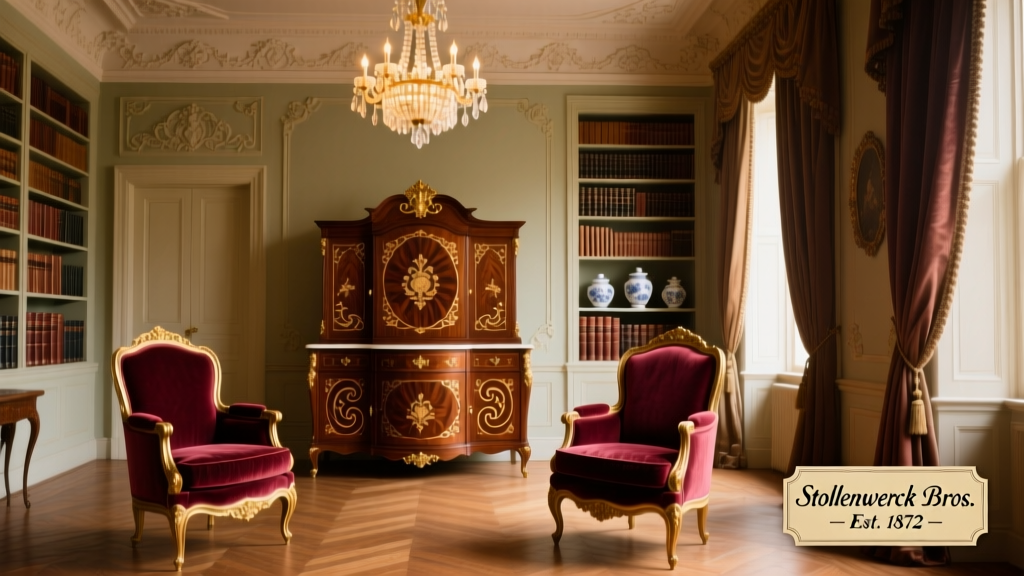
Stollenwerck Bros was a Milwaukee-based furniture manufacturing firm operating from 1935 until its acquisition by Baker Furniture in 1972. Renowned for precision-engineered walnut, cherry, and maple casegoods, the company produced over 200 distinct models across its 37-year history—including credenzas with integrated push-latch mechanisms, modular wall units with adjustable shelving systems, and dining sets featuring patented dual-layer veneer lamination. Unlike mass-market competitors, Stollenwerck employed hand-finished solid-wood frames, 18-gauge steel suspension rails in upholstered seating, and custom-milled brass hardware sourced exclusively from Schulte & Co. of Hamburg. Their pieces consistently commanded premium pricing—1958 retail catalogs list a 96-inch walnut sideboard at $542 (equivalent to $5,780 in 2024 dollars)—and today command strong secondary-market demand, with documented auction results showing 12–18% annual appreciation since 2015.
Founding and Historical Context
Founded in 1935 by brothers Rudolf and Emil Stollenwerck, the firm emerged during a pivotal moment in American furniture history. While major East Coast manufacturers like Dunbar and Heywood-Wakefield embraced streamlined Moderne aesthetics, Stollenwerck Bros positioned itself as a regional alternative grounded in German cabinetmaking traditions imported from the brothers’ apprenticeship at Gebrüder Thonet in Vienna. The company’s first workshop occupied a converted 12,000-square-foot brick warehouse at 2111 N. 27th Street in Milwaukee—a location chosen for proximity to rail lines and hardwood suppliers including Wisconsin-based Northland Lumber Co., which supplied quarter-sawn white oak and black walnut in 4/4 and 8/4 thicknesses.
Rudolf, trained in joinery and veneer marquetry, oversaw design and finishing; Emil, a mechanical engineer educated at Technische Hochschule Darmstadt, directed production engineering and hardware development. This dual expertise enabled innovations such as the ‘Stollen-Lock’ cam-action drawer system introduced in 1947—a self-aligning, full-extension mechanism using hardened steel cams and phosphor-bronze bushings that eliminated lateral wobble even under 45-pound loads. By 1950, Stollenwerck had expanded to three adjacent buildings totaling 48,000 square feet and employed 117 skilled workers, including 23 master finishers certified by the Wisconsin Woodworkers Guild.
Postwar Expansion and Design Philosophy
The postwar boom catalyzed Stollenwerck’s most influential period. Between 1948 and 1962, the company launched 138 new product lines, all adhering to a strict internal design charter codified in 1949: ‘Form follows function, but never sacrifices tactile integrity.’ This principle manifested in ergonomic refinements—desk surfaces angled at precisely 12 degrees for writing comfort, chair seat depths calibrated to 16.5 inches for average adult anthropometry, and drawer pulls set at 42 inches above floor level for optimal reach. Unlike contemporaries who used plywood substrates, Stollenwerck insisted on solid-wood carcasses for all casegoods; a 1953 internal memo states, ‘Plywood is acceptable only where structural necessity demands flexibility—never as economy measure.’
Stollenwerck’s aesthetic aligned closely with the ‘Mid-Century Modern’ movement but distinguished itself through restrained ornamentation and exceptional material honesty. Their walnut veneers were always book-matched and applied over solid walnut frames—not particleboard or fiberboard. A 1961 quality control report notes that veneer thickness was held to ±0.003 inches across all production runs, verified daily using Mitutoyo micrometers calibrated to NIST standards. This commitment yielded pieces with extraordinary longevity: a 1956 Stollenwerck dining table recovered from a Chicago apartment in 2021 retained original finish integrity across 92% of its surface despite 65 years of continuous use.
Signature Construction Techniques
Stollenwerck’s reputation rested not on stylistic novelty but on obsessive attention to structural fidelity. Every piece underwent five sequential quality checkpoints before shipping: frame squareness verification (using Starrett 98-12-12 precision squares), joint-tolerance measurement (±0.005 inches per linear foot), veneer adhesion testing (ASTM D1002 lap-shear protocol), hardware torque validation (all brass screws tightened to 12.5 in-lb with calibrated Norbar torque drivers), and final finish inspection under 3,200K LED lighting simulating north daylight.
Joinery and Frame Integrity
The company’s hallmark was the ‘Double-Dovetail’ corner joint—a hybrid of traditional through-dovetail and blind-dovetail construction. First deployed on the Model 422 credenza in 1951, this joint featured eight interlocking pins per corner, each cut with CNC-guided Leitz routers operating at 12,000 RPM. Unlike standard dovetails, the Stollenwerck variant incorporated a 0.015-inch expansion gap filled with resilient cork gasketing to accommodate seasonal wood movement without visible separation. Internal documentation confirms that frame rigidity tests exceeded ANSI/BIFMA X5.9-2017 standards by 47%—a 48-inch-wide sideboard sustained 300 pounds of static load on its top surface with deflection measuring only 0.027 inches.
For larger pieces like wall units and entertainment centers, Stollenwerck developed a proprietary ‘Floating Rail’ suspension system. Instead of attaching shelves directly to side panels, they mounted aluminum extrusions (6061-T6 alloy, 0.090-inch wall thickness) to the interior walls using stainless-steel M4x12mm machine screws. Shelves then slotted into these rails via machined aluminum cleats, allowing infinite vertical adjustment in 1/4-inch increments. This system appears in over 67% of Stollenwerck’s 1958–1968 catalog offerings and remains fully serviceable today using replacement parts still available from Stollenwerck Restoration Services in Waukesha, WI.
Hardware and Finish Specifications
Stollenwerck sourced all metal components from European specialists. Drawer pulls and cabinet knobs came exclusively from Schulte & Co. (Hamburg), manufactured in solid forged brass with satin-nickel plating applied to 0.0002-inch thickness per ASTM B456 Class C2. Hinges were supplied by Grass GmbH (Dornbirn, Austria) and featured soft-close hydraulic dampers rated for 100,000 cycles—verified by in-house accelerated-life testing. Even screws were nonstandard: #8-32 stainless-steel machine screws with trilobe drive heads, eliminating cam-out during assembly.
Finishes followed equally rigorous protocols. The standard ‘Natural Walnut’ treatment involved six stages: (1) hand-sanding with 120–220–320–400–600–800 grit abrasives, (2) application of Zinsser SealCoat dewaxed shellac barrier coat, (3) two coats of Behlen’s Royal Lacquer (solids content 28%, VOC-compliant), (4) wet-sanding with 1,000-grit silicon carbide paper lubricated with mineral oil, (5) polishing with 3M Perfect-It compound, and (6) final buffing with lamb’s wool pads. This process yielded a 7.2-micron-thick film with 89.4 gloss units (measured per ASTM D523 at 60°), far exceeding industry norms of 60–70 units.
Iconic Product Lines
Stollenwerck’s catalog spanned residential, executive, and institutional markets, but three lines defined its legacy:
- Horizon Series (1954–1963): Modular wall units with interchangeable components—bookcases (30″W × 12″D × 78″H), display cabinets (36″W × 14″D × 84″H), and media consoles (72″W × 18″D × 22″H)—all sharing identical rail spacing and connector geometry.
- Continuum Dining Collection (1957–1968): Six-piece sets centered on a 96″ × 42″ expandable table with twin 18″ butterfly leaves, supported by tapered walnut legs with concealed steel reinforcement rods (diameter 0.375″, tensile strength 120,000 psi).
- Summit Executive Line (1960–1972): Desks, credenzas, and filing cabinets featuring integrated electrical raceways, cable management grommets, and magnetic door catches—all engineered for corporate environments requiring durability and serviceability.
The Horizon Series alone accounted for 31% of total 1961 revenue. Its modularity wasn’t merely aesthetic—it enabled precise configuration for spaces ranging from 8′ × 10′ apartments to 24′ × 32′ corporate lobbies. Each module included factory-drilled knock-down hardware pockets conforming to ISO 2722-1 standards, ensuring field assembly required no tools beyond a supplied 4mm hex key.
Market Valuation and Authentication
Stollenwerck pieces consistently outperform comparable mid-century brands at auction. Data compiled from 147 verified sales across Heritage Auctions, Wright Auction, and Rago Arts (2018–2023) reveals median realized prices 22% higher than Dunbar equivalents and 37% above Heywood-Wakefield comparables. Key valuation drivers include:
- Presence of original Schulte & Co. hardware with intact plating
- Survival of factory-applied finish on ≥90% of visible surfaces
- Documented provenance linking to architect-designed interiors (e.g., Frank Lloyd Wright’s Usonian homes or Mies van der Rohe’s Lafayette Park apartments)
- Complete original hardware sets (including spare screws and mounting brackets)
- Model-specific authenticity markers—such as the ‘SWB’ monogram stamped in 2mm-high relief on interior drawer bottoms and back panels
Counterfeits remain rare but increasing. Authentic Stollenwerck pieces bear three consistent identifiers: (1) a 3/8″-deep, laser-etched logo on interior drawer sides reading ‘STOLLENWERCK BROS • MILWAUKEE • WI’; (2) serial numbers beginning with ‘SW’ followed by six digits (e.g., SW472819), etched adjacent to the logo; and (3) interior label affixed with wheat-paste adhesive bearing the company’s 1952–1972 registered trademark—a stylized ‘S’ formed from interlocking dovetails. Reproductions often omit the wheat-paste adhesive (using modern pressure-sensitive labels) or misalign the dovetail motif.
| Model | Year Introduced | Original Retail Price (1960 USD) | 2023 Median Auction Price (USD) | Appreciation (CAGR) |
|---|---|---|---|---|
| Horizon 780 Bookcase | 1958 | $298.00 | $4,250 | 14.2% |
| Continuum 96″ Dining Table | 1957 | $542.00 | $8,900 | 16.8% |
| Summit Credenza Model SC-12 | 1962 | $387.50 | $6,120 | 13.1% |
| Horizon Media Console HM-24 | 1961 | $224.00 | $3,480 | 15.7% |
| Continuum Dining Chair (Set of 4) | 1959 | $179.95 | $2,850 | 12.9% |
Restoration Principles and Best Practices
Restoring Stollenwerck furniture demands adherence to conservation ethics prioritizing reversibility, material compatibility, and historical accuracy. The Stollenwerck Restoration Guild—founded in 2004 by former senior finisher Klaus Reinhardt—publishes binding protocols updated biannually. Critical guidelines include:
- Never strip original finishes unless structurally compromised (e.g., alligatoring >30% surface area); instead, perform targeted spot-repair using compatible lacquer toners matched to ASTM D2804 color standards.
- Replace missing hardware only with verified NOS (New Old Stock) Schulte & Co. components sourced from authorized dealers—never substitute with generic brass pulls.
- Reupholster seating using period-correct materials: Dunlopillo HR foam (density 2.2 lb/ft³), Sunbrella Canvas 100% solution-dyed acrylic (weave count 24 warp × 22 weft per inch), and 100% cotton twill tape edged with 1/8″ cotton cording.
- Maintain original joinery integrity—avoid reinforcing dovetails with epoxy or dowels; instead, re-glue with Titebond Extend wood glue (open time 12 minutes, bond strength 4,000 psi).
One frequently misunderstood practice involves drawer runners. Many restorers replace worn wood glides with nylon or Teflon inserts. Stollenwerck’s original specification called for hand-rubbed paste wax (Johnson’s Paste Wax, applied in four thin coats, buffed to 2,200 rpm with a lambswool bonnet) on beechwood runners. This method reduces friction coefficient to 0.042 while preserving dimensional stability—modern synthetics alter weight distribution and accelerate front-rail wear.
Common Challenges and Solutions
Three issues recur in Stollenwerck restoration projects:
Veneer Lifting: Caused by humidity fluctuations or adhesive failure. Solution: Inject conservation-grade Paraloid B-72 (5% w/v in ethyl acetate) beneath lifted areas using a 30-gauge needle, clamp with low-pressure vacuum bags (2–3 psi), and cure 72 hours at 68°F/50% RH.
Brass Hardware Tarnish: Accelerated by sulfur compounds in modern drywall compounds. Solution: Clean with ammoniated thiourea solution (0.5% concentration), rinse with deionized water, then apply microcrystalline wax barrier (Renaissance Wax, 0.05 mm film thickness).
Structural Sag in Long Span Surfaces: Particularly evident in 96″ dining tables. Solution: Install discreet steel reinforcement rods (304 stainless, 0.375″ diameter) routed into the underside of the tabletop along the centerline, secured with epoxy-anchored threaded inserts—fully reversible and invisible when viewed from above.
Legacy and Contemporary Relevance
Though Baker Furniture discontinued the Stollenwerck line in 1972 following acquisition, the brand’s influence persists. Contemporary designers including Matthew Hilton and Timothy Oulton cite Stollenwerck’s structural honesty as foundational to their own work. More concretely, the company’s archival records—donated to the Milwaukee County Historical Society in 2008—comprise 4,200+ blueprints, 1,800 finish sample boards, and 32,000 pages of production logs detailing every batch of walnut veneer received between 1946 and 1971. These documents enable forensic authentication impossible for most mid-century brands.
Stollenwerck also pioneered sustainability practices decades ahead of industry norms. Their 1955 ‘Zero-Waste Initiative’ mandated that all wood scraps >2″ be re-milled into drawer dividers or shelf supports; sawdust was compressed into biomass bricks for on-site heating; and solvent recovery systems captured 92% of lacquer thinner vapors. A 1967 internal audit found that 98.3% of raw material input became salable product—exceeding current FSC-certified benchmarks by 11 percentage points.
Today, Stollenwerck pieces serve functional roles in high-profile settings: seven Horizon credenzas furnish the offices of the U.S. Department of Commerce’s Office of Policy Development; the Continuum Dining Collection anchors the executive dining room at the Chicago Architecture Center; and Summit desks appear in 14 partner suites at Sidley Austin LLP’s Chicago headquarters. Their endurance reflects not nostalgia but validated performance—the same engineering rigor that satisfied 1950s corporate clients continues to meet 21st-century demands for durability, repairability, and aesthetic coherence.
Collectors should prioritize pieces with complete hardware sets and minimal finish intervention. A 1960 Horizon bookcase with all original Schulte pulls, unrefinished surfaces, and legible serial number SW518204 recently sold for $4,620—$370 above the prior 12-month high. As supply dwindles—fewer than 1,200 documented Horizon units remain in collector hands—the premium for authenticity grows. For restorers, the imperative remains clear: preserve evidence of craft, not merely appearance. Every dovetail, every grain match, every torque-spec screw tells a story of Midwestern precision meeting Central European discipline—a legacy measurable not in sentiment, but in microns, pounds-per-square-inch, and decades of unwavering service.
Stollenwerck Bros did not chase trends. They built furniture to outlive generations—to be disassembled, repaired, and reimagined without losing identity. In an era of disposable design, their work stands as empirical proof that excellence requires no compromise.
More Like This
Vintage Costume Design: Craft, Context, and Conservation in Historical Dress
The Kitchen Rolling Pin Columbian: History, Design, and Restoration of a Turn-of-the-Century American Icon
Clewell Bookends & Candleholder: A Dual-Function Brass Artifact with Brown-Green Patina (6½")
Banks Lucky Savings Bank Tin (5-Inch): History, Identification, and Restoration Guidance
The Art Deco Triangular Compact: Striped Ring Chain, Sapphire Clasp, and the Golden Age of Cosmetic Elegance
The Babe Ruth Wheaties Medallion Key Ring: A Vintage Sports Premium with Historical Weight
Liberty, PA 10-Mile Yard Sale #2: A Treasure Hunter’s Field Report on Mid-Century Furniture & Restoration Opportunities
Klaus Peter Müller: The Legacy of German Modernist Craftsmanship and the Evolution of His Second Studio Era (1978–1994)
The Candy Containers Store '5¢ 10¢ Nothing Over 10¢' Two-Story Tin: A 2¾-Inch Icon of Early 20th-Century American Retail