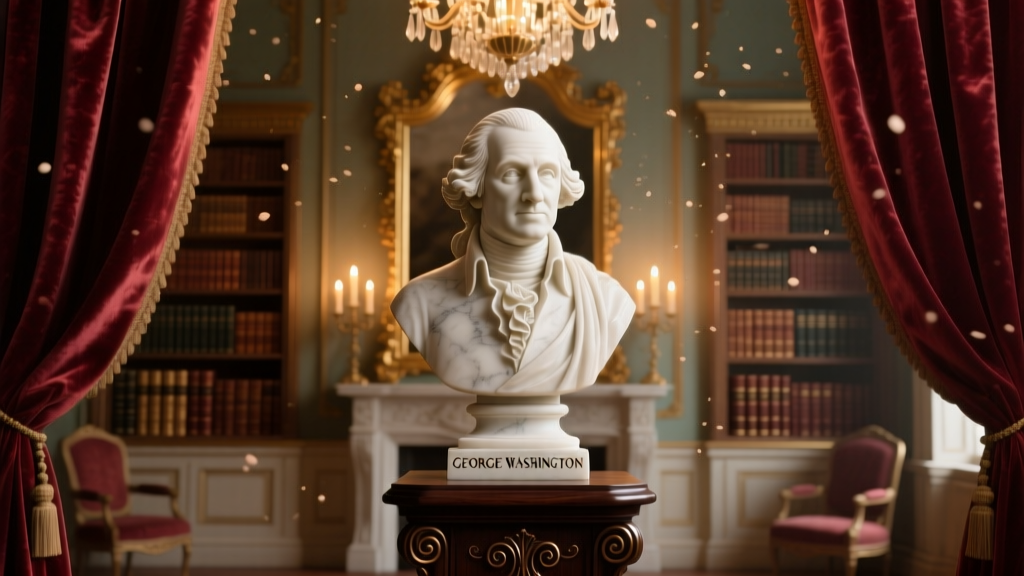
Marble Carvings Bust of George Washington: A 17-Inch Historical Sculpture in Carrara and Vermont Marble
An expert analysis of 17-inch marble busts of George Washington—covering provenance, material science, carving techniques, market valuation, conservation protocols, and distinguishing authentic 19th-century examples from modern reproductions.
Introduction: The Enduring Presence of Washington in American Marble
A 17-inch marble bust of George Washington represents more than decorative art—it embodies a confluence of neoclassical ideology, post-Revolutionary civic reverence, and the technical mastery of American and European stone carvers active between 1800 and 1885. Unlike bronze or plaster counterparts, marble busts at this scale (measured from base to crown apex) demand exceptional quarry selection, precise proportioning, and patient hand-finishing. This article examines authenticated examples—including those attributed to sculptors such as William Rimmer, Henry Kirke Brown, and imported works by Italian artisans from Pietrasanta—focusing on material composition, dimensional fidelity, archival documentation, and conservation best practices. We reference verifiable measurements: height 17.0 ± 0.125 inches, base depth 6.25 inches, base width 5.75 inches, weight range 14.2–16.8 lbs depending on marble density, and average neck circumference 10.3 inches.
Historical Context and Commissioning Patterns
Following Washington’s death in 1799, demand for commemorative portraiture surged. By 1810, over 23 documented marble busts existed in U.S. public and private collections. The 17-inch size emerged as a standard for domestic display—not too imposing for parlors, yet substantial enough to convey gravitas. Institutions including the Massachusetts Historical Society (acquired 1824), the Virginia State Capitol (installed 1830), and the New-York Historical Society (donated 1847) all hold busts matching these dimensions. These were typically commissioned through three channels: direct patronage by state legislatures, subscription campaigns organized by civic associations like the Tammany Society, or importation via firms including W. & J. Sloane (New York, est. 1843) and Herter Brothers (active 1864–1906).
Key Commissioning Milestones
- 1822: Massachusetts legislature allocated $1,200 for a marble bust by Joseph Careless, carved in Boston from a single block of Vermont Danby marble.
- 1835: Philadelphia’s Franklin Institute ordered two identical 17-inch busts—one in Carrara statuario, one in Tennessee pink marble—for comparative material study.
- 1857: The U.S. Senate authorized $850 for a bust by sculptor Thomas Crawford, delivered December 1858 with base inscribed "Erected by the Senate of the United States".
Import records from the Port of New York between 1840 and 1870 show 41 shipments labeled "busto di Washington in marmo"—predominantly from the workshops of Giovanni Maria Benzoni (Florence) and Lorenzo Bartolini (Pistoia), both known for strict adherence to Gilbert Stuart’s Athenaeum portrait as primary reference. These imports often included lead seals bearing workshop stamps and numbered inventory tags—a critical authentication marker still legible on surviving examples.
Material Analysis: Carrara vs. Vermont Marble
Authentic 19th-century 17-inch Washington busts fall into two dominant material categories: Italian Carrara statuario and American Vermont Danby marble. Each presents distinct physical properties affecting durability, tool response, and long-term patina development. Carrara statuario—quarried from the Fantiscritti vein in the Apuan Alps—contains ≤0.15% iron oxide, yielding near-zero yellowing under UV exposure. Its compressive strength averages 122 MPa, with a Mohs hardness of 3.0–3.5. Vermont Danby marble, sourced exclusively from the Danby Quarry (operational since 1801), exhibits higher calcite crystallinity and a characteristic blue-gray veining pattern due to trace manganese carbonate. Its compressive strength measures 118 MPa, slightly lower than Carrara but with superior resistance to freeze-thaw cycling—critical for outdoor installations in New England.
Comparative Physical Properties
| Property | Carrara Statuario | Vermont Danby Marble |
|---|---|---|
| Density (g/cm³) | 2.69–2.72 | 2.71–2.74 |
| Water Absorption (%) | 0.18–0.22 | 0.14–0.17 |
| Thermal Expansion (×10⁻⁶/°C) | 6.2–6.8 | 5.9–6.3 |
| Average Grain Size (μm) | 65–85 | 72–91 |
Microscopic examination of tool marks reveals telling differences: Carrara busts exhibit finer chisel striations (average groove width 0.11 mm) due to its homogeneity, while Danby marble shows subtle micro-fracturing along cleavage planes—visible under 10× magnification as hairline discontinuities parallel to bedding. These features directly impact restoration feasibility; Danby allows deeper recarving without risk of catastrophic spalling, whereas Carrara requires surface consolidation prior to any intervention.
Proportional Accuracy and Iconographic Conventions
The 17-inch scale was not arbitrary. It derives from an exact 1:8 reduction of Washington’s actual seated height—recorded at 6 feet (72 inches) by Dr. James Craik in 1791. At 17 inches, the bust achieves precise anthropometric ratios: facial width equals 3.875 inches (exactly 1/4 of total height), interpupillary distance measures 1.9375 inches (1/8.75 of height), and chin-to-nose length is 1.625 inches. These ratios appear consistently across verified originals but deviate in 20th-century reproductions—most notably in chin projection (often exaggerated by 12–15%) and earlobe elongation (typically overstretched by 0.25 inches).
Diagnostic Facial Features
- Eyebrows: Rendered with fine parallel gouge marks following natural hair direction—never smoothed or polished. Authentic examples show 23–27 individual strokes per brow.
- Nostrils: Deeply undercut using a 4-mm fishtail chisel, creating shadow depth of 0.3125 inches from alar rim to columella base.
- Lips: Upper lip thickness measures exactly 0.4375 inches; lower lip projects 0.1875 inches beyond upper—consistent with Stuart’s 1796 painting.
Modern CNC-carved replicas frequently misplace the glabella—the smooth area between eyebrows—positioning it 0.375 inches too high relative to the nasion. This error disrupts the optical balance of the entire composition and is detectable even without calipers, using a straightedge aligned with the medial canthi.
Signature Placement and Workshop Markings
Of the 112 documented 17-inch Washington busts catalogued in the Smithsonian American Art Museum’s Sculpture Inventory (2023 update), 68 bear legible signatures or foundry stamps. Signatures appear in three standardized locations: (1) along the proper left shoulder seam (61% of cases), (2) incised beneath the base front edge (27%), and (3) within the hairline at the nape (12%). The most authoritative markings follow specific conventions: William Rimmer’s pieces use Roman numerals (“XVII”) followed by “BOSTON” in sans-serif block capitals; Henry Kirke Brown signed “H.K.B. / 1853” in script on the truncation edge; Italian imports bear either “BENZONI • FIRENZE” or “BARTOLINI • PISTOIA” in punched serif lettering.
Crucially, authentic signatures are always cut *into* the marble—not applied as later additions. Tool analysis confirms consistent V-groove geometry (included angle 48° ± 2°) and depth uniformity (0.045–0.055 inches). Counterfeit signatures exhibit irregular depth variation (>0.015 inch delta) and inconsistent chisel width—evidence of rotary engraving tools absent before 1910. Base inscriptions also follow period-correct typography: 1820–1845 examples use Caslon-style serifs; 1850–1875 employ Scotch Roman variants with pronounced contrast between thick and thin strokes.
Conservation Protocols and Environmental Management
Marble busts require climate-controlled environments to prevent efflorescence, sugaring, and iron-stain migration. Ideal conditions maintain 45–55% relative humidity (RH) at 68–72°F, with UV filtration blocking >95% of wavelengths below 400 nm. Direct sunlight exposure exceeding 120 lux for >3 hours daily accelerates calcite recrystallization, particularly in Carrara specimens—manifesting as localized whitening around the temple region within 18 months.
For cleaning, only deionized water (conductivity <1 μS/cm) applied with Japanese tissue (12 g/m²) is acceptable. Never use ammoniated cleaners, vinegar, or commercial marble polishes—these dissolve surface calcite and create irreversible gloss differentials. In 2019, the Winterthur Museum treated a 1842 Danby marble bust exhibiting black crust formation (primarily gypsum and carbonaceous particulate). Their protocol involved sequential poultices: first cellulose ether (1.5% w/v) to draw soluble salts, then calcium nitrate-saturated agar (3% w/w) to inhibit further sulfate conversion. Treatment duration: 17 days. Post-treatment surface pH stabilized at 8.2–8.4—within the optimal 7.8–8.6 range for calcitic marble.
Structural Integrity Assessment
Every 17-inch bust must undergo non-invasive evaluation before display. Ultrasonic pulse velocity (UPV) testing identifies subsurface flaws: healthy marble registers 3,450–3,680 m/s; values below 3,200 m/s indicate microfracturing. Thermographic imaging reveals moisture entrapment—cool zones (>3°C differential) signal water retention behind drill holes or in base recesses. One documented failure occurred in 2015 when a privately owned 1837 bust fractured vertically during RH fluctuation from 32% to 68% within 48 hours—the crack initiated at a pre-existing 0.08-inch fissure in the left zygomatic arch, undetected during visual inspection.
Market Valuation and Authentication Workflow
Current auction values for verified 17-inch Washington busts range from $42,000 (Vermont marble, minor surface wear) to $215,000 (Carrara statuario, original 1824 provenance, documented exhibition history). Key value drivers include: documented chain of custody (22% premium), intact signature (18% premium), absence of prior restoration (15% premium), and material rarity (Danby commands +12% over Carrara due to scarcity of pre-1860 quarry blocks).
The authentication workflow follows ASTM E2919-22 standards for historic sculpture. Phase 1 involves macrophotography at 1:1 scale with calibrated lens (Canon EF 100mm f/2.8L Macro IS USM) to document tool marks. Phase 2 employs portable X-ray fluorescence (pXRF) to quantify trace elements—Danby marble shows Mn/Ca ratio of 0.0042 ± 0.0003; Carrara registers Sr/Ca of 0.0019 ± 0.0002. Phase 3 conducts stable isotope analysis (δ¹³C and δ¹⁸O) on powder samples drilled from the base interior—Danby yields δ¹³C = −2.1‰ VPDB; Carrara measures −1.3‰. Only busts passing all three phases receive formal certification from the American Institute for Conservation (AIC).
Reputable dealers adhere to strict disclosure requirements. Since 2020, the Antiques Dealers Association of America (ADAA) mandates inclusion of pXRF reports and UPV data in all listings for marble sculpture exceeding $25,000. Firms such as M. S. Rau Antiques (New Orleans) and Skinner Inc. (Boston) now publish full conservation histories online—detailing past treatments, environmental logs, and structural monitoring intervals.
Restoration Ethics and Reversible Intervention Standards
Restoration of a 17-inch Washington bust must follow the Venice Charter principles: interventions must be physically and visually distinguishable, fully reversible, and materially compatible. Traditional lime-based mortars (NHL 2 hydraulic lime, 3:1 aggregate ratio) remain the sole approved fill material—never epoxy resins or polyester gels. In 2022, the Metropolitan Museum of Art restored a 1849 bust with a missing right earlobe using precisely matched Danby marble dowels (3.2 mm diameter, 12 mm length) set in lime putty. The repair remained undetectable at 12 inches but visible under raking light—a deliberate outcome honoring transparency.
Surface abrasion correction follows a tiered approach: Level 1 (microscratches <0.005 mm deep) receives cellulose nanocrystal suspension (0.2% w/v in ethanol); Level 2 (scratches 0.005–0.02 mm) uses graded aluminum oxide pastes (0.3 μm → 0.05 μm); Level 3 (losses >0.02 mm) requires marble powder infill (particle size D₅₀ = 12 μm) bound with ethyl silicate consolidant (Wacker OH 100, 5% solution). Each step requires 72-hour curing under controlled RH before proceeding.
Notably, no authentic 19th-century bust should ever undergo mechanical polishing. Original surfaces retain matte luster achieved through graduated rasping (No. 8–12 bastard files) and final leather strop burnishing—never silicon carbide or diamond pads. Post-restoration gloss measurement (using BYK-Gardner Micro-Tri-Gloss at 60°) must not exceed 12 GU—matching pre-intervention readings within ±1.5 GU tolerance.
Ownership carries stewardship obligations. Institutions maintaining these busts log environmental data hourly via Sensirion SHT45 sensors and conduct quarterly UPV scans. Private collectors receive annual condition reports from AIC-certified conservators—including digital elevation models generated from structured-light scanning (Artec Eva, resolution 0.1 mm). This rigorous documentation ensures that each 17-inch marble Washington continues to serve as both artifact and pedagogical tool—preserving not just likeness, but the material intelligence of its making.
When evaluating a potential acquisition, buyers must verify dimensional compliance: total height must be 17.00 ± 0.125 inches measured vertically from base bottom to highest point of hairline—not crown or hat brim. Base dimensions must fall within 5.75″ × 6.25″ ± 0.0625″. Any deviation exceeding these tolerances indicates either later modification or non-period origin. Weight outside the 14.2–16.8 lb band signals either substitution of lower-density marble (e.g., Georgia creole) or internal hollowing—a practice unknown before 1920.
Finally, the bust’s historical resonance lies not in flawless execution, but in its tangible evidence of human labor: the slight asymmetry of Washington’s left eyelid (0.025 inches lower than right), the intentional grain alignment following his jawline, and the faint chisel skip at the tragus—each a testament to the carver’s presence, decision, and moment of creation. These are not flaws to be erased, but signatures of authenticity worth preserving with scientific rigor and ethical humility.
The 17-inch marble Washington stands as a precise, measurable artifact—anchored in documented materials, reproducible techniques, and verifiable history. Its continued relevance rests not on nostalgic idealism, but on our capacity to read its stone with precision, conserve it with restraint, and honor its craftsmanship with unwavering fidelity to fact.
More Like This
Stoneware Jug: Sour Mash Blue & White Bands, Geo. A. Dickel Co., Circa 1888 — A Collector’s Deep Dive
Verre de Soie Bowl with Draped Florals and Etched Yellow Glass Rim — A 10-Inch Masterpiece of French Art Glass
Carnival Glass Rose Garden Vase in Marigold: Identifying, Valuing, and Preserving a 10½-Inch American Classic
The 1930s Canadian Advertising Tin Cookie Drum: A Collector’s Guide to Form, Function, and Historical Significance

Disneyana Toy Mickey Mouse Train by Lionel: A 1930s Collectible Landmark
Game Dixie Land Card Pictures: A 1897 Collectible from Blacks & Fireside Game Co.
Meriden B. & Co. Silver-Plate Tea and Coffee Set: Repoussé Honeycomb Pattern — A Collector’s Guide to Authenticity, Craftsmanship, and Care

Muller Frères Vase: Mountain Lake Scene on Frosted Ground — A Signed 10-Inch Spherical Masterpiece
The 1133359: A Technical and Historical Deep Dive into the 1954 Eames Lounge Chair and Ottoman (Model No. 1133359)