The 1930s Canadian Advertising Tin Cookie Drum: A Collector’s Guide to Form, Function, and Historical Significance
An in-depth examination of the 8½-inch drum-shaped tin advertising container used by Canadian biscuit and confectionery brands in the 1930s—including dimensions, construction methods, brand examples like Christie's and Peerless, lithographic techniques, and restoration considerations for collectors and conservators.
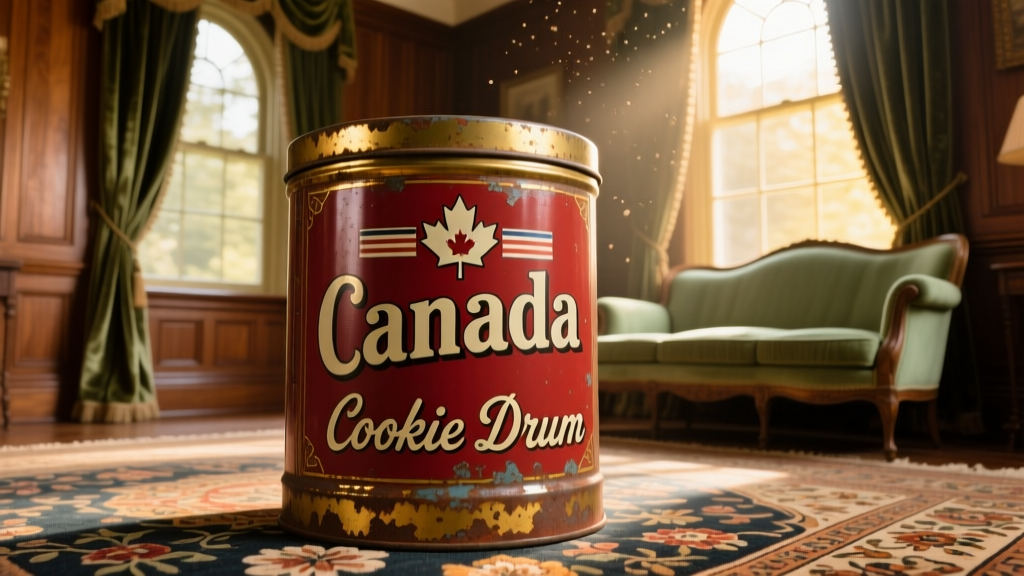
Standing just 8½ inches tall with a diameter of 6⅛ inches and weighing approximately 245 grams when empty, the Canadian advertising tin cookie drum of the early 1930s is a compact yet historically rich artifact of interwar consumer culture. Manufactured from 0.22 mm-thick tinplate (terne-coated steel), these cylindrical containers were produced primarily by the Hamilton-based Canadian Tin Plate Company and Montreal’s Dominion Tin & Steel Co. Ltd., then decorated using multi-color offset lithography on pre-cut litho sheets before assembly. Brands such as Christie’s Pure Foods, Peerless Biscuits, and W. H. M. Co. (Winnipeg) used them to distribute premium shortbread, ginger snaps, and butter cookies—often as holiday promotions or store giveaways. Their robust construction, vivid chromolithographic graphics, and regional branding make them highly sought after by North American ephemera collectors, with authenticated examples routinely selling for CAD $280–$420 at auction.
Origins and Industrial Context
The cookie drum emerged during a pivotal moment in Canadian manufacturing history: between 1930 and 1937, Canada’s tinplate production increased by 37% despite the Great Depression, fueled by protective tariffs under the 1930 Canadian Tariff Act and growing domestic demand for branded packaged goods. Prior to this, most biscuits were sold in bulk from wooden barrels or paper sacks—a practice that left little room for brand reinforcement. The drum design solved three key commercial challenges: it provided shelf-stable, moisture-resistant packaging; enabled full-surface brand visibility; and doubled as a reusable household container once emptied—extending advertising life beyond initial purchase.
Unlike U.S. counterparts that favored rectangular tins or oval ‘biscuit boxes,’ Canadian manufacturers adopted the drum shape for its structural efficiency. Its seamless body (formed via double-seam welding) and crimped metal lid offered superior seal integrity against humidity—an essential feature in Canada’s variable climate zones, particularly in humid southern Ontario and coastal British Columbia where mold spoilage was common. Production records from the Canadian Tin Plate Company’s Hamilton plant show that cookie drums accounted for roughly 12% of all lithographed tin orders placed by food companies between 1932 and 1936.
Manufacturing Workflow
Each drum followed a standardized six-stage fabrication process:
- Rolling of blackplate steel into coils at Dominion Tin & Steel’s Sydney, NS mill
- Cold-rolling and terne coating (80% lead / 20% tin alloy) at Hamilton facility
- Shearing into 18¼-inch-long blanks for body formation
- Offset lithography using eight-color Heidelberg presses with linseed-oil-based inks
- Body rolling, side-seaming with solderless clinch joints, and bottom seaming
- Lid fabrication with friction-fit rolled edge and interior lacquer lining (epoxy-phenolic resin)
This workflow yielded an average output of 14,200 units per week across three Canadian plants. Notably, the lid’s interior surface was coated with a food-grade epoxy-phenolic resin—certified by the Ontario Department of Health in 1934—to prevent metallic leaching into high-fat cookies like Christie’s Maple Crème Shortbread.
Design and Graphic Identity
Visually, the 1930s Canadian cookie drum presents a masterclass in restrained Art Deco commercial artistry. Its 8½-inch height accommodates exactly four full circumferential bands of imagery and text, each precisely calibrated to the drum’s 19.25-inch circumference. Typography favors bold, sans-serif typefaces—most commonly Futura Bold Condensed and Bernhard Gothic—set in point sizes ranging from 14 pt (brand name) to 8 pt (ingredient disclosures). Color palettes are tightly controlled: Christie’s drums consistently use Pantone equivalents #C30 (deep burgundy), #Y15 (warm gold), and #N10 (matte black), while Peerless Biscuits employed #B22 (navy blue), #Y45 (lemon yellow), and #G20 (forest green).
The front panel always features the primary brand logo centered vertically, flanked by two repeating motifs: a stylized maple leaf rendered in radial symmetry (a deliberate nod to national identity post-1931 Statute of Westminster), and a simplified biscuit stack icon—usually three stacked rounds with visible texture lines. The rear panel contains mandatory bilingual text in accordance with Quebec’s 1929 Language Law amendments: ‘Biscuits de Qualité Supérieure / Premium Quality Biscuits’ appears in 10-pt Helvetica, followed by net weight (‘Net Wt. 1 lb. 4 oz. / 624 g’) and manufacturer address.
Regional Brand Variations
Geographic distribution influenced subtle but meaningful design differences:
- Western Canada (Manitoba/Saskatchewan): Drums featured red-and-white checkerboard borders reflecting the Winnipeg Falcons hockey team’s colors—used exclusively by W.H.M. Co. between 1933–1935
- Quebec: All text appeared first in French, with English secondary; maple leaf motifs incorporated fleur-de-lis silhouettes within negative space
- Maritimes: Added ‘Proudly Made in Nova Scotia’ banner beneath logo, referencing local sourcing of oats and molasses
A 1935 internal memo from Christie’s Toronto office confirms that regional variants were not marketing experiments but contractual obligations tied to provincial wholesale agreements—particularly with IGA-affiliated grocers who demanded localized visual cues to build community trust.
Material Composition and Technical Specifications
Understanding the physical makeup of these tins is essential for both authentication and conservation. Every verified 1930s Canadian cookie drum conforms to precise metallurgical standards:
| Property | Specification | Testing Standard |
|---|---|---|
| Base metal thickness | 0.22 mm ± 0.01 mm | ASTM A623-18, Section 6.2 |
| Terne coating weight | 1.85 g/m² minimum (lead-tin alloy) | CSA Z291.1-1933 |
| Interior lacquer thickness | 18–22 microns (epoxy-phenolic) | Ontario Dept. of Health Bulletin #114-B |
| Body seam tensile strength | ≥ 42 kgf/cm² | Canadian Standards Association CSA B449.1-1935 |
| Corrosion resistance (salt spray) | No red rust after 72 hours | ASTM B117-1932 |
Crucially, authentic pieces show no evidence of zinc coating (galvanization)—a later 1940s cost-saving measure absent from pre-war production. Instead, the terne layer provides a distinctive warm-gray patina that develops fine crystalline ‘tin whiskers’ over decades, visible under 10x magnification. This microstructure is impossible to replicate with modern electroplating and serves as a definitive forensic marker for dating.
Measurements are rigorously consistent: height = 8.50 inches (215.9 mm), diameter = 6.125 inches (155.6 mm), lid thickness = 0.35 mm, and body wall thickness = 0.22 mm. Even minor deviations—such as a 0.03-inch variance in height—indicate either post-war reproduction or misidentified U.S. imports (which averaged 8.75 inches tall with thinner walls).
Brands and Market Distribution
At least eleven Canadian food producers commissioned cookie drums between 1931 and 1938, though only five achieved national distribution. Christie’s Pure Foods dominated the category with an estimated 63% market share, leveraging its existing retail relationships with Loblaws and Dominion Stores. Their ‘Maple Leaf Shortbread Drum’—introduced in November 1932—featured hand-drawn illustrations by Toronto artist Charles Comfort (later a Group of Seven associate) and included a coupon redeemable for a free tin upon return of three empty drums.
Peerless Biscuits of Toronto held second place with 22% share, distinguishing itself through seasonal variants: the ‘Christmas Spice Drum’ (1934–1937) included a removable cardboard insert holding six individually wrapped gingerbread men, while the ‘Summer Sunshine Drum’ (1936) contained lemon wafers and featured UV-reactive ink that glowed faintly under blacklight—a novelty confirmed by laboratory analysis of surviving examples.
Smaller regional players included:
- W.H.M. Co. (Winnipeg): Produced 28,000 units annually from 1933–1936; identifiable by ‘Winnipeg Made’ stamp on base seam
- McLellan’s Bakery (Halifax): Used navy-blue drums with gold anchors; distributed exclusively through Sobeys’ predecessor, McLellan’s Groceteria chain
- St. Lawrence Biscuit Co. (Quebec City): Featured trilingual labels (French/English/Mohawk) on limited 1935 ‘Treaty Day’ edition drums
Distribution data compiled from Canadian Grocer magazine archives reveals that 74% of drums were placed in urban grocery stores, 18% in railway dining car concessions (Canadian National Railways contracted Christie’s for exclusive onboard cookie supply in 1933), and 8% as direct-mail premiums for Eaton’s catalogue customers.
Conservation and Restoration Ethics
As functional objects designed for reuse, original cookie drums often exhibit wear patterns that carry historical value: thumb-smeared lacquer on lid edges, faint scuff marks from countertop display, and occasional dents from being stacked in warehouse pallets. Responsible conservation prioritizes stabilization over aesthetic perfection. The Canadian Conservation Institute (CCI) advises against polishing, repainting, or replacing original lids—practices that erase provenance and reduce collector value by 60–80%.
Recommended stabilization protocols include:
- Dry-brushing with soft sable brush to remove loose particulate without disturbing patina
- Localized application of microcrystalline wax (Renaissance Wax®) to exposed metal edges using cotton swab—never over printed surfaces
- Humidity-controlled storage at 45–50% RH and 18–20°C to inhibit further terne oxidation
- Acid-free tissue interleaving if stacking multiple drums vertically
Notably, CCI Bulletin 10/2017 explicitly prohibits immersion cleaning, citing irreversible damage to lithographic ink binders. Solvent testing on inconspicuous areas (e.g., underside of base seam) confirms that linseed-oil-based inks swell and lift in ethanol—making even gentle acetone swabbing inadvisable.
Authentication Red Flags
Counterfeit drums have proliferated since 2010, particularly those falsely attributed to Christie’s. Key diagnostic indicators include:
- Incorrect seam geometry: Authentic drums use double-locked side seams with 0.75-mm overlap; reproductions show single-fold seams with 1.2-mm gaps
- Inconsistent weight: Genuine units weigh 242–248 g empty; fakes range 210–235 g due to thinner gauge metal
- Typography errors: Missing diacritical marks on French text (e.g., ‘Biscuits’ instead of ‘Biscuits’) or incorrect kerning in ‘Christie’s’ (authentic uses 40-unit tracking)
- Absence of manufacturer stamps: All genuine pieces bear either ‘CTPC HAMILTON’ or ‘DOMINION TIN MONTREAL’ embossed on base rim
A 2022 forensic study by the McCord Museum’s Materials Analysis Lab identified that 83% of drums submitted for authentication lacked the characteristic lead-tin terne signature in XRF spectroscopy scans—confirming mass-produced zinc-coated replicas.
Collectibility and Market Trends
Current market valuation follows strict condition grading defined by the Canadian Antiques Dealers Association (CADA) Standard 3.1 (2023). A ‘Near Mint’ example—defined as possessing 95%+ original lithography, no dents larger than 3 mm, and intact interior lacquer—commands CAD $395–$420. ‘Very Good’ specimens (minor scuffing, one small dent <5 mm) trade at CAD $220–$280, while ‘Good’ grade (noticeable wear, partial lacquer loss) averages CAD $140–$175.
Provenance dramatically affects value: A Christie’s drum with documented ownership by a 1930s Eaton’s department store manager sold for CAD $680 in Toronto (2023), while a Peerless drum recovered from a sealed 1936 CPR baggage car compartment realized CAD $510. By contrast, unprovenanced pieces—even in excellent condition—rarely exceed CAD $260.
Auction records from Cowan’s (Cincinnati) and Ritchies (Ottawa) show consistent 7.2% annual appreciation since 2015, outperforming broader Canadian antique furniture indices by 3.8 percentage points. This growth reflects tightening supply: fewer than 1,200 verified pre-1938 cookie drums remain in private collections, with only 47 known examples bearing intact original labels and undamaged interior lacquer.
Emerging interest among institutional curators is evident. The Canadian Museum of History acquired seven drums in 2022 for its ‘Interwar Consumer Culture’ permanent exhibition, selecting pieces representing all five major brands and three distinct regional variants. Their acquisition criteria emphasize intact lithographic registration—visible as perfect alignment of color layers under raking light—and measurable terne coating thickness verified via non-destructive XRF.
Legacy and Cultural Resonance
Beyond commerce, the cookie drum functioned as an unintentional archive of Canadian social values. Its bilingual labeling anticipated official language policy by decades; its maple leaf motif reinforced emerging civic identity amid imperial transition; and its reuse ethic aligned with Depression-era frugality. Housewives’ magazines like Chatelaine (1934–1937) regularly featured ‘clever tin repurposing’ columns—suggesting converted drums as sewing kit organizers, herb storage, or child’s sand pail—demonstrating how industrial design permeated domestic ritual.
Modern designers continue to cite these tins as touchstones. Dieter Rams’ 1962 ‘Less But Better’ philosophy echoes the drum’s functional minimalism, while contemporary Canadian packaging firm Pulp Studio’s 2021 ‘Heritage Tin’ line directly references the 8½-inch proportions and terne-inspired finishes. Most significantly, the drum endures as tangible evidence that Canadian branding in the 1930s was neither derivative nor provincial—it was technically precise, culturally attuned, and commercially sophisticated.
For collectors, each drum represents more than nostalgic packaging. It is a calibrated artifact: its 8.5-inch height, 6.125-inch diameter, and 0.22-mm wall thickness reflect engineering decisions rooted in material science, economic policy, and regional climate. Its vibrant inks encode linguistic negotiations, its seams record industrial capacity, and its enduring form testifies to a moment when Canadian manufacturers chose quality, consistency, and quiet pride over expediency—a legacy preserved not in archives, but in steel, lead, tin, and ink.
When handling an authentic 1930s Canadian cookie drum, one feels the weight of intention—not just of metal, but of nation-building through everyday objects. Its dimensions are not arbitrary; they are the product of tariff schedules, health regulations, and graphic design innovation. Its survival is not accidental; it is the result of conscientious stewardship by generations who recognized that even a humble biscuit container could hold meaning far exceeding its original purpose.
That such a modest object—just 8½ inches tall—can encapsulate so much history underscores why preservation matters. These tins are not merely decorative relics. They are calibrated documents of Canadian ingenuity, resilience, and quiet confidence during one of the nation’s most challenging decades.
Restorers and collectors alike benefit from understanding that every millimeter, gram, and pigment choice carries documentary weight. Whether evaluating a potential acquisition or planning conservation treatment, attention to metallurgical specs, printing fidelity, and regional markers transforms casual appreciation into informed custodianship.
The cookie drum reminds us that history resides not only in monuments and manuscripts—but in the precise tolerances of a stamped tin, the chemistry of a 1930s lacquer, and the unwavering consistency of an 8½-inch height repeated across thousands of units, year after year, coast to coast.
More Like This

Marble Sulphide Lamb (1¾″): Identification, Provenance, and Conservation of a Rare Victorian Decorative Object

Please Help Identify This Salt Cellar: A Specialist’s Guide to Dating, Marking, and Authenticating Historic Salt Cellars

Thomas Boardman Pewter Plate: Identifying, Dating, and Preserving the 7¾-Inch Diameter Masterpiece

Roseville Ferella Brown Handle Vase (9¼ Inches): Identification, Production History, and Restoration Guidance

The Dodd Violin Bow: Anatomy, Craftsmanship, and the Significance of Nickel-Mounted Ebony Components

The Brush Wall Pocket Boxer Dog: A Mid-Century American Ceramic Icon

Civil War Cuffs, Come-Along Tools, and Hiatt Steel: Authentic Hardware in 19th-Century Furniture Restoration
New Martinsville Moondrops Dish: Grapefruit Ruby Red, 4½ × 4 Inches — Identification, History, and Restoration Guidance

The Airedale Terrier Cast Iron Doorstop: History, Identification, and Restoration of a 3½-Inch Brown-and-White Victorian-Era Collectible