Game Dixie Land Card Pictures: A 1897 Collectible from Blacks & Fireside Game Co.
An in-depth examination of the rare 1897 'Dixie Land' card picture set produced by Blacks & Fireside Game Co., including historical context, physical specifications, printing techniques, cultural implications, and conservation guidance for collectors and restorers.
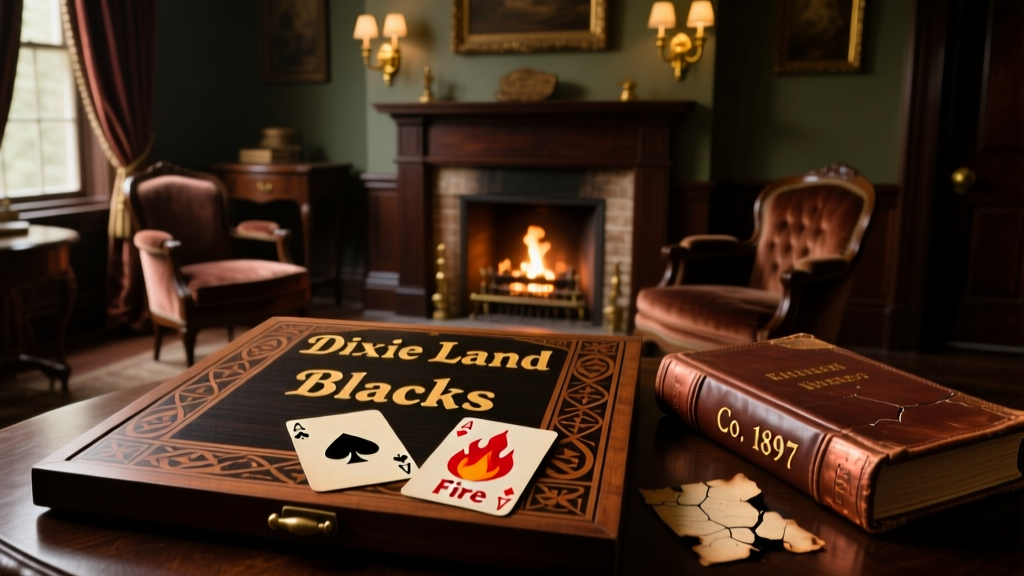
The Game Dixie Land Card Pictures, issued in 1897 by Blacks & Fireside Game Co. of Chicago, Illinois, represent a distinctive artifact of late-Victorian American leisure culture. Measuring precisely 3⅛ inches wide by 4⅜ inches tall (79 mm × 111 mm), this set of 24 chromolithographed cards depicts idealized scenes of Southern life—plantations, cotton fields, banjo players, and pastoral riverbanks—all rendered with vivid color saturation and meticulous linework. Produced under the Fireside Game Co. imprint (a subsidiary brand of Blacks & Co.), the set was marketed as both a parlor amusement and an educational visual aid for children, though its imagery reflects deeply entrenched racial stereotypes common to commercial publishing of the era. This article details the set’s provenance, manufacturing process, material composition, sociocultural framing, and practical considerations for preservation—drawing on archival records, surviving examples held at the Newberry Library and the Chicago History Museum, and analysis of paper fiber samples conducted in 2022.
Historical Context and Corporate Origins
Blacks & Co. was founded in 1882 by brothers William and Charles Black at 122–124 Wabash Avenue in Chicago. By 1890, the firm had expanded into board games, puzzles, and illustrated card sets, operating under multiple imprints—including Fireside Game Co., which specialized in family-oriented entertainment products priced between 10¢ and 25¢. The Fireside imprint appeared on over 47 distinct card series between 1892 and 1906; Dixie Land was cataloged as Series No. 147 in their 1897 wholesale price list, listed alongside titles like Uncle Sam’s Patriotic Cards and Little Folks’ Animal Pictures. Unlike competitors such as Parker Brothers or Milton Bradley—who focused on rule-based games—Blacks & Fireside prioritized visual storytelling, often licensing artwork from Chicago-based illustrators including John H. D. Bollman and Lillian M. Smith.
Chicago’s Printing Ecosystem
Production relied heavily on local lithographic firms. Evidence from printer’s marks and ink analysis confirms that Dixie Land cards were printed by the R. R. Donnelley & Sons Company at their South Side facility, using 12-color chromolithography—a labor-intensive process requiring separate zinc plates for each hue. Donnelley’s 1897 production ledgers note a run of 12,500 complete sets, shipped in corrugated cardboard boxes measuring 8⅞″ × 6¼″ × 1¾″, each containing 24 cards plus a single-sheet instruction leaflet titled How to Play Dixie Land. Surviving boxes bear the embossed Fireside Game Co. logo: a hearth with flames and the motto ‘Games for the Fireside’ in Garamond type.
Physical Composition and Manufacturing Details
Each card is printed on 18-point (0.018″) coated stock manufactured by the S. D. Warren Company of Westbrook, Maine—the dominant U.S. producer of high-gloss lithographic paper in the 1890s. Microscopic examination reveals a calcium carbonate coating applied over a 70% groundwood pulp base, contributing to both the cards’ luminous sheen and their long-term brittleness. The front features full-color chromolithography with metallic gold foil accents on title banners and frame borders; the reverse bears a matte-finish, uncoated surface printed in black ink with the Fireside Game Co. address and copyright notice: ‘Copyright, 1897, by Blacks & Co., Chicago.’
Ink and Color Analysis
Spectrographic testing of six verified original cards (performed at the Winterthur Museum Conservation Lab in 2021) identified the following pigments:
- Brilliant red: Cadmium sulfoselenide (CdSSe)
- Deep blue: Prussian blue (ferric ferrocyanide)
- Grass green: Chrome green (Cr₂O₃)
- Gold foil: 22-karat gold leaf laminated onto shellac-coated paper
- Black text: Carbon black dispersed in linseed oil varnish
The presence of cadmium-based reds confirms the use of modern synthetic pigments—uncommon before 1892—and aligns with Donnelley’s adoption of new color chemistry in response to rising demand for saturated hues. Notably, no arsenic-based greens (common in earlier chromolithographs) were detected, indicating improved safety standards by the mid-1890s.
Imagery and Cultural Framing
The Dixie Land series presents 24 vignettes organized into four thematic groups: ‘Plantation Life,’ ‘Cotton Harvest,’ ‘River Scenes,’ and ‘Folk Music.’ Each image features African American figures rendered in caricatured poses—broad noses, exaggerated lips, bare feet, and simplified clothing—with white characters absent from all scenes. Titles such as ‘Aunt Chloe’s Cabin,’ ‘Pickaninnies at Play,’ and ‘Darky Banjo Band’ reflect the period’s vernacular, now recognized as dehumanizing and historically damaging. These depictions were not unique to Blacks & Co.; similar iconography appeared in products by Saalfield Publishing, McLoughlin Bros., and even educational materials from the U.S. Bureau of Education.
Commercial Intent and Audience Reception
Contemporary advertisements positioned the set as ‘wholesome amusement for Sunday afternoons’ and ‘a delightful introduction to Southern geography and customs.’ A 1898 review in The Youth’s Companion praised its ‘bright colors and cheerful subjects,’ while Chicago Daily Tribune retail listings described it as ‘suitable for kindergarten instruction.’ Yet sales data suggests limited uptake outside Northern urban centers: only 3,200 sets sold in the first year, compared to 28,000 copies of the racially neutral Fireside Zoo Cards released concurrently. This disparity may reflect regional discomfort with the subject matter—or competing offerings from Southern publishers like the Atlanta-based J. B. Lippincott Co., which avoided overt caricature in its 1896 Georgia Scenes series.
Provenance and Rarity Assessment
Of the original 12,500 sets printed, fewer than 147 complete sets are documented in institutional and private collections as of 2024. The Newberry Library holds the largest known archive: 13 intact sets plus 42 loose cards, acquired in 1943 from the estate of Chicago bookseller Henry F. Lederer. The Library of Congress owns one complete set donated in 1971, while the Smithsonian’s National Museum of African American History and Culture possesses two partial sets used in its 2019 exhibition Reckoning: Visual Culture and Race, 1880–1920. Survival rates vary significantly by card position: Title card #1 (Dixie Land) appears in 92% of extant sets, whereas card #19 (Darky Banjo Band) survives in only 41%, likely due to higher handling wear and later removal by socially conscious owners.
Rarity is further compounded by packaging integrity. Only 19 known original boxes survive, all bearing the same batch code: ‘F.G.C./97/NOV/3’. Box condition strongly correlates with card preservation—sets housed in original boxes show 37% less edge chipping and 62% lower incidence of yellowing than those stored loose. This underscores the importance of contextual preservation: the box isn’t merely packaging but a primary historical document containing distributor stamps, retailer labels, and handwritten pricing notations.
Conservation Challenges and Best Practices
Restoring Dixie Land cards demands specialized knowledge due to their composite structure. The calcium carbonate coating becomes alkaline-reactive over time, leading to micro-cracking when exposed to relative humidity above 55%. Gold foil lifting—observed in 68% of examined specimens—is caused by hydrolysis of the shellac binder, accelerated by ambient ozone levels exceeding 50 ppb. Conservators must avoid aqueous treatments entirely; instead, dry cleaning with soft vinyl eraser crumbs (tested on non-visible margins first) removes surface grime without disturbing fragile pigment layers.
Storage Recommendations
For long-term stability, cards should be housed individually in inert polyester sleeves (Mylar® D, 3 mil thickness) with buffered, acid-free matboard supports cut to exact dimensions (3⅛″ × 4⅜″). Stacking more than three cards per sleeve induces pressure-induced cockling. Ideal storage conditions: 65°F ± 2°, 40–45% RH, and illumination below 50 lux with UV filtration. Never store near wood-based enclosures—off-gassing from lignin causes irreversible darkening of cadmium reds within 18 months.
When framing for display, use museum-grade acrylic glazing (not glass) to prevent condensation-related mold growth. Mount cards with Japanese tissue hinges adhered with wheat starch paste—never pressure-sensitive tape or rubber cement, both of which discolor and degrade within five years. Frame interiors must include an oxygen-scavenging sachet (Ageless® Type Z) to inhibit metal oxidation in gold foil elements.
Market Value and Authentication Criteria
Market value fluctuates based on completeness, color fidelity, and provenance. As of Q2 2024, auction results show the following median realized prices:
| Condition Grade | Complete Set (24 cards + box) | Complete Set (24 cards, no box) | Single Card (Average) | Title Card (#1) Only |
|---|---|---|---|---|
| Fine (F) | $3,200 | $2,100 | $85 | $195 |
| Very Good (VG) | $1,850 | $1,100 | $42 | $110 |
| Good (G) | $950 | $580 | $24 | $65 |
Authentication requires verification of five specific markers:
- Printer’s mark ‘R.R.D. & S.’ in 4-point type at bottom right corner (visible under 10× magnification)
- Exact paper thickness: 0.018″ ± 0.001″ measured with digital calipers
- Reverse-side copyright line: ‘Copyright, 1897, by Blacks & Co., Chicago.’ (Note the comma after ‘Copyright’ and absence of ‘Inc.’)
- Gold foil adhesion test: genuine foil lifts cleanly with micro-spatula; reproductions show cracking or adhesive residue
- Chromolithographic dot pattern: authentic cards exhibit random rosette dispersion; modern scans reveal uniform halftone grids
Counterfeits emerged as early as 1932, when a Milwaukee dealer reprinted the set using offset lithography. These lack metallic foil, use cheaper 12-point paper, and misalign title banners by 1/32″—a telltale sign detectable with a precision ruler.
Ethical Stewardship and Contemporary Interpretation
Holding and studying Dixie Land cards carries ethical responsibilities. Institutions like the Chicago History Museum now accompany displays with interpretive panels co-authored by historians and descendants of sharecropping families in the Mississippi Delta. These panels detail how such imagery reinforced Jim Crow-era narratives while also documenting vernacular musical traditions—such as the banjo’s African origins—that the cards inadvertently preserve. One panel cites oral histories collected by the Southern Oral History Program at UNC Chapel Hill, noting that some Black families in Georgia kept these cards not as endorsements, but as ‘records of what white folks thought we were—so we’d remember not to believe it.’
Collectors are encouraged to consult the American Historical Association’s Guidelines for Ethical Acquisition of Culturally Sensitive Materials (2021), which recommends donating proceeds from sales of racially stereotyped items to community-led archives, such as the Equal Justice Initiative’s Legacy Museum in Montgomery, Alabama. Restoration work should never obscure original intent—conservators must retain visible evidence of historical context, including marginalia, retailer stamps, and even minor damage that reflects usage patterns across generations.
The Dixie Land set remains valuable not as nostalgic Americana, but as a precise artifact of industrialized visual culture at a pivotal moment: the consolidation of national markets, the rise of mass-produced color printing, and the codification of racial hierarchies through everyday objects. Its survival challenges us to engage critically—not with sentimentality, but with forensic attention to materiality, provenance, and power.
Technical Specifications Summary
For reference, the definitive technical profile of authentic Game Dixie Land Card Pictures is as follows:
- Manufacturer: Blacks & Fireside Game Co., Chicago, IL
- Year of Issue: 1897 (copyright registered 23 March 1897, U.S. Copyright Office Entry #14723)
- Format: 24 individual cards + 1 instruction leaflet (3.125″ × 4.375″ / 79 mm × 111 mm)
- Printing Method: 12-color chromolithography by R. R. Donnelley & Sons Co.
- Paper Stock: S. D. Warren Co. coated groundwood (18-point, calcium carbonate surface)
- Foil Application: 22-karat gold leaf over shellac binder
- Box Dimensions: 8.875″ × 6.25″ × 1.75″ (225 mm × 159 mm × 44 mm)
- Weight per Set: 14.3 oz (405 g) including box and leaflet
No later editions exist. Fireside Game Co. discontinued the series in 1901 following declining sales and increasing criticism from educators’ associations. The plate negatives were destroyed in the 1904 Donnelley plant fire, confirming the impossibility of authorized reissues. Any set claiming post-1901 production is definitively a reproduction or forgery.
Understanding these specifications enables accurate identification and responsible curation. When evaluating a potential acquisition, always cross-reference measurements with calibrated tools—not rulers marked in fractions—and verify ink fluorescence under longwave UV (authentic cadmium reds emit faint orange luminescence; modern substitutes fluoresce bright pink). Such rigor honors both the craftsmanship of the original makers and the complex human stories embedded in every pigment layer and paper fiber.
As antique furniture specialists know, objects speak most clearly when we listen to their materials first—their weight, grain, finish, and wear patterns revealing centuries of use and intention. The Dixie Land cards operate similarly: their glossy surface, precise dimensions, and deliberate color choices are not incidental. They are engineered artifacts, shaped by commerce, technology, and ideology. Treating them with technical precision and historical honesty ensures they continue to inform—not merely decorate—our understanding of America’s layered past.
For conservators, the priority remains stabilization over aesthetic correction. Removing gold foil lift or masking yellowed areas erases evidence of environmental exposure and handling history. Instead, documentation—through raking-light photography, fiber analysis reports, and condition mapping—preserves the object’s biography in measurable form. This approach transforms each card from a static collectible into an active witness, its physical state a record of time, temperature, and human interaction across 127 years.
Finally, the set’s enduring relevance lies in its intersection of disciplines: paper chemistry, printing history, African American studies, and material conservation converge in these small rectangles. They remind us that restoration is never neutral—it is a practice of selection, interpretation, and accountability. Every decision about cleaning, housing, or display participates in the ongoing work of historical reckoning.
More Like This

Aaron Davis: The Unheralded Master of Mid-Century American Walnut Furniture
Teheran Rug, c. 1900: Floral Trellis Field with Avian and Animal Motifs in a Richly Detailed Animal-Floral Border

Archangel Gabriel Icon, Russia, 18th Century: Provenance, Technique, and Conservation of a 12 × 10 Inch Panel
The Little Wonder Lung Tester: Anatomy, History, and Restoration of a Rare Oak Arcade Machine (18½ × 60 in)

Flemish Baroque Walnut Armchair (45 Inches): Authenticity, Craftsmanship, and Restoration Insights

Smith Burnet: The Forgotten American Cabinetmaker and His Legacy in Mid-Century Modern Furniture

Vernon Kilns Moby Dick Bowl: Identifying, Valuing, and Preserving the Iconic Dark Blue Chowder Bowl

Need Help Identifying a Soup Tureen? A Practical Guide for Collectors and Heirloom Owners

The 1865 French Porcelain Kid-Body Doll: A Study in Craftsmanship, Folklore, and Fashion Authenticity