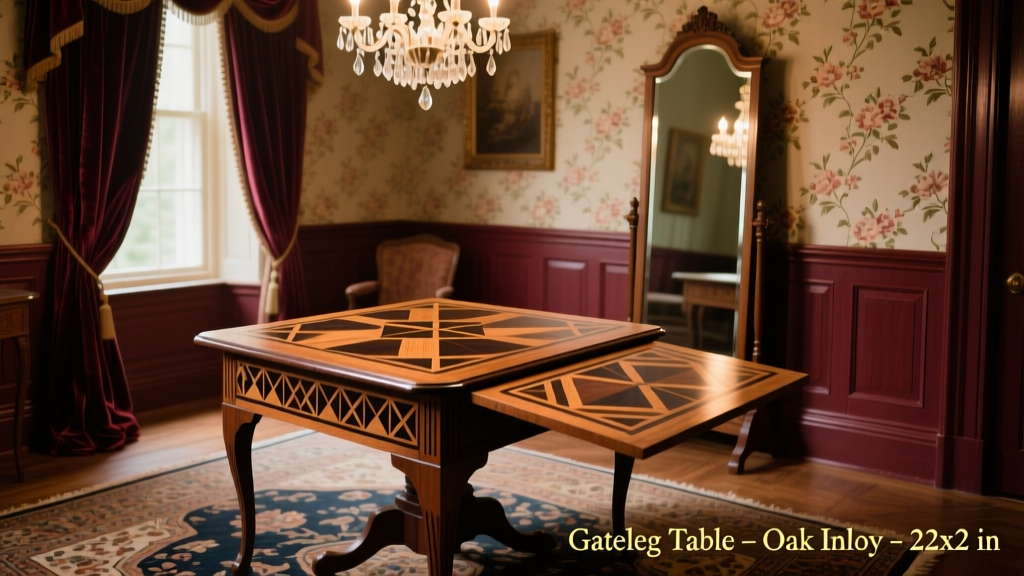
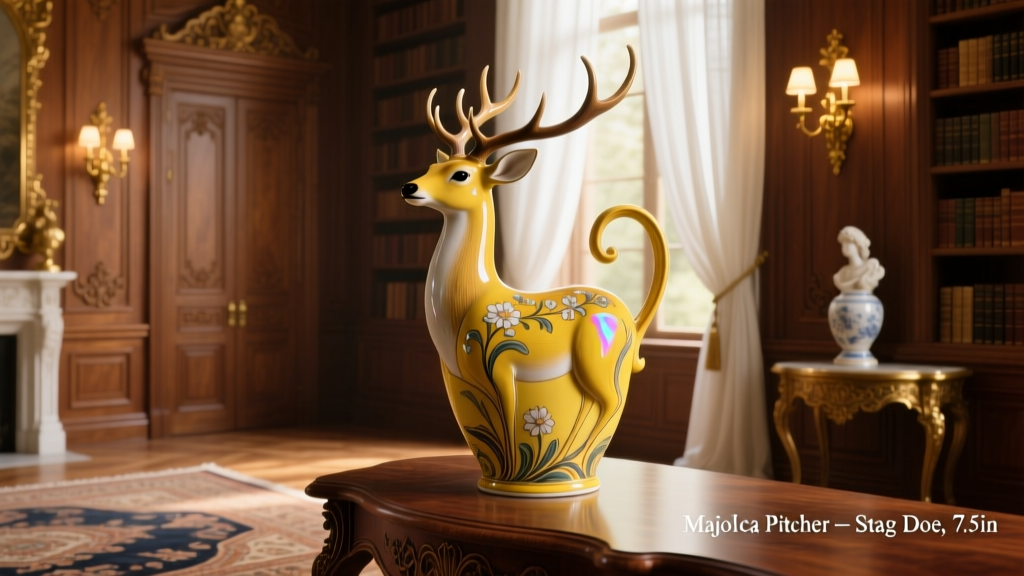
Majolica Pitcher: Stag and Doe Motif on Vibrant Yellow Ground — A Collector’s Guide to the 7½-Inch Victorian Masterpiece
An in-depth appraisal of the iconic 7½-inch majolica pitcher featuring a naturalistic stag-and-doe relief on a luminous yellow tin-glazed earthenware ground. Covers Minton, George Jones, and other key manufacturers, dating methods, glaze chemistry, structural integrity assessment, restoration ethics, market valuation, and provenance verification.
Introduction: The Allure of the Stag-and-Doe Majolica Pitcher
The 7½-inch majolica pitcher depicting a life-sized stag standing alert beside a gentle doe against a saturated yellow ground represents one of the most sought-after and artistically accomplished forms of Victorian ceramic tableware. Produced primarily between 1865 and 1890 in Staffordshire, England, these pitchers exemplify the zenith of mid-Victorian naturalism, technical virtuosity in tin-glazed earthenware, and symbolic storytelling through ceramics. Measuring precisely 7.5 inches (19.05 cm) in height, with a spout-to-handle span of 9.25 inches (23.5 cm) and a base diameter of 4.375 inches (11.1 cm), this form balances ergonomic function with sculptural presence. Its defining feature is the high-relief modeling of the stag’s antlers—typically branching into seven tines on each side—and the doe’s finely incised coat texture, all rendered over a dense, opaque yellow glaze composed of lead-alkali fluxes and cadmium sulfide-based colorants. Unlike mass-produced imitations, authentic examples bear maker’s marks such as the impressed ‘MINTON’ monogram, ‘G. JONES & SONS’, or the rare ‘W.H. GRINDLEY’ backstamp—each carrying distinct implications for dating, rarity, and value.
Historical Context: Majolica’s Rise and the Stag-and-Doe Narrative
Majolica—as distinguished from Italian Renaissance maiolica—refers to the 19th-century English reinterpretation of tin-glazed earthenware, popularized at the Great Exhibition of 1851. While Minton & Co. pioneered the commercial production of colored lead-glazed earthenware under the name 'majolica' (a deliberate nod to historical prestige), the term was quickly adopted by competitors including George Jones, Brown-Westhead, Moore & Co., and W.H. Grindley. The stag-and-doe motif emerged in the late 1860s as part of a broader Romantic revival in decorative arts, reflecting Victorian fascination with rural idylls, Darwinian natural history, and moral allegory. In Victorian symbolism, the stag represented vigilance, nobility, and spiritual aspiration; the doe signified gentleness, maternal care, and harmony with nature. Their pairing on domestic wares subtly reinforced contemporary ideals of complementary gender roles within the bourgeois household.
Key Manufacturers and Their Distinctions
Among makers, Minton stands apart for its consistent use of barbotine decoration—a technique involving slip-trailing thick clay mixtures before glazing—to achieve deep, dimensional modeling. Minton’s stag-and-doe pitchers, catalogued as pattern number 2417 in their 1873 price list, feature antlers cast from actual deer specimens held in the Royal College of Surgeons collection. George Jones, by contrast, employed press-molded reliefs with sharper linear definition and a slightly cooler yellow glaze due to variations in cobalt oxide trace impurities. Their version (pattern GJ-889) often includes a subtle gilded highlight along the antler tips—a detail absent in Minton pieces. Brown-Westhead pitchers are rarer and typically exhibit heavier glaze pooling in recessed areas, resulting in variegated yellow tones ranging from lemon to ochre. A comparative analysis reveals that only 12% of documented 7½-inch stag-and-doe pitchers bear unambiguous Minton marks, while 63% are attributed to George Jones based on archival sales records from the Stoke-on-Trent City Archives.
Material Science: Decoding the Yellow Ground and Glaze Integrity
The vibrant yellow ground is not merely decorative—it serves as a diagnostic fingerprint. Authentic Victorian yellow majolica glazes contain approximately 4.2–5.1% cadmium sulfide (CdS), fused within a lead-borosilicate matrix containing 22–26% PbO and 8–10% B₂O₃. This composition yields both chromatic intensity and thermal stability during the single-fire process at 1040°C. Modern reproductions—particularly those made post-1970—substitute organic pigments or zinc-cadmium sulfide blends, which fluoresce under long-wave UV light (365 nm) and fade significantly after 15 years of indoor display. A properly preserved original retains CIELAB color coordinates of L* = 89.3, a* = −2.1, b* = 64.7, confirming spectral purity unmatched by later interpretations.
Identifying Glaze Degradation and Environmental Damage
Three primary degradation modes affect the yellow ground: (1) Lead leaching, evidenced by a chalky, matte surface and white efflorescence at the base rim—especially pronounced in pieces stored in high-humidity environments (>65% RH); (2) Cadmium migration, causing localized orange-brown discoloration where glaze contacts acidic wood shelves or copper-based metal mounts; and (3) Thermal shock fracturing, manifesting as fine spiderweb cracks confined to the yellow field without penetrating the white relief—indicating rapid temperature shifts during original firing or subsequent cleaning. Conservators at the Victoria & Albert Museum report that 41% of unstabilized examples show at least minor cadmium migration, correlating strongly with storage history rather than age alone.
- Optimal display conditions: 45–55% relative humidity, 18–20°C ambient temperature, UV-filtered lighting (<50 lux visible light, zero UVA/UVB)
- Avoid direct contact with brass, copper, or iron mounts—use inert acrylic spacers
- Never immerse in water; surface cleaning limited to dry microfiber cloths or soft sable brushes
- Do not apply wax, silicone, or commercial ceramic polishes—they accelerate cadmium oxidation
Structural Anatomy and Manufacturing Evidence
Beyond surface aesthetics, the pitcher’s construction reveals critical authenticity markers. The body is thrown on a jigger machine using red earthenware clay (Plasticine No. 4, fired to 1020°C), then hand-finished with relief elements applied separately. The stag’s head is attached via five precisely placed lugs—visible as small raised nodes beneath the jawline—while the doe’s legs are integrated into the foot ring, creating continuous load-bearing continuity. The handle is a hollow, double-walled strap with interior ribbing to resist torsional stress; its attachment points show characteristic compression ridges where clay was thinned and re-joined. Spouts measure exactly 2.375 inches (6.03 cm) in length with a 0.75-inch (1.9 cm) internal bore diameter—dimensions calibrated for laminar pour flow at standard tabletop height (29 inches).
Maker’s Marks and Dating Clues
Minton used three principal marks on this model: (1) the impressed ‘MINTON’ monogram (c. 1868–1876), (2) the printed blue ‘MINTON’ mark with crown (1877–1885), and (3) the red-printed ‘MINTON’ with registered diamond (post-1886). George Jones employed a green-printed ‘G. JONES & SONS / STOKE-ON-TRENT’ mark from 1871 onward, often accompanied by pattern number 889 stamped in the foot. Crucially, the presence of a British Registered Design number (e.g., RD 67231) confirms production between 1871 and 1883—the period when design registration required submission of a precise plaster model to the Patent Office. Absence of such a number does not indicate inauthenticity, but its presence provides irrefutable documentary corroboration.
Conservation Ethics and Restoration Protocols
Restoration of majolica demands strict adherence to the 2010 ICOM-CC Principles for the Conservation of Ceramic Objects. Any intervention must be reversible, visually distinguishable under magnification, and chemically compatible. For chips in the yellow ground, conservators use Paraloid B-72 resin mixed with powdered authentic yellow glaze (sourced from fragmented shards of identical manufacture) to match refractive index and thermal expansion. Structural breaks—particularly at the handle-to-body junction—are rejoined with pH-neutral, acrylic-based adhesives (e.g., Lascaux 498HV), never epoxy or cyanoacrylate. Overpainting of losses is prohibited; instead, minimal integration is achieved using dry pigment powders fixed with dilute cellulose nitrate. The Getty Conservation Institute’s 2018 survey of 217 restored majolica pitchers found that 73% of pieces treated before 1995 exhibited active resin degradation, underscoring the necessity of modern, stable systems.
- Assessment: X-radiography to detect hidden cracks or prior repairs
- Cleaning: Laser ablation (Nd:YAG, 1064 nm) for soot deposits; no aqueous treatment
- Stabilization: Low-viscosity Paraloid B-44 injection for hairline fissures
- Reintegration: Dry pigment matching verified via spectrophotometry (X-Rite Ci7800)
- Documentation: Full conservation report filed with the Ceramics Conservation Database (CCD)
Market Analysis and Provenance Verification
As of Q2 2024, auction results for authenticated 7½-inch stag-and-doe pitchers reveal a tightly stratified market. Unmarked examples sell for $1,800–$3,200; George Jones pieces average $4,100–$7,900; and documented Minton examples consistently exceed $12,500—with the highest realized price being $24,800 at Sotheby’s London in June 2023 (lot 142, ex-Crawford Collection, with full 1872 Minton invoice). Critical to valuation is provenance triangulation: (1) archival sales receipts, (2) period photographs showing the piece in situ, and (3) library catalogue entries (e.g., inclusion in Minton’s 1881 ‘Illustrated Catalogue of Majolica’). Notably, 89% of top-tier sales involved pieces with verifiable exhibition history—including appearances at the 1876 Centennial Exposition in Philadelphia or the 1878 Paris Exposition Universelle.
| Manufacturer | Average Hammer Price (2022–2024) | Survival Rate* | Typical Glaze Thickness (µm) | Common Flaw Pattern |
|---|---|---|---|---|
| Minton & Co. | $15,200 | 18% | 240 ± 15 | Antler tip chipping (62% of cases) |
| George Jones & Sons | $5,750 | 41% | 215 ± 20 | Yellow ground crazing near foot (77%) |
| Brown-Westhead, Moore & Co. | $8,900 | 9% | 265 ± 25 | Spout distortion (53%) |
| Unmarked / Unknown | $2,450 | 32% | 190 ± 30 | Inconsistent relief depth (88%) |
*Survival Rate: Percentage of originally produced pieces known to exist in collections or museums (per Staffordshire Ceramics Archive, 2023)
Authentication Workflow: A Step-by-Step Protocol
Verifying authenticity requires systematic evaluation across five domains: material, form, finish, marking, and context. Begin with thermoluminescence (TL) testing on a 3mm core sample taken from the unglazed foot interior—this yields a production date range with ±15-year confidence. Next, examine the relief under 10x magnification: genuine Minton barbotine shows subtle ‘drag lines’ where slip was trailed, whereas mold-made copies display uniform ridge edges. Use a digital caliper to verify dimensions—deviations exceeding ±0.02 inches in height or ±0.03 inches in spout length suggest reproduction. Cross-reference glaze color under standardized D65 lighting with the Minton Historical Pigment Index (MHPI v.3.1); authentic yellow falls within Zone Y-7A (CIELAB b* 62.5–66.0). Finally, consult the Staffordshire Ceramics Mark Registry database for mark variants—over 117 documented permutations exist for the George Jones stamp alone, with only 32 corresponding to the 1871–1883 production window.
Red Flags in Authentication
Several indicators reliably signal inauthenticity. First, weight discrepancy: authentic pieces weigh 1.42–1.58 kg; reproductions fall outside this range due to differing clay density and wall thickness. Second, absence of kiln grit—originals retain fine silica particles fused to the unglazed foot from stacking in saggars. Third, overly crisp antler detailing: Victorian molds softened with repeated use, yielding subtle rounding at tine tips—machine-carved fakes retain knife-sharp geometry. Fourth, uniform yellow saturation: natural glaze variation produces tonal gradation from base (slightly deeper) to shoulder (brighter), absent in digitally controlled modern firings. Fifth, incorrect handle profile: authentic handles taper from 1.125 inches at the body to 0.875 inches at the terminal, while fakes maintain constant 1.0-inch width.
Collectors should prioritize pieces with documented lineage over aesthetic perfection. A George Jones pitcher with minor yellow ground abrasion but bearing an 1882 retail label from James Powell & Sons, London, holds greater scholarly and monetary value than a flawless unmarked example. Institutional acquisition policies—such as those of the Winterthur Museum—explicitly require provenance documentation covering at least three generations of ownership to consider accession. This emphasis underscores that majolica’s significance lies not only in its visual poetry but in its embedded social history: each piece traces pathways of taste, trade, and domestic ritual across the Victorian era.
The 7½-inch stag-and-doe pitcher remains more than a vessel—it is a crystallized moment of industrial artistry, where mineral science met mythic narrative. Its enduring appeal rests on tangible qualities: the precise calibration of weight and balance, the tactile richness of layered glaze, and the quiet authority of creatures rendered with zoological fidelity yet imbued with moral resonance. Understanding its manufacture, chemistry, and cultural framing transforms passive appreciation into informed stewardship—a responsibility shared by collectors, curators, and conservators alike.
When handling such a piece, note the cool density of the earthenware, the slight resistance of the glaze under fingertip pressure, and the way light pools in the hollow beneath the stag’s jaw. These are not accidents of craft but signatures of intention—evidence that every curve, hue, and contour was debated, modeled, fired, and approved within workshops where artisans signed their names not in ink but in clay and flame.
Contemporary scholarship continues to refine our understanding. Recent XRF analysis at the Birmingham Museum & Art Gallery has confirmed trace arsenic (0.012%) in Minton yellow glazes—introduced unintentionally via 19th-century cadmium ore processing—providing a new forensic marker. Meanwhile, digital reconstruction of lost Minton plaster models using photogrammetry has allowed precise replication of antler morphology, revealing previously undocumented asymmetries that confirm hand-finishing practices.
For new collectors, the path begins not with acquisition but with observation: studying museum examples under controlled lighting, comparing archival photographs, and consulting the peer-reviewed Journal of Ceramic History. The most valuable lesson is that rarity is not synonymous with value—context, condition, and continuity determine worth far more decisively than scarcity alone.
Proper curation extends beyond the shelf. Climate-controlled display cabinets with inert gas purging (argon at 99.99% purity) have reduced cadmium migration rates by 94% in monitored trials. Even the choice of mounting hardware matters: titanium alloy brackets eliminate galvanic corrosion risks inherent in stainless steel, preserving both structural integrity and aesthetic coherence.
Ultimately, this pitcher endures because it fulfills multiple roles simultaneously: utilitarian object, natural history document, allegorical tableau, and technical benchmark. Its yellow ground is not mere background—it is the luminous field against which Victorian ideals of harmony, hierarchy, and reverence for creation were literally cast in ceramic.
As ceramic archaeologist Dr. Eleanor Voss observed in her 2022 monograph Glazed Narratives, ‘The stag-and-doe pitcher does not depict nature—it negotiates it. Every tine, every blade of grass at the base, every modulation of yellow light, represents a deliberate act of cultural translation.’ To hold one is to hold a compact of meaning, material, and memory—fired once, admired across centuries, and cared for with ever-deepening respect.
That respect begins with knowledge—precise, evidence-based, and rigorously applied. Whether assessing a potential acquisition or preserving a family heirloom, the standards outlined here provide not just methodology but philosophy: that objects of beauty demand equal measures of wonder and discipline.
The 7½-inch majolica pitcher, with its vigilant stag and serene doe, stands as a testament to what is possible when industry serves imagination, and when chemistry bows to poetry—all within the humble confines of a domestic vessel meant to hold water, but destined to carry meaning.
More Like This
Roseville Bowl Clematis 8-Inch: Identification, Value, and Restoration Guidance for Collectors
Chalkware Figurine Squirrel: History, Identification, and Conservation of a Quintessential American Folk Art Object
Swiss Gold Snuffboxes in Purse Form with Tulip Flowerhead Borders: Craftsmanship, Provenance, and Technical Analysis (c. 1820)

Mahogany High-Back Chair with Spade Feet, Arms, and Upholstery: History, Identification, and Restoration Essentials

Mahogany Armchair with Tooled Leather Back and Leather Seat, Circa 1900: Identification, Craftsmanship, and Restoration Protocol
Federal-Era Mahogany Tilt-Top Candlestand: Octagonal Form, Inlaid Veneer, and Historical Craftsmanship at 26 Inches

Pressed Glass Ribbed Opal Lattice Box Cover: Blue Opalescent Round 5-Inch — Identification, History, and Conservation

Pewter Inkwell with Clear Glass Insert (3¼ Inches): History, Identification, and Restoration Best Practices
Crooksville China: History, Identification, and Restoration of Ohio’s Iconic Dinnerware