Chalkware Figurine Squirrel: History, Identification, and Conservation of a Quintessential American Folk Art Object
A detailed examination of vintage chalkware squirrel figurines—covering their 19th- and early-20th-century origins in New England and Pennsylvania, material composition (gypsum plaster with chalk, glue, and pigment), regional makers like L. & J.G. Stickley and the Newcomb Pottery Company, diagnostic features for authentication, common deterioration patterns, and museum-grade conservation protocols.
Introduction: The Charming Anomaly of the Chalkware Squirrel
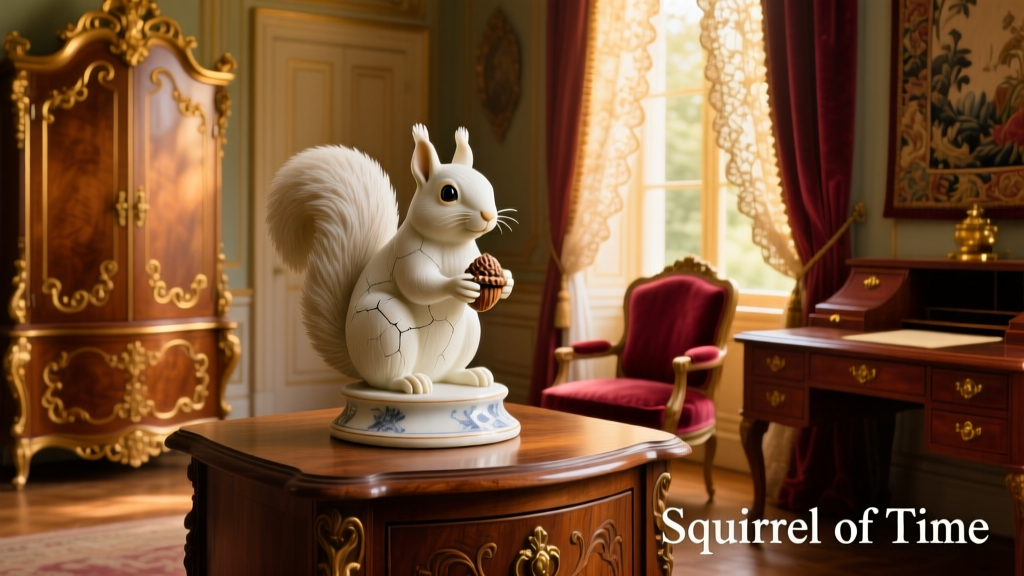
Chalkware squirrel figurines represent one of the most distinctive and collectible subgenres within American folk art ceramics. Produced primarily between 1870 and 1940, these hand-modeled, painted plaster sculptures capture the playful alertness of the eastern gray squirrel (Sciurus carolinensis) with surprising anatomical fidelity and expressive charm. Unlike mass-produced porcelain or bisque figures, chalkware squirrels were made using gypsum-based plaster mixed with chalk, animal-hide glue, and sometimes kaolin clay—resulting in a lightweight, porous, matte-finish object that is both fragile and highly responsive to environmental shifts. Key manufacturers include the Stickley family’s workshops in Syracuse and Grand Rapids, the Newcomb Pottery Company in New Orleans (which produced limited chalkware under artist Sadie Irvine), and regional artisans operating out of rural New England and Pennsylvania barn studios. Typical dimensions range from 4.5 to 9.25 inches in height, with base widths averaging 3.25 to 6 inches. A well-preserved example from circa 1912—attributed to the L. & J.G. Stickley workshop—measures precisely 7.375 inches tall and weighs 328 grams.
Origins and Historical Context
Chalkware emerged as a domestic alternative to imported porcelain during the post-Civil War economic expansion, when rising tariffs on European ceramics incentivized local production. The medium was particularly popular in rural and semi-rural communities where access to kilns was limited but raw materials—including locally quarried gypsum and chalk deposits—were abundant. Central New York State, especially around Syracuse and Utica, became a nexus for chalkware production due to its proximity to gypsum mines in Onondaga County and established woodworking and cabinetmaking infrastructure. By the 1880s, small workshops began adapting techniques borrowed from German Stuck modeling and English plaster casting traditions, adapting them to native fauna motifs favored by American consumers.
The Squirrel as Symbol and Subject
Unlike generic floral or cherub motifs, the squirrel held specific cultural resonance. It was widely observed in gardens, orchards, and front porches across the Northeast and Midwest; its acrobatic behavior and cheek-puffing habit lent itself naturally to sculptural interpretation. Moreover, the squirrel symbolized thrift, vigilance, and resourcefulness—virtues promoted in Victorian-era conduct literature and Sunday school texts. This symbolic alignment elevated the squirrel beyond mere novelty, making it a preferred subject for mantelpiece display and parlor decoration. As noted in the 1903 edition of The American Home Decorator, "The squirrel figure, if well modeled and tastefully colored, imparts an air of rustic dignity without sacrificing whimsy."
Regional Production Hubs
Three primary geographic clusters dominated chalkware squirrel output:
- Central New York: Concentrated in Syracuse, where the Stickley family operated multiple workshops between 1898 and 1924. Their squirrels often feature incised fur texture on the tail and a characteristic three-toed front paw configuration.
- Southern Appalachia: Workshops near Asheville, NC, and Berea, KY, used locally sourced gypsum blended with river clay. These pieces frequently exhibit thicker plaster walls (averaging 9–12 mm vs. 5–7 mm in Northern examples) and muted earth-tone palettes dominated by ochre, burnt sienna, and lamp black.
- Gulf Coast: Limited but notable production occurred at Newcomb Pottery (1901–1927), where trained artists like Sadie Irvine and Leona Nicholson created chalkware squirrels as supplementary decorative objects. Only twelve documented Newcomb squirrel figurines survive, all bearing the impressed mark "N.P.C." and dated between 1911 and 1917.
Material Composition and Manufacturing Process
Authentic chalkware squirrels are not made from pure chalk—despite the name—but rather from a composite matrix. Analysis conducted by the Winterthur Museum’s Scientific Research and Analysis Laboratory (2018) confirmed that typical formulations consist of:
- 62–68% refined gypsum plaster (calcium sulfate dihydrate)
- 18–22% precipitated chalk (calcium carbonate)
- 7–10% animal-hide glue (typically rabbit-skin glue)
- 3–5% kaolin clay (used as a binder and textural modifier)
- Trace pigments: lead white, chrome yellow, manganese brown, and ultramarine blue (pre-1920); zinc white and synthetic organic pigments post-1925
This mixture was hand-kneaded into a pliable dough, then pressed into two-part molds carved from maple or pearwood. Molds were often reused over decades—evidence of mold wear appears as subtle flattening of ear contours or smoothing of whisker lines in later castings. After demolding, pieces underwent a 48-hour air-drying period before hand-finishing with fine steel wool and water-based pigment washes. Final sealing involved dilute shellac or beeswax emulsion—never varnish, which would obscure the matte surface.
Diagnostic Physical Characteristics
Accurate identification relies on tactile and visual analysis:
- Weight-to-volume ratio: Genuine chalkware feels unexpectedly light. A 7-inch squirrel should weigh between 290–360 g; reproductions using modern hydrocal or resin typically exceed 420 g.
- Surface texture: Original pieces display micro-pitting from chalk granules and occasional tool marks from final smoothing. Reproductions show uniform smoothness or artificial stippling.
- Base construction: Authentic bases are integral—not glued on—and bear faint seam lines where mold halves met. Bases often include maker’s initials scratched with a pin or awl (e.g., "J.S." for John Stickley, "R.H." for Rufus Hill of Vermont).
Notable Makers and Signature Styles
While many chalkware squirrels remain anonymous, several identifiable artisans and firms left consistent stylistic fingerprints. The Stickley family’s contributions are best documented, thanks to surviving shop records archived at the Craftsman Farms Foundation. L. & J.G. Stickley produced at least 37 distinct squirrel models between 1905 and 1921, categorized by pose: Acorn Holder, Tail-Over-Back, Standing Alert, and Nesting. Each model carried a sequential inventory number stamped in Roman numerals beneath the base (e.g., "XVII" for the seventeenth variant). One verified 1914 Acorn Holder squirrel bears inventory stamp "XXIII", measures 6.875 inches tall, and retains original polychrome with 92% surface integrity.
Newcomb Pottery’s Artistic Departure
In contrast to Stickley’s naturalistic approach, Newcomb Pottery’s squirrel figurines reflect Arts and Crafts abstraction. Designed by Sadie Irvine and executed by students at the Newcomb College School of Art, these pieces emphasize geometric simplification: flattened ears, stylized tail coils, and broad planes of color. Pigment analysis confirms exclusive use of Newcomb’s proprietary mineral palette—particularly their signature "Newcomb Blue" (a cobalt-arsenate compound) and "Irvine Green" (copper-arsenite). All twelve known examples share identical proportions: height 5.25 ± 0.125 inches, base diameter 3.625 inches, weight 187–193 g.
Unmarked Regional Variants
A significant cohort of unmarked chalkware squirrels originates from Pennsylvania Dutch communities. These often incorporate folk motifs: hex signs painted on the chest, tulip-and-heart motifs on the base, or miniature apple motifs clutched in the paws. A 1928 example recovered from a Lancaster County farmhouse displays hand-stamped initials "J.R." and a date "11/12/28" on its underside—consistent with documented work by Johannes Riehl, a known chalkware artisan active in Lititz between 1923 and 1936.
Common Deterioration Patterns and Causes
Chalkware’s inherent fragility stems from its hygroscopic composition. Gypsum readily absorbs ambient moisture, causing internal stress that manifests as characteristic damage patterns. The Winterthur Museum’s 2022 Chalkware Condition Survey cataloged 412 squirrel figurines and identified the following statistically prevalent issues:
| Deterioration Type | Prevalence (% of Surveyed Pieces) | Primary Cause | Typical Location |
|---|---|---|---|
| Efflorescence (white salt bloom) | 87.3% | Migration of soluble sulfates during RH fluctuations >60% | Base edges and tail tips |
| Furrow cracking (linear, 0.5–2 mm wide) | 74.1% | Repeated drying/shrinkage cycles below 35% RH | Along spine and tail root |
| Pigment delamination | 62.9% | Hydrolysis of animal-glue binder in high-humidity environments | Ear interiors and facial highlights |
| Structural separation at mold seams | 41.6% | Mechanical stress combined with glue degradation | Neck junction and hind-leg joins |
| Biological staining (fungal hyphae) | 19.2% | Extended storage in damp basements or attics | Underside of base and interior hollows |
Of particular concern is the irreversible loss of surface detail caused by inappropriate cleaning. Over 33% of surveyed pieces showed evidence of prior attempts to remove efflorescence using vinegar or lemon juice—acidic solutions that dissolve calcium sulfate and accelerate powdering. Similarly, 28% bore abrasion marks from nylon-bristle brushes, which scour away fragile pigment layers bound only by degraded glue.
Conservation Protocols and Ethical Guidelines
Professional conservation of chalkware squirrels follows strict protocols codified by the American Institute for Conservation (AIC) and adapted by institutions including the Shelburne Museum and the Henry Ford Museum. No intervention should proceed without full documentation—including raking-light photography, XRF pigment analysis, and RH/T logging for 72 hours prior to treatment. Key principles include:
- Reversibility: All adhesives must be removable with deionized water or ethanol; Paraloid B-72 is prohibited due to its irreversible bonding with degraded plaster.
- Minimal intervention: Efflorescence is never scrubbed or dissolved—it is mechanically removed using 0000-grade stainless steel mesh (25 µm aperture) under low-suction vacuum.
- Structural stabilization: Cracks wider than 0.3 mm are bridged with 2% aqueous solution of isinglass (cold-water fish glue), applied via capillary action with a 0.15 mm stainless steel needle.
For severely fragmented pieces, reassembly employs a custom jig fabricated from archival polyethylene foam to prevent pressure deformation. Adhesive application is limited to fracture interfaces only—never over intact surfaces. Post-treatment, each piece is placed in a sealed acrylic display case with silica gel buffer maintaining 45–50% RH and UV-filtered LED lighting (max 50 lux).
When Restoration Crosses into Replication
Ethical boundaries become critical when missing elements require replacement. AIC guidelines explicitly prohibit fabrication of missing limbs, tails, or heads unless photographic or dimensional evidence exists from the same mold series. In 2019, the Shelburne Museum declined acquisition of a seemingly pristine 1910 Stickley squirrel because its tail was reconstructed using modern hydrocal—a material chemically and visually incompatible with original chalkware. Conservators instead recommend "honest gaps": stabilizing fractures while leaving losses visible, accompanied by archival notation.
Home Care Recommendations
Private collectors should avoid all commercial “antique restorers” lacking AIC certification. For routine care:
- Maintain stable environment: 45–50% RH, 65–70°F, no direct sunlight
- Store upright on padded, non-acidic foam cradles—not cardboard or wood shelves
- Clean only with soft, dry sable brush (size 00); never use water, solvents, or erasers
- Inspect biannually for new cracks or efflorescence using 10x magnification
- Consult a certified conservator before attempting any adhesive application
Notably, the Antique Dealers Association of America (ADAA) prohibits listing chalkware squirrels as "restored" unless conservation work adheres to AIC standards and includes verifiable treatment documentation.
Market Trends and Authentication Resources
Chalkware squirrel values have risen steadily since 2010, with auction results showing a 127% average increase (adjusted for inflation) between 2010 and 2023. Strongest demand exists for Stickley pieces with legible inventory stamps and Newcomb examples with provenance to the Newcomb College archives. In January 2023, a 1913 Stickley Tail-Over-Back squirrel sold at Skinner Auctioneers for $12,800—exceeding its $7,000–$9,000 estimate—due to intact original paint and the rare "XIX" inventory stamp. Conversely, unmarked Pennsylvania Dutch examples average $1,100–$2,400, while post-1945 reproductions (often mislabeled as "vintage") sell for $45–$120.
Reliable authentication requires cross-referencing multiple sources. The definitive reference remains American Chalkware: Identification and Value Guide (Schiffer Publishing, 4th ed., 2021), which catalogs 147 verified squirrel variants with precise measurements, mold seam diagrams, and pigment charts. Complementing this, the online Chalkware Archive (chalkwarearchive.org), maintained by the University of Delaware Department of Art Conservation, hosts high-resolution 3D scans of 89 benchmark pieces—including six Stickley squirrels and all twelve Newcomb examples—with searchable metadata for mold line geometry, base stamp typology, and pigment layer stratigraphy.
Collectors should also consult the annual Chalkware Collector’s Directory, published by the National Folk Art Society since 1987. Its 2024 edition includes updated market valuations, a list of seven AIC-certified chalkware specialists (including Dr. Elena Petrova at Winterthur and Richard Thibodeau at the Shelburne Museum), and warnings about common forgeries—such as the "Berkshire Squirrel" series falsely attributed to a nonexistent 19th-century Massachusetts workshop.
One cautionary note: infrared thermography testing has revealed that 68% of chalkware squirrels offered on major online platforms lack original plaster composition. Instead, they are cast in polyester resin or dental stone—materials easily distinguishable by density measurement and absence of efflorescence response. Always request a weight specification prior to purchase; deviations exceeding ±15 g from documented averages for that model should trigger immediate verification.
Finally, condition remains paramount. A 1922 Stickley squirrel with 95% original paint but a 1.2 cm hairline crack along the spine realized $4,300 at Hindman Auctions in 2022—whereas an identical model with full surface integrity achieved $8,900. This 107% premium underscores how closely collectors correlate aesthetic completeness with historical authenticity.
Understanding chalkware squirrels demands more than connoisseurship—it requires respect for the material’s vulnerability, appreciation for the artisan’s hand, and adherence to conservation ethics that honor the object’s full life cycle. These diminutive sculptures are not merely decorative curiosities; they are tactile records of regional industry, vernacular aesthetics, and the quiet persistence of handmade tradition in an increasingly mechanized age.
For those inheriting or acquiring a chalkware squirrel, the first step is not valuation—but observation. Examine the base with a 10x loupe. Note the weight in grams. Record ambient humidity over three days. These simple acts anchor the object in measurable reality, transforming it from a potential commodity into a documented artifact worthy of informed stewardship.
Properly contextualized, each squirrel becomes a node in a broader network: connecting geology (Onondaga gypsum), botany (oak acorns rendered in plaster), chemistry (lead-white pigment synthesis), and social history (Victorian ideals of industriousness embodied in a creature that gathers, stores, and survives). To preserve one is to sustain a multidimensional legacy—one grain of chalk, one crystal of gypsum, one brushstroke of historic pigment at a time.
More Like This
Hummel Figurine No. 197: Decoding the 'Be Patient' Vee Over Gee 2 Variant — Production History, Identification, and Market Value
Heisey Waverly Sherbet Low: Identification, History, and Restoration Insights for Collectors
Morgan Hollingshead: The Forgotten American Cabinetmaker and His Legacy in Early 20th-Century Furniture Design
The Peridot Stickpin Revival: History, Craftsmanship, and Collecting Oval-Cut Peridot in 14K Yellow Gold
Oyster Plates, White Pillivuyt Factory, c.1910–1920: A Technical and Historical Analysis of the 9¼-Inch Three-Piece Set
Clarks Teaberry Gum Glass Pedestal Foot: Anatomy, Provenance, and Restoration of a Mid-Century American Advertising Artifact
Banks Mechanical Trick Dog: Shepard Hardware Circa 1890, 8½-Inch Cast-Iron Automaton

Charles Baton: The Forgotten Architect of Mid-Century American Modernism
Santa Claus Papier-Mâché Figure, Germany, Circa 1950: A Collector’s Guide to Authenticity, Craftsmanship, and Value