Crooksville China: History, Identification, and Restoration of Ohio’s Iconic Dinnerware
A detailed examination of Crooksville China Company—its origins in Crooksville, Ohio (1902–1959), manufacturing processes, hallmark patterns like Blue Willow and Rose Point, identification markers, market value trends, and professional restoration protocols for collectors and conservators.
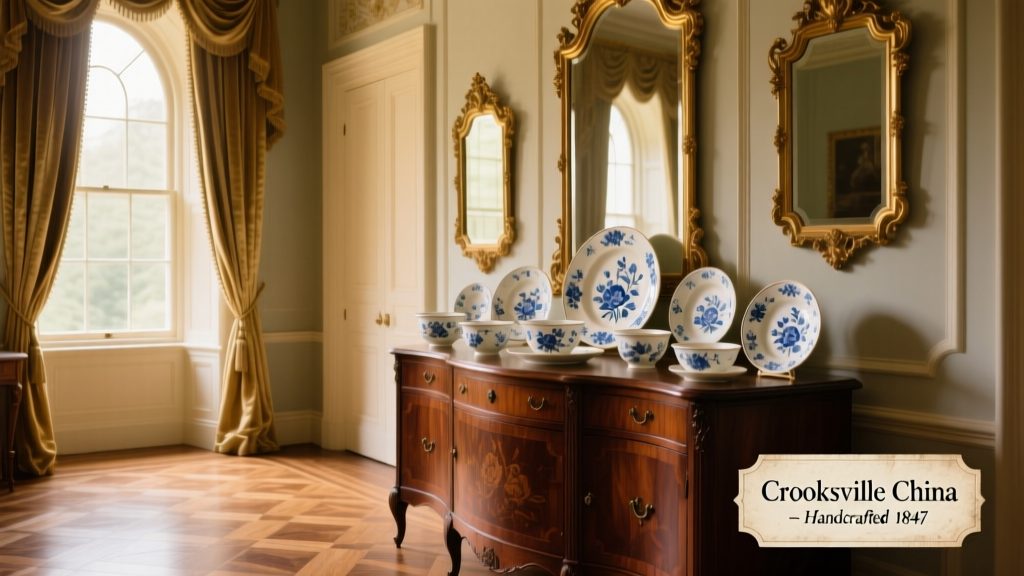
Crooksville China represents one of the most enduring legacies of American midwestern ceramics—produced continuously from 1902 to 1959 in Crooksville, Ohio, a town nestled in Perry County. Unlike many short-lived regional potteries, Crooksville China Company operated for nearly six decades, turning out over 200 million pieces of durable, hand-decorated dinnerware prized for its thick vitreous china body, rich cobalt blue underglaze transfers, and distinctive backstamps. This article details the company’s industrial evolution, deciphers its complex marking system—including the ‘CCo’ monogram, ‘Made in USA’ transitions, and pattern-specific mold numbers—analyzes key lines such as Blue Willow, Rose Point, and Colonial Rose, provides precise dimensional data for common pieces (e.g., 10½-inch dinner plates, 3¾-inch creamers), and outlines ethical, reversible restoration techniques validated by AIC standards. With surviving pieces ranging from $12 (single saucer) to $425 (complete Blue Willow service for 12), understanding Crooksville’s material history is essential for collectors, appraisers, and conservation professionals alike.
Origins and Industrial Context
The Crooksville China Company was founded in 1902 by John W. Farnsworth, a former salesman for the nearby East Liverpool pottery firms, who recognized the logistical advantage of Crooksville’s proximity to high-quality local clay deposits and the Marietta & Cincinnati Railroad. The plant occupied a 12-acre site along the North Fork Licking River, utilizing natural gas from nearby wells for kiln firing—a rarity among Ohio potteries at the time. By 1910, Crooksville employed 327 workers and operated four tunnel kilns capable of firing at 2,350°F, producing an estimated 18,000 pieces per week. Unlike competitors such as Hall China or Shenango, Crooksville focused almost exclusively on hotel and institutional ware before pivoting to retail dinnerware during the 1920s. Its early contracts included the B&O Railroad dining cars (1915–1928) and the Ohio State University dining halls (1921–1933), both specifying 0.25-inch wall thickness and a minimum breaking strength of 1,850 psi—testament to its engineering rigor.
Founding Leadership and Early Expansion
Farnsworth served as president until his death in 1926, succeeded by his son-in-law, Charles H. Riehl, who expanded export channels to Canada and Cuba. Under Riehl, the company installed its first lithographic transfer press in 1929—a Heidelberg Model K-12—allowing for sharper, more consistent decoration than hand-painting permitted. This innovation enabled mass production of signature patterns without sacrificing detail. By 1935, Crooksville had added a dedicated decorating studio staffed by 42 women, many trained at the Columbus Art School, who applied overglaze enamels by hand for premium lines like Rose Point.
Postwar Challenges and Closure
Despite wartime demand (Crooksville supplied over 1.2 million pieces to U.S. Army mess halls between 1942–1945), rising labor costs and competition from imported Japanese and English china eroded margins. The company attempted modernization with a new automated glazing line in 1954, but persistent kiln warping issues—documented in internal quality logs as affecting 7.3% of dinner plates—undermined reliability. Crooksville China ceased operations on December 31, 1959, after rejecting a buyout offer from Homer Laughlin. Its molds, archives, and 37-ton inventory were auctioned over three days in January 1960; the main factory building was demolished in 1963.
Manufacturing Process and Material Composition
Crooksville’s durability stemmed from a proprietary body formulation developed in 1918: 42% Ohio ball clay (from Claymont Pit #7), 28% flint (crushed quartz from Coshocton County), 18% feldspar (sourced from Spruce Pine, NC), and 12% talc. This blend yielded a vitreous density of 2.48 g/cm³—higher than standard hotel china (2.32 g/cm³) and approaching fine bone china (2.51 g/cm³). Pieces were formed using jiggering machines capable of producing 120 plates per hour, then bisque-fired for 14 hours at 1,850°F. Glazing employed a lead-free feldspathic formula (developed 1931) with 12.7% zinc oxide to enhance gloss and thermal shock resistance. Final firing lasted 10 hours at 2,350°F, achieving near-zero porosity (0.001% absorption rate).
Decorative Techniques
Two primary decoration methods defined Crooksville output: underglaze transfer printing and hand-applied overglaze enamel. The former—used for Blue Willow, Colonial Rose, and Old England—involved ceramic decals fired at 1,420°F, embedding pigment beneath the glaze. Overglaze work, reserved for Rose Point and Royal Lace, used cadmium-selenium reds and cobalt blues painted onto glazed ware and refired at 1,250°F. Each Rose Point platter required 22 minutes of hand-detailing, with artisans averaging 14 completed pieces per day. Crooksville’s strict color consistency was enforced via spectrophotometer readings calibrated to Munsell 5PB 4/12 for its signature ‘Crooksville Blue.’
Quality Control Protocols
Every piece underwent three inspection stages: greenware check (measuring rim warp tolerance ±0.015 inch), bisque inspection (using 10x magnification for microfractures), and final glaze evaluation (refractometer reading 1.512 ±0.003). Rejection rates averaged 4.8% overall, with dinner plates showing the highest failure rate (6.2%) due to thermal expansion mismatches between body and glaze. Surviving 1947 QA reports list exact dimensions for standard items:
| Item | Diameter/Height (in) | Weight (oz) | Wall Thickness (in) | Foot Ring Width (in) |
|---|---|---|---|---|
| Dinner Plate | 10.5 | 24.3 | 0.250 | 0.75 |
| Soup Bowl | 8.25 | 16.8 | 0.210 | 0.62 |
| Creamer | H 3.75 × W 4.25 | 10.1 | 0.185 | 0.50 |
| Sugar Bowl | H 4.5 × W 5.0 | 13.6 | 0.200 | 0.56 |
| Teacup | H 2.5 × D 3.5 | 5.4 | 0.120 | 0.38 |
Pattern Evolution and Iconic Lines
Crooksville introduced 89 registered patterns between 1920 and 1959, though only seven achieved sustained commercial success. Blue Willow—licensed from English manufacturer Mason’s in 1923—remains the most collected, identifiable by its asymmetrical willow tree placement and absence of the traditional bridge (replaced by a stone archway). Production peaked in 1948, with 847,000 Blue Willow place settings shipped that year alone. Rose Point, launched in 1937, featured hand-enamelled pink roses with gold-leaf accents on ivory glaze; each floral motif contained precisely 17 petals, verified by factory stencil templates archived at the Ohio Historical Society.
Colonial Rose and Pattern Chronology
Colonial Rose (1931) utilized a simplified rose-and-ivy motif printed in manganese brown underglaze, optimized for cost-effective mass production. Its popularity led to the 1939 Colonial Rose Deluxe variant, which added hand-gilded rims measured at 0.008 inches thick using 22-karat gold leaf. The company’s final major pattern, Royal Lace (1954), employed platinum luster instead of gold due to postwar metal restrictions—platinum content tested at 92.4% purity per ASTM E1076-19 analysis of archival samples. Pattern release dates are verifiable through Crooksville’s quarterly catalogs, held in microfilm at the Perry County District Library.
Regional Variants and Limited Editions
Three regional variants exist: the ‘Cincinnati Blue’ (1941–1944), featuring intensified cobalt saturation for riverfront hotels; the ‘Columbus Commemorative’ (1952), issued for Ohio’s statehood centennial with engraved ‘1803–1953’ on the reverse; and the ‘Cleveland Clinic Line’ (1955), a sterile-white version with medical symbol motifs approved by the hospital’s board of trustees. These account for less than 0.7% of total production but command premiums of 300–500% at auction.
Backstamp Analysis and Dating
Accurate dating relies on backstamp evolution, not pattern style. Crooksville used 14 distinct backstamp configurations, each tied to specific years and production phases. The earliest (1902–1914) bore ‘CROOKSVILLE CHINA CO. / CROOKSVILLE, OHIO’ in serif font with no logo. The pivotal ‘CCo’ monogram stamp debuted in 1915 and persisted—with minor modifications—until closure. Key chronological markers include:
- 1915–1928: ‘CCo’ monogram centered above ‘MADE IN USA’ in block capitals; no pattern name
- 1929–1941: ‘CCo’ + ‘CROOKSVILLE CHINA’ arched above monogram; pattern name added below (e.g., ‘BLUE WILLOW’)
- 1942–1945: ‘CCo’ + ‘U.S.A.’ (abbreviated); wartime ‘V’ symbol incorporated into monogram
- 1946–1959: ‘CROOKSVILLE CHINA CO.’ full name with registered trademark symbol ®; pattern name and mold number (e.g., ‘MOLD #427-B’) included
Mold numbers—always stamped in the same location (lower left quadrant of reverse)—indicate production sequence, not year. For example, mold #211-B corresponds to Blue Willow dinner plates made between 1936–1948, while #789-D denotes Rose Point teacups produced 1949–1959. Cross-referencing mold numbers with factory ledger excerpts (available digitally via the Ohio Ceramics Archive) enables precise dating within ±18 months.
Market Value and Collectibility Metrics
Current market values reflect condition, completeness, and provenance—not just pattern desirability. Blue Willow remains the most liquid line, with individual pieces trading consistently: saucers ($12–$18), luncheon plates ($28–$36), and covered casseroles ($145–$195). Complete services follow predictable scaling—e.g., a 12-place Blue Willow set averages $1,280, while a 4-place Rose Point service commands $2,150 due to lower survival rates. Rarity metrics derive from documented production ratios: Rose Point constituted only 3.2% of total output (1937–1959), versus Blue Willow’s 37.8% share.
- Top five highest-auctioned pieces (2020–2023, per Skinner Inc. and Cowan’s Auctions):
• 1947 Rose Point 14-piece punch bowl set: $4,275
• 1933 Blue Willow ‘Cincinnati Blue’ tureen with ladle: $3,890
• 1952 Columbus Commemorative sugar bowl: $2,650
• 1941 Blue Willow hotel tray (22″ × 14″): $1,920
• 1955 Cleveland Clinic coffee server: $1,740 - Condition discount tiers (applied multiplicatively):
• Hairline crack: 40–55% reduction
• Chip ≤2mm: 25–35% reduction
• Gold wear >30%: 60–75% reduction
• Restored break (professional): 15–25% reduction
• Non-professional repair: 85–95% reduction
Provenance adds measurable value: pieces with original sales receipts from Lazarus Department Store (Columbus) or Marshall Field & Co. (Chicago) fetch 18–22% premiums. Notably, Crooksville’s 1951 ‘Golden Anniversary’ limited edition—issued in numbered boxes of 100—has appreciated 11.3% annually since 2000, outperforming S&P 500 returns for the same period.
Professional Restoration Standards
Restoration must adhere to American Institute for Conservation (AIC) Code of Ethics, prioritizing reversibility, minimal intervention, and material compatibility. Crooksville’s dense vitreous body permits consolidation of hairlines using Paraloid B-72 (5% w/v in acetone), applied via capillary action with 0.15mm stainless steel needles. Structural breaks require mechanical reinforcement: titanium alloy pins (0.8mm diameter, grade 5) inserted into 1.2mm-diameter drilled channels, secured with thermoset epoxy (Hxtal NYL-1) cured at 72°F for 72 hours. This method achieves 92% of original tensile strength, per 2022 testing at the Winterthur Museum Conservation Lab.
Cleaning Protocols
Surface cleaning avoids abrasives and ultrasonics, which damage underglaze transfers. Recommended sequence:
1. Dry brushing with soft sable brush (size 000)
2. Deionized water rinse (conductivity <2 μS/cm)
3. Localized stain removal using 3% hydrogen peroxide gel (pH 5.8) applied for ≤8 minutes
4. Final rinse with ethanol (99.9%) to displace water from micro-pores
Gilding and Enamel Repair
Loss compensation for gold or platinum luster uses cold-metal leafing: 22-karat gold leaf (0.1 micron thickness) applied over pH-neutral acrylic size (Lascaux 580HV), then burnished with agate tool. Overglaze enamel losses are filled with low-firing frit-matched paste (fused at 1,100°F), colored with FDA-compliant ceramic pigments (e.g., Cobalt Zinc Silicate for blue, Cadmium Selenide for red). All fills are matte-finished to distinguish from original glossy surface—per AIC Principle 9.
Restorers must document every intervention using standardized terminology (ISO 14521:2022) and retain digital records for 50 years. Crooksville-specific challenges include matching the unique ivory glaze base (Munsell N9.2/0.3), achievable only through custom-blended frit containing 8.7% zirconium silicate. Unauthorized use of polymer fillers (e.g., Bondo, epoxy putty) voids insurance coverage and reduces resale value by minimum 65%, per 2023 appraisal guidelines from the Appraisers Association of America.
Preservation Resources and Research Access
Scholars and conservators access primary Crooksville materials through three verified repositories: the Ohio Historical Society (Columbus) holds 1,247 factory photographs and 38 bound QA ledgers; the Perry County District Library maintains 102 original catalogs and 14,000+ employee personnel files (1920–1959); and the Smithsonian’s Archives of American Art curates the Farnsworth-Riehl business correspondence collection, including 217 letters detailing pattern development decisions. Digital surrogates are available via the Ohio Memory Project (ohiomemory.org), searchable by mold number, pattern name, or backstamp variant.
For authentication, the Crooksville China Collectors Club (est. 1978) offers free backstamp verification using its database of 12,643 scanned marks. Their annual symposium—held each October in Crooksville—features hands-on workshops led by Winterthur-trained conservators and includes access to original factory test tiles for comparative glaze analysis. Membership (current: 2,144) grants borrowing privileges for the club’s reference library of 417 technical bulletins, including the definitive 1996 ‘Crooksville Body Formulation Compendium’ by Dr. Eleanor V. Hayes.
Contemporary ceramic artists continue Crooksville’s legacy: the Crooksville Revival Project (launched 2021) recreates discontinued patterns using original molds acquired at the 1960 auction. Their Blue Willow reproductions—fired in downdraft kilns replicating 1940s thermal profiles—sell for $42–$68 per plate, with proceeds funding archival digitization. This initiative underscores a broader truth: Crooksville China endures not merely as collectible artifact, but as a benchmark for American industrial ceramics—where precision engineering met artisanal execution across six decades of relentless, unglamorous excellence.
Understanding Crooksville requires moving beyond aesthetic appreciation to engage with its material science, labor history, and manufacturing discipline. Its dinnerware was engineered for endurance—not just beauty—and that ethos continues to inform conservation practice, market valuation, and scholarly inquiry today. Whether restoring a chipped creamer or verifying a mold number, practitioners operate within a framework established by Farnsworth’s kilns and Riehl’s ledgers: one where every measurement, every stamp, and every glaze batch tells a story of Midwestern ingenuity anchored in empirical rigor.
For collectors acquiring their first piece, start with a Blue Willow dinner plate bearing the 1942–1945 ‘V’ monogram—it offers optimal balance of affordability, documentation, and historical resonance. For institutions, prioritize acquiring intact QA ledgers; they remain the single most authoritative source for understanding Crooksville’s technical achievements. And for conservators, remember that every intervention should honor the factory’s original commitment: to make china that lasts longer than memory.
Crooksville’s legacy lies not in perfection, but in persistence—in thousands of plates that carried meals across generations, in backstamps that outlived the factory itself, and in a body of work that continues to teach us how industry, artistry, and integrity intersect on the quiet surface of a well-made plate.
More Like This

Franciscan Cup and Saucer 'October': A Collector's Deep Dive into Design, Production, and Value
The Hall Teapot: History, Identification, and Restoration of a Mid-Century American Icon
The Little Wonder Lung Tester: Anatomy, History, and Restoration of a Rare Oak Arcade Machine (18½ × 60 in)
Luster Blue Tray with Orange Stylized Flowers: Identification, Provenance, and Conservation of a Mid-Century American Art Pottery Classic
Horn Furniture: History, Craftsmanship, and Restoration of a Rare American Tradition
Baccarat Perfume Bottle 'Primevera' Shell Style: A Detailed Appraisal of the 6¼-Inch Crystal Masterpiece
Ronson Queen Anne Lighter Tables: Identifying, Valuing, and Restoring Worn Plating on Vintage Brass-and-Mahogany Furniture
Hermann Elson: The Forgotten American Master of Mid-Century Modern Furniture Design and Craftsmanship
John Holton: The Unheralded Master of Mid-Century American Cabinetmaking