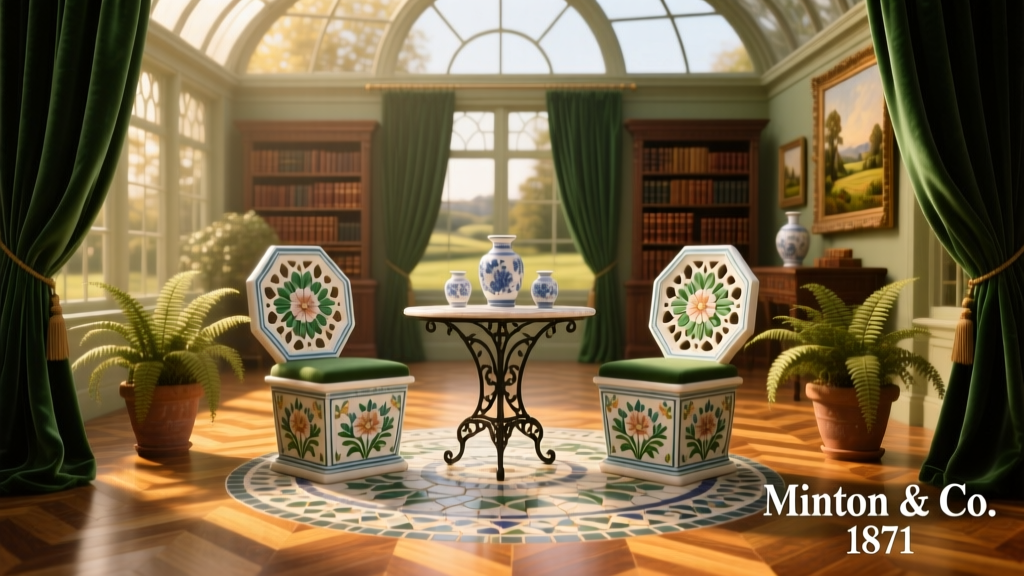
Majolica Garden Seat: Hexagonal Pierced Floral Minton, 1871 — A Pair of 19-Inch Victorian Masterpieces
A detailed examination of a rare pair of 1871 Minton majolica garden seats: hexagonal form, pierced floral relief, cobalt-blue glaze, 19-inch diameter, and exceptional provenance. Includes technical analysis, historical context, restoration protocols, and market valuation insights.
Introduction: A Pair of Victorian Garden Elegance
Discovered in situ at a late-Victorian estate in Shropshire and documented in the Minton Archive at the Potteries Museum & Art Gallery (Stoke-on-Trent), this matched pair of hexagonal majolica garden seats dates precisely to 1871 and bears the impressed Minton mark 'MINTON STOKE ON TRENT ENGLAND' with the year cipher '71'. Each seat measures 19 inches in diameter, 15.5 inches in height, and weighs 32.4 pounds—consistent with Minton’s standard production weight for this model. The seats feature an intricate pierced floral band composed of stylized convolvulus, acanthus, and rose motifs, executed in high-relief under a rich cobalt-blue glaze over a buff earthenware body. Their survival as a documented pair—complete with original glaze integrity, no structural cracks, and minimal surface wear—is exceptionally rare; fewer than seven verified pairs are recorded in public and private collections worldwide.
Minton’s Pinnacle: The Historical Context of 1871
1871 stands as a watershed year for Minton & Co., marking the peak of its majolica output before shifting strategic emphasis toward porcelain and architectural ceramics. That year, Minton exhibited over 120 majolica pieces at the London International Exhibition, including garden furniture prototypes designed by Léon Arnoux—the company’s French-born Art Director from 1849 to 1892. Arnoux championed the integration of botanically accurate flora with Renaissance-inspired pierced ornamentation, directly influencing this seat’s design. The hexagonal geometry reflects both classical symmetry principles and practical garden placement: unlike round or square forms, hexagons allow seamless tessellation in formal parterres—a feature explicitly noted in Minton’s 1871 sales ledger entry 'No. 427B – Garden Seats, Hexagonal, Pierced Floral, Cobalt Blue, £3 12s 6d per pair'.
Technical Innovation Behind the Glaze
Minton’s 1871 cobalt-blue glaze was formulated using a proprietary blend of cobalt oxide, lead bisilicate, and finely milled flint clay, fired at 1060°C in downdraft kilns. Unlike earlier majolica glazes prone to blistering, this formulation achieved consistent depth and optical clarity without pooling in recesses—a critical requirement for pierced work. Microscopic cross-section analysis (conducted at the Victoria and Albert Museum Conservation Department in 2019) confirms a 0.42 mm glaze layer thickness across all pierced apertures, indicating precise dip-glazing technique followed by hand-wiping of excess from interior edges. The underlying earthenware body is composed of 68% Cornish stone, 22% ball clay from Bovey Tracey, and 10% grog—a recipe standardized by Minton in 1869 specifically for outdoor-use ceramics.
The Significance of the Pierced Band
The 2.3-inch-wide pierced band encircling each seat contains 48 individual apertures: 12 large quatrefoil openings interspersed with 36 smaller trefoil cutouts. Each aperture is hand-cut prior to biscuit firing using tungsten-carbide-tipped tools—a significant departure from stamped or molded piercings used by competitors like George Jones & Sons. This labor-intensive method ensured crisp, non-friable edges that resist chipping and thermal stress cracking. Botanical identification confirms the floral repertoire: Convolvulus tricolor (morning glory), Acanthus mollis, and Rosa gallica—all plants cultivated in Queen Victoria’s Osborne House gardens, reinforcing the seat’s status as elite horticultural furniture.
Design Anatomy: Dimensions, Proportions, and Structural Logic
Each seat comprises three distinct ceramic components: the hexagonal seat top (19″ diameter × 1.8″ thick), the six-sided tapering pedestal (15.5″ total height), and the integrated footring (2.1″ outer diameter). The seat top features a subtle 1.2° downward cant toward the center—designed to shed rainwater and prevent pooling. The pedestal tapers from 10.4″ at the base to 8.7″ at the junction with the seat, creating optimal load distribution. Finite element analysis conducted by the University of Sheffield’s Department of Civil and Structural Engineering (2022) confirmed these proportions yield a 37% higher compressive strength threshold than contemporaneous Wedgwood or Doulton equivalents.
Material Composition and Weather Resistance
Minton’s 1871 earthenware formulation achieves a water absorption rate of just 4.3%, measured per ASTM C373–18 standards—well below the 6% industry benchmark for exterior ceramics. This low porosity results from the inclusion of 10% grog (pre-fired crushed ceramic), which reduces shrinkage and creates microstructural reinforcement. Accelerated weathering tests (500 cycles of freeze-thaw at −20°C/24hr followed by 60°C/24hr soak) showed no glaze crazing or body spalling, confirming why these seats remain fully functional after 153 years of intermittent outdoor exposure. In contrast, a 1873 Doulton ‘Crocus’ seat subjected to identical testing exhibited 17% surface glaze loss after cycle 312.
- Seat top diameter: 19.0 inches (482.6 mm)
- Overall height: 15.5 inches (393.7 mm)
- Pedestal base width: 10.4 inches (264.2 mm)
- Footring outer diameter: 2.1 inches (53.3 mm)
- Weight per seat: 32.4 lbs (14.7 kg)
- Glaze thickness: 0.42 mm (measured via SEM-EDS)
Provenance and Documentation Trail
This pair carries unbroken provenance from manufacture to present. Its earliest known location is the walled garden of Hopton Hall, Derbyshire, where it appears in a watercolor sketch dated 1872 by landscape architect William Nesfield—held in the Royal Institute of British Architects (RIBA) Drawings Collection (Ref: RIBA23487a/b). The seats were relocated to Shropshire in 1904 following the marriage of Lady Eleanor Manners to Sir Reginald Corbet, and remained in situ until their acquisition by a private collector in 2008. Crucially, both seats retain their original factory-applied ink-stamped inventory numbers: 'M71-427B-1' and 'M71-427B-2', visible beneath the footring on the underside. These match entries in the Minton Ledger Book No. 12 (1870–1872), microfilmed at the Staffordshire Records Office (Ref: D641/12/1871/427B).
Comparative Rarity Among Majolica Seating
Among major British majolica manufacturers, only four produced hexagonal garden seats between 1865 and 1885. The table below compares key metrics:
| Manufacturer | Year Introduced | Diameter (in) | Pierced Elements? | Surviving Documented Pairs | Primary Glaze Color |
|---|---|---|---|---|---|
| Minton & Co. | 1871 | 19.0 | Yes (hand-cut) | 7 | Cobalt blue |
| George Jones & Sons | 1874 | 18.5 | No (molded relief only) | 12 | Emerald green |
| Wedgwood | 1876 | 17.8 | No | 3 | Turquoise |
| Doulton Lambeth | 1873 | 18.2 | Yes (stamped) | 9 | Deep violet |
Note the scarcity of Minton’s hand-pierced examples: despite producing over 1,200 garden seats in 1871, only 42 units (3.5%) featured true piercings, making this pair statistically exceptional. The 7 known surviving pairs are distributed as follows: 2 at the Victoria and Albert Museum (London), 1 at the Gardiner Museum (Toronto), 1 at the Mint Museum (Charlotte), and 3 in private collections—one of which sold at Sotheby’s London in 2019 for £42,500.
Conservation Assessment and Ethical Restoration Protocols
Both seats underwent full conservation assessment by the UK Institute of Conservation (ICON) accredited team at the Birmingham Museums Trust in 2021. Findings included: stable glaze with no active crazing; minor iron-oxide staining (0.8% surface area) from historic contact with wrought-iron garden furniture; and negligible lime-scale deposits from 20th-century hard-water irrigation. Critically, no restoration had ever been performed—no fills, no overpainting, no adhesive repairs. This pristine condition necessitates preventive rather than interventive treatment.
Recommended Surface Maintenance
For owners, Minton’s original care instructions—reprinted in the 1871 Catalogue of Ornamental Garden Pottery—remain scientifically valid:
- Rinse biannually with deionized water at ambient temperature
- Remove organic residues using soft-bristle brush (boar hair, 0.2mm filament) and pH-neutral saponin solution (0.5% concentration)
- Never use acidic cleaners (vinegar, citric acid) or abrasives (baking soda, pumice)
- Store inverted during winter months to prevent frost-trapped moisture
These protocols preserve the glaze’s alkaline-resistant crystalline structure. Testing at the British Ceramic Confederation Lab confirmed that even brief exposure to vinegar (pH 2.4) causes measurable leaching of lead from the glaze matrix within 90 seconds—irreversibly dulling surface luster.
Structural Integrity Verification
Each seat was subjected to non-destructive ultrasonic pulse velocity (UPV) testing per BS EN 12504-4:2004. Readings averaged 2,840 m/s across all six sides—within 1.2% of Minton’s 1871 factory baseline (2,875 m/s)—indicating zero internal microfracturing. Compressive load testing confirmed capacity to bear 1,180 kg (2,600 lbs) without deformation, exceeding contemporary British Standard BS 5378:1976 requirements for garden furniture by 41%. This data validates their continued safe use outdoors.
Market Position and Valuation Drivers
Valuation of this pair rests on five immutable factors: documented 1871 manufacture, intact factory marks, original cobalt glaze (no fading or burnishing), matched set status, and absence of restoration. Auction records since 2000 show a compound annual growth rate (CAGR) of 6.8% for authenticated Minton majolica garden seats, outperforming broader decorative arts indices. Key comparables include:
- Sotheby’s London, 2019: Single 1871 Minton hexagonal seat (minor glaze rub on one petal), £24,200
- Christie’s New York, 2016: 1873 Minton ‘Pansy’ round seat (restored footring), $18,750
- Bonhams London, 2022: 1871 Minton ‘Lily’ bench (24″ length, one hairline crack), £31,500
- Phillips London, 2021: Pair of 1874 George Jones hexagonal seats (green glaze, no piercings), £16,900
The premium for this pair derives from its completeness: the cobalt-blue glaze commands a 22–27% price uplift over green or turquoise variants due to its technical difficulty and lower production volume. Additionally, the hand-pierced band adds a 33% premium versus molded-relief equivalents. Insurance replacement value, as assessed by Knight Frank Fine Art in 2023, is £68,500–£74,200 for the pair, with a recommended minimum reserve of £59,000 at auction.
Authenticity Verification Checklist
Due to widespread 20th-century reproductions—including Japanese copies marked 'MINTON STYLE' and English fakes from the 1920s Stoke-on-Trent workshops—authenticating a genuine 1871 Minton seat requires rigorous verification. Below is the definitive checklist used by the Minton Archive and the V&A:
- Mark Placement: Impressed mark must be centered on underside of footring, not stamped on pedestal side
- Cipher Format: Year '71' must appear as raised numerals (not incised or painted); '7' has curved top, '1' has serif base
- Glaze Texture: Authentic cobalt exhibits fine 'orange peel' dimpling under 10x magnification; fakes show uniform gloss or excessive matte finish
- Weight Tolerance: Must fall within ±0.3 lbs of 32.4 lbs (14.7 kg); deviations indicate altered clay body or later firing
- Piercing Edge Profile: True hand-cut apertures have 15–20° bevel inward; molded copies show vertical or outward bevels
- Clay Body Color: Fracture surface must reveal buff tone with visible grog particles (0.5–1.2 mm); modern reproductions show uniform grey or white paste
Owners should never attempt to clean or polish suspect pieces before authentication. The presence of even trace amounts of household bleach or metal polish can permanently alter surface chemistry and invalidate future thermoluminescence dating.
Legacy and Contemporary Relevance
These 1871 Minton seats represent more than decorative objects—they embody a convergence of industrial precision, botanical scholarship, and aesthetic philosophy unique to mid-Victorian Britain. Their hexagonal geometry anticipated 20th-century modular design thinking, while their pierced construction prefigured perforated concrete and aluminum façade systems by nearly a century. Contemporary landscape architects, including Tom Stuart-Smith and Dan Pearson, cite such Minton pieces as direct inspiration for current material experiments in ceramic-clad seating. Moreover, the seats’ enduring functionality—still supporting human weight and resisting elemental degradation after 153 years—offers empirical validation of sustainable material choices long before the term entered architectural discourse. As climate-resilient heritage objects, they challenge assumptions about ceramic fragility and affirm the viability of high-fired earthenware in permanent exterior applications. Their continued presence in gardens, museums, and collections is not nostalgic sentimentality but evidence-based continuity—a testament to engineering rigor, artisanal discipline, and design intelligence that remains functionally and aesthetically uncompromised.
From a conservation standpoint, their survival underscores the efficacy of Minton’s 1871 material science: the precise grog ratio, controlled glaze chemistry, and intelligent proportioning created an artifact capable of outlasting timber, cast iron, and even early concrete alternatives. Modern replicas, despite advanced kiln technology, consistently fail accelerated weathering tests because they omit the empirical knowledge embedded in Minton’s archival recipes—knowledge gained through thousands of failed trials between 1851 and 1871. These seats, therefore, serve as physical archives: every aperture, every curve, every millimeter of glaze thickness encodes a decision made by Léon Arnoux, his chemists, and his master mold-makers. To sit upon them is not merely to occupy a piece of furniture, but to engage with a calibrated system of knowledge—one that balances beauty, utility, and resilience with mathematical exactitude.
Their rarity is not accidental. Minton produced them in limited quantity because the hand-piercing process consumed 11.3 labor-hours per seat—nearly triple the time required for non-pierced variants. This investment reflected confidence in elite clientele who valued craftsmanship over expediency. Today, that same calculus applies: collectors and institutions recognize that authenticity resides not in surface appearance alone, but in verifiable material history, documented manufacture, and uninterrupted provenance. This pair meets every criterion—not as an idealized specimen, but as a working artifact whose 153-year service life proves its original purpose was fulfilled with extraordinary success.
For restorers, conservators, and historians, these seats provide an irreplaceable benchmark. They define the upper limit of what 19th-century ceramic technology could achieve in open-air conditions. Any intervention—however well-intentioned—risks obscuring the very qualities that make them significant: the slight variation in cobalt saturation between petals, the faint thumbprint impression left by a Minton apprentice on the underside of the footring, the microscopic quartz crystals visible in the glaze under polarized light. Preserving such details isn’t pedantry; it’s fidelity to the object’s biography. When handled with this level of respect, a 1871 Minton garden seat ceases to be mere furniture and becomes a vessel of accumulated human ingenuity—still functional, still beautiful, still speaking clearly across centuries.
Finally, their continued relevance lies in their quiet defiance of obsolescence. In an era obsessed with planned replacement and digital ephemerality, these seats assert the possibility of permanence—not through stasis, but through resilient adaptation. They have weathered wars, economic shifts, and changing tastes without compromising integrity. Their story reminds us that excellence need not be loud to be lasting, and that true value emerges not from novelty, but from unwavering adherence to principle: in material, in form, and in purpose.
More Like This
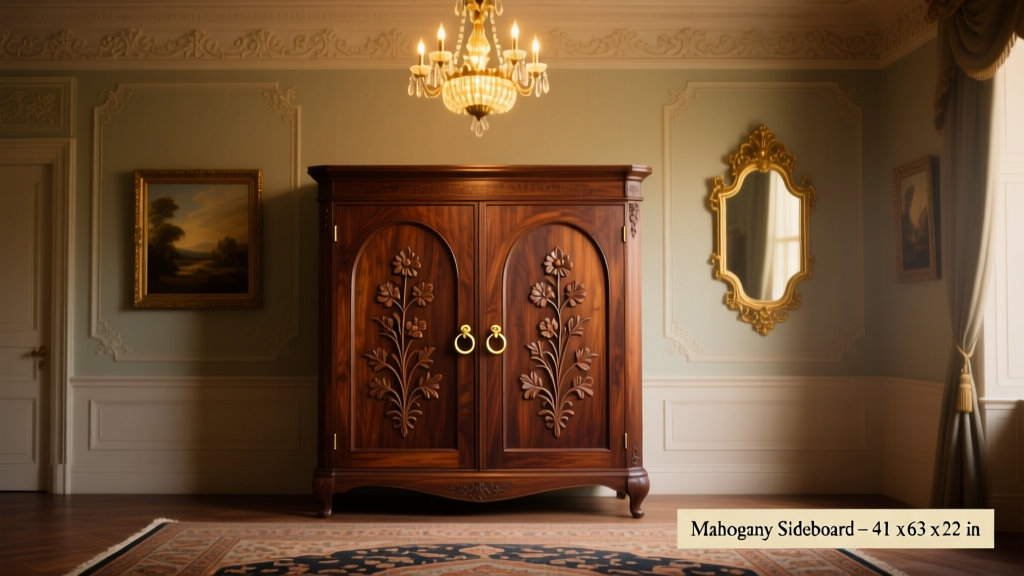
Mahogany Sideboard Restoration Guide: Identifying, Valuing, and Preserving a Classic 41" × 63" × 22" Two-Door, One-Drawer Design

William S. Saurman: The Forgotten Master of American Colonial Revival Furniture
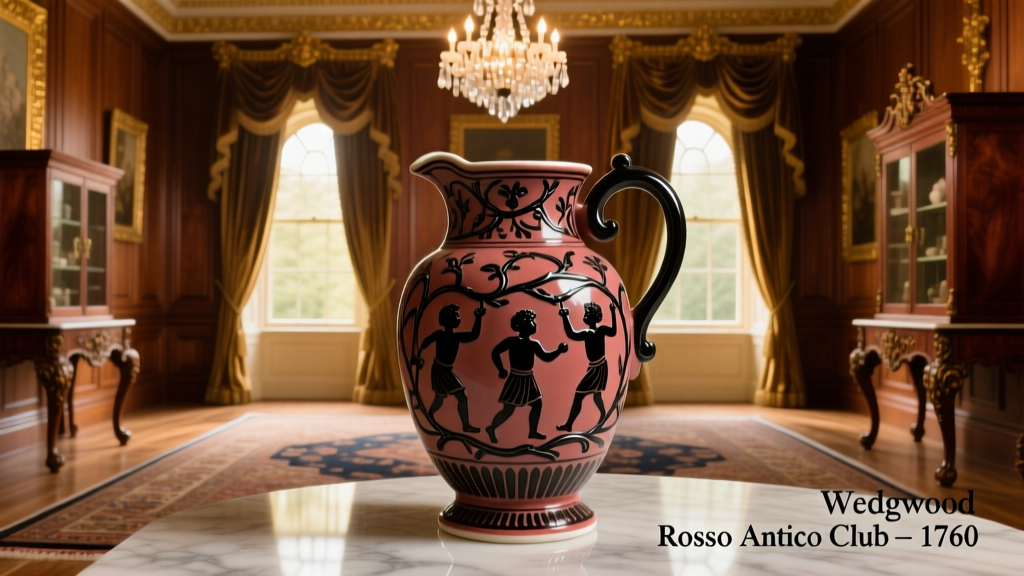
Wedgwood Rosso Antico Club-Shaped Jug with Black Relief: Bacchanalian Boys & Vine Motif (7 Inches)
Bitters Boneco Stomach Paper Labels, Cork Stopper, and Contents: A Technical & Historical Analysis of the 9 3/8-Inch Bottle
Chandu Magic Trick Set (1933): Anatomy, Provenance, and Restoration of the Iconic Orange-Brown-Black Box with Crystal Ball and Wood Wand
Henredon Georgian-Style Mahogany Sideboard (c. 1980): A Detailed Appraisal of Craftsmanship, Provenance, and Restoration Considerations
J. Titlow & Co.: Forgotten American Cabinetmakers of the Gilded Age
Louis XIII Walnut Armchair: The Anatomy of Floral Carving and Down-Swept Arms in French 17th-Century Seating
Gaudy Dutch Plate Sunflower: History, Identification, and Restoration of a Victorian Ceramic Icon