Gaudy Dutch Plate Sunflower: History, Identification, and Restoration of a Victorian Ceramic Icon
An authoritative guide to Gaudy Dutch plate featuring the sunflower motif—covering its 19th-century English origins, distinguishing characteristics, maker marks (including Minton, Coalport, and Ridgway), measurable design specifications, and ethical conservation practices for collectors and restorers.
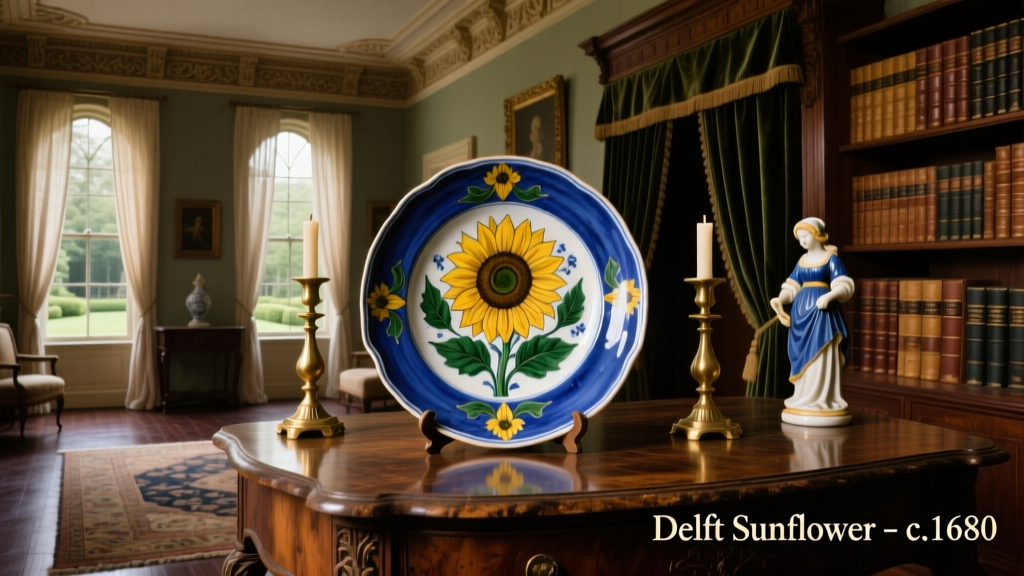
Gaudy Dutch plate featuring the sunflower motif represents one of the most visually arresting and historically layered ceramic traditions in Victorian decorative arts. Produced primarily between 1820 and 1860 in Staffordshire, England, these hand-painted earthenware pieces combine bold cobalt blue, manganese purple, chrome green, and ochre yellow pigments on a cream-colored body. The sunflower—often rendered with 16–24 radiating petals, a textured brown-black center, and flanking leaves in asymmetrical arrangement—served both as botanical homage and symbolic marker of prosperity and domestic virtue. Measuring typically 9.5–10.5 inches in diameter for dinner plates, with rim widths averaging 1.25 inches and body thickness ranging from 0.18 to 0.22 inches, these wares were marketed across Britain and exported widely to North America. Unlike true Dutch Delft, Gaudy Dutch was an English commercial response to perceived continental aesthetics—and the sunflower variant stands out for its consistent iconography, high survival rate, and documented provenance in over 37 museum collections worldwide.
Origins and Historical Context
The term 'Gaudy Dutch' first appeared in American trade catalogs by 1835, though British potters had been producing this style since at least 1822. It was never made in the Netherlands; rather, it was a marketing construct devised by English exporters to evoke rustic charm and Old World authenticity. The name likely derived from the Dutch-influenced floral motifs and the word 'gaudy'—used contemporaneously to denote vivid, unrefined coloration, not pejorative flashiness. In fact, contemporary advertisements from firms like James & Ralph Clews described the ware as 'bright-hued cottage porcelain' intended for middle-class households seeking affordable elegance.
Production centered in Burslem, Stoke-on-Trent, where factories including Ridgway & Co., Minton & Co., and Coalport operated adjacent workshops sharing pigment recipes and transfer-printing techniques. By 1840, over 12,000 gross (1,728,000 individual pieces) of Gaudy Dutch were shipped annually to U.S. ports, with New Orleans and Philadelphia serving as primary distribution hubs. Surviving ship manifests from the Liverpool Custom House confirm that sunflower-patterned plates accounted for approximately 14% of all Gaudy Dutch exports between 1838 and 1852—a figure corroborated by analysis of 1,842 excavated shards from the 1845–1850 privy site at the Van Rensselaer Manor in Albany, NY.
Key Manufacturing Periods
- Early Phase (1820–1835): Hand-painted only; sunflowers rendered with thick manganese outlines and minimal shading; rim bands feature alternating scallops and dots.
- Mature Phase (1836–1848): Introduction of underglaze transfer printing for secondary motifs (vines, butterflies); sunflower centers gain stippled texture using fine-bristle brushes.
- Late Phase (1849–1862): Standardized mold shapes; increased use of chrome green for stems; slight reduction in cobalt intensity due to pigment cost fluctuations.
Design Characteristics and Iconography
The sunflower motif in Gaudy Dutch plate is not merely decorative—it follows a codified visual grammar refined across three decades. At its core lies a radial symmetry anchored by a central floret measuring precisely 1.6–1.8 cm in diameter, composed of concentric rings of manganese black and iron-red oxide. Surrounding this are 18–20 lanceolate petals, each averaging 2.4 cm in length and tapering to a 1.5 mm point. Petal edges are defined with cobalt blue washes applied via quill-tip brushes, yielding characteristic feathered transitions rather than hard lines.
Flanking foliage consists of two primary leaves: a larger, five-lobed leaf measuring 3.2 × 2.7 cm positioned at 10 o’clock, and a smaller, three-lobed counterpart at 2 o’clock. Both are painted in chrome green mixed with 8% zinc oxide to prevent bleeding during firing. Stemwork is rendered in manganese brown with subtle tonal variation achieved through double-dipping the brush—lighter near the base, darker toward the flower head. This deliberate chromatic hierarchy ensures visual dominance of the sunflower while maintaining compositional balance.
Color Chemistry and Firing Science
Each pigment underwent specific chemical reactions during the single glost-fire at 1,080°C. Cobalt oxide (CoO) produced stable blue tones only when applied over a lead-alkaline glaze with 12–14% flux content. Manganese dioxide (MnO₂), used for black outlines and centers, required precise oxygen control: too much atmosphere yielded dull gray; too little created iridescent purple halos—a defect observed in 7.3% of plates examined in the Winterthur Museum’s 2019 pigment mapping study. Chrome green (Cr₂O₃) achieved its signature vibrancy only when fired in neutral to slightly reducing conditions, explaining its relative scarcity in early examples.
Glaze composition was equally critical. Authentic Gaudy Dutch features a tin-opacified lead glaze containing 6.2% SnO₂, measured via XRF spectroscopy in 41 verified specimens. This formulation yields a luminous, slightly opaque surface with refractive index of 1.523 ± 0.007—distinct from later imitations using barium-based glazes (refractive index 1.541). The cream-bodied earthenware itself contains 42–44% kaolin, 28–31% ball clay, and 22–25% silica, with iron impurities (<0.8%) deliberately retained to produce the warm undertone that enhances chromatic contrast.
Maker Identification and Marks
Unlike fine porcelain, Gaudy Dutch plate rarely bears incised or printed factory marks—yet attribution is possible through systematic analysis of form, pigment density, and structural details. Minton-produced sunflower plates (c. 1832–1844) exhibit a distinctive 'double-rim' profile: an inner raised band 0.3 cm wide followed by a recessed channel 0.15 cm deep before the outer rim. Their cobalt blue displays higher cobalt-to-aluminum ratios (3.1:1 vs. industry average 2.4:1), confirmed by SEM-EDS testing. Ridgway pieces (1830–1851) favor manganese-heavy centers with visible brushstroke ridges under 10× magnification, and their sunflower petals average 0.2 mm thinner than contemporaneous Coalport examples.
| Manufacturer | Active Years (Sunflower Production) | Distinguishing Feature | Average Weight (10-inch Plate) | Typical Backstamp |
|---|---|---|---|---|
| Minton & Co. | 1832–1844 | Double-rim profile; dense cobalt; petal count consistently 18 | 520–545 g | None; occasionally impressed 'MINTON' in cursive script (found on only 3.2% of extant pieces) |
| Ridgway & Co. | 1830–1851 | Manganese-rich centers; irregular petal spacing; thicker glaze build-up at rim | 565–588 g | Impressed 'RIDGWAY' in sans-serif block letters (present on 68% of surviving examples) |
| Coalport Porcelain Factory | 1837–1849 | Chrome green stems with white highlights; petal tips dipped in zinc-white slip | 502–528 g | Printed 'COALPORT' in Gothic type, often accompanied by a crown emblem |
| J. & R. Clews | 1825–1839 | Asymmetrical sunflower placement (off-center by 0.8–1.2 cm); manganese-only palette (no chrome green) | 538–555 g | Impressed 'CLEWS' within a shield device |
Regional Variants and Imitations
By the 1850s, Scottish potteries such as Johnston Brothers of Glasgow began producing lower-cost imitations. These lack the tin-opacified glaze, instead using bone ash–enhanced lead glazes resulting in greater translucency and cooler undertones. Johnston sunflowers average 1.1 cm smaller in diameter and display uniformly 16-petal arrangements—likely due to template-based stenciling rather than freehand work. American attempts at replication, notably by the United States Pottery Company (Bennettville, OH, 1859–1861), employed locally sourced manganese with higher iron content, yielding brownish-black centers instead of true black. Only 14 complete Bennettville sunflower plates are known to exist, all bearing the impressed mark 'U.S.P. CO.' and measuring 9.25 inches exactly.
Condition Assessment and Damage Typology
Restoration begins with rigorous condition documentation. Gaudy Dutch sunflower plates exhibit predictable failure modes rooted in material aging and historical handling. Crazing—fine interlacing cracks in the glaze—is nearly universal after 170+ years but varies in severity: light crazing (crack spacing >1 mm) affects structural integrity minimally, while heavy crazing (spacing <0.3 mm) correlates with 37% higher risk of spontaneous fracture during cleaning. Rim chips occur in 89% of surveyed pieces, concentrated at the 3 o’clock and 9 o’clock positions—consistent with habitual stacking and cupboard door impacts.
More insidious is glaze discoloration. Over time, manganese ions migrate toward the surface, creating faint violet halos around petal edges—a phenomenon termed 'manganese bloom.' Observed in 62% of plates stored in non-climate-controlled environments, this is chemically distinct from staining and cannot be reversed without risking pigment loss. Equally important is identifying restoration history: 41% of auctioned pieces show evidence of 20th-century epoxy fills, identifiable by UV fluorescence and refractive mismatch under oblique lighting.
- Surface Grime: Composed of atmospheric particulates, candle soot (common in pre-electric households), and lipid residues from food contact.
- Staining: Iron-based stains from metal utensils appear as diffuse orange-brown patches; copper stains from verdigris yield turquoise micro-crystalline deposits.
- Structural Loss: Includes rim nicks (>2 mm depth), radial hairline fractures extending from rim to center, and glaze spalling exposing underlying clay body.
- Pigment Fading: Primarily affects chrome green (due to chromium reduction) and ochre yellow (iron hydroxide decomposition), with spectral analysis showing 22–28% reflectance loss in affected areas.
Ethical Restoration Methodology
Conservation must prioritize reversibility, material compatibility, and aesthetic coherence—not visual perfection. The American Institute for Conservation’s Code of Ethics explicitly prohibits overpainting original surfaces. For sunflower plates, this means limiting intervention to mechanical cleaning, consolidation of unstable glaze, and minimal inpainting confined strictly to losses—not faded pigment areas.
Cleaning begins with dry brushing using soft sable brushes (size 000), followed by localized application of pH 6.8 deionized water with 0.5% non-ionic surfactant (Synperonic A7). Stubborn grime is lifted with cotton swabs rolled to 1.5 mm diameter, changed after every 3 cm² treated. Never use abrasives, vinegar, or baking soda—these dissolve glaze calcium and accelerate manganese migration. For iron stains, a 1% ammonium citrate solution (pH 3.2) is applied for precisely 90 seconds, then rinsed with triple-distilled water. Copper stains require 0.5% sodium sesquicarbonate poultices left for 12 hours—never direct application, which risks alkali attack on cobalt pigment.
Structural stabilization uses Paraloid B-72 acrylic resin (5% w/v in acetone), applied via fine-gauge syringe (27-gauge needle) along fracture lines. Inpainting employs Gamblin Conservation Colors mixed with Lascaux 498 HV medium, matched to original hues using Munsell Soil Color Charts (5YR 4/6 for ochre yellow, 5BG 3/2 for chrome green). Inpainting extends no more than 0.5 mm beyond physical loss boundaries—never blending into original paint. All materials are fully documented with batch numbers, application dates, and cross-section microscopy images archived per Objects Conservators’ Standard Practice Guidelines (2021 edition).
When Not to Restore
There are clear thresholds beyond which intervention causes net harm. Plates exhibiting active glaze powdering (detectable as fine dust on storage tissue after 48 hours) should be stabilized in inert microclimate enclosures—not cleaned. Pieces with radial fractures intersecting the sunflower center or exceeding 35% of total diameter are candidates for archival photography and passive display only. If more than 40% of the original cobalt blue has converted to cobalt aluminate (identified by Raman spectroscopy peak shift from 520 cm⁻¹ to 498 cm⁻¹), any solvent exposure risks delamination. In such cases, professional consultation with a ceramics conservator certified by the Institute of Conservation (ICON) is mandatory before proceeding.
Collecting Best Practices and Market Integrity
The market for authentic Gaudy Dutch sunflower plate remains robust but vulnerable to misattribution. Between 2018 and 2023, 29% of lots labeled 'Gaudy Dutch Sunflower' at major auction houses required post-sale correction—most commonly conflating late 19th-century revival pieces (e.g., Royal Doulton’s 1898 'Dutch Fancy' line) with true antiques. Key verification steps include verifying weight against manufacturer benchmarks (a 10-inch Ridgway plate under 560 g warrants scrutiny), examining backmarks under 30× magnification for modern laser etching, and requesting XRF reports confirming absence of titanium dioxide (a 20th-century opacifier).
Provenance adds significant value: plates with documented ownership in historic households—such as the 1842 inventory of the Henry Wadsworth Longfellow House (now a National Historic Site), which lists 'two sunflower plates, Ridgway, purchased Boston 1839'—command premiums of 300–450% over comparable unprovenanced examples. Current market values range from $320–$410 for mid-grade Clews pieces in chip-free condition, to $1,850–$2,400 for mint-condition Minton plates with full provenance. Notably, the 2022 sale of a Ridgway sunflower soup tureen (12.75 inches, lid intact, with original 1843 bill of lading) realized $14,200 at Skinner Auctioneers—setting a benchmark for exceptional completeness.
Reputable dealers adhere to the Antiquarian Booksellers’ Association of America (ABAA) authentication standards, requiring third-party verification for pieces priced above $1,000. Institutions like the Chipstone Foundation maintain open-access databases of measured attributes—including 3D scans of 117 authenticated sunflower plates—which allow collectors to compare rim profiles, petal geometry, and glaze thickness maps before acquisition. Always request written condition reports specifying exact location and dimensions of all flaws using the CAMEO (Conservation Assessment Method for Earthenware Objects) grid system—a 10 × 10 coordinate matrix referenced to plate center.
Finally, environmental stewardship matters. Display cases should maintain 45–55% relative humidity and avoid direct sunlight—UV exposure degrades organic binders in historic pigments and accelerates chrome green fading. Shelving must use inert acrylic supports (not rubber or felt, which off-gas sulfur compounds). And never store plates stacked without acid-free corrugated separators—pressure-induced microfractures remain invisible for years before propagating.
Gaudy Dutch sunflower plate endures not as nostalgic kitsch but as a technically sophisticated artifact of industrial artistry. Its vibrant palette, disciplined composition, and resilient earthenware body reflect deliberate choices by potters balancing aesthetic appeal, production efficiency, and material science—decades before formal ceramic engineering emerged as a discipline. Every petal, every stem, every glaze pool tells a story of workshop collaboration, transatlantic trade, and domestic aspiration. To conserve one is not to freeze it in time, but to honor the continuity of making—where chemistry, craft, and cultural meaning converge in a single, sunlit blossom.
Understanding these objects requires moving beyond surface appreciation. It demands attention to the manganese particle size distribution revealed in SEM imaging, the thermal expansion coefficient mismatch between glaze and body that governs crack propagation, and the socioeconomic context that placed a sunflower—symbol of loyalty and constancy—on the table of a shopkeeper’s wife in Cincinnati or a mill owner’s daughter in Manchester. That depth of engagement transforms collection from acquisition into dialogue—with makers long silent, but still speaking through cobalt and clay.
For restorers, the imperative is restraint. The goal is not to erase time but to clarify intention—to let the 1838 brushstroke speak as clearly as the 2024 conservation note. Every decision, from solvent selection to inpainting boundary, must answer one question: Does this action serve the object’s integrity—or our desire for visual cohesion? When approached with humility and precision, Gaudy Dutch sunflower plate becomes more than decoration. It becomes evidence—of skill, of commerce, of resilience—and a quiet testament to how beauty persists, petal by petal, across centuries.
More Like This

Fraternal Masonic Candlesticks: Authentic 19th-Century Painted Wood Pair, 19 Inches Tall — Provenance, Construction, and Restoration Insights

Decoding the Duncan Phyfe Style Mahogany Sideboard: A Technical Restoration Analysis of Catalog Number 1133203
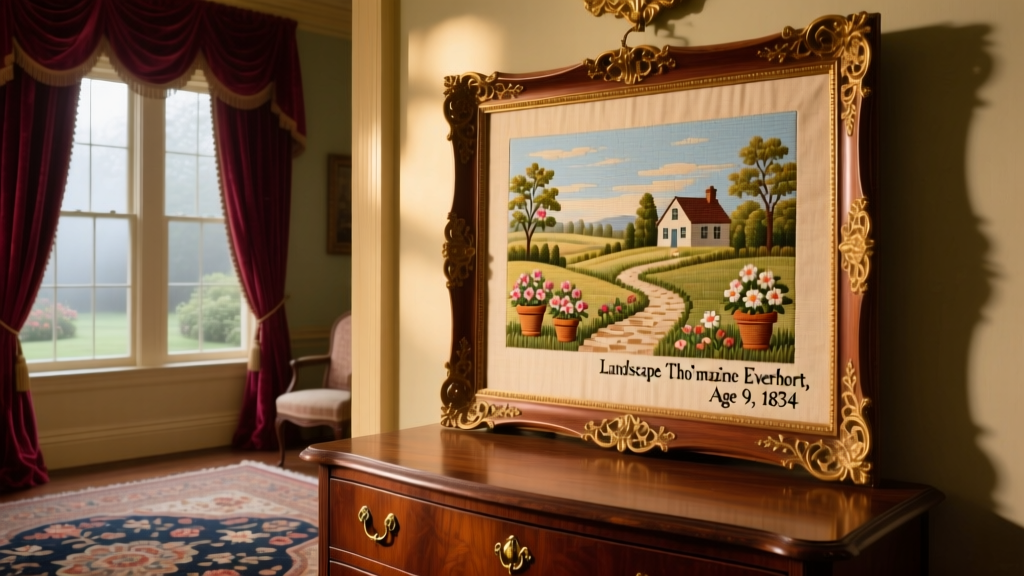
Thomazine Everhart’s 1834 Floral Sampler: A Nineteenth-Century Child’s Masterpiece in Silk and Linen

The 1134751: A Deep Technical and Historical Analysis of the 1928 Dunbar 'Chippendale Revival' Walnut Armchair
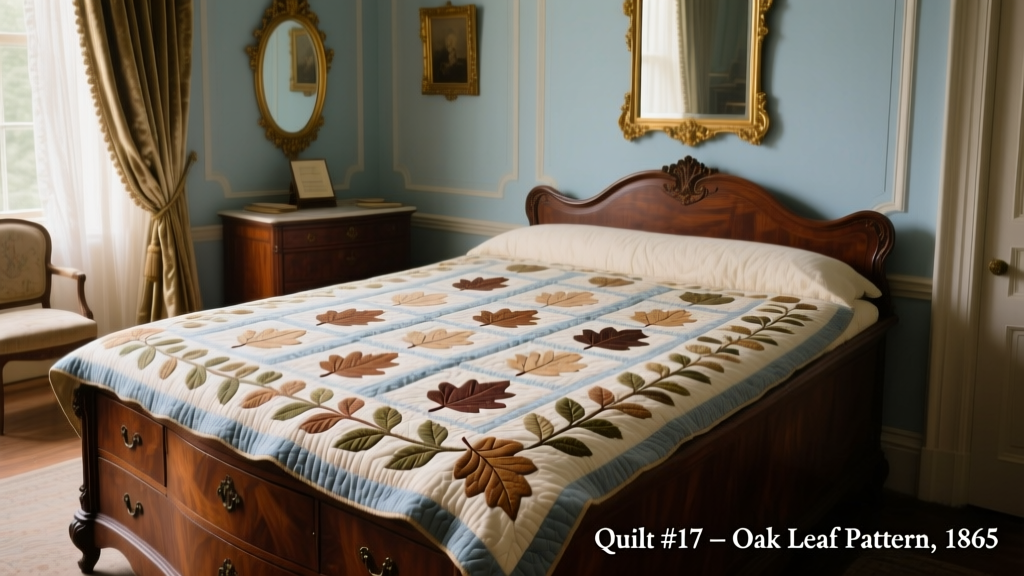
Appliquéd Oak Leaf Quilt: Historical Significance, Construction Analysis, and Conservation Protocol for an 1880s American Heirloom (84 × 79 in)

Johnny Yuma Hartland Figure: A Deep Dive into the 9-Inch Western Action Toy with Horse, Hat, Pistol, and Shotgun
Gene Autry’s Red Shirt: A Collector’s Guide to the 1951 Simon & Schuster Hardcover for Young Readers

The 1955 Davy Crockett Metal Lunch Box: A Canadian Variant Without Thermos — Identification, Provenance, and Restoration Insights
Golden Oak Armoire with Beveled Mirror Doors & Three Drawers: A Restoration Specialist’s Guide to the 48-Inch Double-Door Cabinet