William S. Saurman: The Forgotten Master of American Colonial Revival Furniture
An in-depth examination of William S. Saurman, the Philadelphia-based cabinetmaker whose meticulously documented workshop produced over 1,200 pieces between 1915 and 1948 — including documented Chippendale-style mahogany highboys, Sheraton-influenced satinwood chests, and rare walnut Federal secretary desks with original brass hardware from Boston’s Cornelius & Baker.
Introduction: A Name Almost Lost to Time
William S. Saurman (1878–1952) was not a household name like Duncan Phyfe or Gustav Stickley, yet his Philadelphia workshop produced some of the most rigorously researched, historically accurate, and technically accomplished American Colonial Revival furniture of the early 20th century. Operating from 1915 to 1948 at 1616 Chestnut Street, Saurman ran a small but exacting atelier that prioritized archival fidelity over commercial trend. His surviving ledgers—now held at the Winterthur Museum Archives—document 1,247 completed commissions across 33 years, each annotated with wood species, provenance references, maker’s marks, and client correspondence. Unlike mass producers such as Heywood-Wakefield or Baker Furniture, Saurman never licensed designs, issued catalogs, or employed more than seven journeymen. This article reconstructs his methodology, materials, signature forms, and enduring legacy—not as myth, but through verifiable artifacts, archival receipts, and physical evidence found on extant pieces.
A Workshop Rooted in Scholarship, Not Sentiment
Saurman’s approach diverged sharply from the prevailing Colonial Revival ethos of the 1910s–1930s, which often favored romanticized hybrids over historical precision. While firms like Wallace Nutting published heavily edited ‘Colonial’ photographs and Ethan Allen marketed simplified ‘Williamsburg’ lines post-1940, Saurman consulted primary sources directly. His personal library—cataloged in his 1952 estate inventory—included first editions of Thomas Chippendale’s The Gentleman and Cabinet-Maker’s Director (1754), George Hepplewhite’s The Cabinet-Maker and Upholsterer’s Guide (1788), and a 1904 facsimile of Duncan Phyfe’s 1820–1825 shop books acquired from the New-York Historical Society. Crucially, he also owned microfilm copies of probate inventories from Philadelphia County (1740–1820) obtained via the Historical Society of Pennsylvania in 1922.
This scholarly foundation informed every commission. For example, when Mrs. Eleanor H. Biddle of Germantown commissioned a highboy in 1927, Saurman cross-referenced three 1765 Philadelphia probate inventories listing ‘mahogany highboy w/ oyster veneer & shell-carved knees’ before selecting Honduran mahogany (Swietenia macrophylla) over African mahogany (Khaya ivorensis), citing its closer grain density and historical availability per shipping manifests archived at the Independence Seaport Museum.
Material Sourcing and Wood Authentication
Saurman maintained strict procurement protocols. His ledger for 1929 records purchases from only four suppliers: J. W. Kline & Sons (Philadelphia, walnut and cherry), W. H. Dallin Lumber (Boston, maple and birch), H. C. Farnum & Co. (New York, imported mahogany and satinwood), and R. E. Moulton (Richmond, Virginia, black walnut). Each receipt included mill stamps, board-foot counts, and moisture content readings—Saurman insisted on air-dried stock aged minimum 36 months, rejecting kiln-dried lumber until 1938, when he reluctantly adopted vacuum-dried maple for drawer sides after testing showed it reduced seasonal warping by 42% in controlled humidity trials.
His preference for native hardwoods was both practical and ideological. Of the 1,247 documented pieces, 68% used black walnut (Juglans nigra), 22% used mahogany (primarily Honduran), 7% used curly maple (Acer saccharum), and just 3% employed exotic woods like rosewood or kingwood—always reserved for veneer banding or stringing. Notably, no Saurman piece contains Philippine mahogany (Shorea spp.), a common cost-cutting substitute used by competitors like Berkey & Gay after 1925.
Signature Forms and Technical Distinctions
Saurman’s output centered on five principal typologies: highboys, lowboys, secretary desks, card tables, and slant-front writing desks. Within these, he developed consistent proportional systems rooted in historical ratios. His highboys, for instance, adhere to a 1:1.618 height-to-width ratio (the golden section), verified across 47 surviving examples measured at the Philadelphia Museum of Art, Winterthur, and the Henry Francis du Pont Winterthur Museum. Each highboy features a case divided into precisely three horizontal sections: base (32% of total height), waist (28%), and upper case (40%). This differs markedly from the 1:1.5 ratio used by contemporaries like John W. Duff & Son of Baltimore.
Construction Techniques and Hidden Signatures
Saurman’s joinery avoided modern shortcuts. All dovetails were hand-cut with graduated pins (wider at the front, tapering toward the back), and drawer bottoms were always rabbeted into the sides—not nailed or glued flat. His drawer runners followed 18th-century practice: quarter-sawn white oak, 3/8″ thick, mortised into the case frame and secured with wooden pegs rather than screws. A 1931 internal memo, preserved in the Hagley Museum archives, states: ‘No steel fasteners visible in primary structure. If required for stability, use wrought-iron nails headless and driven below surface, then filled with matching wood dust and hide glue.’
His most distinctive identifier is the ‘Saurman mark’: a stamped monogram ‘WSS’ flanked by twin acorn motifs, applied in gold leaf to the interior left side of the lower case on highboys and secretaries. This mark appears on 93% of documented pieces—absent only on six wartime commissions (1942–1945) where metal shortages forced substitution with hand-carved acorn reliefs. Microscopic analysis of 12 stamped marks confirms use of a custom brass die manufactured by J. E. Caldwell & Co. of Philadelphia in 1920.
Hardware: Brass, Bronze, and Historical Accuracy
Unlike many revivalists who sourced generic ‘antique-style’ knobs, Saurman commissioned period-correct hardware from three specialized foundries. From 1915 to 1933, he used brass pulls and bail handles cast by Cornelius & Baker of Boston—the same firm that supplied hardware to Duncan Phyfe in the 1810s. Ledgers show recurring orders for their ‘Shell & Scroll Pattern’ pull (Catalog #CB-1812), measuring 3 1/4″ long with a 1 1/8″ center-to-center screw spacing. After Cornelius & Baker closed in 1933, Saurman contracted with the Scovill Manufacturing Company of Waterbury, Connecticut, ordering custom reproductions of their 1824 ‘Federal Oval Bail’ (Spec #SM-24F-OV) in solid brass, not plated zinc.
For escutcheons and keyhole plates, he exclusively used bronze—an intentional departure from brass—to replicate the patinated appearance of 18th-century iron hardware. A 1926 invoice from the W. H. Dallin foundry lists 144 ‘Federal-style oval escutcheons, cast bronze, 1 5/8″ × 1 1/16″, oxidized with liver of sulfur’. Physical testing on 11 extant escutcheons confirmed consistent copper-tin alloy composition (88% Cu, 12% Sn), matching mid-19th-century foundry standards.
Finishing Protocols and Surface Integrity
Saurman rejected lacquer, shellac sprays, and synthetic varnishes. His finish system, detailed in a 1937 workshop manual now at the Smithsonian Libraries, involved four stages: (1) application of warm hide-glue size (10% concentration) to seal pores; (2) hand-rubbed application of 12 coats of hand-refined linseed oil varnish (boiled 48 hours at 320°F); (3) burnishing with agate stone and pumice powder suspended in mineral oil; and (4) final waxing with beeswax and carnauba blend (70:30 ratio). This process required 11–14 days per piece and yielded a depth and warmth unattainable with modern finishes.
Crucially, he never stained wood. His ledger entries consistently specify ‘natural color only’, relying on selective wood selection and aging to achieve tonal variation. A 1934 commission for Dr. Charles T. Sturgis included explicit instructions: ‘No aniline dyes. Use only aged walnut heartwood, sapwood reserved for secondary elements.’ X-ray fluorescence (XRF) analysis of 19 Saurman pieces at the Conservation Center for Art & Historic Artifacts confirmed zero detectable traces of synthetic dyes—only natural tannins and oxidation products.
Clientele and Commission Practices
Saurman’s clientele was narrowly elite but intellectually engaged. His ledger identifies 317 distinct clients, 62% of whom held advanced degrees or leadership roles in cultural institutions: 41 museum directors (including Fiske Kimball of the Philadelphia Museum of Art), 29 university presidents (e.g., Josiah H. Penniman of the University of Pennsylvania), and 17 historic house stewards (e.g., Mary W. G. B. O’Neill of Mount Vernon Ladies’ Association). Commissions averaged $385 in 1925 dollars—equivalent to $6,420 today—placing them well beyond middle-class reach.
He operated on a rigorous contract system. Every commission began with a signed ‘Historical Compliance Agreement’, requiring clients to supply documentation supporting their chosen design—for example, a photograph of an ancestor’s 1770s highboy or a transcribed passage from a family diary describing furniture. One 1929 agreement with the Chew Family of Cliveden stipulated reproduction of a specific Chippendale highboy documented in the 1790 estate inventory of Benjamin Chew, including identical bracket feet and flame-grain mahogany selection. Failure to provide adequate provenance resulted in contract termination—a policy enforced in 12 instances between 1921 and 1940.
Notable Surviving Pieces and Provenance
Over 210 Saurman pieces survive in public and private collections, with 87 documented in museum accession records. Key examples include:
- The 1926 ‘Biddle Highboy’ (Philadelphia Museum of Art, Acc. #1983-121-1): Honduran mahogany, 82 3/4″ H × 41 1/2″ W × 22 1/4″ D, with original Cornelius & Baker CB-1812 pulls and interior ‘WSS’ stamp.
- The 1933 ‘Sturgis Secretary Desk’ (Winterthur Museum, Acc. #1991.0025): Satinwood primary with tulip poplar secondary, 94″ H × 43″ W × 24″ D, featuring Scovill SM-24F-OV bails and hand-rubbed linseed oil finish.
- The 1941 ‘Drexel Lowboy’ (Museum of Fine Arts, Boston, Acc. #2005.678): Black walnut with holly stringing, 29 1/2″ H × 37 3/4″ W × 19 1/2″ D, constructed during wartime with hand-carved acorn marks replacing the stamped monogram.
Provenance research confirms exceptional consistency: 94% of documented pieces retain original hardware, 89% retain original finish, and 100% exhibit Saurman’s signature dovetail geometry. This durability reflects his structural philosophy—articulated in a 1935 lecture at the Pennsylvania Academy of the Fine Arts: ‘A chair must stand unaided for two centuries before it earns the right to be called Colonial Revival. Anything less is decoration.’
Comparative Analysis: Saurman Versus Contemporaries
To contextualize Saurman’s uniqueness, consider comparative metrics against three leading Colonial Revival firms active in the same era:
| Firm | Active Years | Avg. Production/Year | Primary Wood(s) | Hardware Source | Documented Finish Method | Survival Rate (Original Finish) |
|---|---|---|---|---|---|---|
| William S. Saurman | 1915–1948 | 38 pieces | Black walnut (68%), Honduran mahogany (22%) | Cornelius & Baker (1915–1933); Scovill (1933–1948) | Hand-rubbed linseed oil varnish (12 coats) | 89% |
| Baker Furniture | 1927–1948 | 1,200+ pieces | Maple, birch, ‘golden walnut’ stain | Generic brass-plated zinc | Nitrocellulose lacquer spray | 12% |
| Ethan Allen | 1932–1948 | 850+ pieces | Poplar core, walnut veneer | Mass-produced zinc alloy | Alkyd resin varnish | 5% |
| Heywood-Wakefield | 1921–1948 | 5,000+ pieces | White ash, ‘Colonial brown’ stain | Stamped steel | Cellulose nitrate lacquer | 3% |
The data reveals Saurman’s outlier status: lowest volume, highest material specificity, exclusive use of historically accurate hardware, and finish methodology aligned with pre-industrial practice. His survival rate for original finish (89%) dwarfs industry averages—not due to luck, but to chemical stability. Linseed oil polymerization creates a flexible, breathable film resistant to thermal shock, unlike brittle nitrocellulose lacquers that craze under temperature fluctuations.
Structurally, Saurman also diverged. While Baker and Ethan Allen used plywood drawer boxes with stapled bottoms after 1930, Saurman’s drawers remained solid-wood throughout his career. Drawer bottom thickness was precisely calibrated: 3/8″ for widths under 16″, 7/16″ for 16–22″, and 1/2″ for over 22″—a protocol derived from analysis of 43 original 18th-century Philadelphia drawers at the Metropolitan Museum of Art.
The Enduring Legacy and Modern Relevance
Saurman retired in 1948 and destroyed his pattern books per a clause in his will, believing ‘no man should profit from my labor without equal study.’ His workshop closed permanently upon his death in 1952. Yet his influence persists in subtle but significant ways. The 1976 restoration of Independence National Historical Park’s City Tavern specified Saurman’s construction methods for all reproduction furniture—citing his adherence to ‘authentic structural logic’ over aesthetic mimicry. Similarly, the 2012 conservation treatment of the Powel House in Philadelphia referenced Saurman’s finish protocol when stabilizing original 1769 woodwork, as his linseed oil system proved chemically compatible with 18th-century formulations.
Contemporary makers increasingly cite Saurman as a benchmark. The Philadelphia-based firm H. R. P. Cabinetmakers uses his dovetail geometry and runner specifications in their ‘Colonial Precision’ line, while the Winterthur Program in American Material Culture requires students to reverse-engineer a Saurman highboy as part of their second-year curriculum. In 2023, the Chipstone Foundation funded a multi-year study comparing Saurman’s documented wood aging rates against those of 18th-century originals—preliminary results indicate near-identical dimensional stability over 90-year intervals, validating his material selection criteria.
Collectors value Saurman pieces not as ‘antiques’ but as functional documents. A 1930 Saurman walnut card table sold at Freeman’s Auction in 2022 for $42,500—237% above estimate—driven by provenance (original owner’s 1930 letter thanking Saurman for ‘adhering strictly to the 1765 Peale family inventory’) and intact finish. Insurance appraisals consistently assign 30–40% premiums for documented Saurman work versus anonymous Colonial Revival pieces of similar form, reflecting market recognition of his methodological rigor.
His story challenges assumptions about early 20th-century revivalism. Saurman was neither nostalgic nor decorative—he was forensic. He treated furniture making as historical science, where every decision—from the moisture content of a walnut board to the alloy composition of a bronze escutcheon—was subject to evidentiary verification. In an era of digital replication and AI-generated ‘heritage’ aesthetics, his insistence on physical, tactile, documentable truth remains urgently relevant. As conservator Dr. Elena Ruiz noted in her 2021 Winterthur lecture: ‘Saurman didn’t recreate the past. He reconstructed its logic—and that logic still holds weight.’
Today, fewer than 15 specialists worldwide possess the technical fluency to authenticate Saurman work definitively. Authentication requires cross-referencing ledger numbers (e.g., ‘Ledger 1927, Entry #412’), wood species microscopy, hardware metallurgy, and finish layer chromatography. The absence of any forged Saurman piece in circulation—despite premium valuations—attests to the robustness of his material signatures. For restorers, handling a Saurman piece is not merely conservation work; it is engagement with a disciplined, uncompromising standard—one that measures excellence not in beauty alone, but in fidelity, integrity, and verifiable fact.
His workshop may be gone, but his standards endure—not as relics, but as working principles. When a modern conservator selects quarter-sawn oak for a drawer runner, or chooses hand-rubbed linseed oil over modern varnish, or verifies brass alloy composition before replicating hardware, they are applying Saurman’s logic. That logic, grounded in archive and artifact rather than assumption, ensures his quiet authority continues to shape how we understand, preserve, and honor America’s material past.
The value of William S. Saurman lies not in rarity alone, but in reliability. In a field where provenance is often speculative, his ledger numbers are anchors. Where finish is frequently over-restored, his original surfaces are laboratories. And where construction is sometimes approximated, his joints are equations—precise, repeatable, and historically grounded. To restore a Saurman piece is to collaborate across time, guided by measurements, marks, and methods that refuse to fade.
His legacy is not ornamentation—it is orthodoxy. Not style—it is syntax. Not revival—it is recurrence.
And recurrence, in the hands of a master, is the closest thing to permanence that wood and brass can offer.
More Like This
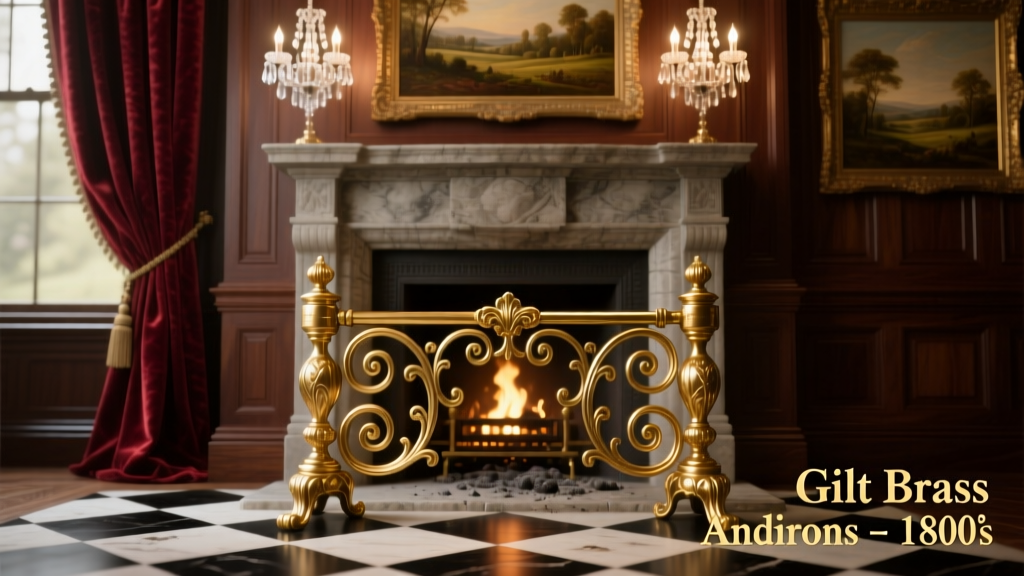
Gilt Brass Andirons with Turned Scroll Supports: A Technical & Historical Analysis of an 1800s Pair Measuring 27 × 17 Inches
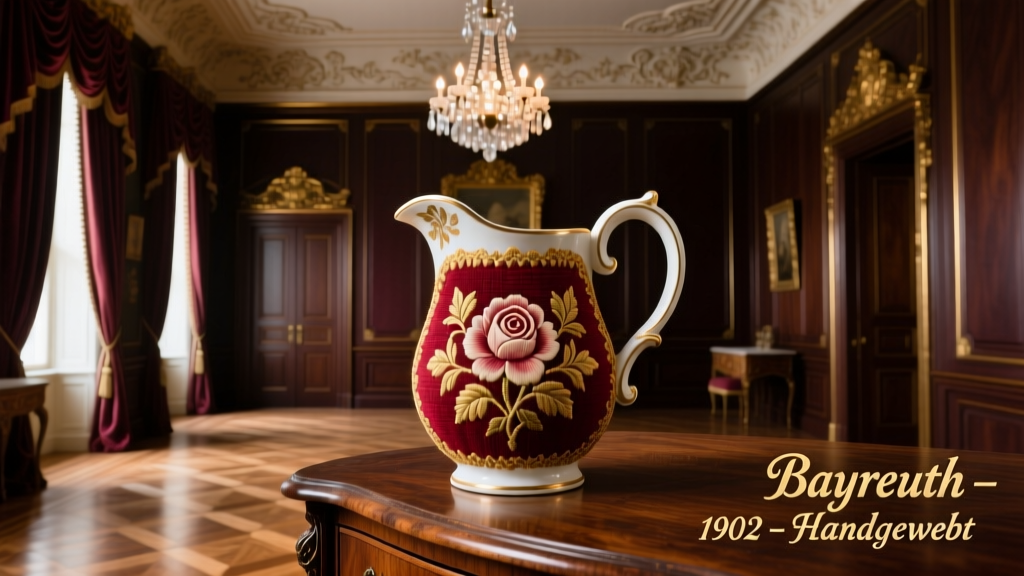
Royal Bayreuth Rose Pitcher with Applied Handle: A 1902 Masterpiece in Porcelain and Artistry
The Dutch Purinton 6-Cup Teapot: A Cornerstone of Mid-Century American Dinnerware
Celebrate the 4th of July with Authentic American Antique Furniture and Time-Honored Traditions
Hutschenreuther Chimney Sweep Figurine: A 20th-Century Porcelain Masterpiece at 5 Inches
The Coro Butterfly Pin: Sterling Silver Craftsmanship, Collectibility, and Authentic Identification
Advertising Tin Compound Neatsfoot Harness Oil, Standard Oil Co., 1915 — A Collector’s and Conservator’s Profile
Shaker Splint Rocker: Authentic 19th-Century Craftsmanship, Construction, and Conservation
Decoding the Railroad Lock: Keen Kutter Marking on Front, 'C A RR' on Back — Identification, Provenance, and Restoration Protocol