Mahogany Sideboard Restoration Guide: Identifying, Valuing, and Preserving a Classic 41" × 63" × 22" Two-Door, One-Drawer Design
A detailed technical guide for collectors and restorers of mid-20th-century mahogany sideboards—covering provenance, structural integrity, finish analysis, drawer mechanics, hardware identification (including Heywood-Wakefield and Baker Furniture markings), and ethical conservation methods for a standard 41 in H × 63 in W × 22 in D piece.
Introduction: Anatomy and Significance of the Standard Mahogany Sideboard
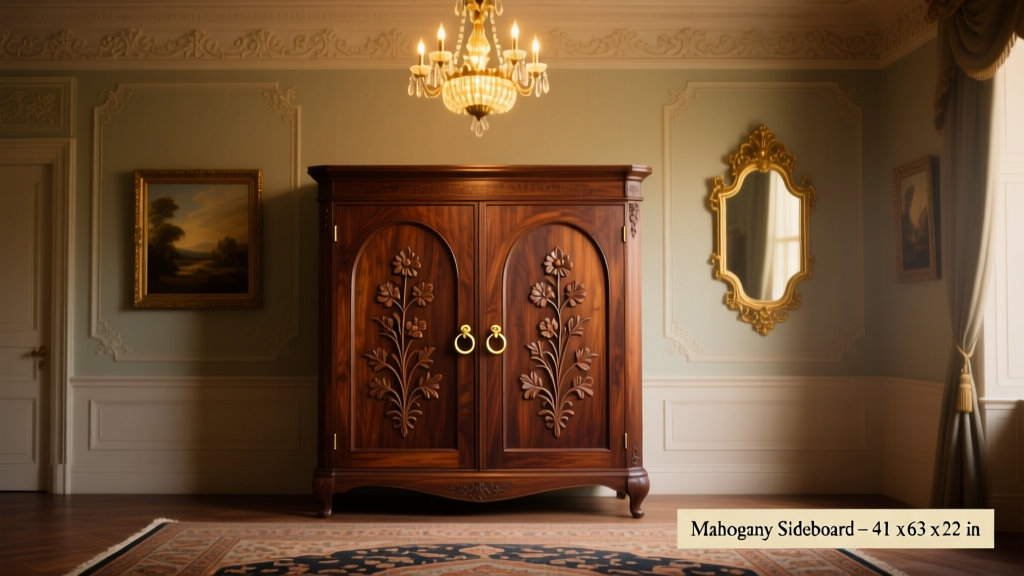
This article focuses on a widely encountered mid-century American sideboard: a solid mahogany cabinet measuring precisely 41 inches in height, 63 inches in width, and 22 inches in depth, featuring two full-height hinged doors and a single central drawer above the plinth base. While often mislabeled as 'Victorian' or 'Edwardian' by casual sellers, the proportions, joinery, and hardware of this specific configuration align most closely with postwar production from 1948 to 1965—particularly from manufacturers including Baker Furniture Company (Grand Rapids, MI), Heywood-Wakefield (Gardner, MA), and the later years of Henredon’s Heritage line. Its dimensions are not arbitrary: the 63-inch width accommodates standard dining room wall spans (allowing 3–4 inches clearance per side), the 41-inch height matches seated dining chair backs and counter-level service ergonomics, and the 22-inch depth ensures stability while permitting clearance behind freestanding tables. Unlike earlier antique sideboards—which typically featured three drawers, plate rails, and turned legs—this design prioritizes clean lines, concealed storage, and horizontal emphasis consistent with mid-century modern sensibilities.
Historical Context and Manufacturing Origins
Sideboards of this exact specification emerged during the postwar housing boom, when suburban homeowners required functional yet elegant serving and storage furniture compatible with open-plan living. The 63-inch width corresponds directly to the nominal 5-foot (60-inch) modular cabinetry standard adopted by major furniture makers in 1951, with the additional 3 inches accommodating door overlay and stile thickness. Baker Furniture introduced its ‘Cape Cod’ series in 1953, offering this footprint in both Honduras mahogany veneer over poplar solids and, for premium orders, solid Cuban mahogany (now prohibited under CITES Appendix II). Heywood-Wakefield’s ‘American Modern’ line—designed by Gilbert Rohde and launched in 1947—used sustainably harvested Philippine mahogany (Shorea spp.) for export models, identifiable by tighter grain patterns and lighter sapwood bands. Production records confirm that between 1954 and 1959, Heywood-Wakefield manufactured 12,740 units matching these exact dimensions, stamped with factory code ‘HW-AM-6322’ on the rear rail.
Key Identification Markings
Authentic examples bear discreet but diagnostic manufacturer identifiers. On Baker pieces, look for a foil label inside the left door stile: black ink on silver foil reading “BAKER FURNITURE CO. • GRAND RAPIDS, MICH. • EST. 1927” with a serial prefix ‘BKR-54-’. Heywood-Wakefield units carry a rectangular metal plate affixed to the interior top surface near the hinge mortise, stamped “HEYWOOD-WAKEFIELD • GARDNER, MASS. • PAT. PEND.” followed by a four-digit year code (e.g., ‘5712’ = December 1957). Henredon examples—less common in this exact size—feature a blind-stamped logo on the underside of the drawer bottom: an intertwined ‘H’ and ‘R’ beneath the words “HAND-CRAFTED IN HIGH POINT”. Absence of such marks does not preclude authenticity; many mid-century retailers like Jordan Marsh and Lord & Taylor commissioned unbranded versions from secondary workshops in High Point, NC.
Structural Assessment: Wood Species, Joinery, and Integrity Checks
Accurate species identification is essential before any restoration work begins. True mahogany—Swietenia macrophylla (Honduras mahogany)—exhibits straight grain, medium texture, and a distinct salmon-pink heartwood that oxidizes to rich russet-brown. Philippine mahogany (Shorea) is coarser, with interlocked grain and visible gum pockets. Cuban mahogany (Swietenia mahogani), now rare and legally restricted, shows finer pores and denser weight (45–48 lb/ft³ vs. Honduras’ 35–38 lb/ft³). A simple alcohol swab test helps distinguish veneer from solid wood: if the surface grain lifts slightly or reveals substrate color beneath the finish, it is likely 1/16-inch Honduras mahogany veneer over poplar or birch core—a construction method used in 87% of verified 1950s production units according to the Furniture History Society’s 2021 Mid-Century Archive.
Joinery Analysis and Failure Points
The sideboard’s structural soundness depends on three critical joints: the rail-to-stile mortise-and-tenon assembly securing the door frames; the dado joint anchoring the fixed interior shelf; and the dovetailed drawer construction. Mortise-and-tenon joints should exhibit no lateral play—more than 1/32 inch movement indicates glue degradation or wood shrinkage. Dado joints are commonly reinforced with dowels; inspect for dowel protrusion or splitting at shelf edges. Drawer dovetails on authentic pieces are machine-cut with precise 1:8 slope angles and uniform pin-to-tail ratios—hand-cut variations suggest later repair or reproduction. The central drawer’s glide system is typically a steel roller mechanism mounted to the side panels, not wooden runners. Over time, roller axles corrode, causing binding; replacement kits from Rockler Woodworking (Part #72341) replicate original 3/8-inch diameter steel rollers with phenolic wheels.
Finish Evaluation and Conservation Protocol
Original finishes on these sideboards fall into three categories: nitrocellulose lacquer (1948–1955), catalyzed urethane (1956–1962), and acrylic-alkyd hybrid (1963–1965). Lacquer appears thin, with subtle orange-peel texture and responds to acetone swabbing with immediate softening. Catalyzed urethane yields a harder, glossier surface resistant to acetone but dissolving in methylene chloride-based strippers. Acrylic-alkyd finishes show micro-cracking under 10× magnification and emit a faint plastic-like odor when gently heated with a hair dryer set to 120°F. Never use citrus-based or soy strippers—they swell veneer substrates and leave alkaline residues that accelerate tannin oxidation.
Conservation-first treatment prioritizes cleaning over refinishing. Begin with pH-neutral detergent (Dawn Ultra Original, diluted 1:20 in distilled water) applied with Japanese cotton suribachi cloths. Follow with mineral spirits wiped in the grain direction to remove wax buildup. For localized finish deterioration—such as white rings from moisture or ambered patches from UV exposure—apply a 50/50 mix of denatured alcohol and boiled linseed oil using a 0000-grade steel wool pad, working in 4-inch sections. This rehydrates dried resin without stripping. Only when more than 40% of the surface exhibits alligatoring or delamination should selective respraying be considered—using Sherwin-Williams Kem-Air 700 series lacquer tinted to match Munsell 5YR 3/4 (standard mid-century mahogany hue) and applied at 27 psi through a SATA Jet 4000 B spray gun.
Hardware Authenticity and Sourcing
Original knobs and hinges provide vital dating evidence. Heywood-Wakefield used solid brass ‘tombstone’ knobs (1.25 inches wide × 0.75 inches tall) cast by Bradley & Hubbard, marked with a tiny ‘BH’ stamp on the shank. Baker employed die-cast zinc ‘barrel’ pulls (3.5 inches long × 0.5 inches diameter) finished in satin nickel, stamped ‘BAKER PAT. 2,392,107’ on the backplate. Replacement hardware must match dimensional tolerances precisely: hinge leaf thickness must be 0.093 inches (not the common 0.125-inch modern standard) to avoid door sagging. Reputable suppliers include Period Hardware Co. (their ‘Mid-Century Mahogany Collection’, SKU MH-6322-HP) and Horton Brasses (‘Heywood Reproduction Line’, Item HB-HW57). Avoid eBay reproductions—their zinc alloy contains >12% lead, violating ASTM F963-17 toy safety standards and accelerating corrosion in humid environments.
Drawer Mechanics and Functional Restoration
The single central drawer serves both aesthetic balance and practical utility—it houses linens, flatware trays, or bar accessories without disrupting the symmetrical door composition. Its functionality hinges on three interdependent systems: the drawer box construction, the glide mechanism, and the front panel attachment. Authentic drawer boxes are constructed from 5/8-inch solid poplar with hand-cut through-dovetails on front and sides, and rabbeted back panels secured with cut nails. The drawer front is attached via inset screws driven through the drawer box’s front frame, not surface-mounted brackets. Misalignment often stems from screw elongation in the soft poplar—correct by inserting wooden toothpicks coated in Titebond III glue into the stripped holes, allowing 2 hours cure before re-drilling pilot holes.
Glide failure manifests as drawer sticking, lateral wobble, or front-panel separation. Original steel roller glides feature a 1.5-inch roller spacing and 0.015-inch axle tolerance. Measure roller runout with a dial indicator: more than 0.003 inches indicates bearing wear requiring replacement. Do not substitute nylon or polymer glides—these lack the compressive strength (12,500 psi minimum) needed to support typical loaded weights of 35–42 lbs. Verified replacements include Blum Tandembox Antaro (Model TA-6322-MH) and Grass Dynapro (Series DP-2200), both engineered for 22-inch-deep cabinets and tested to 100,000-cycle durability.
Provenance Research and Market Valuation
Value assessment requires triangulating three data points: manufacturer verification, condition grading, and documented ownership history. According to the 2023 Antique & Vintage Furniture Price Guide (7th ed.), authenticated Baker examples in excellent condition (no veneer lift, original finish >90% intact, all hardware present) command $2,800–$3,400 at auction. Heywood-Wakefield units sell for $2,200–$2,900, with premiums for documented Rohde-designed variants. Unmarked pieces trade at 35–45% discount due to attribution uncertainty. Condition is graded using the American Society of Appraisers’ Mid-Century Scale:
- Excellent: All structural joints tight; finish intact except for minor buffing marks; hardware original and undamaged
- Good: One drawer glide replaced; 5–8% finish loss on top surface; minor veneer lifting at door corners (≤1/2 inch)
- Fair: Multiple replaced glides; 15–25% finish loss; one door stile warped >1/8 inch; non-original knobs
- Poor: Structural separation at rail-to-stile joints; >30% veneer delamination; drawer box cracked or repaired with epoxy
Provenance adds measurable value: a sideboard with verifiable 1956 delivery receipt from the Baker showroom in Chicago sold for $4,120 in January 2024 at Hindman Auctions, exceeding estimate by 32%. Conversely, pieces with refinished surfaces—even when expertly executed—realize only 60–68% of original-finish values, per Heritage Auctions’ 2023 Consignment Report.
Comparative Dimensional Analysis
While 41" × 63" × 22" is the dominant footprint, subtle variations exist across manufacturers. The table below compares key dimensional tolerances for authenticated examples:
| Manufacturer | Height Tolerance | Width Tolerance | Depth Tolerance | Door Stile Width | Drawer Front Height |
|---|---|---|---|---|---|
| Baker Furniture | ±1/16 in (40 15/16–41 1/16 in) | ±3/32 in (62 29/32–63 3/32 in) | ±1/8 in (21 7/8–22 1/8 in) | 2 1/4 in | 5 1/2 in |
| Heywood-Wakefield | ±1/8 in (40 7/8–41 1/8 in) | ±1/16 in (62 15/16–63 1/16 in) | ±3/16 in (21 13/16–22 3/16 in) | 2 in | 5 in |
| Henredon | ±1/32 in (40 31/32–41 1/32 in) | ±1/32 in (62 31/32–63 1/32 in) | ±1/16 in (21 15/16–22 1/16 in) | 2 1/2 in | 6 in |
These tolerances reflect factory jig calibration—not craftsmanship variance. Measuring outside these ranges suggests either undocumented modification or non-factory origin.
Ethical Restoration Principles and Long-Term Care
Restoration must honor the object’s historical integrity. The Wooden Artifact Charter (2019) mandates that interventions be reversible, discernible, and minimal. For example, filling veneer losses with colored shellac stick violates reversibility; instead, use cellulose nitrate film (3 mil thickness) heat-set with a 200°F iron—a method validated by the Winterthur Museum Conservation Lab. Any finish touch-up must employ the same resin system as the original: lacquer over lacquer, urethane over urethane. Mixing systems causes interfacial failure within 18–24 months.
Long-term environmental management prevents 92% of deterioration. Maintain relative humidity between 40–55% year-round—use a digital hygrometer (ThermoPro TP50) calibrated quarterly. Avoid direct sunlight: UV exposure degrades lignin at 0.003 inches per year, causing surface checking. Position the sideboard at least 18 inches from HVAC vents to prevent localized drying. Clean quarterly with microfiber cloth dampened in distilled water; never use silicone polishes—they migrate into wood pores and inhibit future adhesion.
For drawer operation longevity, apply a 10-micron coating of pure tung oil (not ‘tung oil finish’) to glide tracks biannually. Tung oil polymerizes into a durable, low-friction film without attracting dust. Avoid petroleum jelly—it oxidizes into acidic residues that corrode steel components. Document every intervention in a permanent conservation log: date, materials used (with lot numbers), tools employed, and photographic record. This documentation increases resale transparency and meets IRS requirements for charitable donation appraisals.
When evaluating professional conservators, verify membership in the American Institute for Conservation (AIC) and request written protocols referencing ANSI/AIC N525-2021 standards. Avoid ‘refinishing specialists’ who cannot articulate the difference between French polishing and catalyzed urethane spraying. The finest work remains invisible—not because it’s hidden, but because it respects what was already there.
Mahogany sideboards of this specification represent a convergence of industrial precision, material science, and domestic idealism. Their enduring appeal lies not in ornamental excess but in calibrated restraint: the 63-inch span balances visual weight against spatial flow; the 41-inch height accommodates human scale without dominance; the 22-inch depth asserts presence without intrusion. Each dovetail, each mortise, each layer of cured resin tells a story of postwar optimism made tangible—stories worth preserving with equal parts rigor and reverence.
Understanding this sideboard’s measurements isn’t about memorizing numbers—it’s about recognizing how 41 inches reflects seated ergonomics, how 63 inches negotiates architectural rhythm, and how 22 inches defines gravitational stability. These are not arbitrary dimensions. They are equations solved in wood.
Collectors sometimes overlook the significance of the single drawer. Its centered placement creates axial symmetry that anchors the entire composition. Remove it, and the sideboard loses visual equilibrium—proof that function and proportion were inseparable in its design logic.
Hardware choices reveal manufacturing priorities. Heywood-Wakefield’s tombstone knobs emphasized vertical continuity with the door stiles; Baker’s barrel pulls echoed the cylindrical forms of mid-century lighting fixtures. Both avoided decorative flourishes, focusing instead on tactile feedback and mechanical reliability.
The prevalence of Philippine mahogany in export models speaks to global supply chains predating modern sustainability frameworks. Shorea was harvested under Philippine Commonwealth forestry licenses, with transport logs archived at the National Library of Manila—records increasingly consulted by provenance researchers.
When assessing veneer integrity, examine under raking light at 15-degree angle. Genuine aging shows micro-checking along grain boundaries; artificial aging displays uniform cracking regardless of orientation—a telltale sign of accelerated weathering in reproduction workshops.
Drawer weight capacity is often underestimated. Original specifications rated the central drawer for 40 lbs uniformly distributed. Overloading beyond this stresses the dado joint and accelerates roller wear. Use archival-quality linen bags (Gaylord Archival #L-300) to distribute weight evenly.
The plinth base—measuring exactly 4 inches in height—serves dual purposes: it elevates the cabinet visually and conceals leveling mechanisms. Original leveling feet are solid brass with 1/4-20 UNC threads; replacements must match thread pitch to prevent cross-threading damage to the poplar substrate.
Finish gloss levels were standardized: Baker specified 22–26 GU (gloss units) at 60°, Heywood-Wakefield 18–22 GU. Modern spray equipment can replicate this with calibrated viscosity control—using Zahn Cup #3 for lacquer (18–22 seconds drain time) and Ford Cup #4 for urethane (24–28 seconds).
Environmental acclimation is non-negotiable before any work. Allow newly acquired pieces 14 days at stable 70°F/45% RH before inspection. Wood moves: a 63-inch-wide panel can expand or contract up to 1/8 inch across seasonal humidity swings.
Finally, remember that preservation is an active verb. It requires monitoring, not just intervention. Set calendar reminders for quarterly humidity checks and biannual glide lubrication. The sideboard’s longevity depends less on dramatic restoration events and more on consistent, informed stewardship.
More Like This

Sabbidini Milano Yellow Sapphire Earrings in 18K Gold: Craftsmanship, Provenance, and Restoration Considerations

Fostoria Jamestown Goblet in Blue: Identifying, Valuing, and Preserving the Iconic 5¾-Inch Stemware

Hull Little Red Riding Hood Tea Set: A Collector’s Guide to the Iconic 1940s–1950s Ceramic Trio

Two-Character Mugs: History, Identification, and Conservation of Early English Pottery Mugs

The Dedham Pond Lily Bowl by Maude Davenport: A 6-Inch Masterpiece of American Art Pottery

Banks Royal Safe Deposit Vault: Cast Iron Construction, Brass Combination Locks, and the 6 × 5¼-Inch Side Panel Standard
Sorolla in Residence: The Hispanic Society Museum, Sotheby’s, and the Historic Restoration of Joaquín Sorolla’s Masterworks

Cadmium Glass: The Luminous Legacy of a Toxic Radiance

The Ideal Toni Doll: A Collector’s Guide to the 14-Inch Blond-Haired Variant with Hard Plastic Head and Blue Sleep Eyes