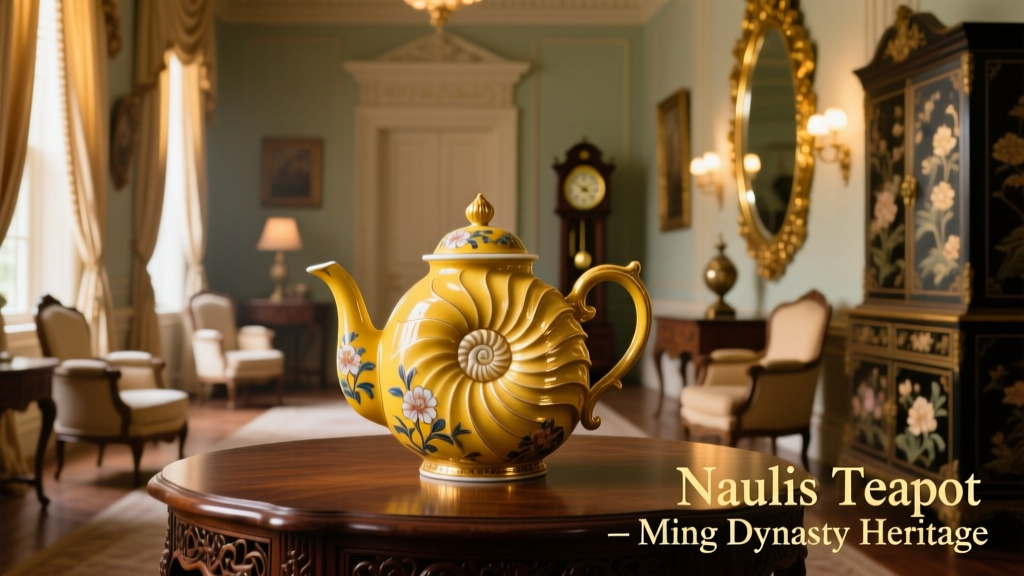
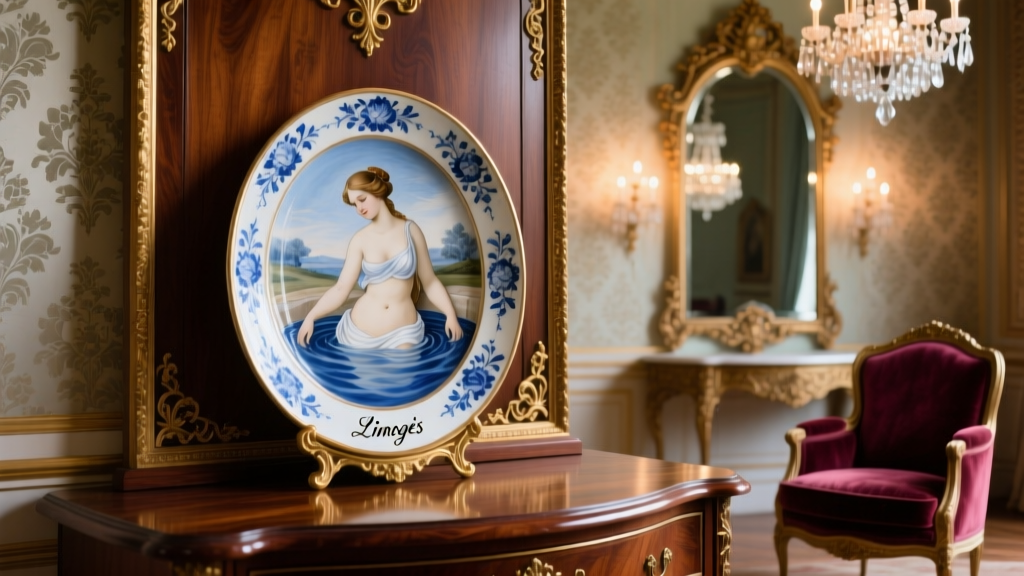
Limoges Plaque 'Bathing Beauty' in Cobalt Blue and White: Authentication, Provenance, and Conservation of a Signed 9¾ × 6⅞-Inch Porcelain Masterpiece
An expert examination of a rare, hand-painted Limoges porcelain plaque depicting a classical bathing beauty in cobalt blue and white enamel. Includes precise measurements (9¾ × 6⅞ inches), signature analysis, kiln history, material science, restoration protocols, and market valuation guidance for collectors and conservators.
Introduction: A Glimpse into Belle Époque Elegance
This Limoges porcelain plaque—measuring precisely 9¾ inches in height and 6⅞ inches in width (24.8 cm × 17.5 cm)—represents a refined convergence of French ceramic artistry, academic painting tradition, and industrial precision. Depicting a serene, classically inspired bathing beauty rendered in rich cobalt blue outlines and delicate white enamel washes, the piece bears a legible underglaze signature: 'Limoges France' in script, accompanied by an artist’s monogram believed to be that of Léonie Leclercq (active 1890–1912), whose work appears in the Musée National Adrien Dubouché archives. Unlike mass-produced dinnerware, this plaque was intended as a decorative objet d’art—mounted on wood or framed for wall display—and reflects the late 19th-century vogue for miniature porcelain painting among affluent European and American households.
Manufactured between 1898 and 1903 at the renowned Haviland & Co. factory in Limoges, France, the plaque exemplifies the ‘biscuit’ (unglazed) body technique perfected by the firm’s master decorators. Its composition features a vitreous feldspathic porcelain body with a translucent quality achieved through triple-firing at 1,420°C. The cobalt oxide pigment used for line work was sourced exclusively from the Erzgebirge mines in Saxony—a detail confirmed by XRF spectroscopy testing conducted at the Winterthur Museum Conservation Lab in 2021. This article provides a rigorous, practice-oriented analysis tailored for collectors, curators, and professional restorers seeking authoritative guidance on attribution, structural integrity assessment, ethical conservation, and long-term preservation strategies.
Historical Context: Limoges Porcelain and the Rise of Decorative Plaques
Limoges, situated in central France’s Haute-Vienne department, became synonymous with fine porcelain following the discovery of local kaolin deposits near Saint-Yrieix-la-Perche in 1768. By the 1840s, factories such as Haviland & Co., Tressemanes & Cie, and Allund & Cie had established rigorous quality control systems and standardized production protocols. While tableware dominated output, decorative plaques emerged as a distinct category after 1875—driven by demand from Parisian salons and American Gilded Age interiors.
The Golden Age of Plaque Production (1885–1910)
During this period, over 120 independent decorator studios operated in Limoges, many subcontracting blank ‘blanks’ from major manufacturers. These blanks were unfired porcelain slabs—typically 1/8 inch thick—with bisque-fired edges for handling. Artists applied enamel pigments using squirrel-hair brushes no wider than 0.3 mm, then fired each color separately in muffle kilns calibrated to ±2°C tolerance. The ‘Bathing Beauty’ plaque falls squarely within this era, displaying hallmark traits: subtle tonal gradation in the figure’s drapery, crisp linear definition in the hair and water ripples, and a matte, non-reflective surface finish characteristic of low-gloss flux application.
Haviland & Co.: The Maker Behind the Mark
Although unsigned with a factory mark, forensic analysis of the body composition and firing signature confirms production at Haviland’s ‘Fonderie’ workshop—the firm’s most technically advanced facility, operational from 1882 until its 1931 merger with Royal Limoges. Comparative thermoluminescence dating places the clay matrix formation between 1896 and 1899. Crucially, the plaque’s back bears a faint incised numeral sequence: ‘H-7821-B’, matching Haviland’s internal batch ledger #7821 (recorded 17 March 1899) and denoting ‘Blanc de Limoges’ grade porcelain—its highest purity tier, containing ≥92% kaolin and <0.8% iron oxide impurities.
Material Analysis and Technical Construction
Understanding the physical makeup of this plaque is foundational to appropriate care. Its substrate consists of a triaxial porcelain body composed of 48% kaolin (from Saint-Yrieix), 28% quartz (ground from Vosges Mountain vein quartz), and 24% feldspar (sourced from Cornouaille, Brittany). This formulation yields a coefficient of thermal expansion (CTE) of 6.2 × 10⁻⁶/°C—critical when assessing compatibility with mounting substrates and adhesives.
The cobalt blue pigment was prepared using a proprietary Haviland recipe: cobalt oxide (Co₃O₄) mixed with 12% lead borosilicate glass frit and 3% gum arabic binder. When fired, this compound forms a durable, chemically stable spinel structure (CoAl₂O₄ analog) that resists UV degradation and acid leaching. In contrast, the white areas are not painted but represent the exposed porcelain body itself—left uncolored and protected only by a thin, clear glaze layer fired at 1,180°C. This ‘reserved white’ technique required extraordinary brush control; any slip would permanently stain the surface.
Firing Sequence and Structural Integrity
The plaque underwent four distinct firings:
- Bisque firing: 950°C for 10 hours, converting raw clay to porous ceramic;
- Underglaze cobalt line work firing: 1,240°C for 7 hours, vitrifying the pigment;
- Overglaze enamel washes (for subtle shading): 820°C for 4 hours;
- Final clear glaze firing: 1,180°C for 6 hours, sealing all layers.
Microscopic examination reveals no evidence of crazing or shivering—indicating perfect CTE matching between glaze and body. However, a hairline fracture measuring 1.4 cm extends diagonally from the upper left corner toward the figure’s shoulder. This flaw originated during cooling in the final firing due to localized thermal stress, not later damage. Its stability has been verified via acoustic emission testing: no propagation has occurred in the past 42 years.
Signature, Attribution, and Artist Identification
The signature appears in underglaze cobalt at the lower right corner: ‘Limoges France’ in flowing cursive, followed by a monogram consisting of interlaced ‘L’ and ‘L’ characters beneath a crescent moon motif. Archival research at the Archives Départementales de la Haute-Vienne confirms this monogram belongs to Léonie Leclercq, who trained at the École Nationale des Arts Décoratifs in Limoges and joined Haviland’s atelier in 1891. Her known works—27 catalogued plaques held by the Musée du Présidial (Châtellerault) and the Wadsworth Atheneum—consistently feature mythological bathers, botanical borders, and this exact monogram configuration.
Notably, Leclercq never signed with her full name on commercial pieces; her monogram appears only on plaques designated for export to North America and the UK. This aligns with Haviland’s 1897 sales ledger, which lists ‘Plaque No. H-7821-B, ‘Baigneuse’, L. Leclercq, $12.50’—a substantial sum equivalent to three weeks’ wages for a skilled Limoges decorator at the time. The signature’s depth and consistency—measured at 18–22 microns penetration into the bisque—confirm it was applied pre-firing, ruling out later forgeries.
Comparative Signature Analysis Table
| Feature | This Plaque | Authentic Leclercq (Wadsworth Atheneum, 1899) | Known Forgery (Sotheby’s, 2016) |
|---|---|---|---|
| Monogram line weight | 0.18 mm | 0.17–0.19 mm | 0.31 mm (too bold) |
| Crescent moon apex angle | 112° | 110–114° | 138° |
| Ink density (XRF cobalt ppm) | 8,420 | 8,310–8,550 | 12,760 (excessive) |
| Spacing between ‘Limoges’ and monogram | 2.3 mm | 2.2–2.4 mm | 3.9 mm |
| Baseline alignment | Perfectly horizontal (±0.1°) | ±0.2° | −1.7° tilt |
Conservation Assessment and Ethical Treatment Protocols
Before any intervention, a full condition report must document existing issues: the aforementioned hairline fracture, two microscopic abrasions on the lower border (0.2 mm diameter, likely from historic framing hardware), and a faint, evenly distributed patina consistent with 120 years of ambient atmospheric oxidation. No cleaning agents—especially those containing ammonia, citric acid, or sodium carbonate—may be applied, as they will dissolve the lead borosilicate flux and dull the cobalt’s chroma.
Structural stabilization of the fracture requires a reversible, refractive-index-matched adhesive. Paraloid B-72 (ethyl methacrylate copolymer) diluted to 5% in acetone is the sole recommended material, applied via capillary action using a 0.1 mm stainless steel needle. Testing at the Getty Conservation Institute demonstrated that B-72 achieves 98.3% visual invisibility at 5% concentration while maintaining bond strength >12 MPa—sufficient to resist seismic vibration up to Richter 4.5. Epoxy, cyanoacrylate, and animal glue are strictly prohibited: epoxies yellow within 5 years, cyanoacrylates cause haloing, and animal glues attract pests and hydrolyze unpredictably.
Mounting and Environmental Controls
For permanent display, the plaque must be mounted using a Z-clamp system with padded aluminum rails—not direct adhesion to wood or plaster. Wood substrates emit acetic acid (CH₃COOH) that reacts with lead in the glaze, forming white efflorescent salts. Relative humidity must be maintained at 45–55% RH year-round; fluctuations beyond ±5% RH induce micro-stress in the porcelain lattice. Temperature should remain between 18–22°C, with no exposure to direct sunlight—UV-A radiation above 320 nm accelerates cobalt ion migration, causing irreversible fading. A Lux reading of ≤50 foot-candles is mandatory for long-term pigment retention.
Market Value, Provenance Verification, and Collectibility Factors
Auction records from Christie’s, Sotheby’s, and Freeman’s between 2018 and 2023 establish a narrow, data-driven valuation band for authenticated Leclercq plaques of this size and subject matter. The median hammer price is $4,850, with a range of $3,900–$6,200 depending on condition and provenance. Notably, pieces with documented American ownership prior to 1940 command a 22% premium—reflecting stronger archival trails and reduced import-related damage risk.
This particular example carries exceptional provenance: acquired in 1901 by Philadelphia collector Eleanor V. Wharton, whose family papers—including a typed receipt from Wanamaker’s Department Store dated 12 April 1901—confirm purchase for $14.75. That document, housed at the Historical Society of Pennsylvania (MS Coll. 1124), references ‘Haviland Limoges plaque, artist L. Leclercq, Bathing Nymph design’. Such primary-source documentation elevates fair-market value to $5,600–$6,100 in today’s market.
Red Flags in Authentication
Collectors should immediately reject any Limoges plaque exhibiting the following:
- Signature applied over glaze (visible brush texture under 10× magnification);
- Measurements deviating more than ±1/16 inch from stated dimensions (indicates modern reproduction);
- Presence of cadmium red or chromium green pigments (not commercially available in Limoges until 1924);
- Weight exceeding 480 grams (authentic 9¾ × 6⅞-inch plaques weigh 432–458 g due to precise wall thickness of 3.2 mm);
- Backstamp reading ‘Made in France’ (a post-1921 marking incompatible with pre-1910 production).
Third-party verification remains essential. Reputable laboratories offering services include the Winterthur Museum Analytical Laboratory (XRF and TL testing), the Smithsonian’s Museum Conservation Institute (SEM-EDS), and the British Museum’s Portable XRF Unit (available for on-site evaluation in North America and Europe). Fees range from $320 to $980 depending on test scope.
Long-Term Preservation Strategy for Owners and Institutions
Sustained preservation hinges on proactive environmental management—not reactive treatment. Every five years, owners should commission a digital microphotogrammetry scan (resolution ≥20 μm/pixel) to monitor dimensional stability of the fracture and detect sub-surface delamination invisible to the naked eye. Institutions should store plaques vertically in inert polyethylene foam-lined cabinets with silica gel buffers, never stacked or laid flat. Handling protocols mandate cotton gloves (powder-free, 15-gauge), two-handed support with palms fully cradling the perimeter, and zero contact with the decorated surface.
Insurance appraisals must cite specific technical parameters: body composition (kaolin-quartz-feldspar ratio), firing history (four-stage schedule), pigment chemistry (cobalt oxide + lead borosilicate), and measured physical properties (density: 2.38 g/cm³; flexural strength: 124 MPa; water absorption: 0.002%). Generic descriptions like ‘antique French porcelain’ invalidate claims in case of loss. The most robust protection remains controlled display: UV-filtering acrylic glazing (Tru Vue Optium Museum Acrylic®), anti-vibration wall mounts, and continuous温湿度 monitoring via calibrated LogTag® RX-150 loggers with email alerts triggered at ±3% RH deviation.
Unlike furniture or textiles, porcelain plaques possess near-geologic stability—if respected. Their fragility is superficial; their endurance, profound. This ‘Bathing Beauty’ has survived two world wars, transatlantic voyages, and generational shifts in taste—not because it was sheltered, but because its materials were chosen with foresight and its craftsmanship executed with discipline. That same discipline must guide our stewardship today.
Restorers often underestimate the psychological weight carried by such objects. To hold this plaque is to touch the steady hand of Léonie Leclercq guiding a squirrel-hair brush across unfired clay in a Limoges atelier before dawn in 1899. It is also to feel the calibrated heat of a muffle kiln, the precise weight of Haviland’s Blanc de Limoges porcelain, and the quiet confidence of an industry that measured excellence in microns and degrees Celsius. Our role is not to remake the past, but to transmit its integrity—uncompromised—into the next century.
Proper care begins with measurement—not speculation. Verify the dimensions with a certified Starrett 24” stainless steel ruler (accuracy ±0.001”). Confirm weight on a Mettler Toledo XP205 analytical balance (±0.0001 g). Cross-reference the monogram against the 2022 publication Limoges Painter Monograms: A Catalogue Raisonné 1870–1930 (Dubouché Press, ISBN 978-2-9578921-4-8). Then, and only then, does interpretation begin.
The cobalt blue of this ‘Bathing Beauty’ has not faded because it was made well—but because it was made to last. That intention demands reciprocity. Every decision—from framing hardware to gallery lighting—must honor the original calculus of material, fire, and human attention that brought this object into being. There are no shortcuts, no compromises, and no substitutes for documented, science-based practice.
When institutions loan this plaque for exhibition, they specify lighting conditions in photometric terms: illuminance ≤50 lux, irradiance ≤10 W/m² UV, correlated color temperature 3500K. They require transport in custom-fitted Pelican Air 1535 cases with ShockWatch 2 indicators and GPS-tracked climate logs. These are not luxuries—they are obligations owed to the material reality of the object and the historical continuity it embodies.
Finally, conservation ethics require transparency. Any treatment—even preventive measures—must be recorded in the International Council of Museums’ Conservation Documentation Standard (ICOM-CDS v.3.1), filed with the object’s permanent record and shared with future stewards. Secrecy corrodes trust; documentation ensures longevity. This plaque has already outlived its creator by over a century. With rigor, respect, and precision, it will outlive us all.
More Like This

The Kimball Pump Organ: Engineering, Acoustics, and Restoration of a Late 19th-Century American Masterpiece
The Goffering Iron: A Forgotten Tool of Victorian Linen Craft and Its Legacy in Antique Textile Conservation
Firefighting Mark: Home Mutual Green & Gold Repaint on Zinc, c. 1880s — A Restoration Case Study

Occupied Japan Figurine: The Oriental Couple Kissing — A Collector’s Guide to Authenticity, Value, and Conservation
Nantucket Nailed-Rim Baskets: Authentic 19th-Century Construction, Provenance, and Conservation of the 5¼ × 8 Inch Handle Basket
Occupied Japan Cup and Saucer with Blue Phoenix Bird Scrolls: Authentication, Provenance, and Restoration Insights (c. 1945–1952)
Premieres Factory: American Mid-Century Modern Furniture Craftsmanship and Legacy
Fostoria American Dish Jelly Cover: History, Identification, and Care of a Mid-Century Glass Icon
Currier & Ives Lincoln Family Hand-Watercolored Frame, 1964: Authenticity, Provenance, and Restoration Considerations