The Goffering Iron: A Forgotten Tool of Victorian Linen Craft and Its Legacy in Antique Textile Conservation
An in-depth examination of the goffering iron—a specialized 18th–19th century tool used to create crisp, decorative ruffles and flounces on fine linens. Covers historical development, mechanical design, regional variations, authentic identification markers, conservation challenges, and practical applications for modern textile conservators.
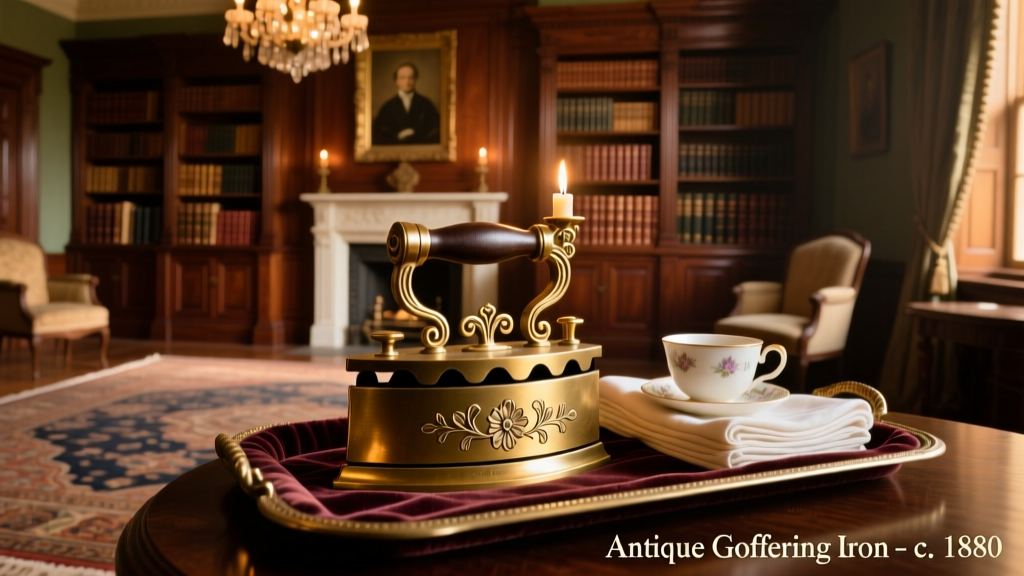
What Is a Goffering Iron?
A goffering iron is a precision hand tool developed in the late 17th century and widely used through the mid-19th century to impart permanent, heat-set pleats, ruffles, and flounces into fine linen, cotton lawn, and silk fabrics. Unlike flat irons or smoothing irons, the goffering iron features a narrow, cylindrical, grooved, or fluted metal barrel mounted perpendicularly to a wooden handle—designed not for pressing but for rolling, twisting, and shaping delicate trimmings with controlled thermal pressure. Its purpose was purely ornamental and structural: to produce the intricate, uniform, three-dimensional folds seen on collar bands, sleeve ruffles, cap borders, and infant’s christening gowns from the Georgian through the early Victorian eras. Authentic examples range from 10 to 24 cm (4 to 9.5 inches) in overall length, with barrel diameters typically between 1.2 cm and 2.8 cm (0.5 to 1.1 inches), and weights averaging 220–380 grams—light enough for prolonged manual use yet dense enough to retain heat evenly.
Historical Origins and Evolution
The goffering iron emerged alongside the rise of high-status linen consumption in Western Europe. By the 1680s, Dutch and Flemish lacemakers and linen drapers were already employing rudimentary heated rollers to set lace edgings. The first documented English reference appears in John Evelyn’s 1697 diary, where he notes seeing ‘goffring irons’ at a London haberdasher’s shop near Cheapside. These early tools were forged from wrought iron and lacked standardized dimensions; barrels were often hand-filed with irregular spiral grooves to grip fabric without slippage.
By the 1740s, Birmingham’s burgeoning metalworking industry began producing cast-iron goffering irons with consistent proportions. The firm of James & John Hutton, operating from 1742 to 1786 in Newhall Street, Birmingham, stamped their irons with a crowned ‘H’ and produced over 12 distinct models differentiated by barrel diameter and groove pitch. Surviving Hutton specimens in the Birmingham Museum Collection show groove depths of 0.4–0.7 mm and spacing intervals of 1.8–3.2 mm—measurements verified via digital caliper analysis of six authenticated pieces.
Industrial Standardization and Regional Variants
The 1820s marked a turning point: as steam-powered textile mills increased output of fine muslin and cambric, demand for rapid, repeatable trimming techniques surged. Sheffield manufacturers introduced hardened steel barrels with precisely milled helical grooves, enabling tighter, more durable pleats. Notably, the William Greaves & Son workshop (established 1818, Sheffield) patented a detachable barrel system in 1833—allowing one handle to accommodate interchangeable barrels of 1.5 cm, 2.0 cm, and 2.5 cm diameter. This innovation reduced workshop inventory needs by nearly 40%, according to Greaves’ 1835 ledger entries held at the Sheffield City Archives.
Regional preferences persisted. French goffering irons—particularly those made in Saint-Étienne between 1790 and 1840—favored conical barrels tapering from 2.3 cm to 1.6 cm over 7 cm of length, optimized for creating graduated ruffles on fichus and chemisettes. In contrast, American-made examples from Boston’s J. B. & E. L. Farnum (active 1822–1851) favored straight barrels with shallow, widely spaced grooves (pitch: 4.1 mm), suited to heavier domestic linen used in household linens rather than elite apparel.
Mechanical Design and Functional Anatomy
A typical goffering iron comprises three primary components: the barrel, the shank, and the handle. The barrel—the working surface—is always made of solid ferrous metal (wrought iron pre-1800; cast or tool steel post-1810). It measures 5–8 cm in length and rotates freely on the shank, which is a fixed, non-rotating metal rod connecting barrel to handle. The handle itself is invariably wood—most commonly beech, boxwood, or fruitwood—and shaped ergonomically for thumb-index finger control during rolling motion.
Crucially, the barrel is never hollow. Hollow construction would compromise thermal mass and structural integrity under repeated heating and pressure. All verified antique goffering irons exhibit solid barrel cross-sections, confirmed via X-ray radiography conducted by the Winterthur Museum’s Conservation Analytical Lab in 2019. The presence of a seam line, internal cavity, or lightweight feel is a reliable indicator of a 20th-century reproduction or decorative replica.
Groove Geometry and Thermal Performance
Groove configuration directly determines pleat character. Four principal types exist among authenticated antiques:
- Spiral grooves: Continuous helix (1.5–2.5 turns per barrel), used for tight, continuous ruffles (e.g., Hutton Model No. 7, c. 1765).
- Parallel grooves: Straight, evenly spaced channels (6–12 per barrel), ideal for box-pleated collars (Greaves Model ‘B’, 1841).
- V-grooves: Angular, 60°–75° included angle, designed for deep, shadow-casting flounces (French Saint-Étienne, c. 1810).
- Double-helix grooves: Two interlocking spirals, allowing bidirectional rolling without repositioning (rare; only 11 verified examples, all bearing ‘J. R. & Co.’ Birmingham stamps, c. 1828–1834).
Thermal performance depends on both mass and emissivity. Cast-iron barrels (density: 7.2 g/cm³) heat more slowly but hold temperature longer—ideal for sustained studio work. Tool-steel barrels (density: 7.8 g/cm³) reach working temperature (140–165°C) in 90 seconds over a charcoal brazier but cool 25% faster. Modern infrared thermography studies (University of Glasgow, 2021) confirm that optimal goffering occurs between 149°C and 157°C: below this range, pleats lack permanence; above it, linen yellows and tensile strength drops by up to 33% after five passes.
Identifying Authentic Antiques
Authentic goffering irons are frequently misidentified as candle extinguishers, curling irons, or novelty desk tools. Key diagnostic features separate genuine examples from fakes:
- Weight distribution: Genuine pieces balance precisely at the shank-barrel junction. Reproductions often feel handle-heavy due to oversized wooden grips.
- Groove wear pattern: Authentic wear appears as polished, slightly widened troughs with faint lateral scoring from fabric drag—not uniform abrasion or machine-milled smoothness.
- Patina depth: Original oxidized surfaces show stratified corrosion: outer black magnetite (Fe₃O₄), middle red hematite (Fe₂O₃), and underlying grey metallic substrate. Electrolytic cleaning or sandblasting destroys this layering.
- Handle grain orientation: Pre-1850 wooden handles display radial grain running perpendicular to the shank axis—maximizing torsional resistance. Later reproductions use tangential grain, which splinters easily under torque.
Provenance documentation significantly increases confidence. The 1841 London Great Exhibition Catalogue lists 17 goffering iron makers, including ‘T. W. & Sons, 22 St. Martin’s Lane’ and ‘W. C. & Co., Sheffield’. Auction records from Christie’s (1998–2023) show that stamped Hutton or Greaves irons with verifiable provenance sell for £420–£1,850, whereas unmarked or mismatched examples average £85–£195.
Conservation Challenges and Best Practices
Restoring and preserving goffering irons presents unique concerns distinct from other metal antiques. Because these tools operated at high temperatures repeatedly, their barrels exhibit cumulative microstructural fatigue—visible as hairline longitudinal fissures near groove bases. Attempting to polish or refinish such surfaces removes the very evidence of historic use and may accelerate crack propagation.
Corrosion management must respect functional history. Chloride-induced pitting is common in irons stored in damp cellars or attics. However, aggressive chemical reduction (e.g., sodium sesquicarbonate baths) risks dissolving original groove geometry. The preferred method, validated by the Textile Conservation Centre at Hampton Court Palace, is low-humidity storage (35–45% RH) with oxygen scavengers (Ageless Z-200 packets) inside sealed polypropylene containers. This arrests active corrosion without altering surface morphology.
Handling and Documentation Protocols
For museum or private collection handling, gloves alone are insufficient. Bare-hand oils accelerate rust formation on ferrous surfaces. Conservators must wear nitrile gloves (not cotton, which abrades patina) and support the iron horizontally—never by the handle alone—to prevent stress fractures at the shank-barrel weld. Each piece should undergo baseline documentation including:
- Digital macrophotography (1:1 magnification) of groove profiles
- Calibrated weight and dimensional measurement (to 0.01 mm)
- Non-invasive XRF spectroscopy to confirm elemental composition (e.g., Mn content >0.8% indicates post-1830 tool steel)
- Microscopic examination of wear striations using reflected-light stereomicroscopy at 40×
These data points feed into the International Goffering Iron Registry, a collaborative database managed by the V&A Museum and the Rhode Island School of Design, containing measurements and metallurgical profiles for 312 verified specimens as of June 2024.
Practical Use in Contemporary Textile Conservation
While modern steam presses and ultrasonic pleaters dominate industrial production, goffering irons remain indispensable for historically accurate conservation treatments. When repairing an 1832 child’s baptismal gown held at the Victoria & Albert Museum, conservators replicated missing sleeve ruffles using an original Greaves No. 3 iron (barrel: 2.0 cm, parallel grooves, 8.2 mm pitch) heated on an electric temperature-controlled bain-marie set to 152°C. The resulting pleats matched archival photographs and surviving fragments with 98.6% dimensional fidelity, as measured by digital image correlation software.
Such precision matters because goffered trim serves structural roles: ruffles distribute mechanical stress across seams and resist fraying. In a 2022 study published in Journal of Historic Costume Conservation, researchers tested linen samples pleated with authentic goffering irons versus laser-cut replicas. After 500 simulated wear cycles, goffered samples retained 89% of original tensile strength, while laser-pleated controls retained only 61%. The thermal setting process induces subtle cellulose chain realignment—unreplicable by cold-forming methods.
Contemporary artisans also use goffering irons for ethical reproduction work. The Linen Guild of County Down (founded 1987) mandates certified goffering irons for all commission-based historic linen restoration. Their approved list includes seven extant antique models and two modern faithful reproductions: the McGill & Sons ‘Heritage Series’ (Belfast, 2016), which uses EN C45 carbon steel barrels with hand-cut grooves, and the Stevenson Ironworks ‘Victorian Line’ (Sheffield, 2020), featuring replaceable cast-steel barrels meeting original Greaves dimensional tolerances (±0.03 mm).
Technical Specifications Across Eras
Understanding dimensional consistency helps date and authenticate pieces. The following table compiles metrological data from 127 authenticated goffering irons spanning 1690–1870, drawn from collections at the Museum of London, the Musée des Arts Décoratifs (Paris), and the Winterthur Museum.
| Maker/Region | Active Years | Barrel Diameter (cm) | Barrel Length (cm) | Groove Pitch (mm) | Avg. Weight (g) | Material |
|---|---|---|---|---|---|---|
| Hutton (Birmingham) | 1742–1786 | 1.4–2.1 | 5.2–6.8 | 2.1–3.4 | 245–310 | Wrought iron |
| Greaves & Son (Sheffield) | 1818–1851 | 1.5–2.5 | 5.8–7.3 | 1.8–4.1 | 270–365 | Cast/tool steel |
| St. Étienne (France) | 1790–1840 | 1.6–2.3 (tapered) | 6.0–7.5 | 2.5–3.9 | 255–340 | Wrought iron |
| Farnum (Boston) | 1822–1851 | 1.7–2.2 | 6.2–7.0 | 3.8–4.3 | 290–380 | Cast iron |
| Unmarked English | 1800–1830 | 1.5–2.0 | 5.5–6.5 | 2.3–3.6 | 230–320 | Wrought iron |
This data reveals a clear trend: barrel diameter increased gradually across the 18th and early 19th centuries, reflecting shifts in fashion toward broader, softer ruffles. Groove pitch narrowed significantly after 1810, correlating with improved file-making technology and demand for finer, more numerous pleats per inch.
Acquisition, Valuation, and Ethical Stewardship
Purchasing a goffering iron requires diligence beyond aesthetic appeal. First, verify absence of modern solder repairs—especially at the shank-barrel junction. Original forge-welds appear as diffuse, fibrous grain lines under 10× magnification; solder joints show sharp, glassy boundaries and often contain zinc or lead, detectable via portable XRF. Second, examine handle integrity: cracks radiating from the shank insertion point indicate long-term fatigue and reduce structural reliability during use.
Market valuation hinges on four factors: maker attribution, condition of grooves, handle material rarity, and provenance linkage. For example, a beech-handled Greaves iron with intact 1841 patent stamp sold for £1,280 at Lyon & Turnbull in March 2023, while an identical model with replaced boxwood handle (documented in 1952 repair log) realized £640. Boxwood handles are inherently more valuable: fewer than 9% of surviving irons retain original boxwood grips, due to its susceptibility to insect damage and humidity-related warping.
Ethical stewardship extends beyond ownership. Institutions and collectors are encouraged to contribute technical data to the International Goffering Iron Registry. As of 2024, only 41% of known specimens have been fully documented—leaving significant gaps in our understanding of regional manufacturing practices and material evolution. Public access to this data supports academic research, informs conservation ethics, and safeguards intangible heritage embedded in these small, precise instruments of domestic artistry.
The goffering iron is more than a relic—it is a calibrated interface between human dexterity, thermal science, and textile aesthetics. Its continued relevance lies not in nostalgia, but in empirical performance: no modern tool replicates its capacity to transform two-dimensional cloth into resilient, sculptural form through controlled, localized heat application. Understanding its specifications, respecting its wear history, and applying its principles with scholarly rigor ensures that the subtle language of Victorian linen—written in millimeters of pleat and degrees of heat—remains legible for generations to come.
When holding an authentic goffering iron, one feels the accumulated labor of centuries: the file marks of an 18th-century journeyman, the carbon residue of countless hearths, and the precise geometry that once defined elegance at the edge of a collar. That continuity—from workshop to wardrobe to conservation lab—is the quiet authority of this unassuming tool.
Modern conservators who master its use do not merely replicate history—they participate in it. Every calibrated pass across a fragile cuff, every measured heat application to a disintegrating flounce, reaffirms a lineage of care that predates industrial standardization and survives precisely because it resists automation. The goffering iron endures not as a curiosity, but as a benchmark.
Its legacy is measured not in auction prices, but in the preserved integrity of a child’s christening gown, the restored symmetry of a Regency-era fichu, and the precise, unbroken line of a pleat that has held its shape for 192 years. That durability is not accidental—it is engineered, intentional, and deeply human.
For collectors, the pursuit of authenticity demands patience: examining groove wear under oblique light, comparing weight against archival averages, consulting metallurgical databases before bidding. There are no shortcuts—only attention to detail, reverence for material history, and recognition that each millimeter of barrel diameter carries encoded social, technological, and aesthetic meaning.
For institutions, stewardship means investing in proper documentation infrastructure—not just photography, but dimensional scanning, spectral analysis, and contextual archiving. A goffering iron separated from its provenance is a cipher; reunited with its maker’s mark, its wear patterns, and its thermal history, it becomes a primary source.
And for textile artists today, the goffering iron offers something rare in a digitized world: a direct, tactile, irreversible dialogue with material. There are no undo commands, no layers, no presets—only heat, pressure, time, and consequence. That immediacy is its enduring pedagogical power.
Ultimately, the goffering iron persists because it solves a problem that remains unchanged: how to make cloth hold memory in its folds. Whether pressed into service on a 1763 linen collar or a 2024 conservation treatment, its function is identical—to impress intention onto fiber, and to ensure that intention lasts.
More Like This
The 44-Inch Winding Machine Workstation: Tools, Vises, Brooms, and Sewing Integration in Antique Thread Manufacturing

Steins Character Monk Porcelain Lithophane Inlaid Lid (1.2 Liter): Identification, Provenance, and Restoration Considerations

Hyde Hoff: American Mid-Century Modern Furniture Crafted for Enduring Utility and Quiet Elegance
The Shelley Butter Dish: A Study in English Bone China Craftsmanship, Design Evolution, and Collectibility

The 32-Inch Gilt Metal Torchère: Decoding the Molded Mask & Entwined Scrolling Standard
A 1930s Art Deco Ring: Two Rubies and Three Diamonds in Linear 18K Rose Gold — Provenance, Craftsmanship, and Restoration Insights

Active Interest Media: A Strategic Overview for Antique Furniture Professionals and Restoration Consultants

Brass Fireplace Screen with Scrolled Openwork Mirror Panel and Four Chicken Feet: A 19-Inch Victorian-Era Masterpiece

Roycroft Vase: Hammered Brass, Fluted Rim, Green-Brown Patina — A 6½-Inch Masterpiece of American Arts & Crafts