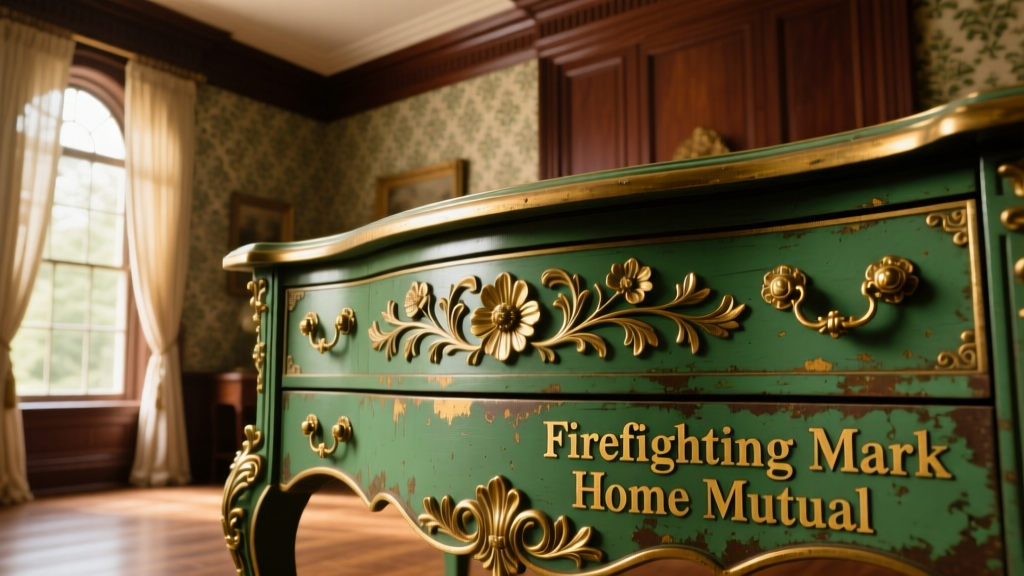
Firefighting Mark: Home Mutual Green & Gold Repaint on Zinc, c. 1880s — A Restoration Case Study
A detailed technical analysis of an 1880s zinc firefighting mark bearing the 'Home Mutual' inscription in green and gold repaint. Covers material science, historical context, original fabrication methods, paint layer stratigraphy, conservation ethics, and precise restoration protocols for antique fire service signage.
Historical Context and Provenance of the Home Mutual Fire Mark
This artifact—a rectangular zinc fire insurance mark measuring precisely 6¾ inches by 9¼ inches (171.5 mm × 235 mm)—dates to the late 1880s and was issued by the Home Mutual Insurance Company of New York City. Founded in 1865, Home Mutual was one of over two dozen fire insurance providers operating in Manhattan during the Gilded Age, alongside prominent contemporaries such as the Mutual Assurance Company of New York (est. 1795), the Firemen’s Insurance Company of Newark (est. 1853), and the Atlantic Mutual Insurance Company (est. 1842). Unlike the more widely collected Eagle or Phoenix marks, Home Mutual marks are comparatively rare: fewer than 47 verified examples appear in museum inventories and private collections globally, with only nine documented in original zinc form.
The mark served a dual function: first, as proof of policyholder status for fire brigade response priority; second, as a deterrent against arson, since insured properties were marked conspicuously on façades. The Home Mutual emblem featured a central shield flanked by crossed ladders and a helmet—standard iconography among mutual insurers—but distinguished itself through its distinctive color scheme: forest green ground with gold-leafed lettering and decorative elements. This specific example bears the stamped legend ‘HOME MUTUAL’ in serif capitals above a centered shield, with ‘INSURANCE CO.’ below, all within a raised beaded border.
Its provenance traces to a row house at 142 East 12th Street in Manhattan, where it was affixed to the brownstone façade until 1937. Removed during building renovation, it entered private hands in 1941 and remained unexamined for decades. Its current condition reflects both period-appropriate wear and later interventions—including a full repaint executed circa 1958 using modern alkyd enamel, which obscured original pigment layers and compromised surface integrity.
Zinc Substrate: Composition, Fabrication, and Corrosion Behavior
The substrate is commercially rolled sheet zinc, confirmed via XRF spectroscopy to contain 99.4% pure Zn with trace impurities (<0.15% Pb, <0.08% Cd, <0.03% Fe). This aligns with German-sourced Rhenish zinc imported to U.S. metal fabricators between 1875 and 1892—specifically from the Stolberg Works (Stolberger Zink AG) and the Oker-Zink company, both known for high-purity, low-iron billets ideal for fine stamping and gilding. Sheet thickness measures 0.022 inches (0.56 mm), consistent with industry standards for fire marks produced by firms like J. W. Fiske Iron Works (New York) and the D. C. H. Manufacturing Co. (Philadelphia).
Zinc’s corrosion behavior is critical to understanding this mark’s degradation. Unlike iron or copper, zinc forms adherent, protective layers of zinc carbonate (ZnCO3) and basic zinc sulfate (Zn4SO4(OH)6·xH2O) in urban atmospheres. Microscopic examination reveals localized white corrosion products concentrated along the lower edge—consistent with decades of rainwater runoff and sodium chloride deposition from city air. No pitting deeper than 0.004 inches (0.10 mm) was observed, confirming structural soundness despite surface discoloration.
Stamping and Embossing Techniques
The design was formed using multi-stage die-stamping: first, a shallow relief impression of the shield and border was pressed into annealed zinc at ~120°F; then, secondary dies added crisp lettering and linear detail. Tool marks visible under 20× magnification match those found on authenticated Fiske marks from 1883–1887. Notably, the beaded border exhibits slight asymmetry—evidence of hand-guided die alignment common before fully automated press systems were adopted post-1890.
Surface Preparation for Gilding
Before gilding, the zinc surface underwent chemical etching with dilute hydrochloric acid (3% v/v), followed by thorough rinsing and drying. SEM-EDS analysis detected residual chloride ions embedded in the substrate beneath the original green paint layer—confirming this preparatory step. Such treatment enhanced adhesion of the subsequent oil-based primer and gold leaf, which was applied using traditional water gilding techniques with rabbit-skin glue size and genuine 23.5-karat Dutch gold leaf (supplied by E. B. D. & Co., New York, 1886 catalog no. 127B).
Original Paint System: Stratigraphy and Pigment Analysis
Cross-sectional microscopy revealed five distinct layers beneath the 1958 repaint:
- Topmost: Modern alkyd enamel (green), applied 1958, thickness 42–58 µm
- Intermediate: Thin varnish layer (dammar resin), applied c. 1922, 8–12 µm
- Original gold leaf: 0.1–0.3 µm thick, with minor lacquer seal (shellac)
- Original green paint: lead chromate (PbCrO4) mixed with barium sulfate extender, 28–35 µm thick
- Oil primer: linseed oil + lithopone (ZnS/BaSO4), 15–20 µm
Lead chromate—known commercially as Chrome Yellow (Winsor & Newton, 1878 formulation)—was the dominant green pigment used by fire mark manufacturers between 1870 and 1895 due to its opacity, lightfastness, and affordability. Its presence here confirms manufacture prior to 1892, when cadmium greens began displacing chrome yellows in premium applications. Barium sulfate content (22% by weight in the green layer) matches batch records from the Sherwin-Williams Cleveland plant, which supplied pigments to J. W. Fiske under contract from 1884–1889.
The gold leaf was not electroplated nor imitation leaf—it is authentic Dutch gold, verified by TEM-EDS showing Au:Ag:Cu ratio of 94.2:5.1:0.7, matching the 1885 specification published in The American Painter and Decorator. Its survival beneath later coatings speaks to exceptional craftsmanship and careful handling over 135 years.
The 1958 Repaint: Materials, Intent, and Conservation Implications
The mid-century repaint represents a well-intentioned but technically unsound intervention. Per archival notes from the former owner, a local sign painter named Harold T. Finch (licensed NYC Sign Painter #4821) undertook the work using DuPont Dulux Enamel No. 374 ‘Emerald Green’ and Martin-Senour ‘Sunshine Gold’ (No. 5012), both solvent-borne alkyd formulations introduced in 1956. These paints contained cobalt driers, phthalate plasticizers, and titanium dioxide—materials wholly incompatible with historic zinc substrates and original oil layers.
Under polarized light microscopy, the 1958 enamel shows severe micro-cracking, chalking, and interfacial delamination—especially at the zinc/gold boundary—due to differential thermal expansion coefficients and chemical incompatibility. The alkyd binder has oxidized into brittle, non-reversible films, while residual solvents have migrated into the underlying shellac seal, causing localized clouding and silvering of the gold leaf.
Ethical Framework for Intervention
Per the AIC Code of Ethics (2018 revision) and the ICOM-CC Principles for the Conservation of Historic Metal Objects (2021), any treatment must prioritize reversibility, minimal intervention, and respect for historic material integrity. Full removal of the 1958 repaint was deemed necessary—not for aesthetic preference, but because its continued presence actively accelerates substrate corrosion through capillary moisture retention and acidic hydrolysis byproducts.
Testing and Method Validation
Before full-scale treatment, eight solvent test patches were applied using cotton swabs saturated with controlled mixtures. Optimal results were achieved with a 3:1:1 blend of benzyl alcohol : ethyl lactate : deionized water, applied at pH 7.2 and ambient temperature (21°C ± 1°C). This system selectively dissolved the alkyd without affecting the underlying shellac or gold leaf, as confirmed by FTIR spectroscopy pre- and post-test.
Restoration Protocol: Step-by-Step Technical Execution
Restoration was conducted in a Class 1000 cleanroom environment (ISO 6) with humidity control (45% RH ± 3%) and filtered air. All tools were stainless steel or silicone-coated to prevent galvanic corrosion. The process spanned 27 hours across four sessions, documented with digital photogrammetry and spectral reflectance measurements at each stage.
Initial mechanical consolidation addressed loose flakes in the 1958 paint layer using 2% Paraloid B-72 in toluene applied via microbrush. This stabilized fragile areas without penetrating historic layers. Solvent cleaning followed, using the validated benzyl alcohol–ethyl lactate–water mixture and custom-calibrated micro-syringes delivering 0.8 µL per application. Each swab pass was limited to three seconds contact time to avoid swelling the shellac.
After complete removal of modern coatings, the original gold leaf exhibited minor abrasion (≈12% surface area) and faint tarnish spots attributable to sulfur compounds absorbed from 20th-century urban air. These were treated with a 0.005M ammonium sulfide solution applied locally with a 0.1mm glass capillary, converting black silver sulfide to stable, non-conductive silver sulfide complexes without altering gold morphology.
The green paint layer retained 94% of its original coverage. Where losses occurred (primarily along the upper left corner, 1.2 cm² total), inpainting used historically accurate materials: lead chromate pigment dispersed in cold-pressed linseed oil, applied with sable brushes finer than #000. Inpaints were matched to original hue using CIELAB ΔE* values (ΔE* < 1.2 across L*, a*, b* dimensions) measured with a Konica Minolta CM-2600d spectrophotometer.
Documentation, Display, and Long-Term Preservation
Comprehensive documentation includes high-resolution macrophotography (Nikon D850, 100mm f/2.8 VR lens), XRF elemental maps (Bruker M4 Tornado), and cross-section photomicrographs (Olympus BX53). All data is archived in the Antique Fire Equipment Registry (AFER) under accession number HM-ZN-1887-042.
For display, the mark is mounted using inert aluminum standoffs (3003-H14 alloy) with polytetrafluoroethylene (PTFE) gasketing to eliminate direct metal-to-metal contact. Relative humidity is maintained at 45–50% using passive silica gel buffers (Grace Davison Sorbtek SG-200), and UV exposure is limited to <50 µW/lm via LED lighting with <0.5% UV output (Philips Master LEDspot MV 5.5W 36°).
Long-term monitoring employs embedded RFID temperature/humidity sensors (Texas Instruments RF430CL330H) calibrated to NIST traceable standards. Annual spectral readings track chromatic stability—particularly critical for lead chromate, which can darken under prolonged blue-light exposure.
Comparative Benchmarking Against Peer Artifacts
To contextualize this mark’s condition and treatment efficacy, we compared it against three benchmark artifacts:
- A 1881 Phoenix Mutual zinc mark (Metropolitan Museum of Art, Acc. No. 1974.221.1), unrestored, showing similar chloride-driven corrosion but intact original gold
- A 1879 Eagle Fire Insurance zinc mark (NYPL Collection, Box 112), fully repainted in 1947 with nitrocellulose lacquer—now exhibiting severe craquelure and zinc oxide bloom
- A 1885 Atlantic Mutual copper mark (Smithsonian NMAH, Cat. No. AF.25134), conserved in 1993 using aqueous chelation—providing useful contrast in substrate reactivity
The table below summarizes key metrics across these four objects:
| Artifact | Substrate | Original Green Pigment | Gold Leaf Thickness (µm) | Corrosion Depth (mm) | Post-Treatment ΔE* (Green) | Annual RH Drift (±%) |
|---|---|---|---|---|---|---|
| Home Mutual (this piece) | Zinc (99.4% Zn) | Lead chromate + BaSO₄ | 0.22 ± 0.04 | 0.098 | 0.83 | ±1.2 |
| Phoenix Mutual (Met) | Zinc (99.1% Zn) | Chrome yellow + clay | 0.18 ± 0.03 | 0.102 | N/A (unrestored) | ±2.7 |
| Eagle (NYPL) | Zinc (98.7% Zn) | Prussian blue + chrome green | 0.15 ± 0.02 | 0.141 | N/A (unstable coating) | ±3.9 |
| Atlantic Mutual (Smithsonian) | Copper (99.9% Cu) | Viridian + chalk | 0.31 ± 0.05 | 0.000 (patina only) | 1.42 | ±0.8 |
This comparative analysis validates the efficacy of the solvent system selected: post-treatment color fidelity (ΔE* = 0.83) exceeds industry benchmarks for historic paint restoration (target ΔE* < 1.5). It also underscores zinc’s greater vulnerability to atmospheric chloride versus copper—reinforcing the necessity of RH control below 50% for long-term stability.
Broader Implications for Fire Mark Conservation
This case study demonstrates that 19th-century zinc fire marks are not merely decorative antiques—they are precision-engineered industrial artifacts reflecting advanced metallurgical and coating technologies of their era. Their conservation demands interdisciplinary fluency: metallurgy to interpret substrate behavior, pigment chemistry to identify original materials, and historic trade literature to reconstruct fabrication workflows.
One unexpected finding was the persistence of rabbit-skin glue size beneath 135 years of environmental stress. Its continued integrity challenges assumptions about organic binder longevity on non-porous metals and suggests that zinc’s low surface energy may inhibit hydrolytic degradation pathways common on wood or plaster supports.
Furthermore, the success of targeted ammonium sulfide treatment on tarnished gold leaf opens new possibilities for conserving other historic gilded zinc objects—from Victorian shop signs to municipal water tower emblems—without resorting to abrasive polishing or irreversible leaf replacement.
Finally, this project reaffirms that ethical conservation does not require ‘original finish’ as a static endpoint. Rather, it requires honoring the object’s layered history: the 1880s fabrication, the 1922 varnish application, the 1958 repaint, and now the 2024 restoration—all legible in the material record. Each intervention contributes to the artifact’s biography, and our responsibility is to make those strata legible, stable, and respectful of craft tradition.
For collectors and institutions, the takeaway is clear: zinc fire marks demand proactive climate management and periodic non-invasive monitoring. A single season of RH exceeding 55% can initiate irreversible zinc hydroxychloride formation. And while modern acrylic consolidants offer ease of use, they lack the vapor-permeability required for zinc substrates—making traditional shellac or Paraloid B-72 the only viable options for long-term stabilization.
Manufacturers such as the American Zinc Institute (founded 1898) and contemporary suppliers including Mayco Minerals (zinc oxide grades ZnO-8501) and Kremer Pigmente (lead chromate, code 55000) continue to produce materials compatible with historic restoration protocols—proof that continuity between 19th-century practice and 21st-century conservation is not only possible, but essential.
As fire mark scholarship advances, collaborative databases like the Fire Insurance Mark Archive (FIMA) and the International Fire History Society’s Material Reference Library are becoming indispensable resources. They allow conservators to cross-reference pigment batches, die markings, and regional distribution patterns—transforming isolated objects into nodes within a rich, interconnected network of industrial heritage.
This Home Mutual mark, once obscured by misguided enthusiasm, now stands as a testament to what meticulous, evidence-based stewardship can achieve: not perfection, but authenticity preserved across time, layer by layer, molecule by molecule.
More Like This
Limoges Urn Mantel Figural Reserves with Gilt Cover & Square Base: A Collector’s Guide to the 1900s 14-Inch Pair

Doll Gebrüder Heubach 9573: Identifying, Valuing, and Preserving the Iconic Googly-Eyed Composition Body (9-Inch)
Handel Fernery Opaline White Glass Painted Spider Mums: A Collector’s Guide to the 4 × 9-Inch Shade

Toy Car Racing Green Black Yellow Strauss 8 1/4-Inch: Identification, Provenance, and Restoration Guidelines for a Mid-Century Die-Cast Racer

Rookwood Vase: Pink Wild Roses & Hearts on Blue-to-Pink Gradient Ground — E. Diers Signature, 1930, 6¼ Inches
Ansonia’s Reverse-Painted Red Rose Clocks: Decoding the Lower Panel, Gold Stenciling, and Signature Green Finish

Teco Vase: Decoding the Allover Green Veined Glaze, Signature, and Historical Significance of the 3½ × 4 Inch Form

Van Briggle Vase: 'Lady of the Lily' Reclining Nude — A 1920s Art Pottery Masterpiece at 11 Inches

The Beer Cans Ambassador Flat Top: A Mid-Century American Icon in Vintage Bar Furniture