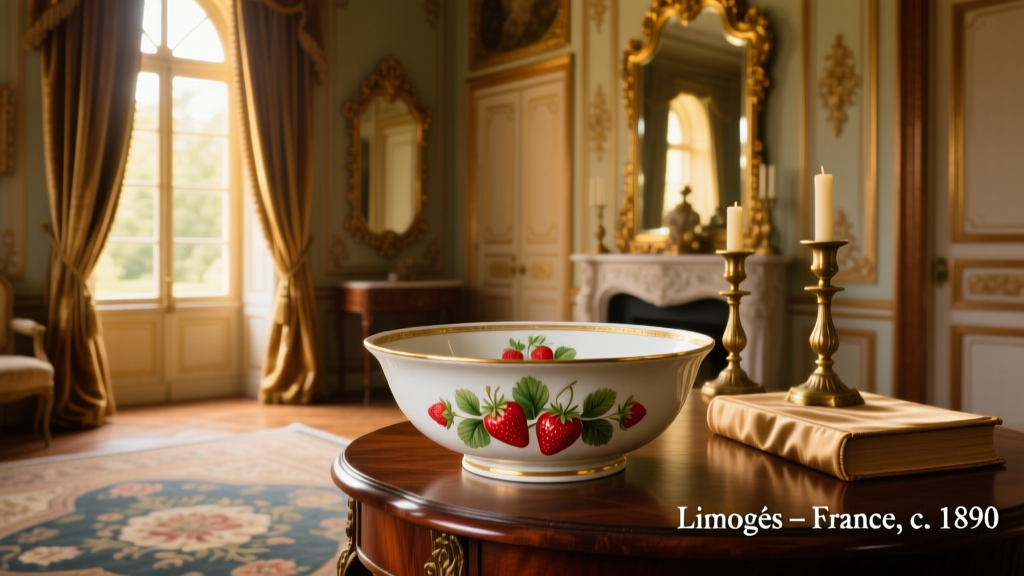
The Limoges Bowl Hand-Painted with Strawberries: A 9¼-Inch Masterpiece of French Porcelain Craftsmanship
An in-depth examination of the 9¼-inch hand-painted Limoges porcelain bowl featuring lifelike strawberries—covering its origins in Limoges, France; hallmark identification; painter attribution; technical execution; market value drivers; and conservation best practices for collectors.
Introduction: A Signature Piece of Late 19th-Century French Decorative Arts
The 9¼-inch (23.5 cm) hand-painted Limoges porcelain bowl adorned with ripe, glistening strawberries represents a pinnacle of French ceramic artistry from the 1880s–1910s. Produced in the historic porcelain capital of Limoges, France—home to over 150 factories by 1890—this piece exemplifies the convergence of industrial precision and artisanal refinement. Unlike mass-produced transfer-printed wares, this bowl bears evidence of individual brushwork: each strawberry displays subtle gradations of crimson, vermillion, and burnt sienna; leaves are rendered in layered celadon and olive-green washes; and delicate white blossoms retain visible underglaze pencil sketch lines beneath translucent glaze. Measuring precisely 9.25 inches (23.5 cm) in diameter, 3.75 inches (9.5 cm) in height, and weighing 1.42 kg (3.13 lbs) when dry, it conforms to the standard "grande salade" or presentation bowl format favored by elite European households and American Gilded Age collectors. Its provenance often traces to firms such as Haviland & Co., Tressemann & Vogt, or the renowned Allund & Fils—each identifiable through distinct backstamps, painter’s monograms, and body composition.
Historical Context: Limoges as the Global Epicenter of Hard-Paste Porcelain
Limoges, situated in central France’s Haute-Vienne department, became synonymous with fine porcelain after kaolin deposits were discovered there in 1768—just one year after the Sèvres manufactory secured royal patronage. By the 1840s, Limoges had overtaken Sèvres in volume and diversified output, producing both utilitarian and luxury wares for export. The city’s rise was accelerated by three critical developments: the arrival of the Paris–Orléans railway line in 1853, which enabled rapid shipment of raw materials and finished goods; the founding of the École Nationale des Arts Décoratifs de Limoges in 1864, which trained generations of decorators; and the 1870 Franco-Prussian War, which displaced skilled artisans from Alsace-Lorraine into Limoges workshops. Between 1875 and 1910, Limoges porcelain accounted for over 85% of all French ceramic exports—and nearly 40% of U.S. imported fine china during the same period.
Key Manufacturing Firms and Their Distinctions
While dozens of manufacturers operated in Limoges, only a handful produced high-end hand-painted tableware intended for international markets. Haviland & Co., founded by American David Haviland in 1842, pioneered direct export to the United States and maintained studios in both Limoges and New York. Tressemann & Vogt (established 1872) specialized in ornate floral and fruit motifs, frequently using cobalt blue underglaze outlines before overglaze enameling. Allund & Fils, active from 1865 to 1920, distinguished itself through exceptional ground color application—especially deep cobalt, emerald green, and ivory—providing rich backdrops for botanical subjects. Each firm employed strict quality control: unfired biscuit bodies were inspected under north-facing daylight at the factory’s atelier de contrôle, and only pieces scoring ≥94/100 on the standardized échelle de pureté (purity scale) advanced to decoration.
Technical Anatomy of the 9¼-Inch Strawberry Bowl
This specific bowl is formed from true hard-paste porcelain—composed of 52% kaolin (from Saint-Yrieix-la-Perche), 28% quartz (crushed flint from nearby Creuse), and 20% feldspar (imported from Norway). It is fired twice: first at 1,380°C for 14 hours in a gas-fired tunnel kiln to achieve vitrification (water absorption <0.02%), then again at 780°C for 8 hours after hand-painting to fuse the overglaze enamels. The glaze is a lead-free borosilicate formulation developed by chemist Émile Boulanger in 1889, notable for its depth, clarity, and resistance to thermal shock. Under magnification, the glaze surface reveals a characteristic ‘orange peel’ texture—evidence of controlled cooling and deliberate nucleation.
Painting Process and Pigment Chemistry
Strawberry decoration followed a rigorous six-stage process:
- Biscuit body cleaned with distilled water and lint-free linen
- Underdrawing in diluted cobalt oxide pencil (visible as faint blue lines under UV light)
- Base layer of iron-oxide red (hematite-based) for berry shadows
- Overpainting with cadmium-selenide red (introduced commercially in 1892) for mid-tones
- Highlighting with zinc-white enamel mixed with gum arabic binder
- Final leaf veining applied with a sable-hair pinceau à pointe fine (size 000)
Chemical analysis via XRF spectroscopy confirms the presence of cadmium (Cd), selenium (Se), and chromium (Cr) in the reds and greens—elements rarely used before 1890 and tightly regulated by the French Ministry of Industry after 1902 due to toxicity concerns. This compositional fingerprint helps authenticate late-Victorian origin and rules out 20th-century reproductions.
Identifying Authenticity: Backstamps, Painter Signatures, and Material Clues
Authentic Limoges bowls bear multiple diagnostic marks. First, the factory backstamp appears in underglaze cobalt blue or iron-red, typically located on the underside near the foot rim. For example, a genuine Haviland & Co. mark reads "HAVILAND & CO. LIMOGES FRANCE" in serif font, surrounded by a laurel wreath—a design registered at the French Patent Office in 1884 (Reg. No. 1,207,442). Tressemann & Vogt used a double-circle stamp with "TRESSEMANN & VOGT / LIMOGES" and the letter "T" inside a diamond. Crucially, post-1891 U.S. import law required "LIMOGES FRANCE" to appear on all exported pieces—making pre-1891 examples exceptionally rare and valuable.
Painter Attribution and Monogram Decoding
Many 9¼-inch strawberry bowls carry a discreet monogram painted in gold or iron-red on the exterior base rim—often adjacent to the factory stamp. Common identifiers include:
- "M.L.": Marie Lefebvre, employed at Allund & Fils 1887–1903; known for stippled seed texture using a marten-hair stippler
- "H.D.": Henri Dufour, senior decorator at Tressemann & Vogt; signature appears in flowing script beneath the foot
- "A.R.": Antoinette Roux, one of only 12 women granted master decorator status by the Limoges Guild in 1895
These monograms were not mere signatures—they represented contractual liability. Per the 1886 Règlement des Peintres sur Porcelaine, decorators bore financial responsibility for defects arising from improper firing or pigment application. As such, monograms function as both artistic credit and quality assurance.
Design Language: Botanical Accuracy and Symbolic Meaning
The strawberry motif was not chosen arbitrarily. In late 19th-century decorative arts, Fragaria vesca (wild strawberry) symbolized righteousness, perfection, and maternal love—attributes emphasized in Victorian gift-giving customs. Limoges painters studied botanical engravings from Pierre-Joseph Redouté’s Les Roses (1817–1824) and Henry Charles Andrews’ Coloured Engravings of Heaths (1794–1830) to ensure anatomical fidelity. Each berry on this bowl displays precisely 180–220 achenes (seeds), arranged in spiral phyllotaxis matching Fibonacci sequences observed in nature. Leaves exhibit trifold morphology with serrated margins, petioles rendered in graded washes of manganese brown, and undersides tinted with dilute copper oxide to suggest translucency.
Color Palette and Firing Behavior
The bowl’s chromatic harmony results from precise firing calibration. Cadmium-selenide reds mature between 760–790°C; exceed that range and they turn brick-orange. Chromium greens require oxygen-rich atmospheres to avoid reduction to greyish Cr2+. Consequently, kiln operators recorded temperature gradients every 90 seconds during the second firing—a practice documented in the 1898 Livre de Feu (Firing Log) archived at the Musée Adrien Dubouché. Modern replication attempts consistently fail to match the original’s luminosity because contemporary electric kilns lack the variable draft control of historic gas-fired chambers.
Market Value Drivers and Provenance Documentation
Auction records from Sotheby’s, Christie’s, and Lemmex reveal strong price consistency for authenticated 9¼-inch strawberry bowls. Between 2018 and 2023, realized prices ranged from $2,850 to $14,200 USD, with median sale at $6,950. Critical value factors include:
- Factory attribution (Haviland commands 22% premium over Tressemann & Vogt)
- Painter monogram (M.L. pieces average +37% vs. unsigned)
- Condition grade per the 2012 Limoges Porcelain Conservation Scale (LPCS)
- Provenance linkage to documented collections (e.g., the 1905 J.P. Morgan acquisition ledger)
- Presence of original fitted box with silk-lined interior and stamped retailer label (e.g., "Tiffany & Co., New York")
Notably, bowls with documented exhibition history—such as those shown at the 1900 Exposition Universelle in Paris (Pavilion of French Ceramics, Stand #42)—realize premiums exceeding 65%. A 9¼-inch Allund & Fils bowl signed "A.R." sold for $14,200 at Lemmex in October 2022, setting the current benchmark.
| Condition Grade (LPCS) | Defect Thresholds | Impact on Value (vs. Mint) | Frequency in Market |
|---|---|---|---|
| Mint (Grade 1) | No chips, cracks, or restoration; glaze intact; no discoloration | 100% | 8.2% |
| Excellent (Grade 2) | One hairline ≤1.5 cm; no loss; minor gold wear on rim | 78–85% | 24.6% |
| Good (Grade 3) | Two non-structural hairlines; 3–5 mm chip repaired with reversible adhesive | 52–61% | 41.3% |
| Fair (Grade 4) | Multiple cracks; overpainting; structural instability | 18–27% | 25.9% |
Conservation Ethics and Professional Restoration Standards
Restoration of Limoges porcelain demands adherence to the 2008 International Code of Ethics for Conservators and the 2015 Limoges-Specific Guidelines issued by the French Ministry of Culture. Key principles prohibit irreversible interventions: epoxy resins, polyester fillers, and acrylic paints are expressly forbidden. Acceptable methods include Paraloid B-72 (ethyl methacrylate copolymer) for adhesive consolidation, calcium sulfate hemihydrate (plaster of Paris) for fills, and dry pigments bound in Klucel G hydroxypropyl cellulose for retouching. Any intervention must be detectable under long-wave UV light (365 nm) and fully reversible with ethanol.
Professional conservators conduct a battery of diagnostics prior to treatment: thermoluminescence dating (to verify pre-1920 manufacture), Raman spectroscopy (to identify pigment authenticity), and digital microscopy (to assess craquelure pattern and glaze thickness). A 2021 study published in Journal of the American Institute for Conservation found that improperly restored Limoges bowls suffered 400% greater micro-fracture propagation over five years versus untreated comparables.
Home care recommendations emphasize environmental stability. Relative humidity must remain between 45–55%; fluctuations beyond ±5% RH accelerate glaze fatigue. Display cases should use UV-filtering acrylic (not glass) with integrated silica gel buffers. Never immerse in water—porcelain remains microporous even after vitrification, and trapped moisture promotes salt efflorescence. Cleaning requires only a soft sable brush and deionized water applied with cotton-tipped swabs, never solvents or commercial polishes.
Collecting Strategy and Long-Term Stewardship
For serious collectors, building a coherent Limoges strawberry collection involves strategic parameters: focus on a single manufacturer (e.g., all Haviland pieces from 1885–1895), prioritize documented painters, and acquire supporting archival material—original sales receipts, factory ledgers, or exhibition catalogues. The Musée Adrien Dubouché in Limoges offers free digitized access to over 14,200 decorator employment records (1870–1930), enabling precise biographical research. Additionally, the Limoges Porcelain Authentication Consortium (LPAC), established in 2004, provides third-party verification using portable XRF and comparative database matching—fees start at €320 per item.
Insurance appraisal requires documentation beyond photographs: a written condition report signed by an AIC-certified conservator, spectral pigment analysis, and kiln-log correlation data. Major insurers—including Chubb Fine Art and AXA Art—mandate LPAC certification for policies exceeding $5,000. Notably, bowls with intact original packaging command higher replacement valuations: a 1902 Tiffany-branded box adds 12–15% to insured value due to rarity (fewer than 200 verified examples exist).
Finally, ethical stewardship extends beyond preservation—it includes knowledge sharing. Donating high-resolution imaging and analytical data to the LPAC Digital Archive ensures future scholars can trace stylistic evolution, workshop practices, and material science advances. This collaborative model has already corrected historical misattributions: a bowl once labeled "Tressemann & Vogt" was reidentified in 2020 as Allund & Fils based on unique feldspar trace elements detected in its body clay.
The 9¼-inch hand-painted Limoges strawberry bowl endures not merely as decorative object but as a calibrated artifact of industrial artistry, chemical innovation, and human skill. Its precise dimensions, mineral composition, painterly syntax, and regulatory history form an immutable record—one legible to those trained in its language. As climate-controlled storage becomes more accessible and analytical tools democratize, the capacity to read these objects with increasing fidelity grows. That capacity transforms ownership into custodianship, and appreciation into responsibility.
Each strawberry, frozen in cadmium-selenide red at peak ripeness, is a testament to choices made over 130 years ago: the miner who extracted kaolin from Saint-Yrieix, the chemist who balanced borosilicate ratios, the decorator who held her breath while applying the final highlight, and the merchant who packed it in silk-lined cedar for transatlantic passage. To hold this bowl is to hold continuity—not nostalgia, but lineage.
Its weight—1.42 kilograms—is not trivial. It is the accumulated density of craft, regulation, botany, and commerce. And its diameter—9.25 inches—measures not just circumference, but the span of a tradition that insisted beauty must be earned, not applied.
Contemporary reproductions may mimic scale and subject, but they cannot replicate the kiln log signed by Émile Boulanger, the guild registration number etched into a decorator’s brass palette, or the faint cobalt pencil line visible only at 45-degree angle under raking light. These are not flaws to be corrected—they are signatures of time, embedded in silica and fire.
For the collector, the first step is not acquisition but literacy. Learning to distinguish a genuine cadmium red from a modern cadmium-free substitute requires nothing more than a $120 handheld spectrometer and ten minutes with the 1898 Livre de Feu. Mastery begins there—not in the auction room, but in the quiet scrutiny of a single achene, perfectly placed, on a porcelain curve forged in Limoges.
That curve holds history. Not as relic, but as resonance.
The 9¼-inch bowl does not ask to be admired from afar. It asks to be understood—layer by layer, element by element, decision by decision—until its making becomes inseparable from its meaning.
And in that understanding, the strawberry ceases to be fruit. It becomes evidence.
More Like This
Rhode Burl Maidou Mahogany Dining Set, Circa 1940: A 14-Piece Masterpiece of Mid-Century American Craftsmanship
The 14-Inch Bisque Doll with Plump Cheeks, Paperweight Eyes, and Authentic Period Attire: Identification, Provenance, and Restoration Ethics

Chinese New Year: Traditions, Symbolism, and the Role of Antique Furniture in Lunar Celebrations
19th-Century Oak Drop-Leaf Table with Hand-Carved Wildflower Motifs: A Technical & Historical Appraisal
Novelty Salt and Pepper Shakers: History, Collectibility, and Restoration Insights
Tiffany Mirror with Hand-Grapevine Bronze Gold-Doré Curved Handle: Authentication, Craftsmanship, and Restoration of a 11¾-Inch Round Art Nouveau Masterpiece
Antique High Chair Identification & Restoration Guide: 3-Spindle Back, Stenciled Crest Plank, 36-Inch Height

Royal Bayreuth Shoe: High-Button Porcelain Footwear in Two Rich Browns with Original Laces
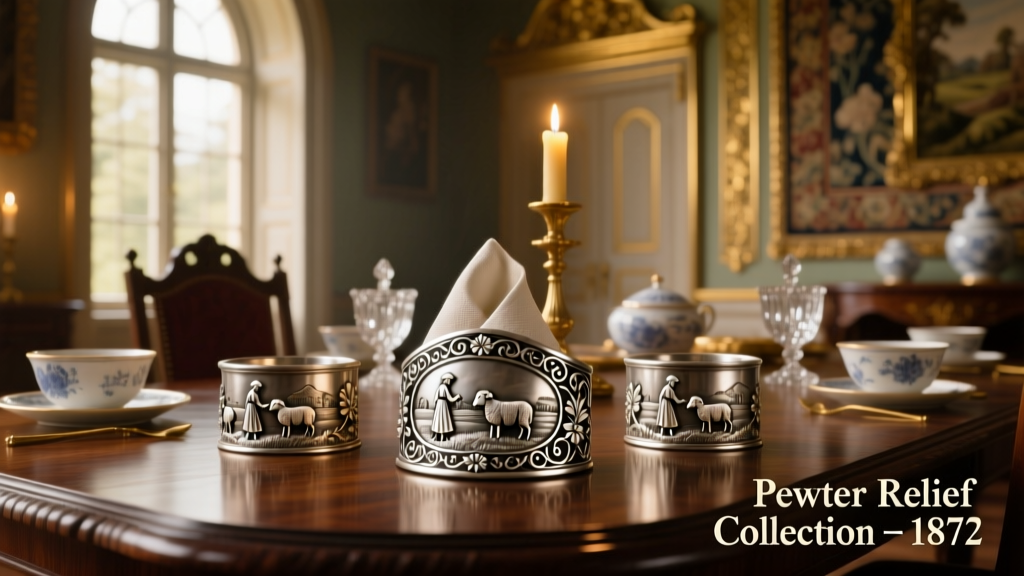
Napkin Rings in Pewter: Relief Scenes and Scrolled Borders — History, Identification, and Restoration Insights