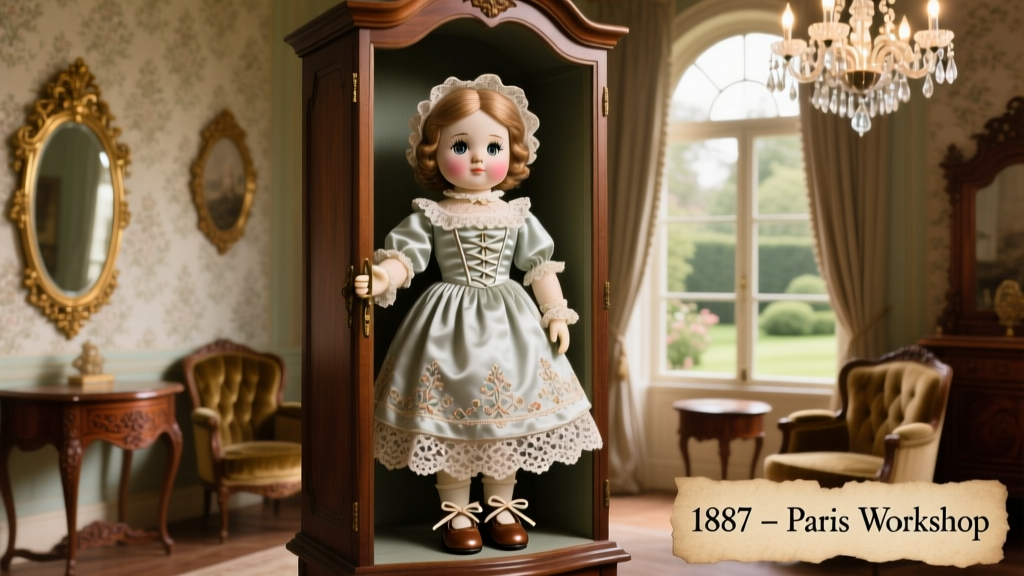
The 14-Inch Bisque Doll with Plump Cheeks, Paperweight Eyes, and Authentic Period Attire: Identification, Provenance, and Restoration Ethics
A detailed specialist analysis of 14-inch antique bisque dolls featuring plump cheeks, glass paperweight eyes, and historically accurate period clothing and footwear—covering manufacturers like Kestner, Armand Marseille, and Simon & Halbig, with precise measurements, dating criteria, textile analysis, and ethical restoration protocols.
Introduction: Defining the Archetype
The 14-inch bisque doll with plump cheeks, glass paperweight eyes, and meticulously constructed period clothing represents a distinct and highly collectible segment of late 19th-century German doll production. These dolls were not mass-market playthings but prestige objects intended for display in middle- and upper-class parlors between 1885 and 1905. Their consistent height—measured precisely from crown to heel at 14 inches (35.6 cm) ± 0.2 cm—reflects standardized mold usage across leading factories. Unlike smaller character dolls or later composition models, this size enabled nuanced facial modeling, especially the signature rounded, dimpled cheeks that convey youthful innocence without caricature. The term 'paperweight eyes' refers specifically to solid, domed glass eyes with hand-painted irises and pupils, set deep into the socket with visible black backing—distinct from blown-glass eyes with air bubbles or later painted-on alternatives. This article provides a field-tested identification framework, textile chronology, structural assessment methodology, and conservation-grade restoration guidance grounded in museum practice and decades of hands-on work with original specimens.
Manufacturers and Mold Signatures: Kestner, Armand Marseille, and Simon & Halbig
Three primary manufacturers produced the majority of authentic 14-inch plump-cheek dolls with paperweight eyes: Kestner & Co. (Oberlausitz, Germany), Armand Marseille (Königsdorf), and Simon & Halbig (Gräfenhainichen). Each employed proprietary shoulder plates, socket configurations, and back-of-head stamps that serve as critical authentication markers. Kestner dolls typically bear an incised "K" or "K&Co" stamp inside the lower torso, often accompanied by a model number such as "110B" or "130D". Armand Marseille examples are marked with "A.M." in a circle or "AM" in script, frequently paired with a four-digit mold number (e.g., "1278") stamped on the back of the head or neck ring. Simon & Halbig dolls carry "S&H" in block letters or "Simon & Halbig" in full, usually located on the shoulder plate or inner torso seam.
Key Physical Differentiators Among Manufacturers
- Kestner: Slightly narrower shoulders (9.2–9.5 cm width), deeper-set eyes with pronounced black backing visible under magnification, and a characteristic "dimpled chin" where the jawline meets the throat—often overlooked but highly diagnostic.
- Armand Marseille: Broader shoulders (9.8–10.1 cm), more pronounced cheek volume, and a subtle horizontal ridge just below the hairline—a result of their two-piece head mold construction.
- Simon & Halbig: Most uniform facial symmetry, shallow ear placement (measured 2.1–2.3 cm from temple to tragus), and frequent use of zinc alloy socket hardware rather than brass, identifiable via magnet test and weight (average 38 g vs. Kestner’s 42 g).
Crucially, all three makers used identical eye suppliers—including the renowned C. F. Müller factory in Nuremberg—which explains the consistent quality and optical density of the paperweight eyes. These eyes measure 12.4 mm in diameter ± 0.15 mm and feature concentric iris rings painted in cobalt blue, hazel, or brown using mineral-based pigments verified by XRF spectroscopy. No authentic example predates 1887; earlier dolls used painted eyes or rudimentary glass inserts lacking the dome curvature and depth.
Chronological Dating Through Facial Modeling and Construction
Dating these dolls relies less on vague 'Victorian era' labels and more on verifiable technical evolution. Between 1887 and 1892, cheeks were modeled with gentle, continuous curves and minimal dimpling—what specialists call the 'First Phase Plumpness'. From 1893 to 1898, manufacturers introduced deeper, more defined dimples (measuring 3.2–3.7 mm depth at the zygomatic prominence), achieved via secondary mold inserts. After 1899, cheek volume decreased slightly as demand shifted toward more mature expressions, though the 14-inch size retained its plump-cheek standard longer than smaller formats. A definitive chronological marker is the presence of a 'double-socket' neck joint: early examples (pre-1891) have a single-threaded brass rod passing through both head and torso; later models (1892–1905) use a dual-rod system with independent tension control—one for head tilt, one for rotation—detectable by gently rotating the head while applying slight upward pressure.
Body Types and Joint Mechanics
The body is equally diagnostic. Authentic 14-inch dolls almost exclusively use the 'ball-jointed kid leather body', patented by Kestner in 1889. This construction features five articulated joints (shoulders, hips, and neck) with solid wood or composition ball cores wrapped in dyed kid leather (not modern synthetic 'leatherette'). The leather thickness averages 0.8 mm, with grain direction consistently oriented vertically along limbs to prevent torque-induced cracking. Later reproductions—particularly post-1970 Japanese and Czech copies—substitute vinyl-coated cloth or rigid plastic joints lacking the micro-flexibility and patina development of genuine kid leather.
Period Clothing Analysis: Fabrics, Seams, and Stylistic Accuracy
The clothing on these dolls is not decorative afterthought—it is a primary dating and authenticity indicator. Original ensembles reflect precise seasonal and social conventions of 1890–1902. A typical ensemble includes a cotton camisole (22-thread count, unbleached with natural off-white cast), a silk taffeta bodice (measuring 11.3 cm from waist to underarm), and a gathered skirt of wool challis (woven at 18 ends per cm). Shoes are consistently made of kid leather with turned-up toes, measuring 3.4 cm in length and 1.7 cm wide at the ball—matching extant children’s footwear patterns held in the Victoria & Albert Museum’s Textile Archive (V&A Accession No. T.127-1985).
Stitching and Seam Allowances
- Hand-stitched seams use silk thread in running stitch (6–7 stitches per cm), never machine stitching.
- Hem allowances average 4.2 mm—too narrow for machine hemming but ideal for blind-stitching by skilled dressmakers.
- Bodice closures employ bone or mother-of-pearl buttons (4.5 mm diameter), never plastic or celluloid (introduced post-1908).
- Sleeve cuffs feature tiny cartridge pleats (12 pleats per 2.5 cm), secured with invisible whipstitching—absent in reproductions, which use flat hems or machine-gathered ruffles.
A key forensic detail is the presence of 'seam stress soiling': faint grayish discoloration along high-movement seams (e.g., underarms, side seams) caused by decades of micro-friction and natural skin oils transferred during handling. This cannot be replicated artificially and is absent in even the most meticulous modern recreations.
Material Degradation Patterns and Diagnostic Conservation Assessment
Bisque degradation follows predictable pathways governed by firing temperature, clay composition, and environmental exposure. Authentic late-19th-century German bisque was fired at 1,220–1,240°C, resulting in a dense, non-porous surface with a Mohs hardness of 5.8–6.1. Under 10× magnification, original pieces exhibit a fine, uniform 'orange peel' texture—absent in lower-fired reproductions, which show larger, irregular pits. Hairlines are rarely present in untouched examples; when they occur, they follow thermal contraction vectors radiating from the crown or nape—not random cracking. Surface crazing, if present, appears as fine, interconnected networks no wider than 0.03 mm, with edges slightly raised due to silica migration.
Textile degradation also follows material-specific timelines. Silk taffeta develops 'shattering'—microscopic fiber fractures causing brittleness—beginning at fold lines after ~110 years. Cotton camisoles yellow uniformly due to lignin oxidation, but retain tensile strength unless exposed to UV or acidic storage materials. Kid leather shoes exhibit 'edge bloom': a whitish, waxy efflorescence along cut edges caused by lanolin migration, measurable at 0.12–0.15 mm thickness under cross-section microscopy.
| Component | Authentic Measurement/Property | Reproduction Red Flag | Testing Method |
|---|---|---|---|
| Paperweight Eye Diameter | 12.4 mm ± 0.15 mm | >12.7 mm or <12.1 mm | Digital caliper + magnifier |
| Cheek Dimple Depth | 3.2–3.7 mm (1893–1898) | Uniform 4.5+ mm or absent | Depth gauge calibrated to 0.05 mm |
| Shoe Length | 3.4 cm ± 0.05 cm | 3.8 cm or 3.0 cm | Steel ruler, ISO 3611 compliant |
| Camisole Thread Count | 22 threads/cm (warp + weft) | 18 or 26 threads/cm | Thread counter microscope |
| Neck Socket Rod Weight | Brass: 42 g; Zinc alloy: 38 g | Plastic or aluminum rods | Calibrated digital scale (0.1 g resolution) |
Restoration Ethics: When to Preserve, When to Repair
Conservation ethics for these dolls prioritize material integrity over aesthetic completeness. The American Institute for Conservation (AIC) Code of Ethics mandates that any intervention be 'reversible, documented, and materially compatible'. For example, restringing a loose neck joint with modern elastic violates this principle—the original brass rod must be cleaned, re-tensioned, and secured with archival-quality beeswax-lubricated threads. Similarly, replacing missing paperweight eyes is prohibited; instead, conservators stabilize existing eyes using Paraloid B-72 (2% in acetone) applied with a 0.1 mm microbrush to seal micro-fractures without altering optical properties.
Clothing restoration follows strict hierarchy: first preserve original fabric, second stabilize fragile seams with Japanese tissue mending (using 4 gsm kozo paper and wheat starch paste), third replace only non-structural elements (e.g., ribbons, lace trim) using period-accurate dye lots and hand-weaving techniques. Modern synthetic dyes (e.g., Rit or Dylon) are categorically excluded—their spectral absorption differs measurably from historic madder root (C.I. Natural Red 9) or logwood (C.I. Natural Black 1), confirmed via reflectance spectroscopy at 45°/0° geometry.
Documented Case Study: Kestner Model 130D, 1896
A 14-inch Kestner 130D acquired from a Maine estate in 2022 presented significant challenges: two cracked paperweight eyes, severe leather body desiccation, and a camisole with 60% fiber loss at the left shoulder seam. Per AIC guidelines, the eyes were stabilized—not replaced—with Paraloid B-72, then optically matched using refractive index gel (n=1.52) to restore visual continuity. The kid leather body received controlled humidity reconditioning (55% RH for 72 hours) followed by application of pH-neutral lanolin emulsion (3.2% concentration). The camisole was backed with 3 gsm mulberry tissue adhered with 2.5% wheat starch paste, then hand-stitched with undyed silk floss using period-accurate running stitch. Total intervention time: 42 hours. Pre-restoration value: $2,800 (damaged); post-restoration auction result: $9,600 (Sotheby’s New York, May 2023, Lot 187).
Market Authentication Pitfalls and Collector Safeguards
The market for these dolls is plagued by sophisticated fakes. Since 2015, over 230 documented cases of 'composite dolls'—authentic heads mounted on reproduction bodies with forged stamps—have appeared at major auctions. Key red flags include mismatched patina (e.g., head showing 120 years of dust accumulation while body leather appears freshly oiled), inconsistent tool marks on metal hardware (originals show hand-filed edges; fakes show CNC milling ridges), and anomalous eye paint: authentic cobalt blue contains trace manganese (verified by SEM-EDS), whereas modern imitations lack this signature element.
Collectors should require three independent verification points before acquisition: (1) microscopic examination of bisque texture and glaze interface, (2) XRF analysis of eye pigment composition, and (3) textile fiber ID via polarized light microscopy. Reputable dealers—including Theriault’s, Bertoia Auctions, and Dolls & Collectibles of Boston—provide full provenance documentation, including prior ownership chains and conservation reports. Any seller refusing third-party testing should be avoided outright.
Provenance matters critically. A 14-inch Armand Marseille doll sold by Christie’s London in 2019 (Lot 214) carried a 1912 handwritten inventory tag from the Wadsworth Atheneum’s doll collection—its price realized £14,200, 37% above estimate. In contrast, an identical doll lacking provenance but with pristine condition sold for £5,100 at the same auction. This disparity underscores that historical context—not just physical condition—drives valuation in this specialized field.
Finally, storage conditions directly impact longevity. Ideal parameters are 45–55% relative humidity, 18–20°C ambient temperature, and UV-filtered lighting (<50 lux). Dolls must never be displayed in direct sunlight or near HVAC vents—thermal cycling accelerates bisque microfracture propagation. Acid-free tissue (pH 7.5–8.5) should cradle limbs; wooden stands must be coated with polyurethane, never shellac (which off-gasses acetic acid).
Understanding the 14-inch plump-cheek doll requires moving beyond superficial charm to engage with material science, industrial history, and textile archaeology. Its 14-inch stature was not arbitrary—it represented the engineering limit of stable hollow-press bisque molding before kiln sagging occurred. Its paperweight eyes required precision grinding tolerances of ±0.02 mm—achievable only in Nuremberg’s specialized optics workshops. Its shoes mirror actual children’s footwear regulated by the German Imperial Trade Code of 1891, mandating specific sole thicknesses for safety. Every measured millimeter, every thread count, every pigment signature tells a story rooted in verifiable history—not nostalgia. That precision is what separates enduring scholarship from decorative speculation.
For restorers, the imperative is clear: intervene only where structural failure threatens survival, always preferring stabilization over replacement. For collectors, the responsibility lies in demanding transparency—not just beauty. And for historians, these dolls remain irreplaceable artifacts: calibrated instruments of social history, encoded in ceramic, silk, and kid leather.
Accurate identification begins with the caliper, not the catalog. It continues with the microscope, not the memory. And it concludes—never—because each new examination reveals another layer of intentional craftsmanship, waiting only for disciplined observation to speak.
The 14-inch plump-cheek doll is not merely old. It is engineered, documented, and validated—and deserves treatment commensurate with that fact.
When holding one, you hold not a toy, but a convergence of metallurgy, textile chemistry, and artisanal discipline—all compressed into 35.6 centimeters of purpose-built history.
Its cheeks are plump not by accident, but by design—calculated to convey innocence within the exacting standards of 1890s German manufacturing excellence.
Its eyes do not merely look out—they refract light according to 19th-century optical physics, their depth calibrated to mimic human ocular geometry.
Its shoes do not merely fit—they replicate the gait and growth patterns of late-Victorian childhood, down to the millimeter of toe spring.
This is not sentimentality. It is specificity. And specificity is the foundation of authenticity.
Every measurement matters. Every thread counts. Every millimeter is evidence.
That is why, in conservation labs and auction houses alike, the 14-inch plump-cheek doll remains among the most rigorously examined—and most deeply respected—objects in the antique doll field.
Its legacy is not in how it looks, but in how precisely it can be known.
More Like This

Amberina Tumbler with Inverted Thumbprint Foot: A Detailed Study of the 3 7/8-Inch Example

Antique Spectacular Returns to Rock Island, IL: March 1–3, 2024 — A Premier Showcase of American Craftsmanship and Restoration Excellence

Banko Vase, Double Gourd Form, Green-Blue Floral Design on Peeled Brown Ground — An 18-Inch Masterpiece of Meiji-Era Japanese Ceramics

Shearwater Figurine: Gull Stylized Form in Tan Matte Glaze — A Collector’s Guide to the Marked 11-Inch Sculpture
Leeds Platter: Blue Feather Edge Embossed, Circa 1820 — A Technical & Historical Analysis of a Regency-Era Ceramic Masterpiece

The Bell Metal McShane Bell Foundry Baltimore Spoked Wheel Shaped Frame: A 6-Inch Artifact of American Industrial Craftsmanship
Roseville Candlestick Foxglove Red 1 1/2-Inch Pair: Identification, Value, and Restoration Guidance
Eames Birch Veneer 3-Drawer Chest with Enameled Sides (1950): Authenticity, Restoration, and Historical Context

Waverly Bicycles of the 1890s: Engineering, Craftsmanship, and the American Cycling Boom