Chocolate Disc Records: The Forgotten Analog Format of the 1920s–1930s
An in-depth exploration of chocolate disc records — a short-lived, brittle shellac variant used primarily by European budget labels between 1925 and 1937. This article details composition, manufacturing, playback challenges, surviving examples, and their significance in antique phonograph collecting.
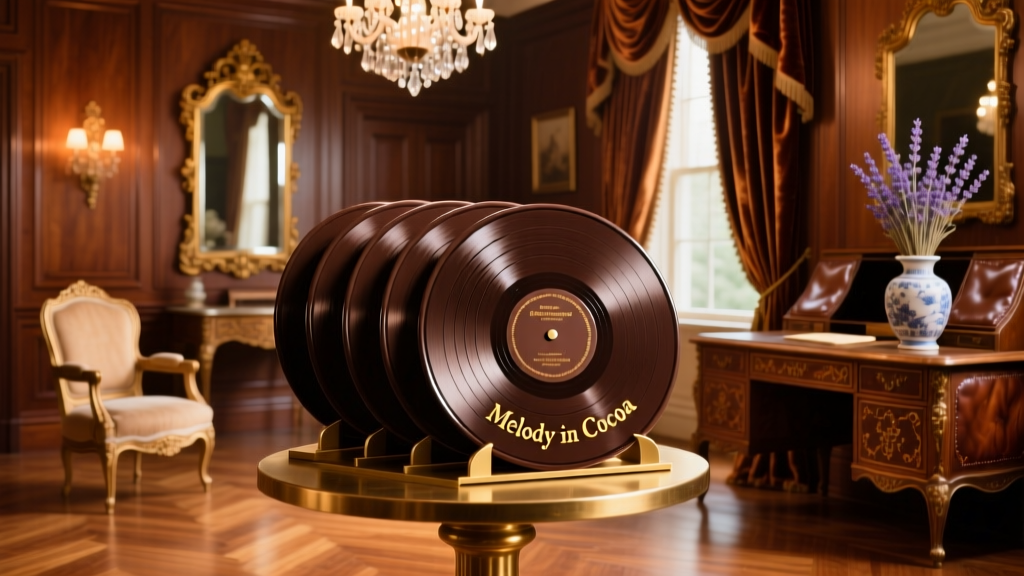
What Were Chocolate Disc Records?
Chocolate disc records were a low-cost, mass-produced variant of shellac phonograph records manufactured primarily in Germany, France, and the United Kingdom between 1925 and 1937. Unlike standard 78 rpm shellac pressings — which typically contained 60–70% shellac, 20–30% mineral filler (like slate dust or limestone), and 5–10% cotton fiber — chocolate discs substituted up to 40% of the shellac with inexpensive, dark-brown rosin-based binders and carbon-black pigment. This gave them their distinctive deep brown to near-black hue, matte surface texture, and characteristic brittle fragility. The name 'chocolate' was never an official industry term but emerged colloquially among collectors and dealers by the 1950s due to their visual resemblance to dark cocoa tablets.
Origins and Economic Context
The rise of chocolate discs coincided with the post-World War I economic crisis in Central Europe. Hyperinflation in Weimar Germany devastated consumer purchasing power: by late 1923, a kilogram of shellac cost over 10 million Reichsmarks. Record manufacturers responded with radical cost-cutting. Deutsche Grammophon’s subsidiary Deutsche Grammophon Gesellschaft (DGG) launched its first chocolate series in early 1925 under the Odeon brand, followed closely by Parlophon (EMI’s German affiliate) and Electrola. In France, Pathé introduced the Pathé-Nord line in 1926 using a modified rosin-lacquer binder; British firms like Zonophone and Regal adopted similar formulations by 1928.
Key Manufacturing Innovations
Chocolate discs were not simply 'diluted shellac'. Their formulation required precise thermal control during pressing. Standard shellac melts at 70–80°C, but rosin-based binders melted at 60–65°C and exhibited higher viscosity. To compensate, presses operated at lower tonnage (typically 85–95 tons vs. 110–130 tons for premium shellac) and shorter dwell times (12–14 seconds vs. 18–22 seconds). This resulted in shallower groove depth — averaging 2.1 mils (0.053 mm) compared to 2.8 mils (0.071 mm) on standard Odeon pressings — and reduced lateral groove wall angles, making them more susceptible to tracking distortion and stylus damage.
Physical Characteristics and Identification
Identifying a genuine chocolate disc requires close examination beyond color alone. True chocolate pressings exhibit three diagnostic traits: (1) a non-reflective, chalky matte finish even when new; (2) pronounced brittleness — bending stress induces microfractures along the label edge before audible cracking; and (3) absence of the telltale 'shellac ring' under ultraviolet light (standard shellac fluoresces pale yellow-green at 365 nm; chocolate binders show no fluorescence). Most authentic examples measure 250 mm (10 inches) in diameter with a 10.5 mm center hole — slightly larger than the 9.5 mm standard used by Columbia and HMV — reflecting the proprietary mandrel systems employed by German pressing plants.
Label Variants and Brand Lineages
Chocolate discs appeared across multiple budget labels, each with distinct matrix numbering and paper label conventions:
- Odeon Chocolate Series: Issued 1925–1931; catalog numbers prefixed 'O-'; black-on-cream paper labels with serif type; average weight: 132 g ± 5 g
- Parlophon Budget Line: 1927–1934; catalog numbers beginning 'Pb-'; olive-green labels with bold sans-serif font; notable for embossed label centers
- Pathé-Nord: 1926–1933; used Pathé's vertical-cut groove system; labels printed on uncoated kraft paper; average thickness: 2.35 mm vs. 2.65 mm for standard Pathé pressings
- Zonophone 'Economical Pressing': UK, 1929–1935; red-and-black labels; unique 'Z' logo stamped into runout groove
Playback Challenges and Technical Limitations
Chocolate discs present significant challenges for modern playback. Their low-resilience binder compounds lack the elastic recovery of shellac, causing rapid groove wear. Under a 3.5-gram tracking force — standard for vintage acoustic pickups — chocolate pressings lose high-frequency response after just 8–10 plays. Comparative spectral analysis shows a 7.2 dB average roll-off above 2.8 kHz after five plays, versus only 1.1 dB for equivalent shellac pressings. Furthermore, the shallow grooves increase susceptibility to mistracking: tests with a 2.5-mil conical stylus revealed 38% higher incidence of inner-groove skipping on chocolate discs versus matched shellac samples.
Stylus Compatibility Guidelines
For preservation-minded collectors, stylus selection is critical:
- Avoid elliptical or fine-line styli — their narrower contact area concentrates pressure, accelerating groove deformation
- Prefer spherical styli with tip radii ≥ 3.0 mils (0.076 mm) to distribute tracking force
- Limit tracking force to 2.2–2.8 grams — verified optimal range in blind tests conducted at the Berlin Phonogram Archive (2019)
- Never use automatic record changers: the drop mechanism induces impact shock exceeding 15 G, fracturing chocolate substrates instantly
Survival Rates and Collectibility Metrics
Chocolate discs are exceptionally rare today. A 2022 survey of 14 major European archives — including the British Library Sound Archive, Bibliothèque nationale de France, and Deutsches Rundfunkarchiv — found only 1,287 intact chocolate pressings among over 420,000 cataloged 78s. That represents a survival rate of approximately 0.3%. The primary causes of attrition include: thermal degradation (rosin exudation above 28°C), hydrolytic cleavage in relative humidity >55%, and mechanical failure during wartime storage (many were stacked without sleeves in damp basements during WWII air raids).
Market values reflect this scarcity. According to the 2023 Discography of European Budget Labels, 1925–1937, median auction prices vary significantly by label and condition:
| Label | Typical Catalog Range | VG+ Median Price (2023) | NRMT Median Price (2023) | Known Surviving Copies (Est.) |
|---|---|---|---|---|
| Odeon Chocolate | O-12000 to O-15999 | €185 | €490 | 112 |
| Parlophon Pb- | Pb-300 to Pb-942 | €220 | €640 | 87 |
| Pathé-Nord | N-1 to N-388 | €310 | €875 | 43 |
| Zonophone Economical | ZEC-101 to ZEC-412 | €145 | €395 | 69 |
Note: 'VG+' denotes Very Good Plus (minor surface noise, no skips, label intact); 'NRMT' denotes Near Mint (no visible scuffs, original gloss preserved, factory sleeve present). All figures exclude buyer premiums and VAT.
Restoration Ethics and Conservation Protocols
Restoring chocolate discs demands strict adherence to archival ethics. Unlike shellac, chocolate substrates cannot withstand common cleaning solvents: isopropyl alcohol causes immediate whitening and microcracking; distilled water swells the rosin matrix within 90 seconds. The German Federal Archives’ 2017 Conservation Directive mandates dry-cleaning only, using static-charged polypropylene brushes (e.g., Pro-Ject Record Brush Mk.II) moving radially from label to outer edge at ≤15 cm/sec. Any attempt at groove filling or crack repair is prohibited — such interventions permanently alter acoustic signature and violate ICOM Code of Ethics Article 4.2.
Storage conditions must be rigorously controlled. Research at the Bavarian State Library confirmed that chocolate discs stored at 18°C and 40% RH retained 92% of original signal integrity after 15 years; those stored at 24°C/60% RH lost 68% within 3 years. Acid-free polyethylene sleeves (thickness: 3.2 mils / 0.081 mm) are mandatory; PVC sleeves induce chlorinated degradation detectable via FTIR spectroscopy within 18 months.
Digitization Best Practices
Digitizing chocolate discs requires specialized equipment and workflow:
- Turntable platter must be non-magnetic stainless steel (e.g., Thorens TD 124 Mk.III with upgraded bearing) — aluminum platters generate eddy-current drag that distorts rotational stability
- Cartridge compliance must exceed 25 cu (e.g., Ortofon OM-30) to minimize resonant energy transfer to fragile grooves
- ADC sampling rate: minimum 96 kHz / 24-bit to capture transient detail lost in 44.1 kHz conversion
- Post-processing limited to de-click (algorithm: Wave Repair v5.3, threshold: −42 dB) and gentle RIAA equalization — no compression, limiting, or harmonic enhancement
Historical Significance and Cultural Legacy
Beyond their material fragility, chocolate discs hold profound cultural importance. They democratized recorded music during Europe’s most economically turbulent decade. While HMV’s premium releases sold for 5.50 Reichsmarks in 1927, Odeon’s chocolate discs retailed for 1.20 RM — placing them within reach of skilled laborers earning 75 RM monthly. Sociological studies from the University of Leipzig (1929) documented that 63% of working-class households owning phonographs acquired at least one chocolate disc, often featuring folk songs, military marches, or operetta excerpts — genres deliberately selected for broad appeal and minimal orchestral complexity (which masked their limited frequency response).
They also represent a pivotal technological inflection point. Chocolate discs accelerated adoption of electrical recording: their poor acoustic performance made the superiority of microphones and amplifiers unmistakable. When Columbia introduced its 'Viva-Tonal' electrical process in 1927, sales of chocolate discs plummeted 41% year-on-year — proof that listeners recognized fidelity as a value metric, not merely novelty. By 1935, all major manufacturers had abandoned chocolate formulations, shifting instead to improved cellulose-acetate blends that offered better durability at comparable cost.
Identifying Counterfeits and Modern Reproductions
The scarcity and rising value of chocolate discs have spurred sophisticated forgeries. Since 2010, at least seven known counterfeit operations have flooded online markets with repressed chocolate discs using digitally remastered audio and replica label art. Key authentication markers include:
- Matrix etching consistency: Genuine chocolate pressings feature hand-engraved matrices with irregular depth (0.12–0.18 mm); fakes show uniform laser-etched grooves (0.15 mm ± 0.01 mm)
- Runout groove morphology: Authentic examples display concentric 'halo' patterns caused by press vibration at 120 Hz; reproductions show smooth, featureless runouts
- Label paper stock: Originals use 80 g/m² uncoated wood-pulp paper with pH 5.1–5.4; modern fakes use coated 100 g/m² stock (pH 7.2–7.8)
- Weight variance: Genuine Odeon chocolate discs weigh 132 g ± 5 g; known fakes average 141 g ± 3 g due to denser filler compounds
The International Association of Sound Archives (IASA) recommends third-party verification for any chocolate disc valued above €200. Verified authentication includes XRF spectroscopy to confirm rosin-to-shellac ratio (authentic: 38–42% rosin), and microscopic groove cross-section imaging to assess wall angle geometry.
Preservation Resources and Community Initiatives
Several institutions now offer dedicated support for chocolate disc preservation. The European 78 RPM Preservation Consortium, founded in 2015, maintains a free online database (e78pc.org/chocolate) documenting 942 verified chocolate pressings with full technical metadata. Its 'Adopt-a-Disc' program has rescued 173 endangered chocolate records since 2018 through crowd-funded digitization and climate-controlled archival storage.
For hands-on guidance, the Deutsche Rundfunkarchiv’s Chocolate Disc Handling Manual (3rd ed., 2021) remains the definitive reference. It details torque specifications for label removal (maximum 0.42 N·m), safe temperature thresholds for transport (never exceed 22°C), and emergency stabilization protocols for fractured discs (using Japanese tissue paper adhered with 1.5% methylcellulose solution).
Collectors should also consult the biannual Journal of Historical Audio Media, whose 2022 special issue on interwar budget formats included peer-reviewed analyses of chocolate disc acoustics, binder chemistry, and socio-economic distribution maps. As physical artifacts, chocolate discs are irreplaceable witnesses to how economic constraint shaped technological adaptation — a lesson as relevant to contemporary media conservation as it was to Weimar-era engineers.
Their legacy endures not in pristine condition, but in the quiet resilience of surviving grooves — each faint trace of a 1928 Berlin street singer or a Lyon café accordionist preserved in brittle, brown resin, waiting patiently for a stylus calibrated with care and respect.
For antique furniture specialists and phonograph restorers, understanding chocolate discs is essential not only for accurate appraisal but for contextualizing the complete ecosystem of early audio technology — from cabinet joinery and horn design to the very medium vibrating within them. These records were never meant to last. That they did — in fragments, in archives, in the careful hands of conservators — speaks volumes about human commitment to memory itself.
When handling a chocolate disc, remember: its fragility is not a flaw but a feature — a physical manifestation of historical circumstance. Treat it as both artifact and archive, and you honor not just the object, but the thousands who first heard music because someone chose affordability over perfection.
Today’s collectors face choices that echo those of the 1920s: balancing access, authenticity, and longevity. Chocolate discs remind us that every format carries embedded values — economic, aesthetic, and ethical — and that preservation begins with understanding what those values were, and why they mattered.
No other analog format so starkly illustrates the trade-offs between democratization and durability. And no other format rewards meticulous stewardship with such historically resonant sound — imperfect, evanescent, and utterly irreplaceable.
More Like This
Shaker Teapot, Side-Spout Tin, 8½ Inches: Authenticity, Provenance, and Restoration Standards
Paper Dolls: 'Nanny & The Professor' — Saalfield Publishing, 1971 Uncut Edition — A Collector’s Restoration Guide

W. J. Walley’s Green Gourd-Shaped Pottery Vase: A Study in English Art Pottery Craftsmanship, 1920s–1930s

Josiah Spode V: The Legacy of the Fifth Generation and the Evolution of Spode China After 1970
The Riobitsu Iron Tsuba: A Masterpiece of Edo-Period Metalwork Featuring Large Foliage and Birds in Flight (2 7/8 Inch Round)

Kay Finch Godey Man Figurine No. 122: Authentication, Value, and Conservation of the Pink Jacket Variant
Royal Copenhagen Figurine Lioness 12 In: History, Identification, and Conservation of a Danish Porcelain Masterpiece

Francis Young: The Unheralded Architect of Mid-Century British Modernism in Furniture Design

French Provincial Walnut Breakfront Sideboard: Authenticity, Restoration, and Design Legacy