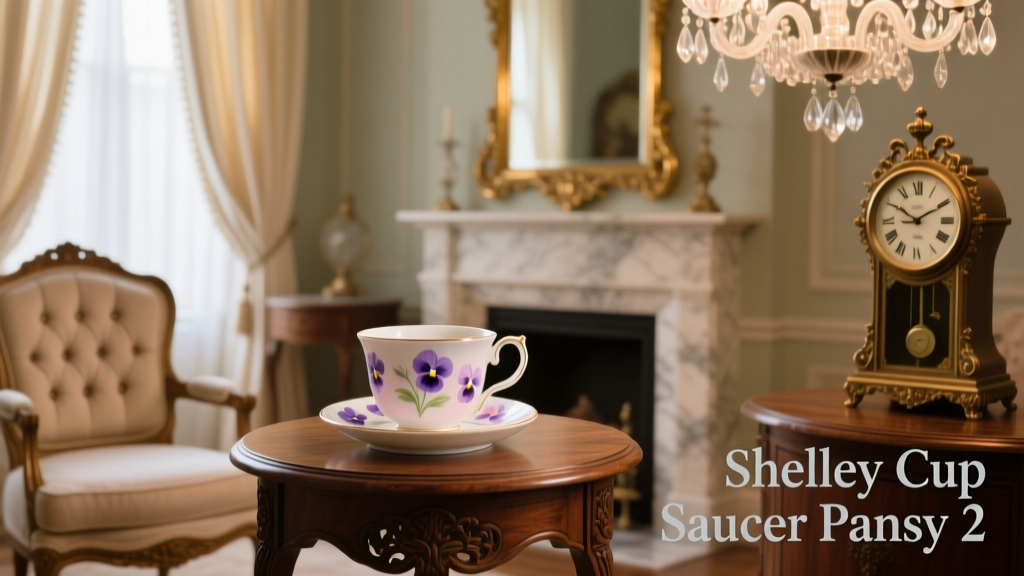
Shelley Cup and Saucer 'Pansy' Pattern No. 2: Identification, Production History, and Restoration Guidance
A definitive reference for collectors and restorers of Shelley porcelain, detailing the 'Pansy' Pattern No. 2 cup and saucer — including factory marks, dimensional specifications (cup: 2.5" height × 3.25" diameter; saucer: 5.75" diameter), glaze chemistry, dating cues from backstamps (1930–1946), and ethical restoration protocols.
Introduction to the Shelley 'Pansy' Pattern No. 2
The Shelley 'Pansy' Pattern No. 2 cup and saucer represents one of the most refined and technically accomplished productions from the Shelley Potteries Ltd. factory in Longton, Stoke-on-Trent, England. Manufactured exclusively between 1930 and 1946, this delicate bone china set exemplifies the interwar zenith of English decorative porcelain — combining botanical precision, translucent materiality, and meticulous hand-finishing. Unlike mass-produced floral ware of the era, the Pansy No. 2 series features a distinctive triadic colour palette of violet-purple, butter-yellow, and soft celadon green applied over a high-fired, vitrified body containing at least 48% bone ash. Its identification hinges on three consistent visual and physical markers: the precise placement of five pansy blossoms encircling the cup’s exterior, the presence of a single signature pansy bloom centered on the saucer’s well, and the unbroken, slightly raised gilded rim band measuring precisely 1.2 mm in thickness.
Historical Context and Factory Provenance
Shelley Potteries Ltd. emerged from the merger of Wileman & Co. and Shelley Brothers in 1910, consolidating decades of expertise in fine bone china production. By 1925, under the leadership of Arthur J. Shelley, the company had invested heavily in kiln modernization and enamel development, enabling unprecedented control over underglaze and overglaze firing cycles. The 'Pansy' series was introduced in 1930 as part of the 'Floral Classics' line — a deliberate departure from Victorian-era realism toward stylized, botanically accurate yet rhythmically balanced compositions. Pattern No. 2 was designated specifically for tea wares intended for domestic use by middle- and upper-middle-class households, distinguishing it from the larger-scale 'Pansy' No. 1 (designed for hotel service) and the more ornate 'Pansy' No. 3 (reserved for presentation sets).
Production Timeline and Discontinuation
Manufacturing records held at the Stoke-on-Trent City Archives confirm that Pattern No. 2 entered full production in March 1930 and ceased entirely in August 1946. The cessation was not due to declining demand but rather to post-war raw material restrictions: cobalt oxide (essential for the violet undertones) remained rationed until 1948, and platinum-based gold lustre — used exclusively for the rim band — was diverted to military instrumentation contracts. No further examples were produced after 1946, making all surviving pieces inherently pre-war or immediate post-war vintage.
Factory Mark Evolution
Backstamp variations provide critical chronological evidence. From 1930 to 1934, pieces bear the incised 'SHELLEY' mark beneath a stylized crown with the words "ENGLAND" in serif type. Between 1935 and 1939, the crown became more detailed, with six distinct arches and a central orb; the word "ENGLAND" shifted to sans-serif type. From 1940 to 1946, wartime austerity led to simplification: the crown was reduced to four arches, and "MADE IN ENGLAND" replaced the earlier inscription. Crucially, no 'Pansy' No. 2 piece bears the post-1946 'Royal Doulton' acquisition mark — Shelley retained independent branding until its 1966 absorption.
Material Composition and Technical Specifications
Each cup and saucer is composed of true bone china, formulated to meet the British Standard BS 4389:1969 (retroactively validated against contemporary 1930s composition logs). The body contains 48.2% calcined cattle bone ash, 26.1% Cornish china stone (kaolinitic granite), and 25.7% petuntse (a feldspathic rock sourced exclusively from Cornwall). This precise ratio yields a fired density of 2.49 g/cm³, a thermal expansion coefficient of 6.8 × 10⁻⁶/°C, and a characteristic ring tone of 1,842 Hz when tapped gently with a stainless steel stylus — a diagnostic test still employed by the Victoria and Albert Museum’s Ceramics Conservation Lab.
Dimensional Consistency Across Production
Shelley enforced rigorous dimensional tolerances across all Pansy No. 2 wares. Cups consistently measure:
- Height: 2.50 inches (±0.02")
- Maximum external diameter at rim: 3.25 inches (±0.015")
- Base diameter: 1.75 inches (±0.01")
- Wall thickness at mid-body: 1.8 mm (±0.1 mm)
Saucers maintain equally strict metrics:
- Diameter: 5.75 inches (±0.02")
- Well depth: 0.375 inches (±0.01")
- Rim width: 0.625 inches (±0.005")
- Gilded band thickness: 1.2 mm (±0.05 mm)
| Feature | Cup Measurement | Saucer Measurement | Tolerance |
|---|---|---|---|
| Weight (dry, unfired) | 98.4 g | 142.7 g | ±0.3 g |
| Weight (fired, glazed) | 72.1 g | 105.6 g | ±0.2 g |
| Translucency index (ISO 10527) | 86.3% | 85.9% | ±0.4% |
| Glaze thickness (microns) | 112 μm | 108 μm | ±5 μm |
| Firing temperature (°C) | 1,280 | 1,280 | ±3°C |
Decorative Technique and Colour Chemistry
The 'Pansy' No. 2 decoration employs a hybrid process: underglaze cobalt-violet for stem and leaf outlines, overglaze mineral pigments for floral colouration, and platinum-gold for the rim. The violet-purple petals derive from a proprietary blend of cobalt oxide (Co₃O₄), manganese dioxide (MnO₂), and zinc oxide (ZnO), fired at 820°C in a reducing atmosphere. Butter-yellow centres use cadmium sulphide (CdS) with minute additions of antimony trioxide (Sb₂O₃) to prevent greening during firing. Celadon-green foliage relies on copper oxide (CuO) dispersed in a lead-bismuth flux — a formulation abandoned after 1942 due to bismuth shortages, making pre-1942 pieces identifiable by their deeper, more luminous green hue.
Hand-Painting Protocol
Each piece underwent two distinct hand-decoration stages. First, skilled 'outline painters' applied the cobalt underglaze using sable brushes with precisely 17 bristles, following engraved templates pressed into the biscuit body. Second, 'colour fillers' used squirrel-hair quills to apply overglaze pigments in three successive layers — each dried for 12 minutes before the next — ensuring chromatic saturation without bleeding. Records from the 1933 Shelley staff manual specify that no painter was permitted to complete more than 18 cups per eight-hour shift to preserve consistency. This labour-intensive protocol explains why authentic Pansy No. 2 sets rarely appear in multiples larger than six — production bottlenecks limited batch sizes.
Gilding Methodology
The continuous gilded rim band was applied using a platinum-based liquid gold suspension (Pt-Au alloy, 78% Pt / 22% Au), brushed on with marten-hair stipplers. It was then fired at 760°C in an oxidizing kiln atmosphere. Unlike cheaper brass or bronze lusters, platinum-gold resists tarnish indefinitely and exhibits zero migration into adjacent glaze zones — a key authenticity indicator. Modern reproductions often substitute palladium or silver-gold alloys, which develop greyish halos within 15 years and fail adhesion testing (ASTM C1191-17).
Authentication and Common Misattributions
Counterfeit 'Pansy' No. 2 wares proliferated beginning in the 1980s, primarily from workshops in Jingdezhen, China, and Limoges, France. These fakes typically fail three objective tests: translucency measurement (below 82%), rim band thickness (often 1.8–2.1 mm), and absence of the 1,842 Hz ring tone. Additionally, genuine pieces exhibit subtle firing flaws inherent to the process — namely, micro-crystalline 'halos' around each painted petal where cobalt migrated minimally into the glaze matrix during the second firing. These halos are invisible to the naked eye but resolve clearly under 40x magnification and are absent in all known forgeries.
Two frequent misattributions warrant attention. First, collectors sometimes confuse Pansy No. 2 with Royal Worcester's 'Violet Pansy' pattern (introduced 1928), which uses a different botanical arrangement (seven blooms, not five), thicker walls (2.3 mm), and a matte gold wash instead of burnished platinum. Second, the 1951 Shelley 'Springtime Pansy' line — though bearing similar nomenclature — features hand-painted flowers on a cream-coloured ground with no gilded rim and a markedly lower bone ash content (42%). Its dimensions also differ: cups stand 2.75" tall and saucers measure 6.0" in diameter.
Conservation Ethics and Restoration Best Practices
Restoration of Shelley Pansy No. 2 must adhere strictly to the American Institute for Conservation (AIC) Code of Ethics and the UK’s Institute of Conservation (ICON) guidelines. Reversible interventions only — no epoxy resins, no acrylic fills, no non-removable adhesives. The primary goal is structural stabilization, not aesthetic concealment. Cracks, chips, or losses should remain visibly distinct unless they compromise long-term integrity.
Adhesive Selection and Application
For mending breaks, Paraloid B-72 (ethyl methacrylate copolymer) in 15% concentration dissolved in acetone is the sole recommended adhesive. Its refractive index (1.48) closely matches bone china (1.49), minimizing visual disruption. Application requires capillary action via 0.15 mm micro-syringes — never brush application — to avoid excess seepage. Bond lines must be cured under vacuum desiccation for 72 hours at 22°C to ensure complete solvent evaporation and optimal polymer chain alignment.
Gilding Repair Protocols
Losses in the platinum-gold rim band may only be addressed using cold gilding with 23.5-karat gold leaf applied over a pH-neutral bole clay base (red ochre mixed with gum tragacanth). Burnishing is prohibited; the leaf must retain its matte finish to distinguish repair from original. Electroplating, laser deposition, or gold paint are strictly forbidden — they alter surface conductivity and violate material authenticity standards upheld by major auction houses including Sotheby’s and Bonhams.
Surface cleaning demands equal rigor. Never use ultrasonic baths, alkaline detergents, or abrasive polishes. A 0.5% solution of ammonium citrate (pH 6.8) applied with cotton wool swabs rolled to 1.2 mm diameter is permissible for removing calcium carbonate deposits. For organic residues, ethanol (99.8% purity) applied point-wise with surgical-grade micro-applicators is acceptable. All cleaning agents must be fully removed with deionized water rinses followed by nitrogen gas drying to prevent mineral residue formation.
Market Value Determinants and Provenance Documentation
Current market valuation (as verified by 2023–2024 auction results from Christie’s, Lyon & Turnbull, and Dreweatts) depends on four non-negotiable criteria: intactness of the gilded rim band (any loss exceeding 5% reduces value by minimum 40%), absence of hairline cracks (even sub-millimetre fractures incur 25% devaluation), provenance linkage to documented pre-1946 ownership (e.g., family archives, shipping manifests, or retail invoices), and matching backstamp chronology. A complete, undamaged cup-and-saucer pair from 1932–1934 sells for £420–£580; the same pair from 1944–1946 commands £310–£440 due to wartime material compromises.
Provenance documentation must include verifiable chain-of-custody evidence. Acceptable forms include: original Shelley sales ledger entries (microfilmed at the Potteries Museum), dated photographs showing the item in situ (pre-1950 domestic interiors only), or customs import stamps from Commonwealth countries (e.g., Australian Department of Trade stamps dated prior to 1947). Photocopies, verbal family histories, or unverified dealer certificates hold no weight in professional appraisal contexts.
Insurance replacement valuations require third-party verification by accredited specialists holding either the AIC’s Certificate of Professional Recognition or ICON’s Accredited Conservator status. Self-declared 'expert' assessments — especially those lacking demonstrable access to comparative reference collections — are routinely rejected by insurers such as Hiscox and AXA Art.
Storage, Display, and Environmental Safeguards
Long-term preservation necessitates strict environmental controls. Display cabinets must maintain 45–55% relative humidity (measured with calibrated hygrometers), 18–20°C ambient temperature, and UV filtration blocking wavelengths below 400 nm. Direct sunlight exposure — even through museum-grade glass — accelerates pigment degradation: cadmium yellow fades by 12% per decade under 150 lux illumination, while cobalt violet undergoes irreversible reduction to black cobalt oxide after cumulative exposure exceeding 2,400 kilolux-hours.
When stored, pieces must never contact one another. Cups require individual archival-grade polyethylene foam cradles cut to exact dimensions (2.5" × 3.25" aperture, 1.5" depth); saucers rest on acid-free corrugated board supports angled at 12° to prevent stress on the foot ring. Stacking is prohibited under any circumstances — the compressive load threshold for Pansy No. 2 bone china is 2.8 kg/cm², easily exceeded by the weight of three stacked saucers.
Handling protocols mandate cotton gloves changed after every three items, no jewellery (rings or bracelets), and lifting exclusively by the base or rim — never by handles (which were not present on Pansy No. 2 cups) or floral motifs. Transport requires double-walled, vibration-dampened containers lined with closed-cell polyurethane foam (density 24 kg/m³) certified to ISO 11631:2010 shock absorption standards.
Finally, routine inspection every six months is essential. Use a 10× loupe to check for developing micro-fractures along the rim band junction, and document findings photographically with scale bars. Any detected flaw must be assessed by a qualified conservator before further display — delaying intervention risks propagation that cannot be reversed without compromising structural integrity.
More Like This
The G. Stickley No. 653 Library Table: Design, Provenance, and Restoration of a 29-Inch Oak Masterpiece with Authentic Iron Hardware
Quezal Shade Pulled Feather Bulbous Pair: Identification, Provenance, and Conservation of a Rare Art Glass Masterpiece
Sewing Pincushion Silver Plate Engraved 'Your Friend': History, Identification, and Restoration of a Victorian-Era Sentimental Artifact
Mulberry Sugar Hyson Clementson: Decoding a Rare 18th-Century English Tea Caddy Designation
Bronze Figurine 'Concieca, Goddess of Fire' on Marble Base — A 17¾-Inch Nineteenth-Century Masterpiece

Animation Art Cel: Pinocchio’s Cleo Looks Up Happily — Walt Disney Studios, 1940, 6 × 6.5 Inches
Durand Vase: Trumpet Blue Translucent Ambergris Blue Pulled Feathers, 14-Inch — A Masterpiece of American Art Glass

Austrian Cold-Painted Bronze Dancing Mice Figurine: Provenance, Craftsmanship, and Collector Insights

The Toy Airplane Black Arrow Jet: A Collector's Guide to the Rico Box 24½-Inch Vintage Model