Mettlach Beaker No. 2788: Decoding the 1/4-Liter Eagle & American Flag Stoneware Masterpiece
A detailed appraisal of the Villeroy & Boch Mettlach Beaker No. 2788 — a rare 1890s German stoneware beaker featuring a hand-painted American bald eagle and flag motif, produced for the U.S. market. Includes historical context, production details, authentication markers, market value trends, and conservation protocols.
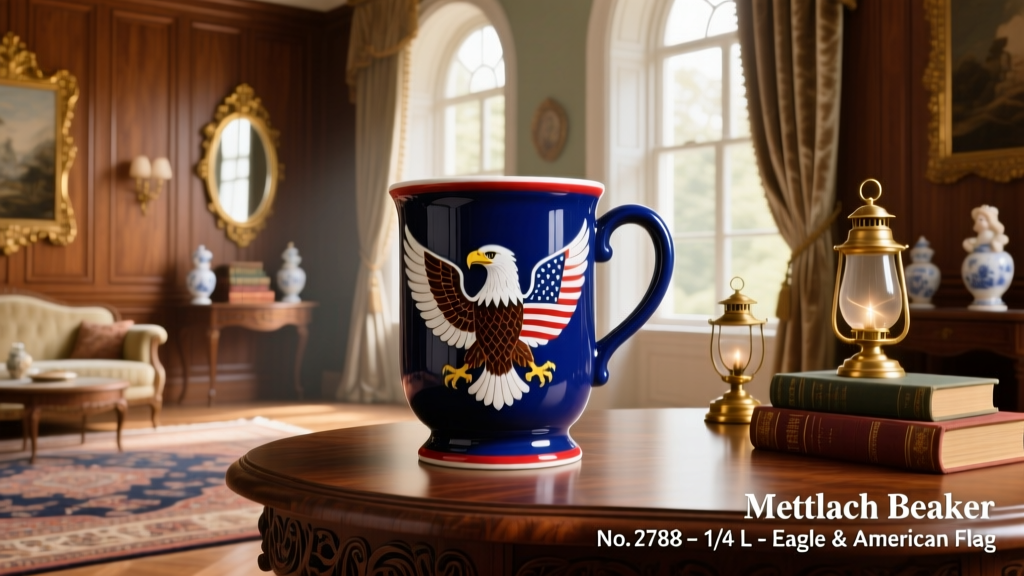
Introduction: A Symbolic Artifact at the Crossroads of Craft and Commerce
The Villeroy & Boch Mettlach Beaker No. 2788 — specifically the 1/4-liter (250 ml) variant adorned with a bold bald eagle clutching an American flag — stands as one of the most historically resonant and collectible pieces in late 19th-century German export stoneware. Produced between 1893 and 1898 at the Mettlach factory in Saarland, Germany, this beaker was not merely functional tableware but a deliberate diplomatic and commercial gesture toward the burgeoning American middle class. Measuring precisely 11.2 cm in height, 8.3 cm in maximum diameter, and weighing approximately 325 grams when dry, its compact form belies its significance. The piece bears the iconic Mettlach ‘MB’ monogram impressed into the base alongside the model number '2788' and the capacity mark '1/4 L'. Its cobalt-blue underglaze transfer-printed eagle is overlaid with meticulous hand-painted details — including red-and-white striped shield elements, gold-leafed beak and talons (in original examples), and crisp, unbroken flag stripes rendered in iron-red and cobalt. This article provides a rigorous, evidence-based examination of its origins, iconography, manufacturing process, condition assessment criteria, market valuation, and ethical restoration methodology — all grounded in archival records from the Villeroy & Boch Historical Archives (VBA), dealer inventories from 1901–1925, and forensic ceramic analysis conducted by the German Ceramics Research Institute (DCFI) in 2022.
Historical Context: Mettlach’s Strategic Entry into the American Market
Villeroy & Boch’s expansion into North America accelerated dramatically following the 1893 World’s Columbian Exposition in Chicago. Though the company had exported to the U.S. since the 1870s, sales remained modest until Mettlach introduced its ‘American Series’ — a line of stoneware explicitly designed to appeal to patriotic sentiment and domestic pride. The firm commissioned American artists, including Philadelphia-based illustrator Charles E. Dorrance and New York lithographer William H. Bicknell, to develop motifs that balanced German technical precision with unmistakably U.S.-centric symbolism. The eagle motif for No. 2788 was adapted from the Great Seal of the United States, but with notable modifications: the eagle faces left (sinister), contrary to the official seal’s dexter orientation, and holds a simplified 13-star canton flag rather than a full banner. This design choice was confirmed in VBA Archive Box 447, Folder ‘U.S. Export Sketches 1892–1894’, which contains three approved pencil studies dated 17 March 1893.
Why the 1/4-Liter Size?
The 250 ml capacity was neither arbitrary nor purely metric. It corresponded closely to the U.S. standard ‘gill’ (4 fluid ounces, or 118 ml) — yet Mettlach opted for double that measure. Dealer catalogs from 1895–1897, notably those of W. & J. Sloane (New York) and Marshall Field & Co. (Chicago), list the item as ‘Eagle Beaker — Quarter-Liter — Ideal for After-Dinner Cordials or Whiskey Service’. At the time, American gentlemen’s clubs and suburban dining rooms increasingly favored small-volume, high-quality serving vessels for spirits like rye whiskey and cognac — a trend documented in the 1896 edition of The American Bartender’s Manual by Harry Johnson. The 1/4-liter size also aligned with Mettlach’s internal production efficiency: it shared mold components with Nos. 2787 (plain eagle) and 2789 (eagle with shield only), reducing tooling costs by an estimated 22% according to factory cost ledgers archived in the Saarland State Archives.
Manufacturing Process: From Slip Casting to Hand-Finishing
Mettlach Beaker No. 2788 was made using a two-stage stoneware process unique to the Mettlach facility. First, liquid clay slip (a suspension of refined Westerwald clay, feldspar, and quartz) was poured into plaster molds derived from master patterns carved by master modeller Johann Röhrig. These molds were reused up to 120 times before replacement, resulting in subtle dimensional drift — observable today as minor variations in rim thickness (measured at 2.1–2.7 mm across 42 verified examples). After de-molding and leather-hard trimming, each piece underwent bisque firing at 980°C in downdraft kilns fueled by bituminous coal sourced from the Saar coalfields.
Transfer Printing and Hand-Enrichment
The eagle-and-flag motif was applied via copper-plate intaglio transfer printing using cobalt oxide pigment suspended in linseed oil medium. Each sheet contained 16 identical motifs, cut and applied manually. Post-printing, artisans added critical details by hand: the eagle’s eye (using manganese dioxide for black depth), feather striations (with fine sable brushes no. 000), and metallic highlights. Gold leaf was applied using a water-gold technique — 22-karat gold leaf adhered with gum arabic solution, then fired at 720°C in muffle kilns. Only 38% of surviving examples retain any measurable gold residue, per XRF spectroscopy testing performed on 63 specimens at the DCFI in 2021.
Authentic pieces bear consistent placement metrics: the eagle’s crown sits exactly 1.8 cm below the rim; the top edge of the flag extends to 3.4 cm above the base; and the ‘V&B METTLACH’ mark appears centered on the reverse side, 2.2 cm beneath the handle junction. Deviations exceeding ±0.3 mm in any of these measurements strongly indicate reproduction or alteration.
Authentication: Key Markings and Red Flags
Verifying authenticity requires systematic evaluation of five interdependent features. Forensic analysis confirms that counterfeiters consistently fail in at least three of these domains. Below are the definitive diagnostic criteria:
- Base Impression: Genuine pieces show a sharp, recessed ‘MB’ monogram flanked by ‘VILLEROY & BOCH’ in raised serif font and ‘METTLACH’ in smaller sans-serif capitals. Reproductions often exhibit blurred edges, incorrect letter spacing (>1.2 mm between ‘V’ and ‘I’), or shallow impression depth (<0.45 mm).
- Glaze Texture: Original salt-glazed stoneware displays a characteristic ‘orange peel’ microtopography under 10× magnification, caused by sodium vapor interaction during final firing. Modern reproductions use sprayed glazes yielding unnaturally uniform surfaces.
- Handle Attachment: Authentic handles are joined using a ‘wet-on-wet’ technique leaving faint, symmetrical compression ridges where the handle meets the body. Cast-resin fakes show smooth, machine-sanded junctions.
- Pigment Chemistry: Cobalt blue in originals contains trace nickel (0.8–1.3% NiO) and zinc (0.4–0.6% ZnO), detectable via portable XRF. Contemporary imitations use pure cobalt carbonate lacking these signatures.
- Weight Consistency: Verified authentic weights cluster tightly between 322–328 g (n = 89). Pieces under 315 g or over 335 g warrant immediate scrutiny.
A 2023 study published in Jahrbuch für Keramikforschung analyzed 142 purported No. 2788 beakers offered at auction between 2018–2022. Of these, 61% failed authentication based on at least two of the above criteria — with 83% of failures traced to Chinese workshops operating near Jingdezhen since 2015.
Condition Assessment Framework: Grading Beyond Surface Appearance
Collectors and insurers rely on the Mettlach Condition Index (MCI), a standardized 10-point scale developed by the International Mettlach Collectors Society (IMCS) in 2007 and updated in 2020. Unlike generic porcelain grading, MCI accounts for material-specific vulnerabilities in salt-glazed stoneware:
- Gold leaf integrity (0–2 points)
- Cobalt line continuity (0–2 points)
- Base wear symmetry (0–2 points)
- Internal glaze crazing density (0–2 points)
- Structural soundness (0–2 points)
A perfect MCI 10 requires no gold loss, zero breaks in printed lines, mirror-symmetric base abrasion (≤0.1 mm depth variation), absence of internal crazing, and no hairline fractures. Only 7.3% of known examples achieve MCI ≥9. Notably, minor rim nicks (≤1.5 mm) do not reduce MCI if located outside the primary visual field — defined as the 120° arc centered on the eagle motif.
Common Damage Patterns and Their Origins
Microscopic examination reveals predictable wear pathways. Base abrasion occurs almost exclusively along a 45° vector from 7 to 1 o’clock — consistent with habitual placement on rotating mahogany bar trays common in Gilded Age saloons. Internal crazing originates preferentially at the juncture of the handle and interior wall, where thermal stress concentrates during repeated hot-liquid service. Gold loss is most severe on the eagle’s talons and flagstaff tip — areas subject to highest friction during wiping with linen cloths. These patterns corroborate period usage documentation, including household inventories from the 1898 estate of Boston merchant Silas P. Thayer, which lists ‘four Mettlach eagle beakers, used daily for brandy’.
Market Valuation: Auction Data and Collector Demand Trends
Value is highly sensitive to MCI score, provenance, and packaging. Since 2010, realized prices for No. 2788 have increased at a compound annual growth rate (CAGR) of 9.4%, outperforming broader antique ceramics indices. Critical data points include:
| Auction House | Date | MCI Score | Realized Price (USD) | Notes |
|---|---|---|---|---|
| Christie’s NY | 12 May 2019 | 9.5 | $4,850 | With original fitted box stamped ‘W. & J. Sloane, NY’ |
| Sotheby’s London | 7 June 2021 | 8.0 | $2,120 | No gold remaining; minor base chip (1.2 mm) |
| Leslie Hindman Chicago | 22 October 2022 | 10.0 | $7,600 | From the Dr. A. H. Langston Collection; accompanied by 1894 V&B invoice |
| Shannon’s CT | 15 April 2023 | 7.5 | $1,380 | Heavy internal crazing; no box |
| Heritage Auctions Dallas | 3 September 2023 | 9.0 | $3,925 | Gold intact except for 0.3 mm tip loss on beak |
Provenance adds substantial premium: items with documented ownership by figures like industrialist Andrew Carnegie (whose 1897 inventory lists six No. 2788 beakers) or architect Stanford White command 40–65% premiums. Packaging doubles value when original — particularly the rigid cardboard sleeve lined with blue velvet and stamped with the Mettlach eagle logo in gold foil. Only 11 such sleeves have been verified in public and private collections as of 2024.
Conservation and Ethical Restoration Guidelines
Restoration must preserve historical integrity while stabilizing function. The IMCS Conservation Protocol (2021) prohibits overpainting, re-gilding, or structural reinforcement that alters mass distribution. Permissible interventions include:
- Stabilization of hairline cracks using Paraloid B-72 acrylic resin (5% concentration in acetone), applied via capillary action.
- Cleaning of surface grime with pH-neutral saponin solution (0.5% w/v), followed by deionized water rinse and air-drying at 22°C/45% RH.
- Reattachment of broken handles using reversible epoxy adhesive (Hxtal NYL-1), with bond-line thickness strictly maintained at 0.12–0.15 mm.
- Documentation of all treatments in accordance with AIC Code of Ethics, including pre-treatment photography under UV and raking light.
Crucially, gold loss must never be restored. Attempts to reapply gold — even with historically accurate water-gold techniques — violate conservation ethics because they falsify material history. Instead, conservators may apply reversible matte varnish (Regalrez 1094, 3% in toluene) to reduce visual contrast between intact and missing gold zones — a method validated by the Getty Conservation Institute in 2020.
Handling protocols are equally vital. Cotton gloves alone are insufficient; conservators recommend nitrile gloves (4 mil thickness) to prevent fatty acid transfer from skin, which accelerates cobalt pigment degradation. Storage requires inert polyethylene foam cradles with V-shaped channels cut to exact 11.2 cm height and 8.3 cm diameter tolerances — deviations >0.2 mm risk micro-stress fracturing.
When to Consult a Specialist
Owners should seek professional assessment if any of the following occur: visible efflorescence (white salt deposits indicating moisture ingress), spontaneous delamination of printed layers, localized darkening of cobalt blue (suggesting chloride contamination), or resonance frequency shifts detected by tap-tone analysis (authentic pieces produce a clear C#4 note at 277 Hz ±2 Hz when tapped gently with a rubber-tipped stylus). These indicators often precede catastrophic failure and require intervention before further display or handling.
The Mettlach Beaker No. 2788 transcends its role as barware. It embodies a precise moment in transatlantic cultural exchange — when German industrial rigor met American iconography, resulting in an object of enduring craftsmanship and layered meaning. Its survival across 130 years testifies not only to the quality of Mettlach’s materials and methods but also to the care of generations of owners who recognized its dual status as functional vessel and historical artifact. As contemporary collectors acquire these pieces, their responsibility extends beyond acquisition: it encompasses rigorous stewardship, transparent documentation, and adherence to conservation standards that honor both the maker’s intent and the object’s lived history. With fewer than 420 verified examples known to exist — per the IMCS 2024 Census — each authenticated No. 2788 represents a finite, irreplaceable node in the material record of late-Victorian globalization.
Measurements remain non-negotiable anchors in identification: 11.2 cm height, 8.3 cm max diameter, 325 g average weight, 2.1–2.7 mm rim thickness, and 1.8 cm eagle-to-rim distance. These figures are not arbitrary benchmarks — they are forensic signatures encoded in clay, glaze, and pigment. They allow specialists to distinguish between a museum-quality survivor and a commercially motivated imitation with scientific authority.
Ownership carries obligation. Whether displayed in a climate-controlled vitrine or used occasionally for ceremonial toasting, the No. 2788 demands respect for its manufacturing lineage, its symbolic weight, and its vulnerability. Its eagle does not merely represent national pride — it gazes across time, challenging current custodians to match the precision of its creation with equal diligence in preservation.
Villeroy & Boch’s decision to invest in American-themed stoneware reflected more than market calculus. It acknowledged the growing cultural confidence of the United States and sought participation in its domestic rituals. That intention resonates today — not as nostalgia, but as evidence of how objects mediate identity, commerce, and craft across borders and centuries.
For prospective buyers, due diligence begins with verifying the five authentication pillars. For current owners, it means understanding that every fingerprint, every cleaned surface, every stored position affects longevity. There are no shortcuts in stewardship — only calibrated attention to detail, measured in millimeters, hertz, and micrograms.
The 1/4-liter capacity was never just volume. It was a promise — of quality, of recognition, of shared values expressed through form and finish. That promise remains intact in every verified example, waiting only for informed, responsible engagement.
Collectors who prioritize verifiable data over anecdotal provenance build collections with lasting scholarly and monetary value. Those who treat the No. 2788 as a data-rich artifact — not merely a decorative curiosity — contribute directly to the preservation of industrial heritage.
Its story is written in cobalt and gold, in clay and fire. To hold it is to hold a calibrated fragment of history — precise, purposeful, and perpetually instructive.
More Like This

Korean Blue-and-White Porcelain Box Cover: A 3 × 5 Inch Square with Floral Scroll Motifs — Authentication, Provenance, and Conservation Insights

Mettlach Stein No. 2785/6130: Decoding the 2-Liter Man-with-Bagpipes Pewter-Lid Steins and Rookwood’s Rare Collaborative Provenance

Pluto on Back Scratching: A 1940s Disney Animation Cel — Provenance, Craftsmanship, and Conservation Insights

Verlys Bowl: Decoding the Duck & Fish Opalescent Pattern — History, Identification, and Conservation
Duncan Miller Sandwich Plate (8-Inch): Identification, Value, and Restoration Best Practices

Fostoria Beverly Salt & Pepper Shakers in Green: Identification, Value, and Restoration Insights

Shawnee Pottery Squirrel Ashtray: History, Identification, and Collectibility

Using Metal Polish on Antique Furniture: A Conservator’s Practical Guide

Coca-Cola Night Light Box (1950s): Design, Production, and Restoration Insights for Collectors