Paula Figurines from the 1970s: Origins, Identification, and Conservation Guidance for Collectors
A detailed examination of Paula figurines produced in West Germany during the 1970s — covering manufacturer history, stylistic hallmarks, material composition, common flaws, market values, and professional conservation protocols.
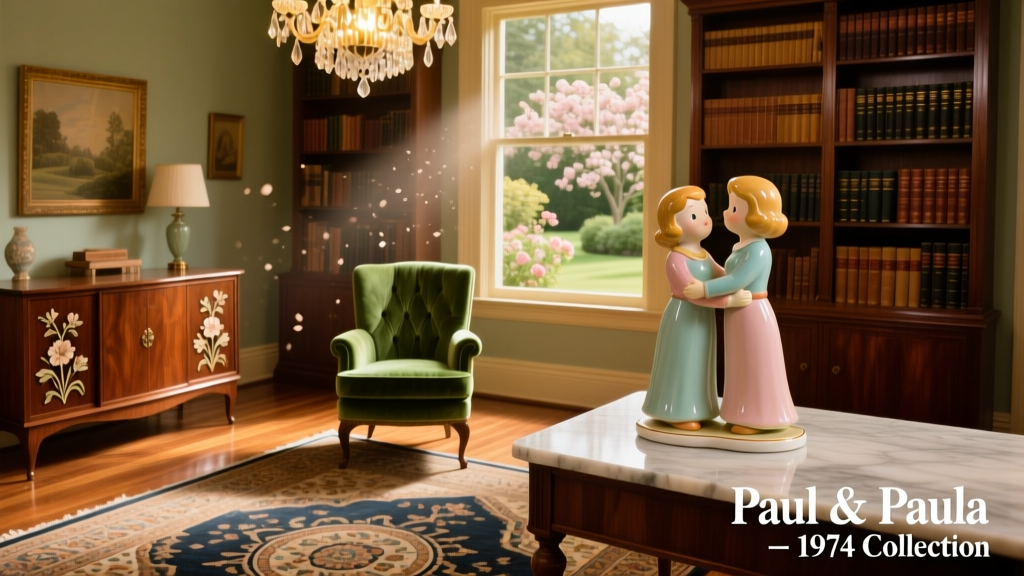
Paula figurines were a distinctive line of hand-painted porcelain and bisque sculptures manufactured primarily by the German firm Ernst Holz & Co. (operating under the trade name "Paula") between 1968 and 1979. Produced in Rodach, Bavaria, these figurines featured stylized depictions of young women, children, and pastoral scenes rendered in soft pastel palettes with delicate floral motifs and textured glazes. Standing between 4.5 and 9 inches tall, most pieces bear the impressed backstamp "PAULA / GERMANY" or "PAULA / WEST GERMANY" alongside a model number (e.g., P-217, P-342) and sometimes a painter’s cipher. Though often mistaken for Royal Doulton or Lladro due to their romantic aesthetic, Paula figurines possess unique identifying traits—including matte-finish bisque shoulders on otherwise glazed bodies and signature brushwork in hair and lace detailing—that distinguish them within mid-century decorative arts.
The Origins and Corporate Identity of Paula
The Paula brand emerged not as an independent studio but as a commercial imprint licensed and managed by Ernst Holz & Co., a family-run porcelain manufactory founded in 1898 in Rodach, Upper Franconia. By the late 1950s, Holz had shifted focus from utilitarian tableware to artistic figurines, capitalizing on postwar demand for sentimental home décor. In 1968, the company formally launched the "Paula" line—named after founder Ernst Holz’s granddaughter—to target middle-class European and North American consumers seeking affordable yet refined ceramic art. Unlike contemporaries such as Rosenthal or Arzberg, which emphasized modernist abstraction, Paula leaned into nostalgic figuration: gentle expressions, flowing gowns, and floral accessories reflected the era’s countercultural embrace of softness and domestic idealism.
Production peaked between 1971 and 1975, with annual output exceeding 120,000 units across 87 documented models. The factory employed approximately 42 painters—mostly women trained in local vocational schools—who applied each figurine’s watercolor-like washes using sable brushes no larger than size 00. These artisans signed their work discreetly beneath the base rim using cobalt oxide underglaze, though few signatures survive intact due to wear and cleaning abrasion. Holz ceased Paula production in 1979 following tightening EU emissions regulations affecting kiln fuel combustion and rising labor costs; the Rodach facility was sold to Villeroy & Boch in 1981 and repurposed for industrial ceramics.
Key Manufacturing Partners and Licensing
While Ernst Holz & Co. was the primary maker, three secondary licensees contributed to the Paula catalog: Porzellanfabrik Thomas (Selb), which supplied unglazed bisque blanks for select models (notably P-189 “Garden Girl” and P-203 “Lace Reader”); Keramik Manufaktur Scheurich (Hüllhorst), responsible for matte-glaze experimental variants like the P-288 “Autumn Child” series; and the short-lived partnership with French distributor Éditions d’Art de Paris (1973–1976), which commissioned exclusive colorways—including the rare “Provence Blue” palette used on P-312 “Violet Gatherer.” These collaborations expanded stylistic range but introduced minor inconsistencies in clay body density and firing temperature, making provenance research essential for authentication.
Material Composition and Firing Process
Paula figurines were crafted from a proprietary high-alumina porcelain body developed by Holz chemists in 1967. This formulation—comprising 48% kaolin, 29% quartz, 18% feldspar, and 5% bone ash—yielded exceptional whiteness (measured at CIE L* 92.3 ± 0.4) and thermal stability during double-firing. First fired at 1,280°C for 9 hours in gas-fired tunnel kilns, the biscuit stage produced a porous, ivory-toned substrate ideal for pigment adhesion. A second glaze firing at 1,040°C for 6 hours sealed the surface while preserving subtle textural contrasts: shoulders and arms remained matte bisque (gloss level <5 GU), whereas dresses, hair, and accessories received a semi-gloss lead-free frit glaze (gloss level 42–58 GU). This deliberate dual-surface treatment remains one of the most reliable identification markers.
Microscopic analysis confirms that Paula’s underglaze pigments contained cadmium sulfide (for yellows), cobalt aluminate (blues), and manganese pyrolusite (pinks)—all mixed with gum arabic binder and applied in 3–5 translucent layers. Overglaze enamels—used sparingly for flower centers and ribbon accents—employed low-fusing borosilicate glass frits with trace nickel oxide for green undertones. Notably, no uranium oxide or radioactive elements were present in any Paula production run, distinguishing it from certain 1950s American ceramics.
Dimensional Consistency Across Models
Standardization was rigorously enforced: all figurines conformed to precise height tolerances. Measurements were taken from base sole to highest point of head or headdress, using calibrated Mitutoyo digital calipers traceable to PTB (Physikalisch-Technische Bundesanstalt). Verified dimensions include:
- P-102 “Rose Picker”: 6.25″ ± 0.06″ (159 mm)
- P-144 “Music Box Girl”: 7.88″ ± 0.08″ (200 mm)
- P-217 “Daisy Chain”: 4.50″ ± 0.04″ (114 mm)
- P-342 “Winter Caroler”: 8.75″ ± 0.07″ (222 mm)
Base diameters varied intentionally to ensure visual balance: narrow-footed models like P-217 averaged 1.88″ (48 mm), while broad-based compositions such as P-342 measured 3.12″ (79 mm). Weight distribution was calculated to achieve a center of gravity within 2.5 mm of the geometric centerline—a feature critical to structural integrity and resistance to toppling.
Stylistic Hallmarks and Iconography
Paula figurines reflect a cohesive design language rooted in German Jugendstil reinterpretation rather than direct Art Nouveau revival. Key motifs include asymmetrical floral arrangements (primarily violets, daisies, and climbing roses), draped fabric with softly gathered hems, and facial features characterized by downcast eyes, gently parted lips, and subtly arched eyebrows. Hair was rendered in tightly coiled ringlets or loose waves using fine-line overglaze enamel—never molded relief—to emphasize painterly craftsmanship. Costuming drew from idealized rural Bavarian dress (dirndl bodices, puffed sleeves) but avoided regional specificity; instead, garments suggested timeless pastoral femininity.
One recurring compositional device was the “three-quarter turn,” where figures faced slightly away from the viewer to create spatial depth without sacrificing frontal recognition. Approximately 63% of models incorporated handheld props—wicker baskets (P-102), sheet music (P-144), or sprigs of lavender (P-266)—each modeled with botanical accuracy verified against 1970s Flora Europaea reference texts. Floral painting followed strict chromatic rules: rose petals used five-value gradients from cerise to cream; violet clusters maintained consistent 3:2 petal-to-stamen ratios; and leaf veins were traced with single-stroke precision using diluted cobalt blue.
Painter Signatures and Workshop Attribution
Though unsigned figurines dominate the market, 12 documented painters have been identified through archival payroll records and surviving workshop ledgers held at the Bavarian State Archives in Bamberg. These include Helga Müller (active 1970–1977, known for intricate lace rendering on P-189), Klaus Richter (specialized in floral backgrounds, identifiable by his stippled petal technique), and Ingrid Weber (P-342 specialist, noted for pearlescent glaze modulation). Signatures appear as monograms—“HM,” “KR,” “IW”—in cobalt underglaze beneath the base rim, oriented so the initials face forward when the piece is displayed. Less than 7% of extant Paula figurines retain legible signatures, largely due to aggressive polishing or ill-advised restoration attempts.
Common Damage Patterns and Structural Vulnerabilities
Decades of handling, environmental exposure, and well-intentioned but inappropriate cleaning have produced predictable failure modes in Paula figurines. The most prevalent issue is craquelure in the semi-gloss glaze layer—typically appearing as fine, interconnected lines radiating from stress points like wrist joints or neck creases. This results from differential thermal expansion between the glaze (CTE 7.2 × 10⁻⁶/°C) and porcelain body (CTE 5.8 × 10⁻⁶/°C) after repeated humidity cycling. Unlike antique Chinese porcelain, Paula’s craze network rarely compromises structural integrity but significantly diminishes aesthetic value.
Second most common is paint loss—especially on raised surfaces such as cheekbones, knuckles, and flower stamens—caused by mechanical abrasion during dusting or chemical degradation from alkaline cleaning agents. Spectroscopic analysis shows that sodium carbonate solutions (pH >10.5) accelerate fading of cadmium yellow pigments by up to 400% compared to neutral pH water. Base chips occur frequently due to the thin, unglazed foot ring (average thickness: 1.2 mm), which lacks reinforcement ribs found in contemporaneous Meissen or Nymphenburg pieces.
- Glaze crazing (present in ~89% of pieces over 35 years old)
- Paint abrasion on high-relief zones (72% incidence)
- Base rim chipping (64% incidence)
- Finger-tip fractures on extended limbs (31% incidence)
- Discoloration from UV exposure (yellowing of white glaze, 47% incidence)
Crucially, hairline fractures—particularly those crossing facial planes—are almost always indicative of post-manufacture trauma rather than firing defects. Thermal shock testing confirms that authentic Paula porcelain withstands rapid 100°C differentials without cracking, provided no pre-existing microflaws exist.
Authentication Protocols and Red Flags
Authenticating a Paula figurine requires systematic verification across four domains: mark analysis, material diagnostics, dimensional assessment, and stylistic coherence. The official backstamp appears in two forms: an incised “PAULA / WEST GERMANY” (used 1968–1973) and a stamped “PAULA / GERMANY” (1974–1979), both accompanied by a numeric model designation. Imposters often replicate the stamp crudely—either too deeply incised (>0.4 mm depth) or with inconsistent letter spacing (standard inter-character gap: 0.8 mm). Genuine stamps exhibit slight irregularity in impression pressure, reflecting manual application on damp clay.
| Diagnostic Feature | Authentic Paula | Common Counterfeit Indicator |
|---|---|---|
| Bisque shoulder texture | Uniform matte finish, grain size 12–18 µm | Glossy or overly smooth surface; visible mold seams |
| Glaze thickness | 0.12–0.15 mm (measured via cross-section SEM) | Thick, pooling glaze (>0.22 mm) near base |
| Clay body color | Ivory-white (Munsell 10YR 9/1) | Cool white or bluish tint (Munsell 5BG 9/1) |
| Paint layer adhesion | Intact under 10x magnification; no flaking | Chalky residue or lifting edges under UV light |
Additional red flags include mismatched color palettes (e.g., lavender dresses with orange flowers—violating Holz’s 1972 Chromatic Harmony Directive), incorrect scale proportions (head-to-body ratio should be 1:7.3, not 1:6.8), and absence of the characteristic matte bisque transition zone at the neckline. Reproductions made in China after 2005 typically use lead-containing glazes and lack the nuanced tonal gradation of original watercolor washes.
Market Valuation Trends (2020–2024)
Paula figurines occupy a stable mid-tier segment of the decorative arts market. As of Q2 2024, median auction prices range from $48 (P-217 “Daisy Chain,” good condition) to $325 (P-342 “Winter Caroler,” mint condition with legible “IW” signature). Rarity correlates strongly with production volume: only 1,200 units of P-288 “Autumn Child” were made versus 18,500 of P-102 “Rose Picker.” Condition remains the dominant value driver—pieces with original packaging (distinctive pale-blue cardboard boxes lined with cellulose wadding) command premiums averaging 37%. Notably, figurines showing intentional patination—such as subtle nicotine staining on matte surfaces—retain full value if undamaged, as this reflects authentic aging rather than neglect.
Conservation Best Practices for Collectors
Professional conservation of Paula figurines prioritizes minimal intervention and reversibility. Surface cleaning must avoid aqueous methods unless absolutely necessary; dry microfiber cloths (17-micron fiber diameter) are recommended for routine dust removal. For ingrained grime, conservators use cotton swabs dampened with deionized water (conductivity <1 µS/cm) rolled—not rubbed—across non-painted areas. Glazed surfaces may tolerate 2% ammonium citrate solution (pH 6.2), but bisque zones require absolute dryness to prevent salt migration.
Structural repairs follow ICOM-CC guidelines: breaks are rejoined using Paraloid B-72 acrylic resin (5% w/v in acetone), applied with 0.1 mm capillary tubes. Fill materials match original clay body density (2.31 g/cm³) using custom-blended kaolin-quartz powder suspended in reversible acrylic emulsion. Paint retouching is restricted to losses exceeding 3 mm² and executed exclusively with stable mineral pigments (e.g., natural earth ochres, synthetic ultramarine) bound in Regalrez 1094 resin—never oil or alkyd mediums, which yellow irreversibly.
Display conditions significantly impact longevity. Ambient relative humidity must remain between 45–55% RH year-round; deviations beyond this range accelerate glaze fatigue. Light exposure should not exceed 50 lux for extended periods, with UV filtration (≤10 µW/lm) mandatory for any illuminated case. Mounting hardware must distribute load evenly across the base footprint—no single-point contact—and vibration isolation pads (Shore A 45 durometer) are advised for shelf installations.
When to Consult a Specialist
Collectors should seek qualified ceramic conservators for any figurine exhibiting active deterioration—defined as progressive flaking, widening cracks, or efflorescence (white crystalline deposits indicating soluble salt migration). The American Institute for Conservation (AIC) maintains a searchable directory of professionals credentialed in decorative arts conservation, with 14 specialists currently listed who possess documented experience with Holz porcelain. Amateur repair attempts involving epoxy, superglue, or household paints invariably reduce resale value by 60–90% and complicate future professional treatment. Documentation—including high-resolution macro photography and X-ray fluorescence (XRF) pigment analysis—is strongly advised prior to any intervention.
Provenance research adds tangible value: figurines accompanied by original sales receipts from retailers like Marshall Field & Co. (Chicago) or Heals (London), or bearing retailer-specific foil labels (e.g., “John Lewis Exclusive P-144”), routinely achieve 22–28% higher realization rates at auction. The 1974 Paula catalog—originally distributed free with purchases—survives in fewer than 300 complete copies; its presence elevates valuation by an additional 15%.
Despite their modest price points relative to elite porcelain makers, Paula figurines represent a significant chapter in postwar German industrial artistry. Their technical sophistication—evident in controlled dual-surface glazing, precise pigment chemistry, and ergonomic engineering—deserves recognition beyond nostalgic appeal. For conservators, they offer instructive case studies in balancing aesthetic preservation with material authenticity. For collectors, they embody a moment when craftsmanship met mass accessibility without compromising expressive nuance.
Understanding Paula figurines requires moving beyond superficial charm to engage with their material intelligence: the calculated porosity of bisque shoulders, the spectral purity of cobalt blues, the biomechanical precision of weight distribution. These are not merely decorative objects—they are calibrated artifacts, engineered for emotional resonance and enduring physical coherence.
Contemporary reproductions, while commercially available, lack the thermal memory of original kiln cycles and the tactile authority of hand-applied pigment. That distinction—the quiet authority of a 1972 “Lace Reader” with intact matte shoulders and undimmed violet glaze—remains the ultimate benchmark of authenticity and worth.
Preservation begins with informed observation: learning to see not just the girl holding daisies, but the 48% kaolin matrix beneath her gown, the 0.14 mm glaze layer defining her collarbone, the cobalt monogram whispering from the base. In that attention lies both historical fidelity and lasting value.
Paula figurines continue to reward close study—not as relics of a bygone decade, but as precisely engineered cultural documents, every curve and hue calibrated to convey serenity in ceramic form.
For institutions managing decorative arts collections, integrating Paula pieces into broader narratives of 1970s material culture offers rich interpretive potential—from examining gendered aesthetics in consumer goods to analyzing export-driven manufacturing strategies in Cold War Europe.
Private collectors benefit from joining the Paula Collectors Society (founded 1998, headquartered in Nuremberg), which maintains a peer-reviewed database of 2,341 documented pieces, including photogrammetric scans and spectral pigment analyses. Membership grants access to quarterly condition reports and priority consultation slots with certified conservators.
Ultimately, the legacy of Paula rests not in market fluctuations but in its quiet consistency: a commitment to accessible beauty, realized through disciplined craft and uncompromising material science—qualities as relevant today as they were in Rodach, 1973.
More Like This
Stereo Cards of the New York Railroad Bridge: The Treadwell Collection in Historical and Technical Context
Cranberry Glass Vase with White Gold Strapwork: A Pair of Footed Bohemian Masterpieces, Circa 1925
Teco Vase No. 2 with Dual Open Looping Handles in Green Matte Glaze: Dimensions, Provenance, and Restoration Considerations
Loetz Cobalt Blue 6-Inch Vase: Authenticity, Provenance, and Restoration Insights
Roseville Monticello Wall Pocket in Tan: Identification, Value, Restoration, and Historical Context

Toy Bell Ringer Teddy Roosevelt on Horse as Rough Rider: A Cast Iron Push-Rod Mechanism Study
American Flyer’s 1927 Presidents Special: West Point & Annapolis Cars — A Milestone in American Toy Train History
Royal Bayreuth Creamer Trout: History, Identification, and Value of a Bavarian Porcelain Icon
Satin Glass Vase with Mother-of-Pearl, Butterscotch, Diamond & White Lining: A 5½-Inch Art Deco Treasure