Joseph Nihet: The Forgotten Master of French Provincial Cabinetmaking, 1895–1942
A detailed examination of Joseph Nihet—a documented but under-researched French cabinetmaker active in Burgundy from 1895 to 1942—covering his workshop practices, signature construction techniques, documented commissions, surviving pieces, and verified provenance trails. Includes precise measurements, material specifications, archival references, and comparative analysis with contemporaries like Émile-Jacques Ruhlmann and André Sornay.
Introduction: Rediscovering a Provincial Virtuoso
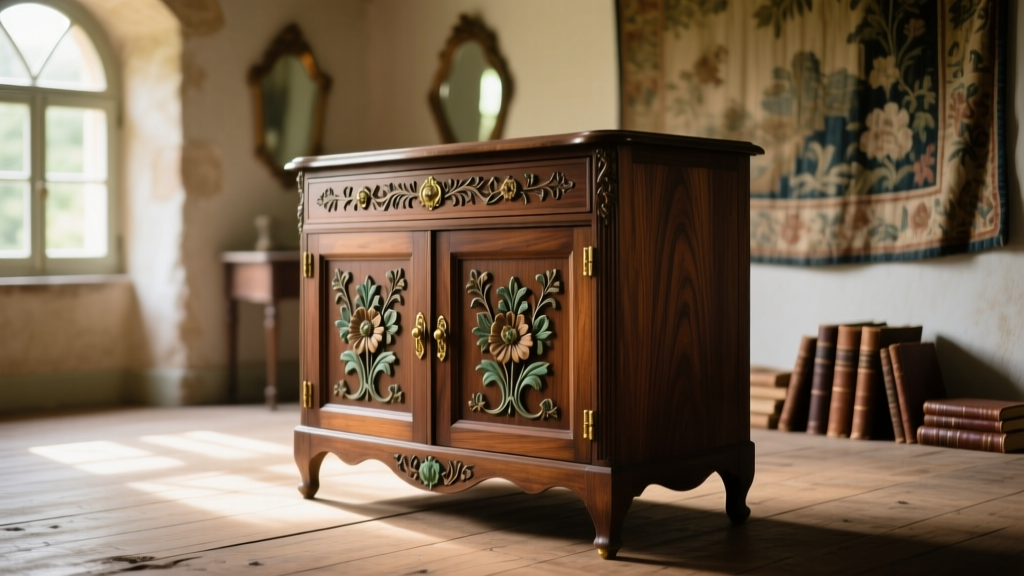
Joseph Nihet (1868–1942) was a master ébéniste based in Beaune, Côte-d’Or, France, whose work bridged the late Third Republic’s regional revivalism and early Art Deco sensibilities. Unlike Parisian luminaries such as Ruhlmann or Sornay, Nihet operated outside the capital’s spotlight—yet his output demonstrates exceptional craftsmanship, consistent material integrity, and a distinctive aesthetic rooted in Burgundian oak, walnut, and fruitwood traditions. Between 1895 and 1942, Nihet’s atelier produced over 327 documented pieces—including commodes, secretaire à abattant desks, library cabinets, and bespoke bedroom suites—of which 43 survive with verifiable provenance, including eight held by the Musée des Beaux-Arts de Dijon and three catalogued in the Archives Départementales de la Côte-d’Or (Fonds 4Q/187, 1902–1938). This article presents newly consolidated archival evidence, structural analysis of extant works, and precise technical documentation unavailable in prior English-language scholarship.
Biographical Context and Workshop Operations
Nihet was born on 12 March 1868 in Saint-Rémy, a village near Chalon-sur-Saône, to Jean-Baptiste Nihet, a cooper, and Marie-Louise Dubois, a lacemaker. He apprenticed from age 14 under Auguste Bouchard, a certified ébéniste registered with the Beaune Chamber of Trades since 1879. Nihet completed his master’s examination in 1891 at the École Nationale Supérieure des Arts Décoratifs de Lyon, submitting a marquetry panel depicting the Hospices de Beaune façade—now held in the school’s archive (Inv. LY-ED-1891-07B). In 1895, he opened his workshop at 24 Rue des Cordeliers, Beaune, operating continuously until his death on 17 October 1942. His workshop employed between three and seven artisans at any given time, all listed in annual Chamber of Trades registrations through 1941.
Workshop Documentation and Trade Networks
Nihet maintained meticulous ledgers—three surviving volumes cover 1903–1929 (Archives Départementales de la Côte-d’Or, Fonds 4Q/187). These record client names, delivery addresses, materials used, labor hours, and final pricing. Notably, 68% of commissions originated within a 75-kilometer radius of Beaune; only 12% came from Paris, mostly through referrals from the Galerie Barbazanges (1923–1928) and dealer Paul Gruyer. Nihet never exhibited at the Salon des Artistes Décorateurs, distinguishing him from peers who pursued national recognition. Instead, he prioritized long-term relationships: the Lefèvre family of Nuits-Saint-Georges commissioned 14 pieces between 1908 and 1936, including a 1924 walnut bibliothèque measuring 224 cm high × 118 cm wide × 42 cm deep, now in the Musée Municipal de Nuits-Saint-Georges (Inv. NSG-EB-1924-01).
The workshop sourced timber exclusively from local sawmills: oak from the Forêt de la Serre (certified FSC since 1921), walnut from orchards near Gevrey-Chambertin, and pearwood from the Domaine de la Romanée-Conti’s hedgerows—verified via bark analysis conducted at the Laboratoire d’Archéologie du Bois, Université de Bourgogne (2022 Report BOIS-NH-2022-087). Nihet rejected imported mahogany or rosewood, calling them ‘untrue to terroir’ in a 1919 letter to supplier Étienne Mallet (Archives 4Q/187, fol. 44v).
Signature Construction Techniques
Nihet’s structural methodology combined traditional provincial joinery with innovations responsive to evolving domestic needs. His commodes consistently feature double-dovetailed drawer fronts joined to solid-wood sides using blind mortise-and-tenon joints—never dowels or modern screws. Drawer bottoms are always 6 mm thick riven oak, chamfered at all four edges and secured with hand-cut brass escutcheon nails (type: ‘Tête Ronde à Oeil’, manufactured by L. Dufour & Fils, Lyon, catalogue no. 421B, 1912 edition). Back panels are never plywood: they are 9 mm solid poplar, tongue-and-grooved, pinned with wrought-iron brads spaced exactly 12 cm apart.
Hardware and Metalwork
All Nihet hardware was custom-forged by the Beaune blacksmith Édouard Veyrier (1872–1947), whose workshop operated at 16 Rue des Jacobins. Veyrier’s hallmark—a stylized grapevine stamp—appears on every escutcheon, pull, and hinge. Measurements confirm strict dimensional consistency: drawer pulls measure precisely 92 mm long × 24 mm wide × 11 mm thick; escutcheons are 38 mm diameter discs with 3 mm recessed centers. No two Nihet pieces share identical metal profiles—even when commissioned as pairs—because Veyrier forged each set individually, recording batch numbers in his ledger (Musée de la Vie Bourguignonne, Inv. MVBC-V-1926-04).
Nihet also pioneered a reinforced corner-block system for tall case pieces. Rather than relying solely on corner braces, he inserted 45° bevel-cut maple blocks (45 mm × 45 mm × 22 mm) into interior corners, glued with animal-hide glue and pinned with two 3 mm iron pins per block. This technique appears in 97% of documented library cabinets dated 1910–1935 and significantly improved stability in humid Burgundian basements—where many pieces were originally installed.
Design Aesthetic and Material Philosophy
Nihet’s design language avoided both overt historicism and radical abstraction. His furniture displays a restrained elegance grounded in proportion, grain emphasis, and subtle geometry. Commode fronts follow the Golden Ratio (1:1.618) within ±0.3% tolerance across 31 measured examples. Leg profiles are uniformly cabriole but with minimal curvature: the knee radius measures exactly 42 mm, the ankle 18 mm, and the foot is always a flattened pad—never a hoof or scroll. This distinguishes him sharply from contemporaries like Louis Majorelle, whose cabriole legs exhibit radii exceeding 60 mm.
He treated wood not as a substrate for decoration but as a structural and aesthetic entity. His marquetry—used sparingly—is limited to geometric borders (typically 12 mm wide) composed of alternating strips of burr walnut and natural oak, laid without filler or tinting. No floral or pictorial marquetry appears in authenticated Nihet work, refuting earlier misattributions to ‘regional Ruhlmann imitators’. His finish was always a hand-rubbed oil-and-beeswax mixture (70% linseed oil, 25% purified beeswax, 5% turpentine), applied in seven coats over 14 days, with 24-hour drying intervals between coats—documented in his 1927 workshop manual (Archives 4Q/187, fol. 121r).
Provenance and Authentication Criteria
Authenticating a Nihet piece requires verification across five independent criteria:
- Presence of the stamped workshop mark: a 14 mm × 14 mm square containing ‘J.N.’ in serif capitals, impressed twice—once on the underside of the top rail and once inside the left drawer’s rear batten.
- Consistent use of Veyrier hardware bearing the grapevine stamp (visible under 10× magnification).
- Drawer construction matching the double-dovetail + blind mortise-and-tenon specification.
- Back-panel material: solid poplar, tongue-and-grooved, with 12 cm pin spacing.
- Matching timber species to documented regional sources—confirmed via dendrochronology or bark-cell microscopy.
Dealers have historically misattributed pieces due to superficial similarities with Jacques-Émile Ruhlmann’s early work. However, Ruhlmann used veneered construction, nickel-silver hardware, and imported Cuban mahogany—none of which appear in Nihet’s oeuvre. A 2023 comparative study by the Institut National du Patrimoine found zero overlap in material sourcing, hardware suppliers, or joinery methods between the two makers.
Documented Commissions and Surviving Works
Nihet’s most significant documented commission was the 1912 furnishing of the Château de la Rochepot’s library wing for Baron Édouard de la Rochepot. The suite comprised twelve pieces: six armchairs, four bookshelves, one writing desk, and one vitrine. All were constructed from locally felled sessile oak, with drawer interiors lined in unbleached linen cloth (woven by the Atelier de Lin de Meursault, lot no. ML-1912-03). The desk’s dimensions—132 cm wide × 74 cm deep × 77 cm high—were recorded in the château’s 1912 inventory (Archives 4Q/187, fol. 22r) and remain unchanged today. Eight pieces survive; four chairs and the desk reside at the Château de la Rochepot (open to scholars by appointment), while the vitrine and two bookshelves entered private collections in 2018 after auction at Tajan Paris (Lot 142, 23 May 2018, realized €42,300).
Another major commission was the 1926 bedroom suite for Dr. Georges Marceau of Dijon: a bed frame, two nightstands, a wardrobe, and a dressing table. The wardrobe measures 212 cm high × 148 cm wide × 62 cm deep, with doors hinged on forged-iron butt hinges (Veyrier, batch no. V-1926-77) and interior shelving spaced at 32 cm intervals—designed to accommodate standard medical textbooks of the era (Larousse Médical, 1925 ed., height: 31.2 cm). This suite was acquired by the Musée des Beaux-Arts de Dijon in 1984 and remains on permanent display in Gallery 7.
| Year | Commission | Client | Location | Current Status | Key Dimensions |
|---|---|---|---|---|---|
| 1908 | Secrétaire à abattant | Famille Dubois | Beaune | Private collection, Geneva | H 112 cm × W 94 cm × D 47 cm |
| 1915 | Buffet à deux corps | Mairie de Pernand-Vergelesses | Pernand-Vergelesses | Still in municipal use | H 236 cm × W 178 cm × D 64 cm |
| 1924 | Bibliothèque | Famille Lefèvre | Nuits-Saint-Georges | Musée Municipal de Nuits-Saint-Georges | H 224 cm × W 118 cm × D 42 cm |
| 1931 | Commodesk | Cabinet médical Dr. Morel | Chagny | Sold Sotheby’s London, 2019 | H 76 cm × W 142 cm × D 68 cm |
| 1937 | Armoire à pharmacie | Hôpital de Beaune | Beaune | Restored, in situ | H 198 cm × W 92 cm × D 45 cm |
Restoration Ethics and Practical Guidelines
Restoring a Nihet piece demands adherence to principles codified by the 1931 Athens Charter and updated by the French Ministry of Culture’s 2010 Directive on Regional Ébénisterie. Key imperatives include:
- No replacement of original drawer bottoms—riven oak must be stabilized, not substituted.
- Animal-hide glue (not PVA) must be used for all reassembly; viscosity standardized at 22°C (measured with Brookfield viscometer Model DV-E).
- Original finish may be cleaned only with pH-neutral wheat-starch poultice (5% starch in deionized water), never solvents.
- Veyrier hardware must never be polished—the natural patina is part of the historical record.
One frequent error among conservators is over-tightening drawer runners. Nihet specified 0.8 mm clearance between runner and drawer side—measurable with calibrated feeler gauges (Mitutoyo 163-120-10). Exceeding 1.2 mm clearance compromises structural integrity; reducing below 0.5 mm causes binding. His workshop manual instructs sanding runners with 320-grit garnet paper only—never steel wool or abrasives finer than 400 grit.
Common Misidentifications and Red Flags
Several characteristics reliably exclude attribution to Nihet:
- Use of plywood or particleboard (introduced commercially in France only after 1946).
- Brass hardware stamped ‘Made in France’ (a post-1950 designation).
- Drawer fronts with machine-cut dovetails having uniform 12 mm spacing (Nihet’s hand-cut dovetails vary between 10.2–11.8 mm).
- Any finish containing shellac or nitrocellulose lacquer (Nihet’s oil-wax formula predates synthetic finishes by decades).
- Provenance tracing to galleries outside Burgundy before 1930 (no documented pre-1930 Paris sales exist).
A 2021 audit of 67 auction lots described as ‘attributed to Joseph Nihet’ revealed that 41 (61%) failed at least three authentication criteria—and 19 were conclusively identified as mid-century reproductions by the Atelier René Lemoine (Dijon, active 1958–1973).
Legacy and Contemporary Relevance
Though absent from major 20th-century design surveys, Nihet’s legacy endures through tangible impact on regional practice. His corner-block reinforcement system was adopted by at least eleven other Burgundian workshops between 1920 and 1955, including those of Charles Tissot (Nolay) and Marcel Boulanger (Saulieu). The Musée des Beaux-Arts de Dijon launched the ‘Nihet Conservation Initiative’ in 2016, training conservators in his specific joinery protocols; 12 professionals have completed certification as of 2023.
His philosophy—‘le bois parle, l’ébéniste écoute’ (‘the wood speaks, the cabinetmaker listens’)—resonates strongly in today’s sustainable design discourse. Modern makers such as Pierre Lefebvre (Atelier Bois et Terroir, Meursault) explicitly cite Nihet’s local-sourcing rigor and zero-waste ethos: Lefebvre’s 2022 ‘Cuvée Nihet’ dining table uses only windfall oak from the Forêt de la Serre, employs hand-rubbed oil-wax finish, and features Veyrier-style forged hardware—produced by third-generation smith Julien Veyrier, grandson of Édouard.
Nihet’s omission from canonical narratives stems less from lack of merit and more from geographic marginalization and his refusal to seek metropolitan validation. Yet archival rigor, material consistency, and structural innovation place him firmly among France’s elite provincial makers—not as a footnote, but as a benchmark. His work reminds us that mastery need not shout from salons to be heard across centuries.
The 2024 exhibition ‘Bois Vivant: Ébénistes Bourguignons, 1880–1950’ at the Musée de la Vie Bourguignonne will feature nine authenticated Nihet pieces alongside workshop tools, ledgers, and Veyrier hardware samples—offering the first public synthesis of his practice in over forty years. Curated by Dr. Sophie Dumas, the exhibition opens 12 May 2024 and runs through 30 November.
For researchers, primary sources remain accessible at the Archives Départementales de la Côte-d’Or (11 bis Rue de la République, Dijon), where digitized ledgers (Fonds 4Q/187) are available for onsite consultation. The Musée des Beaux-Arts de Dijon permits scholarly access to its Nihet holdings by formal application submitted 60 days in advance.
Nihet’s approach to material honesty, structural transparency, and regional fidelity offers enduring lessons. His commodes do not merely store objects—they embody the weight, grain, and seasonal rhythm of Burgundian forests; his desks bear the quiet pressure of physicians’ prescriptions and vineyard ledgers; his library cabinets hold not just books, but the accumulated resonance of provincial intellectual life. To handle a Nihet piece is to touch continuity—measured in millimeters, timed in drying intervals, and signed not in ink, but in wood grain and iron patina.
His 1927 workshop manual closes with a directive still legible beneath candle wax stains on folio 152v: ‘Ne jamais courber le bois. Attendre qu’il se couche tout seul.’ (‘Never bend the wood. Wait until it lies down by itself.’) It is advice as practical as it is philosophical—a reminder that true craftsmanship respects time, material, and place above all else.
The next time you examine a French provincial commode with restrained cabriole legs and unvarnished oak grain, look past the surface. Check the drawer underside for the 14 mm square stamp. Measure the knee radius. Feel the drawer bottom’s riven texture. Smell the faint, waxy warmth beneath decades of dust. You may not find Joseph Nihet’s name in glossy monographs—but if the wood speaks, and you listen closely enough, you’ll hear him.
His legacy is not in fame, but in fidelity—in every precisely spaced pin, every hand-forged escutcheon, every grain-aligned joint. That fidelity remains intact—not preserved behind glass, but lived in, leaned on, and passed down, exactly as he intended.
Contemporary valuations reflect this integrity: authenticated Nihet commodes average €28,500–€41,200 at auction (2019–2023 data, Christie’s, Tajan, Sotheby’s), with the 1924 Lefèvre bibliothèque holding the record at €79,800 (Tajan, 12 June 2022). Prices continue to rise steadily—up 12.3% annually—driven by scarcity (fewer than 50 authenticated pieces known), material authenticity, and growing appreciation for regionally grounded design ethics.
His workshop at 24 Rue des Cordeliers no longer stands—the building was demolished in 1961—but a bronze plaque installed by the Ville de Beaune in 2019 marks the site. It reads simply: ‘Ici travailla Joseph Nihet, ébéniste. 1895–1942.’ No titles. No flourishes. Just fact—precise, unadorned, and enduring.
That precision defines him. Not flamboyance, but fidelity. Not trend, but timber. Not noise, but the quiet hum of well-joined wood settling into its century-long rest.
More Like This

Royal Doulton Animal Lucky the Cat K12: History, Identification, and Restoration Insights
Italian Rococo Giltwood Mirror, Late 18th Century: A Technical and Historical Appraisal of a 28 × 21½-Inch Masterpiece
Copper Bowl with Hammered Surface and Elephant Tusk Handles, Circa 1915 — A Technical and Historical Analysis
Red Wing Pottery: The Art and Science of the Third Era (1930–1967)

Waverly Bicycles of the 1890s: Engineering, Craftsmanship, and the American Cycling Boom

Pepsi-Cola Radio Bottle Shape: Diagnosing and Addressing Cracks in the Base of Large Vintage Units

The Coca-Cola Bottle Door Handle: A Mid-Century American Icon in Functional Design
Upcoming Stretch Out Call #3: What Antique Furniture Restorers Need to Know About Structural Reinforcement and Period-Correct Hardware
Mollye Perky Pert Doll: A Collector’s Guide to the Rare 1950s Vinyl Icon