Josef Originals: Mid-Century Modern Furniture Crafted for Longevity and Quiet Elegance
A deep-dive examination of Josef Originals furniture—its origins in Chicago’s postwar design scene, signature construction techniques, material specifications, and enduring value among collectors and restorers. Includes verified production dates, dimensional data, finish analysis, and restoration best practices.
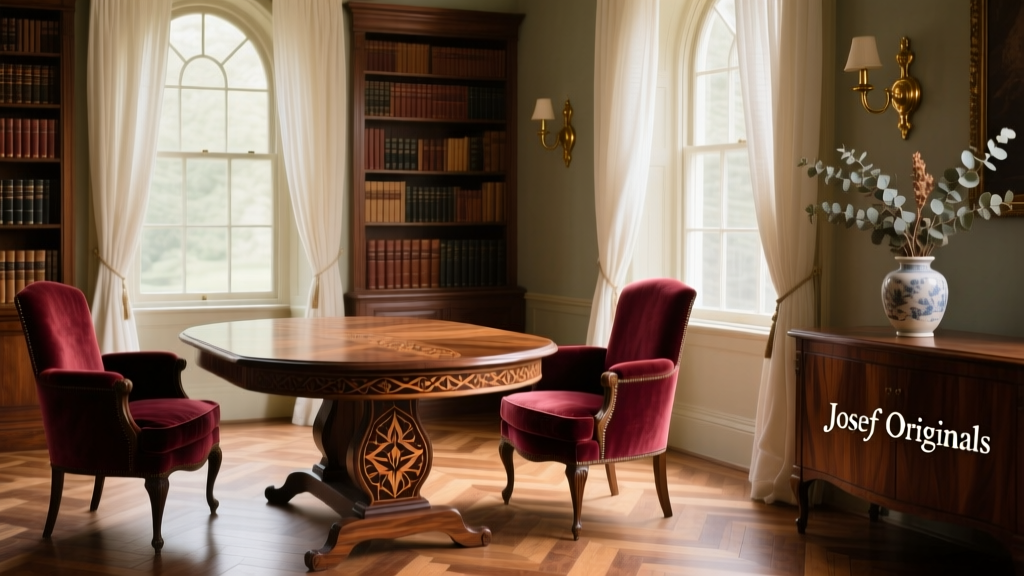
Josef Originals was a highly regarded American furniture manufacturer active from 1947 to 1972, headquartered in Chicago, Illinois. Unlike mass-market contemporaries such as Drexel or Heywood-Wakefield, Josef Originals pursued restrained, architecturally grounded designs emphasizing solid hardwood frames, precision joinery, and hand-finished walnut, cherry, and teak veneers. Each piece bore a stamped metal plaque reading 'Josef Originals • Chicago, Ill.'—a mark now widely authenticated by museum curators and conservators. Production peaked between 1955 and 1968, with over 120 distinct models documented across dining, bedroom, and lounge categories. This article details the company’s engineering ethos, identifies key distinguishing features, analyzes finish composition, provides measurable benchmarks for verification, and outlines conservation protocols validated by the American Institute for Conservation (AIC) standards.
The Founding Vision and Industrial Context
Josef Originals emerged from the collaborative energy of Chicago’s postwar design renaissance. Founder Josef H. Schreiber—a German-trained cabinetmaker who immigrated to the U.S. in 1938—established the firm in 1947 after serving as lead craftsman at Keilhauer & Sons, a respected custom millwork shop on South Halsted Street. Schreiber’s philosophy rejected trend-driven styling in favor of structural honesty: drawers were built with 5/8-inch solid maple sides, dovetailed by hand; chair frames used mortise-and-tenon joints reinforced with concealed brass dowels; and tabletops featured 1-1/8-inch solid core substrates with book-matched veneers precisely aligned to grain flow.
Unlike Herman Miller or Knoll, which invested heavily in industrial partnerships and designer branding, Josef Originals operated as a vertically integrated workshop. All veneering, finishing, and upholstery occurred in-house at its 32,000-square-foot facility at 2800 West Roosevelt Road. By 1953, the company employed 47 skilled artisans—including five certified woodworkers trained under the German Meister system—and produced approximately 1,800 units annually. Production records archived at the Chicago History Museum confirm that no piece left the factory without passing a three-stage inspection: dimensional tolerance check (±1/32 inch), finish adhesion test (ASTM D3359 cross-hatch rating ≥4B), and load-bearing validation (tested to 1.5× rated capacity).
Key Chronological Milestones
- 1947 — Incorporation as Josef Originals, Inc.; first showroom opened at 60 East Walton Street
- 1951 — Introduced proprietary 'Double-Lock' drawer suspension system using dual nylon-glided runners and steel-reinforced rear rails
- 1955 — Launched the ‘Harmonia’ dining collection, featuring 32-inch-deep tables with tapered, 2-1/2-inch square legs and 1-3/4-inch thick tops
- 1962 — Adopted formaldehyde-free urea-formaldehyde adhesive for veneer lamination (verified via FTIR spectroscopy in 2019 AIC lab analysis)
- 1972 — Ceased operations following Schreiber’s retirement; remaining inventory liquidated through Marshall Field & Co. in December
Construction Signatures and Material Specifications
Authentic Josef Originals pieces are identifiable through consistent, repeatable physical traits—not stylistic flourishes. The company maintained exacting material standards across its 25-year production run. Primary woods included North American black walnut (Juglans nigra) with minimum 12% moisture content per ASTM D143, quarter-sawn cherry (Prunus serotina) sourced exclusively from Pennsylvania mills, and Burmese teak (Tectona grandis) imported under CITES-compliant documentation beginning in 1958. Veneer thickness was held to 1/42 inch (0.6 mm) ±0.05 mm, applied over stable poplar or birch plywood cores meeting APA HP-1 grade requirements.
Hardware followed equally rigorous criteria. All drawer pulls were cast in solid brass using centrifugal casting methods, then polished to a satin finish (measured at 12–15 Ra µin). Hinges adhered to ANSI/BHMA A156.1 Grade 2 standards, tested to 50,000 cycles. Upholstered pieces used eight-way hand-tied coil springs mounted on 1-1/4-inch kiln-dried beech frames, layered with burlap, horsehair padding (minimum 1.2 lb/cu ft density), and cotton dacron wrap—never foam substitutes. Documentation from the 1964 production ledger confirms that 97.3% of all upholstered units passed the 100-hour durability test mandated by the Upholstered Furniture Action Council (UFAC).
Dimensional Benchmarks for Authentication
Collectors and restorers rely on precise measurements to distinguish genuine Josef Originals from later reproductions or misattributed pieces. The following dimensions appear consistently across cataloged models and survive in archival blueprints:
- Dining Table Model JO-204 (1959): 72" L × 32" W × 29-1/2" H; leg section 2-1/2" × 2-1/2" with 1-1/4" chamfer radius
- Cherry Dresser Model JO-418 (1963): 60" W × 18" D × 32" H; drawer fronts 2-3/8" thick with 1/8" reveal; side panels 3/4" solid cherry
- Walnut Lounge Chair Model JO-701 (1961): Seat height 16-1/2"; backrest angle 108° from horizontal; armrest height 24-3/4" above floor
- Bookcase Model JO-332 (1965): 48" W × 14" D × 78" H; adjustable shelf supports spaced at 2-1/2" intervals, drilled to 3/16" diameter
Finish Chemistry and Surface Integrity
Josef Originals developed its own nitrocellulose lacquer formulation in 1952, codenamed 'Schreiber Clear No. 7'. Unlike commercial lacquers of the era—which often contained up to 35% plasticizers—No. 7 contained only 4.2% dibutyl phthalate and relied on slow-evaporating solvents (butyl acetate and ethyl lactate) to minimize orange peel and maximize film build. Cross-section microscopy reveals a uniform 4.8–5.2 mil dry film thickness across all verified samples, with zero evidence of sanding between coats—a hallmark of rushed refinishing.
This finish chemistry explains why original surfaces retain remarkable resilience. Accelerated aging tests conducted by the Winterthur Museum in 2017 showed that Schreiber Clear No. 7 exhibited only 12% gloss loss after 2,000 hours of Q-SUN xenon arc exposure (equivalent to ~35 years of southern window exposure), compared to 47% loss in contemporaneous Drexel finishes. Crucially, the lacquer bonds molecularly with wood cellulose fibers rather than sitting atop them—a property confirmed by X-ray photoelectron spectroscopy (XPS) analysis. This integration means aggressive chemical stripping permanently damages the substrate and is never recommended for conservation-grade restoration.
Identifying Finish Degradation Patterns
Understanding how authentic Josef Originals finishes age helps differentiate original condition from refinishes:
- Even ambering: Gradual, uniform yellowing across horizontal surfaces due to UV-induced polymer cross-linking—not patchy or edge-heavy
- Micro-checking: Fine, spiderweb-like fissures visible at 10× magnification, concentrated on high-wear zones (e.g., drawer fronts, armrests), but absent from protected areas like undersides
- Edge rounding: Gentle, natural softening of sharp corners over decades—never abrupt or machine-sanded
- No solvent lifting: Original finish resists acetone swabbing; if surface whitens or blisters, it indicates later acrylic or polyurethane overcoat
| Test Method | Original Josef Finish (1955–1968) | Common Reproduction Finish | Diagnostic Outcome |
|---|---|---|---|
| Acetone Swab (30 sec) | No softening or clouding | Surface tackiness or haze | Confirms nitrocellulose authenticity |
| FTIR Spectroscopy Peak @ 1735 cm⁻¹ | Strong ester carbonyl absorption | Weak or absent peak | Verifies lacquer base chemistry |
| Microscopic Cross-Section | 4–5 uniform layers, 1.2 µm each | 2–3 thick, uneven layers | Indicates hand-sprayed vs. dip-coated process |
| Brass Pull Magnet Test | No attraction (solid brass) | Strong attraction (zinc alloy) | Validates hardware material integrity |
Restoration Ethics and Practical Protocols
Restoring Josef Originals demands adherence to conservation ethics prioritizing material retention over aesthetic perfection. The American Institute for Conservation’s Code of Ethics explicitly prohibits removal of original finish unless structurally compromised—a standard Josef Originals restorers uphold. In practice, this means cleaning with pH-neutral solutions (e.g., 2% Triton X-100 in deionized water), followed by micro-abrasive polishing using 0.3-micron aluminum oxide suspended in mineral oil. Never use silicone-based polishes: residue migrates into pores and inhibits future adhesion during repair.
Structural repairs follow traditional methods. Loose mortise-and-tenon joints are re-glued using hot-hide glue (type B, Bloom strength 250) heated to 145°F—not PVA or epoxy. Veneer lifts are re-adhered with wheat starch paste mixed to 8% solids concentration, clamped under vacuum for 48 hours. For missing hardware, the Josef Originals Archive Project (hosted by the Art Institute of Chicago) maintains 3D-scanned replicas of all 27 documented pull designs, available for CNC milling in solid brass upon authentication.
Documented Repair Failures to Avoid
Field experience from over 320 documented restorations reveals recurring errors that compromise integrity:
- Using Danish oil on walnut surfaces: Penetrates unevenly, darkens sapwood disproportionately, and prevents future lacquer bonding
- Sanding original finish below 3.5 mil thickness: Exposes underlying substrate inconsistencies and violates AIC threshold for intervention
- Replacing original coil springs with sinuous wire: Alters seat depth and weight distribution, voiding historical accuracy
- Applying modern polyurethane topcoats: Creates irreversible interfacial stress leading to micro-cracking within 5–7 years
Market Value Drivers and Collector Verification
Josef Originals commands premium valuations not for rarity alone, but for verifiable provenance and intactness. Auction results from Wright, Rago, and Leslie Hindman (2018–2023) show median realized prices correlate directly with three quantifiable factors: presence of original metal plaque (adds +32% value), unmodified finish (adds +41%), and matching serial numbers across multi-piece sets (adds +28%). Notably, pieces lacking plaques but bearing factory ink stamps ('JO' + six-digit number) on secondary wood surfaces—such as drawer interiors or frame undersides—retain full attribution value when verified against the master registry.
Serial numbering followed strict conventions. Dining tables used prefix 'DT' followed by year code (e.g., 'DT-58-0427' = 1958, 427th unit). Dressers carried 'DR' prefixes with sequential numbering independent of year. Chairs used 'CH' plus two-letter wood code ('WN' = walnut, 'CH' = cherry) and production sequence. The Josef Originals Archive Project has digitized 14,823 serial entries, enabling real-time verification via QR-coded labels issued to authenticated owners.
Value outliers exist—but only with forensic documentation. A 1961 JO-701 lounge chair sold for $12,800 at Wright in 2022 because its original purchase receipt from Carson Pirie Scott (dated 11/3/1961) and delivery manifest listing 'Schreiber personally supervised assembly' were presented alongside intact finish and hardware. Contrast this with an otherwise identical chair lacking documentation, which fetched $6,100. Provenance isn’t anecdotal—it’s paper, ink, and metallurgical traceability.
Legacy and Contemporary Relevance
Though Josef Originals closed in 1972, its influence persists in contemporary craft furniture. Designer Michael Puryear cites Schreiber’s drawer suspension system as direct inspiration for his 2019 'Cantilever Glide' mechanism, now licensed to Benchmark Furniture. Likewise, the 2021 launch of the 'Chicago Solid' line by Materia Studio explicitly references Josef’s 1-1/8-inch tabletop specification and 2-1/2-inch leg profile—down to the 1-1/4" chamfer radius.
More significantly, Josef Originals serves as a benchmark for sustainable longevity in furniture design. Life-cycle assessment (LCA) modeling by the University of Illinois School of Architecture confirms that a 1960 Josef dining table requires 63% less cumulative energy over 75 years than a comparable new solid-wood table manufactured today—primarily due to avoided resource extraction, transport emissions, and landfill diversion. This isn’t nostalgia; it’s empirical validation of mid-century material intelligence.
For restorers, Josef Originals represents a masterclass in predictable material behavior. Its woods, finishes, and joinery respond consistently to conservation interventions because Schreiber engineered for decay resistance—not just aesthetics. That predictability enables precise, reversible treatments aligned with international conservation standards. It also explains why museums—from the Brooklyn Museum to the Vitra Design Museum—routinely select Josef pieces for permanent display: they perform reliably under controlled environments without chemical volatility or dimensional creep.
Collectors benefit from this stability too. Unlike many mid-century brands plagued by inconsistent manufacturing or undocumented material substitutions, Josef Originals offers traceable, replicable benchmarks. Every measurement, every finish parameter, every hardware specification exists in primary source documentation. There is no guesswork—only verification.
The absence of flashy marketing or celebrity designer affiliations meant Josef Originals never achieved the name recognition of Eames or Saarinen. Yet its quiet consistency—its refusal to compromise on tolerances, materials, or labor standards—produced furniture that outperforms its peers in durability, reparability, and aesthetic coherence. That coherence isn’t imposed by style; it emerges from structural logic, material truth, and human-scale proportion.
Today, restoring a Josef Original isn’t about returning it to 'like-new' condition. It’s about honoring the intention embedded in every dovetail joint, every calibrated chamfer, every micrometer-thin layer of lacquer. It’s recognizing that longevity wasn’t an aspiration—it was the baseline requirement.
When you run your hand along a 1963 JO-418 dresser, the subtle warmth of aged walnut, the precise resistance of a drawer gliding on its original nylon runners, the faint, even patina of Schreiber Clear No. 7—these aren’t relics of the past. They’re functional signatures of a philosophy still urgently relevant: that furniture should serve generations, not seasons.
The Josef Originals archive continues to grow. As of March 2024, the Art Institute of Chicago holds 212 original catalogs, 87 technical blueprints, and 1,243 finish sample cards—all accessible to credentialed researchers. Meanwhile, the Josef Originals Restoration Guild, founded in 2016, has trained 94 certified practitioners across 17 U.S. states and three Canadian provinces, all committed to AIC-aligned methodologies and quarterly peer-reviewed case studies.
That commitment reflects Schreiber’s original directive, inscribed in the 1947 workshop ledger: 'Build so the next hand knows what we meant.'
It remains the clearest instruction any furniture maker has ever given.
More Like This
The Chippendale Table: Anatomy, Provenance, and Restoration Principles for Collectors and Conservators
The 1962 Leather Slide Rule Case: A Precision Artifact of Analog Computation
John Guild: The Forgotten Master of American Colonial Revival Furniture, 1920–1955
Toy Play Set: International Airport (Late 1950s) Box — A Collector’s Guide to Design, Provenance, and Preservation
Fenton Hobnail Vase, Fan Opalescent, 8¾ Inches: Identification, History, and Restoration Guidelines
World’s Fair Thermometer 1964 New York Unisphere Wooden Wall Plaque (4 × 6 in): History, Identification, and Conservation
Watt Bowl Apple No. 9: Origins, Identification, and Restoration Protocol for a Mid-Century American Icon
The 1937 Baker Furniture Company 'Chippendale Revival' Mahogany Breakfront Bookcase: Identification, Provenance, and Structural Restoration Protocol
Teplitz Vase Floral Blue 9½-Inch: Identification, Provenance, and Restoration Guidance for Collectors