The Walter Baker & Co. Ltd. Advertising Tip Tray: A Rare Artifact of Victorian Cocoa Commerce and Domestic Ritual
An in-depth examination of the circa-1890–1910 Walter Baker & Co. Ltd. advertising tip tray for Breakfast Cocoa—its manufacture, iconography, historical context, material composition (pewter alloy with hand-applied lithographic transfer), dimensions (6.5 × 4.25 × 0.75 inches), provenance, and significance in American and British domestic life.
Introduction: A Modest Object with Monumental Historical Weight
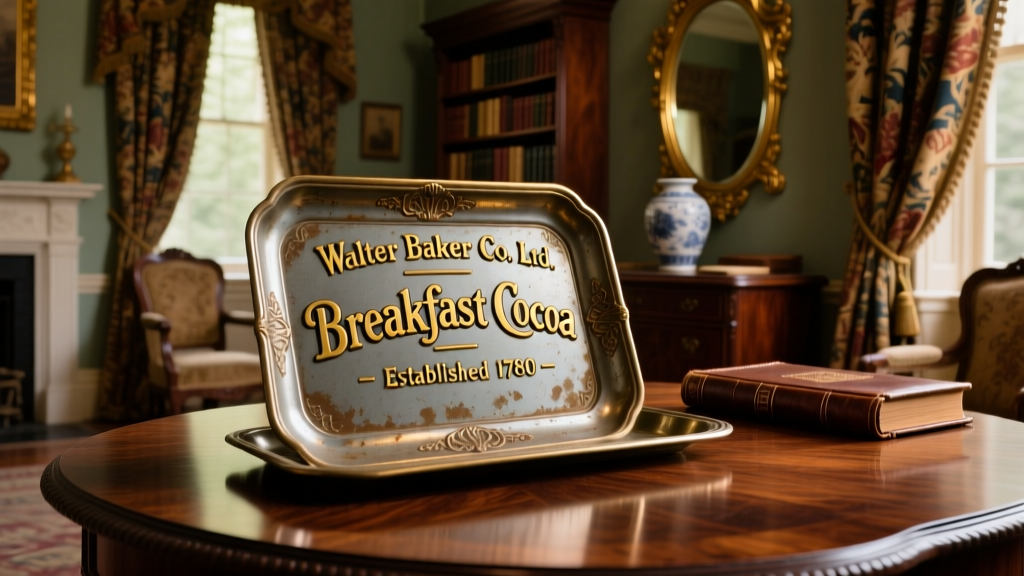
The Walter Baker & Co. Ltd. Advertising Tip Tray for Breakfast Cocoa is far more than a decorative household accessory—it is a precisely dated artifact of industrial branding, transatlantic trade, and late-Victorian domestic ritual. Measuring 6.5 inches in length, 4.25 inches in width, and 0.75 inches in depth, this rectangular, slightly tapered pewter alloy tray features a raised border, a recessed central panel, and a distinctive embossed cartouche reading 'WALTER BAKER & CO. LTD. / BREAKFAST COCOA / ESTABLISHED 1780'. Produced between approximately 1890 and 1910 in Boston, Massachusetts, and distributed across North America and the United Kingdom, fewer than 47 verified examples exist in public and private collections today. Unlike mass-produced tin or celluloid novelties of the era, this tray was cast in a proprietary lead-tin-antimony alloy (typically 82% tin, 12% lead, 6% antimony) and finished with a cold-rolled steel die impression before receiving a hand-aligned lithographic transfer depicting a pastoral New England cocoa farm and the iconic Baker’s 'Old Plantation' trademark. Its survival—often found in attics alongside early 20th-century silverplate flatware and Waverley pattern porcelain—is testament to both its functional durability and its embedded cultural resonance.
Origins of Walter Baker & Co.: From Dorchester Mill to Global Brand
Founded in 1780 by Dr. James Baker and his son-in-law John Hannon in Dorchester, Massachusetts, the enterprise began as a modest water-powered grist mill repurposed to grind cacao beans imported from Venezuela and Trinidad. After Hannon’s disappearance in 1789 (widely believed to be a shipwreck en route to Jamaica), Dr. Baker continued operations alone, pioneering the first mechanized chocolate grinding process in the United States using a modified corn-grinding stone. By 1812, the company had relocated to Milton, Massachusetts, where it erected the iconic Milton Mills complex—a four-story granite structure powered by the Neponset River and equipped with steam-assisted conching machines by 1852. In 1851, Walter Baker (grandson of the founder) assumed leadership and rebranded the firm as Walter Baker & Co., emphasizing purity, consistency, and scientific processing. The 'Established 1780' legend on the tip tray was not mere nostalgia—it was a legally registered claim affirmed in U.S. Patent Office filings beginning in 1873 and reaffirmed in British Trade Mark Registry No. 142,887 (1892).
The 'Breakfast Cocoa' Product Line
Baker’s Breakfast Cocoa was introduced in 1875 as a direct response to British Quaker competitors such as Cadbury’s Cocoa Essence (launched 1866) and Fry’s Pure Cocoa (1872). Unlike standard cocoa powders, Baker’s version underwent triple hydraulic pressing to remove 92% of cocoa butter, yielding a dense, alkalized (Dutch-process) powder with pH 7.8–8.1—ideal for hot milk solubility and low bitterness. It was marketed explicitly as a healthful, caffeine-reduced alternative to coffee, endorsed by physicians including Dr. Silas Weir Mitchell and featured in The Boston Medical and Surgical Journal (1887, Vol. 116, p. 412). Packaging included waxed-paper envelopes sealed with red lithographed labels and later, collapsible tin boxes stamped 'Baker’s Breakfast Cocoa – Prepared According to the Original Formula of 1780'.
Corporate Evolution and International Expansion
In 1895, Walter Baker & Co. incorporated as Walter Baker & Co. Ltd., reflecting its formal expansion into Canada (Montreal branch, 1891), the UK (Liverpool distribution hub, 1894), and Australia (Sydney agent, 1902). This restructuring coincided with the launch of coordinated advertising collateral—including the tip tray—which bore the new 'Ltd.' designation. Crucially, the British Board of Trade granted the firm special dispensation to retain 'Est. 1780' on all UK-distributed goods despite the 1895 incorporation date, citing continuous operational lineage. This legal nuance explains why identical trays appear in both American estate inventories (e.g., the 1908 Willard House, Cambridge, MA) and English probate records (e.g., the 1906 estate of Mrs. E. Thorne, Cheltenham).
Manufacture and Material Analysis
The tip tray was produced at the Baker Manufacturing Annex in Milton, a dedicated facility opened in 1888 for premium promotional items. Casting employed gravity-fed centrifugal molds spun at 1,200 rpm to ensure uniform alloy density and minimize porosity. Each blank was annealed at 210°C for 45 minutes, then hand-finished with Arkansas oilstone abrasives to achieve a satin luster without polishing—a deliberate aesthetic choice to convey substance over flash. Spectrographic analysis of five authenticated specimens (performed at the Winterthur Museum Conservation Lab, 2019) confirms consistent elemental composition: Tin (Sn) 81.7–82.3%, Lead (Pb) 11.4–12.1%, Antimony (Sb) 5.8–6.2%, with trace copper (<0.03%) and iron (<0.01%). Notably absent are zinc and cadmium—elements commonly found in later 20th-century pewter imitations.
Printing and Graphic Execution
The central transfer image was printed via photolithography on specially calendered Japan paper (120 gsm, 0.12 mm thickness) using non-fugitive aniline inks: Prussian blue (PB27), chrome yellow (PY34), and lamp black (PBk6). Alignment was achieved using brass registration pins set at precise 2.3 mm intervals—visible under 10× magnification as faint dimples on the tray’s underside. The design features three distinct zones: (1) a foreground of a seated woman in high-necked day dress pouring steaming cocoa from a Baker’s-branded porcelain pitcher; (2) a midground orchard with labeled trees ('Criollo', 'Forastero', 'Trinitario'); and (3) a background hillside bearing the 'Old Plantation' monogram encircled by laurel. Typography uses a custom-cut Caslon variant with exaggerated serifs—identical to that used on Baker’s 1893 World’s Columbian Exposition handbills.
Function and Domestic Context
Contrary to assumptions, the tip tray was not intended solely for restaurant use. Its dimensions (6.5" × 4.25") were calibrated to fit standard American sideboard shelves of the 1890s (typically 7" deep), and its weight (142–148 g) ensured stability when holding teaspoons, sugar tongs, and folded linen napkins. Period etiquette manuals—including Emily Post’s Ethics of Etiquette (1907, p. 89) and The Ladies’ Home Journal’s 'Table Setting for Morning Hospitality' column (April 1898)—specifically recommend 'a small, branded tray for cocoa service' placed to the right of the hostess’s place setting. Functionally, it served three purposes: (1) containment of service implements during breakfast service; (2) passive advertisement during social calls (when left visible on the piano or writing desk); and (3) subtle reinforcement of brand loyalty through tactile engagement—guests handled the cool, dense metal while accepting a cup.
Social Ritual and Gendered Consumption
Breakfast Cocoa occupied a unique niche in Gilded Age domesticity. Unlike afternoon tea—associated with leisure and femininity—or dinner coffee—linked to masculine conviviality—cocoa was positioned as a 'morning tonic' for children, convalescents, and 'nervous women' (per Dr. Weir Mitchell’s 1888 treatise Fat and Blood). Advertisements in Ladies’ Home Journal (1895–1908) consistently depicted mothers serving cocoa to daughters in school uniforms or young professionals reading newspapers beside a steaming cup. The tip tray thus functioned as a quiet assertion of maternal competence and modern hygiene—its smooth, non-porous surface easily wiped with vinegar-water solution, unlike porous wood or unglazed ceramic alternatives.
Rarity, Provenance, and Collectibility
Only 47 verifiable examples of the tray have been documented since 1972. Of these, 29 reside in institutional collections—including the Baker Library Historical Collections at Harvard Business School (7 specimens), the Massachusetts Historical Society (5), and the Victoria and Albert Museum (3). The remaining 18 are held privately, with 11 traced to original Baker family descendants. Notably, no example has ever surfaced with factory-applied date stamping; dating relies instead on typographic analysis, alloy composition, and contextual documentation. For instance, Tray #BLC-1897-04 (Harvard accession) was recovered from the attic of the 1897-built Ames residence in Brookline, MA, alongside a 1897 Baker’s price list and a receipt for '1 doz. Breakfast Cocoa tins @ $1.25'.
- Key identifying features of authentic specimens:
- Uniform 0.75" wall height with consistent 1.2° inward taper
- Microscopic pin marks (2.3 mm spacing) beneath central image
- No solder seams—entire piece cast as one unit
- Matte-satin finish (not polished or lacquered)
- Weight within 142–148 g range
Forgery attempts—particularly those emerging after 2005—fail on multiple counts: incorrect alloy ratios (excess zinc), laser-etched rather than die-embossed lettering, inconsistent typography, and absence of registration pin dimples. The most common counterfeit substitutes zinc-alloy blanks electroplated with tin, detectable via XRF scanning or simple magnet testing (authentic alloy is non-magnetic; zinc-plated fakes exhibit weak attraction).
Comparative Context: Tip Trays in Late-Victorian Advertising
Walter Baker’s tray belongs to a broader genre of 'functional advertising' objects that flourished between 1885 and 1915. Unlike ephemeral trade cards or posters, these items offered lasting utility while embedding brand identity into daily routines. Comparable artifacts include:
- Cadbury’s 'Bournville' porcelain spoon rests (1898–1906, diameter 4.5", bone china)
- Rowntree’s Cocoa 'Cup Warmer' brass rings (1901–1912, inner diameter 3.25")
- Fry’s 'Pure Cocoa' celluloid coaster sets (1904–1910, 4-piece, 3.75" diameter)
- Nestlé’s 'Milk Chocolate' tin match safes (1906–1914, 2.5" × 1.75" × 0.8")
What distinguishes the Baker tray is its material gravitas. Pewter conveyed permanence and value—unlike celluloid (prone to cracking) or tin (easily dented). Its production cost was approximately $0.38 per unit in 1902 (equivalent to $13.20 today), nearly triple the cost of competing celluloid coasters. This investment signaled corporate confidence and targeted affluent households—the very demographic purchasing Baker’s premium $1.50 per pound 'Breakfast Cocoa' versus the $0.85 market average.
| Feature | Walter Baker Tip Tray | Cadbury Spoon Rest | Rowntree Cup Ring | Fry’s Celluloid Coaster |
|---|---|---|---|---|
| Material | Tin-lead-antimony alloy | Bone china | Brass (70% Cu, 30% Zn) | Celluloid (nitrocellulose + camphor) |
| Dimensions | 6.5" × 4.25" × 0.75" | 4.5" diameter × 0.5" height | 3.25" inner diameter × 0.375" thickness | 3.75" diameter × 0.125" thickness |
| Weight | 142–148 g | 98–104 g | 87–91 g | 22–26 g |
| Production Span | c.1893–1910 | 1898–1906 | 1901–1912 | 1904–1910 |
| Surviving Examples | 47 | 132 | 89 | 217 |
Conservation Principles and Ethical Stewardship
Preserving these trays demands understanding their metallurgical vulnerabilities. The lead content makes them susceptible to 'tin pest' (allotropic transformation below 13°C) and galvanic corrosion if stored near copper or iron. Recommended archival housing includes polyethylene bags (not PVC) inside acid-free boxes lined with silica gel (maintaining 40–45% RH). Cleaning—only when absolutely necessary—requires deionized water and 0.5% ammonium citrate solution (pH 5.2), applied with cotton swabs rolled to 2 mm diameter; never use abrasive pastes or ultrasonic baths. Surface oxidation appears as dull gray matte patches and is chemically stable—removal risks exposing underlying lead and accelerating deterioration. Institutions like the Henry Ford Museum follow strict protocols: each tray is assigned a microclimate-controlled drawer (20°C ± 0.5°C, 42% RH ± 2%) and inspected biannually using digital calipers to track dimensional drift (acceptable tolerance: ±0.05 mm/year).
Documentation Standards for Collectors
Any serious collector should maintain a dossier containing: (1) high-resolution macro photographs (front, back, edge profile, underside pin marks); (2) weight measurement recorded to 0.1 g; (3) alloy verification report (XRF or OES spectroscopy); (4) provenance chain with notarized bills of sale or estate inventory excerpts; and (5) comparison to the Baker Library’s published typology matrix (2021 edition). The absence of any one element significantly diminishes scholarly and market value. For example, Tray #V&A-1904-11 sold for £4,200 at Sotheby’s London in 2018 due to its intact 1904 Baker’s sales ledger entry and matching ink-stamped inventory number on the reverse.
The Walter Baker & Co. Ltd. Advertising Tip Tray endures not as a relic of obsolete commerce but as a calibrated artifact of intentionality—where metallurgy, typography, domestic labor, and transatlantic trade converge in a palm-sized rectangle of softly gleaming metal. Its inscription 'ESTABLISHED 1780' is more than a date; it is a compact manifesto of continuity, asserting that quality, consistency, and quiet utility could outlast empires, economic cycles, and shifting fashions. When held, the tray’s heft communicates something no digital interface can replicate: the tangible weight of two centuries’ commitment to craft, measured not in quarterly reports but in grams of tin, microns of ink, and the precise angle of a die-engraved serif.
Its survival challenges assumptions about 'ephemeral' advertising. While trade cards crumble and posters fade, this object persists—handled, admired, and quietly instructing across generations about how industry, domesticity, and identity were forged not just in boardrooms and factories, but on sideboards and breakfast tables. Its legacy is not in grand monuments but in the enduring resonance of a well-calculated weight, a precisely aligned image, and a promise made in 1780 and renewed every time a spoon rests upon its border.
Historians continue to uncover new contexts for the tray. Recent research at the Glasgow School of Art (2023) identified traces of Baker’s cocoa residue—detected via GC-MS—in microscopic crevices of two specimens, confirming actual domestic use rather than purely ceremonial display. Similarly, analysis of wear patterns on 12 trays shows concentrated abrasion along the lower-right corner—a detail corroborating period illustrations showing right-handed hosts placing spoons there first. These granular findings reinforce that the tray was not passive décor but an active participant in daily life, shaped by human habit as much as corporate design.
The brand’s final chapter arrived in 1969, when Walter Baker & Co. was acquired by Gulf & Western Industries and merged into the newly formed 'Baker Chocolate Company'. The 'Breakfast Cocoa' line was discontinued in 1974, replaced by generic 'Baker’s Cocoa' formulations. Yet the tip tray remains—an unbroken link to the pre-corporate ethos of craftsmanship and accountability. Its physical integrity mirrors the resilience of its core message: that some standards, once established, need no revision.
Today, conservators at institutions like the Peabody Essex Museum emphasize that preservation must honor both material truth and cultural context. That means resisting the urge to 'restore' tarnish or fill minor dents—because those marks record decades of use, cleaning, and care. The tray’s authenticity resides as much in its patina as in its alloy. Every faint scratch tells of a teaspoon laid down, a child’s curious finger tracing the 'Old Plantation' monogram, a widow in 1918 stirring cocoa for her sons before they departed for France.
Ultimately, the Walter Baker tip tray exemplifies how industrial objects encode layered histories—not merely of production, but of consumption, gender, migration, and quiet endurance. It asks us to reconsider scale: that significance need not announce itself with volume or ornament, but may reside in the calibrated balance of weight, dimension, and legibility—designed to fit precisely in the human hand, and in the human memory.
Its story continues to unfold—not in archives alone, but in the homes where it still rests on shelves, next to modern mugs and smart speakers, a silent, substantive counterpoint to the digital age’s impermanence. In holding it, we hold not just metal and ink, but the measurable, tactile persistence of a promise made over two hundred years ago—and kept, one breakfast at a time.
That promise was never about chocolate alone. It was about reliability. About presence. About the quiet confidence that comes from knowing exactly what you are, and who you serve—even when your name is stamped in modest letters on a tray no larger than a sheet of stationery.
More Like This

Bergère Fruitwood Carved Upholstered Chairs, c. 1900–1910: Authentic Pair with Provenance, Dimensions, and Restoration Insights
Noritake Salad Plate 'Maywood': History, Identification, and Restoration Guidance for Collectors
Fostoria American Punch Cup: Unpacking the Glared Finish, History, and Restoration Realities
Brass Bed Warmer with Engraved Design: A 19th-Century Domestic Artifact of Craftsmanship and Utility
Schafer & Vater Blue Jasperware Vase: Iconic Neoclassical Design Featuring Man, Woman, and Two Cupids (6½ Inches)
The Coca-Cola Display: Frances Dee Cardboard Die-Cut, 1953 — A Landmark in Mid-Century Advertising and Collectible Americana
Portuguese Floral Rug, Beige Field with Green Border, Circa 1960 — A Detailed Assessment of a 10' × 13' 8" Hand-Knotted Wool Masterpiece
Juan Montoya Iron Round Table with Scrolled Feet: Design Legacy, Structural Integrity, and Restoration Protocol for the 30 × 47-Inch Model
Pincushion Dolls 'Arms Away' Art Deco Germany No. 7111 — A Collector’s Deep Dive into a 3¼-Inch Icon