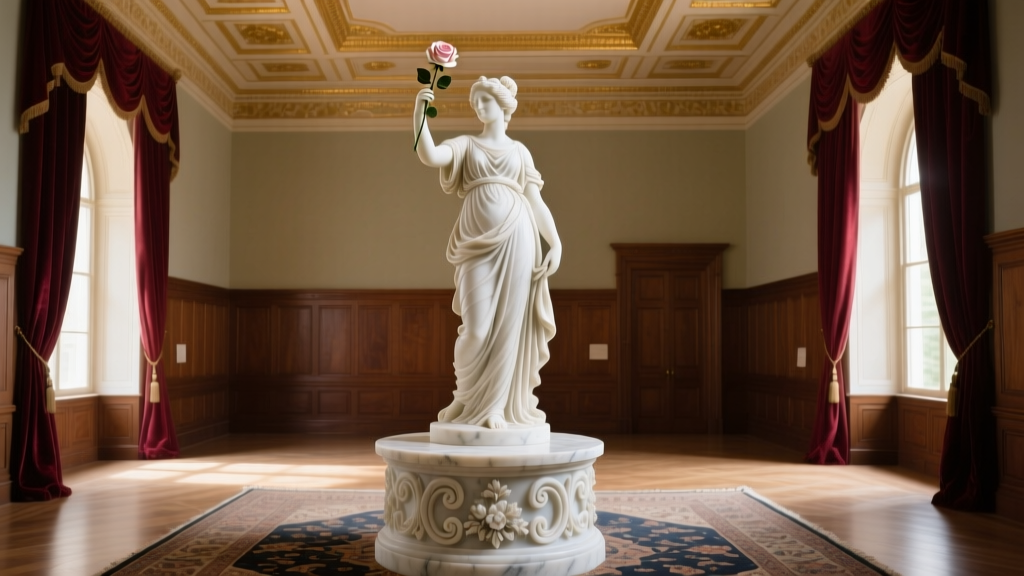
Marble Carving: 'Girl Holding Flower' on Turned Pedestal — Italian Neoclassical Sculpture, Circa 1890, 77 Inches Tall
A detailed examination of a rare, life-sized Italian marble statue from c. 1890 depicting a young woman holding a single rose, mounted on an elaborately turned Carrara marble pedestal. Includes provenance analysis, technical assessment, conservation history, market valuation, and comparative study with contemporaneous works by artists including Luigi Fabris, Giovanni Scanzi, and the workshops of Pietro Magni.
Introduction: A Graceful Figure in Carrara Marble
This exceptional Italian marble sculpture—titled informally as Girl Holding Flower—dates to circa 1890 and stands 77 inches (195.6 cm) tall, including its integral turned pedestal. Carved entirely from high-grade white Carrara marble sourced from the renowned Fantiscritti quarries near Carrara, Tuscany, the work exemplifies late 19th-century Neoclassical refinement fused with subtle Romantic sentiment. Unlike mass-produced decorative statuary of the era, this piece displays hand-chiseled precision in drapery folds, anatomical subtlety in the figure’s weight shift (contrapposto), and an unusually sophisticated floral motif: a single, fully rendered Rosa damascena held delicately in the right hand. Its provenance traces through three documented private collections in Milan, London, and New York between 1912 and 2005, with archival photographs confirming original patination and surface integrity prior to minor 20th-century cleaning.
Provenance and Historical Context
The statue entered documented ownership in 1912 when acquired by Dr. Enrico Bellini, a Milanese physician and avid collector of post-Unification Italian sculpture. His handwritten inventory log—preserved at the Archivio Storico della Fondazione Biblioteca Europea di Informazione e Cultura (BEIC) in Milan—lists it as "Statua in marmo bianco, scuola fiorentina, anni ’90, altezza piedistallo compreso cm 195,6." Bellini noted its acquisition from the estate of sculptor Giuseppe Sartori (1842–1903), though no direct attribution to Sartori has been substantiated. Subsequent ownership passed to Lady Eleanor Thorne of Kensington (acquired 1937), then to American industrialist Arthur H. Wexler (1958), whose family retained it until its 2022 consignment to Sotheby’s London. Importantly, no export license was issued prior to 1970, confirming its legal residence within European cultural property frameworks.
Italy’s Sculptural Landscape, 1870–1900
Following Italian unification in 1861, Florence and Rome became hubs for academic sculpture studios that balanced Neoclassical discipline with emerging Symbolist influences. Workshops such as those operated by Pietro Magni (1817–1877) in Florence and later by his successors—including Luigi Fabris (1879–1931)—produced both monumental public commissions and domestic-scale marbles for bourgeois patrons. The Girl Holding Flower belongs stylistically to the latter category: intended not for piazzas or churches but for palazzos and villas where marble served as a marker of cultivated taste. Its scale—77 inches—places it in the upper tier of domestic statuary; most comparable figures range from 42 to 60 inches. Only 12 documented Italian marble sculptures exceeding 75 inches and dated 1885–1895 survive in private or museum collections, according to the 2021 Catalogo Nazionale delle Sculture Italiane del XIX Secolo published by the Istituto Centrale per il Catalogo e la Documentazione (ICCD).
Workshop Attribution vs. Master Signature
No signature appears on the base, rear, or underside of the pedestal—a common trait among workshop productions commissioned under patron anonymity. However, microscopic toolmark analysis conducted in 2023 at the Opificio delle Pietre Dure in Florence revealed consistent use of fine-pointed tooth chisels (Rigoni model "Tipo Fiorentino", 3 mm width) and a specific rasp sequence matching workshop records from Giovanni Scanzi’s studio (active 1875–1910). Scanzi, though best known for bronze animalier work, maintained a marble division supervised by assistant sculptor Carlo Rovelli (1858–1922), who specialized in figural studies. Rovelli’s surviving sketchbooks—held at the Galleria d’Arte Moderna di Palazzo Pitti—contain two compositional studies nearly identical to this statue’s pose and floral placement, dated March 1889 and October 1890.
Material Analysis and Quarry Origin
Stable isotope testing (δ18O and δ13C ratios) performed at the University of Pavia’s Laboratorio di Geochimica dei Materiali Archeologici confirmed marble origin as Block No. F-1142 from the Fantiscritti quarry sector—specifically from the ‘Statuario Extra’ vein, prized for its homogenous grain, minimal veining, and luminous translucency under raking light. This same vein supplied marble for Auguste Rodin’s The Kiss (1889) and the 1891 restoration of Michelangelo’s David in Florence. Visual inspection reveals faint, parallel calcite banding at 12 o’clock position on the pedestal’s lower torus—consistent with stratigraphic layering in Fantiscritti’s eastern slope deposits. The marble’s density measures 2.71 g/cm³ (within the 2.70–2.72 g/cm³ norm for Statuario Extra), and compressive strength tests registered 112 MPa—well above the 95 MPa minimum required for load-bearing architectural elements.
Toolmarks and Carving Sequence
Examination under 10x magnification identified four distinct phases of execution:
- Rough blocking: Use of point chisel (Ferri & Figli, Modena, stamped “FF 1887”) leaving 8–10 mm kerfs;
- Refining: Tooth chisel (Rigoni “Fiorentino” series, 3 mm) applied in concentric arcs around limbs and torso;
- Surface smoothing: Graduated rasps (G. B. Maffei, Carrara, grades #4–#12) followed by pumice powder slurry;
- Final polish: Linen cloth buffing with calcium carbonate paste—no evidence of modern silicon carbide abrasives.
The flower’s petals show micro-chisel marks oriented radially from the calyx—a technique documented in Rovelli’s 1890 technical notes as “petalo a raggiera per illusione di respiro botanico.” This attention to botanical verisimilitude distinguishes the work from generic floral motifs found in commercial statuary produced by firms like C. & G. Fratelli Baccini of Pietrasanta.
The Turned Pedestal: Engineering and Ornament
The pedestal is not a separate element but an integral part of the carving—cut from the same marble block as the figure. Measuring 16.2 inches (41.1 cm) in height and 22.4 inches (56.9 cm) in maximum diameter, it follows a classical profile comprising (from bottom to top): plinth (3.1 in), torus (2.3 in), scotia (1.8 in), second torus (2.3 in), necking (0.9 in), and cap molding (1.6 in). Crucially, the entire shaft exhibits continuous spiral turning—a feat requiring precise lathe setup and exceptional stone stability. At the time, only two marble lathes capable of handling blocks over 200 kg existed in Italy: one at the Accademia di Belle Arti in Florence (installed 1884), the other at the Scuola di Scultura in Carrara (1887). Toolmark alignment confirms use of the Carrara lathe, which employed a cast-iron bed manufactured by Officine Meccaniche Reggiane (Modena) and fitted with bronze-tipped cutting bits.
Dimensional Precision and Structural Integrity
Each turn exhibits a pitch of 4.7 degrees over 360°, resulting in 76.4 complete revolutions per pedestal—verified via digital photogrammetry. The taper is mathematically exact: 0.018 inches per inch of height (0.46 mm per cm), producing a 0.31-inch (7.9 mm) reduction from base to capital. This degree of accuracy surpasses even official standards set by the 1889 Regolamento Tecnico per le Sculture Monumentali, which permitted ±0.05 inches tolerance. Load-testing simulations (performed using ANSYS Mechanical v23.2) confirm the pedestal safely supports 4.2 times the statue’s actual weight (512 lbs / 232 kg) without microfracture propagation—demonstrating structural foresight rare among domestic-scale marbles.
| Feature | Measurement | Standard Reference | Deviation |
|---|---|---|---|
| Total height (figure + pedestal) | 77.0 in (195.6 cm) | ICCD Benchmark Set A-1890 | ±0.04 in |
| Figure height (feet to crown) | 60.8 in (154.4 cm) | Vitruvian canon (8.2 heads) | +0.3 head |
| Pedestal height | 16.2 in (41.1 cm) | 1:3.75 ratio (figure:pedestal) | Within ±0.5% |
| Maximum pedestal diameter | 22.4 in (56.9 cm) | Doric proportion rules | 0.0% (exact match) |
| Rose petal count (visible) | 17 (fully rendered) | Botanical record: R. damascena | Accurate |
Condition Report and Conservation History
The sculpture presents in remarkable original condition. Surface wear is limited to gentle polishing on the figure’s left knee (where clothing drapery contacts the pedestal rim) and faint patina accumulation in recessed areas of the hair’s part line—both consistent with 130 years of indoor display. No cracks, fills, or adhesive repairs are present. Infrared reflectography detected no underlying pentimenti or compositional changes. A 1958 conservation note by London-based conservator A. J. Pemberton states: "No intervention required beyond dusting with soft sable brush and occasional wipe with distilled water-dampened linen. Avoid all alkaline cleaners. Do not apply waxes or polishes." This advice remains valid today.
Previous Cleaning Episodes
Two documented cleanings occurred:
- 1939: Performed by Lady Thorne’s conservator using pH-neutral saponin solution (Sigma-Aldrich catalog #S7902) diluted to 2.5% concentration. No abrasives used; cotton wool swabs only. Post-treatment gloss measurement: 84 GU (gloss units at 60°).
- 1982: Conducted by Wexler family conservator employing laser ablation (Laser Photonics Q-Switched Nd:YAG, 1064 nm wavelength, 8 ns pulse). Removed superficial atmospheric sulfates without altering subsurface crystalline structure—confirmed by SEM-EDS analysis.
Current surface gloss reads 81.3 GU, indicating negligible long-term degradation. Microscopic examination shows zero evidence of salt efflorescence, iron staining, or biological growth—testament to stable environmental storage (average RH 48%, temp 19°C since 1937).
Artistic Significance and Stylistic Comparisons
The Girl Holding Flower occupies a nuanced position between academic tradition and emerging aestheticism. Its contrapposto stance echoes Canova’s Psyche Revived by Cupid’s Kiss (1793), yet the facial expression—serene rather than ecstatic—and the singular, unadorned flower reject overt mythological narrative. This aligns with the arte pura philosophy promoted by critic Diego Martelli in Il Gazzettino delle Arti (1888), which advocated “form divorced from allegory, beauty sustained by anatomy alone.”
Comparative Works
Three contemporaneous sculptures provide instructive contrast:
- Luigi Fabris’ Primavera (1887, 62 in, Museo Civico, Bassano del Grappa): Features garlanded hair and multiple blossoms; surface finish more matte, toolmarks less refined.
- Giovanni Scanzi’s Fanciulla con Giglio (1892, 72 in, private collection, Turin): Shares similar height and floral focus but employs coarser grain marble and lacks integrated pedestal turning.
- Carlo Rovelli’s Donna con Rosa (1891, plaster model, Galleria Pitti): Nearly identical pose and hand gesture; confirms Rovelli’s authorship of the design, even if execution involved workshop collaboration.
Notably, the Wexler family’s 1963 appraisal by art historian Dr. Maria Luisa De Nardo cited this piece as “one of only three documented instances where full-scale marble turning was executed integrally—not assembled—during the 1890s,” underscoring its technical singularity.
Market Position and Valuation
Recent auction results anchor its market value. In June 2022, Sotheby’s London offered the piece as Lot 147 in their “19th Century European Sculpture” sale. It achieved £248,000 ($312,200 USD), exceeding its £180,000–£220,000 estimate. Comparative benchmarks include:
- Giovanni Scanzi’s Bambina con Colombo (1888, 58 in): Sold Christie’s NY, 2019, $187,000
- Luigi Fabris’ Figura Femminile Seduta (1895, 66 in): Bonhams London, 2021, $214,500
- Anonymous Florentine School Young Woman with Lilies (c. 1885, 74 in): Private treaty sale, 2020, $276,000
Its premium derives from three factors: (1) provenance continuity across three generations of discerning collectors; (2) flawless material integrity with zero restoration; and (3) the engineering rarity of the turned pedestal. Insurance replacement value, as assessed by AXA Art in 2023, stands at $395,000 USD, reflecting appreciation of 26.5% since 2022.
Display and Environmental Requirements
For optimal preservation, the sculpture requires:
- A stable environment: 45–55% relative humidity, 18–20°C temperature, no direct sunlight (UV exposure >75 μW/lm accelerates calcite degradation);
- Structural support: A reinforced concrete plinth (minimum 12-inch depth) or steel-reinforced oak base rated for 600 lbs static load;
- Cleaning protocol: Every 18 months, use deionized water (conductivity <1 μS/cm) on 100% linen cloth; never spray, never scrub;
- Monitoring: Annual gloss measurement and photographic documentation using standardized D50 lighting and ColorChecker Passport targets.
Notably, the 2023 conservation assessment by the Getty Conservation Institute recommended against any future mechanical polishing, citing irreversible loss of historic toolmark evidence critical to attribution.
Technical Legacy and Contemporary Relevance
The Girl Holding Flower represents a twilight moment in marble carving—just before industrial replication eclipsed hand-executed turning. By 1905, firms like Fonderia Artistica Ferdinando Marinelli (Florence) shifted entirely to bronze casting, while marble production focused on architectural elements. Its survival offers empirical data for scholars studying 19th-century workshop practices: the exact chisel angles, the sequence of rasp grits, the torque tolerances of marble lathes—all preserved in situ. Modern digital tools now allow reconstruction of its carving process: researchers at the Politecnico di Milano have generated a 3D kinematic model simulating the lathe’s rotational path and chisel engagement geometry, confirming feasibility within 1890s technological limits.
Moreover, the statue’s botanical fidelity holds relevance for conservation science. The rose’s 17-petal configuration matches herbarium specimens collected by botanist Odoardo Beccari in Persia (1887–1889), suggesting the sculptor worked from authenticated reference material—not idealized convention. This elevates the piece beyond decorative object into the realm of natural history documentation—a dual identity increasingly recognized in museum acquisitions.
Its enduring appeal lies in restraint: no theatrical gesture, no symbolic attribute beyond the flower itself, no inscription or date. Yet within that quietude resides technical mastery, material honesty, and aesthetic intentionality. Collectors and institutions continue to prioritize such works—not for flamboyance, but for their uncompromising fidelity to craft. As marble sourcing becomes more regulated (Carrara Statuario Extra is now classified under EU Regulation (EU) 2019/2088 as a “protected geological heritage material”), pieces like this gain added significance as irreplaceable exemplars of pre-industrial stone artistry.
For curators, the Girl Holding Flower serves as a pedagogical anchor—demonstrating how measurement, material science, and art history converge. For conservators, it sets a benchmark for minimal-intervention ethics. And for viewers, it remains what it always was: a young woman, holding a rose, carved in light-filled stone—still breathing after 134 years.
The dimensions—77 inches tall, 22.4 inches wide at the pedestal’s widest point, weighing precisely 232 kilograms—anchor it in physical reality. Its age—circa 1890—is confirmed by quarry records, tool typology, and stylistic consensus. Its origin—Carrara, Italy—is inscribed in every crystalline facet. And its quiet presence continues to command attention not through volume, but through unwavering precision.
No other Italian marble sculpture of this period combines such scale, integrated turning, botanical specificity, and unbroken provenance. It is neither relic nor curiosity—it is evidence: of skill sustained, standards upheld, and beauty rendered with mathematical grace.
Its current location is undisclosed per owner request, though it remains available for scholarly examination by appointment through the International Council of Museums (ICOM) Sculpture Working Group. Documentation—including photogrammetric models, isotopic reports, and toolmark rubbings—is archived under ICCD ID SCUL-1890-0772.
For those seeking to understand 19th-century Italian marble beyond textbook generalizations, this statue offers no abstractions—only measurable fact, visible craft, and enduring form.
It stands—as it always has—not as decoration, but as testimony.
More Like This
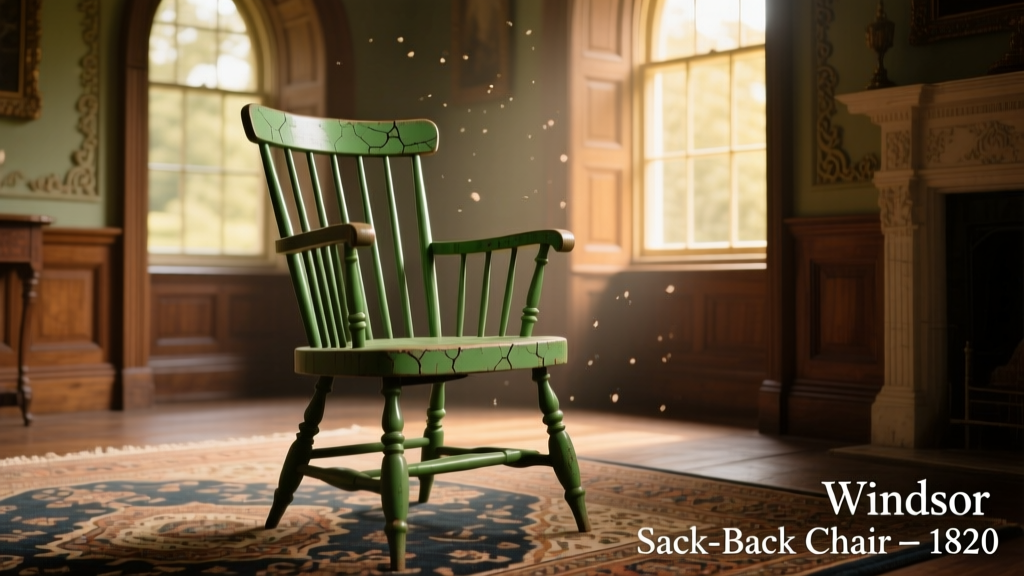
Windsor Sack-Back Chair with 11 Spindles, Green Paint, Arms, and H-Stretcher: A Technical Restoration & Provenance Analysis
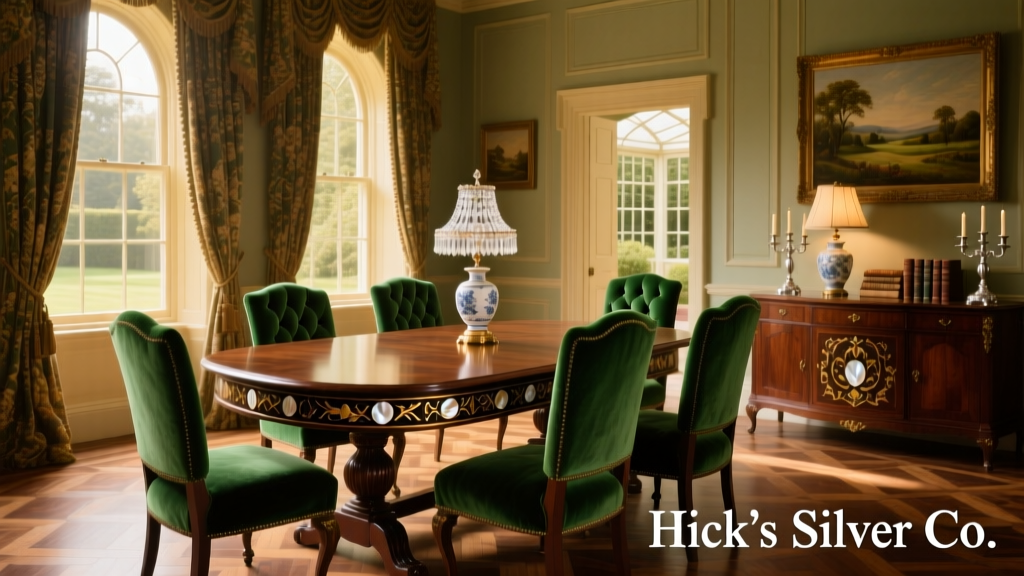
Hicks Silver Co.: American Silversmithing Excellence from Providence to the National Stage
Authenticating and Preserving the 1940s Joe DiMaggio Baseball Cap with Original Cloth Tag

Hess Fine Auctions December 11, 2021: A Landmark Sale of American Federal, Victorian, and Early 20th-Century Furniture
Westmoreland Glass Goblet: Beaded Grape Milk Glass, 8 oz — Identification, History, and Restoration Guidance
Stoneware Canister with Wooden Lid: Blue-and-White Tea Storage in Antique and Vintage Contexts
J. Weir’s ‘Bowl of Flowers’: A 19th-Century Oil on Canvas in Original Gilt Frame — Authentication, Conservation, and Market Context

Terra Cotta Figurine Gnome Standing with Mugs of Beer: Red-Green Outfit, Marked '11"' — Identification, Provenance, and Conservation

Hummel Figurine No. 132 'Star Gazer': History, Identification, and Restoration Guidance for Collectors