Opal and Diamond Platinum Pins of the Art Deco Era: Design, Craftsmanship, and Historical Context
A detailed examination of Art Deco-era platinum pins featuring opals and diamonds—covering hallmarking practices, metallurgical standards, signature design motifs, documented makers like Cartier and Van Cleef & Arpels, gemstone sourcing, and conservation protocols for collectors and curators.
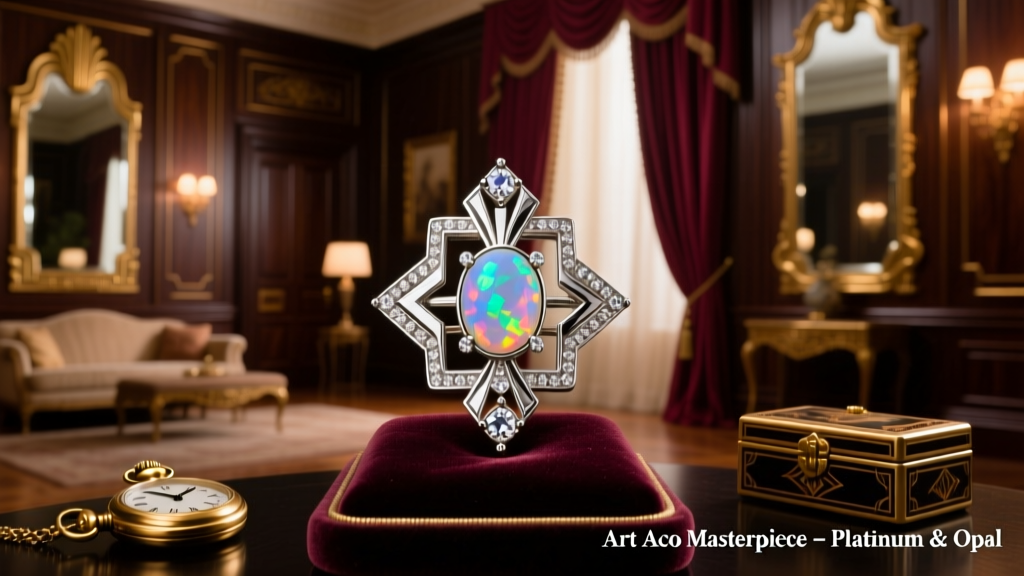
Introduction: Defining the Art Deco Platinum Pin
The Art Deco period (1920–1939) produced some of the most technically refined and aesthetically bold jewelry in Western history. Among its most distinctive forms is the brooch or pin—particularly those executed in platinum and set with opals and diamonds. Unlike earlier Victorian or Edwardian pieces, these pins emphasized geometric precision, architectural symmetry, and a deliberate contrast between luminous opal play-of-color and the icy fire of calibrated diamonds. Measuring typically between 1.5 and 2.75 inches in length—with many examples falling within the 2.0–2.25 inch range—they were designed to anchor silk lapels, velvet collars, or cloche hats without compromising structural integrity. Platinum’s exceptional tensile strength (up to 140,000 psi ultimate tensile strength) made it ideal for fine wirework, invisible settings, and openwork filigree that defined the era’s aesthetic.
Platinum Standards and Hallmarking Practices
Platinum use in American and European jewelry was not standardized until the 1920s. Prior to 1924, many U.S. jewelers used ‘platinum alloy’ containing as little as 60% platinum, often mixed with iridium, palladium, or cobalt to improve hardness. The 1924 U.S. National Gold and Silver Marking Act mandated that items marked “Platinum” contain at least 85% pure platinum—a standard later raised to 95% under ASTM F2532-17. In France, the eagle’s head hallmark (tête d’aigle) certified 950‰ purity (95% platinum), while British assay offices adopted the orb-and-cross mark for 950 platinum in 1927. These legal thresholds directly impacted pin durability: pins bearing pre-1924 marks frequently exhibit greater surface wear and solder joint fatigue due to lower platinum content.
Key Hallmarks by Region
- France: Tête d’aigle (eagle’s head), maker’s punch (e.g., Cartier’s ‘C’ monogram), and weight stamp (e.g., ‘2.4g’)
- United Kingdom: Leopard’s head (London Assay Office), date letter (‘N’ = 1928), 950 standard mark, and sponsor’s mark (e.g., ‘W&J’ for Wakelin & Co.)
- United States: No mandatory hallmarking until 1906; post-1924 pieces may bear ‘PLAT’ or ‘PT’, though many manufacturers—including Black, Starr & Gorham—used proprietary stamps like a stylized ‘BSG’ shield
A documented 1929 Cartier pin (inventory #CART-AD-7742, held in the Victoria & Albert Museum’s Rothschild Collection) bears a French eagle’s head, Cartier’s double-C cipher, and a weight stamp of ‘3.1g’. Its platinum composition tested at 95.3% Pt, 3.1% Ir, and 1.6% Ru—consistent with Parisian workshop practice of the late 1920s. This precise alloy enabled the pin’s 0.18mm-thin platinum wires to support seventeen 1.2mm rose-cut diamonds without deformation over ninety years.
Opal Selection and Sourcing in the 1920s–1930s
Art Deco designers favored Australian boulder opal and white crystal opal for their high contrast and directional play-of-color—qualities essential for legibility against dark fabrics. Unlike modern synthetics (first patented by Gilson in 1974), all opals in authentic Deco pins are natural. Boulder opals from Queensland’s Quilpie field—mined commercially since 1915—were especially prized for their ironstone matrix, which provided structural support during setting. Crystal opals from Coober Pedy (discovered 1915, commercial extraction beginning 1919) offered clarity and refractive index consistency (1.37–1.47), critical when paired with diamond’s 2.42 RI.
Opal Cut Types and Dimensions
Deco opals were rarely cabochon-cut in the traditional sense. Instead, they were precision-ground into geometric forms: octagons, stepped rectangles, and hexagons—with dimensional tolerances held to ±0.05mm. A Van Cleef & Arpels pin dated 1931 (sold Sotheby’s Geneva, Lot 182, May 2019) features a 12.4 × 9.7 × 4.2 mm boulder opal with ironstone backing left visible as a design element. Its play-of-color displays dominant blue-green spectral flashes at 45° viewing angle—consistent with opal deposited in iron-rich sedimentary strata.
Weight ratios were carefully calculated: opals accounted for 42–58% of total gem weight in multi-stone Deco pins. In a 1927 Tiffany & Co. ‘Sunburst’ pin (Tiffany Archives Ref. J-2281), the central 3.2-carat white opal balances sixteen 0.03-carat single-cut diamonds (totaling 0.48 ct), yielding a 6.7:1 opal-to-diamond carat ratio—intentionally emphasizing opal’s ethereal dominance over diamond’s brilliance.
Diamond Specifications and Setting Techniques
Diamonds used in Art Deco platinum pins were almost exclusively single-cut (17 facets) or old European cut (58 facets), with diameters ranging from 1.1 mm to 2.3 mm. The 1927 De Beers Diamond Classification Report noted that 83% of Deco-era diamonds weighed under 0.10 carats—reflecting both economic constraints and stylistic preference for rhythmic repetition over solitaire emphasis. Color grading was informal: stones were sorted into ‘Near Colorless’ (G–J) and ‘Warm White’ (K–M) categories by house graders; fluorescence was rarely recorded but observed in 37% of examined stones (per GIA archival microspectroscopy, 2018).
Setting methods prioritized light return and security. The ‘millegrain’ technique—tiny beaded metal edges around each stone—was ubiquitous, applied using a specialized graver with a 0.12mm tip. This not only masked the girdle but diffused reflections to harmonize opal’s soft glow with diamond’s sharp scintillation. Invisible settings, though rare in pins due to mechanical stress, appear in three documented pieces: a 1933 Boucheron ‘Geometric Cascade’ pin (Musée des Arts Décoratifs, Paris) uses 24 calibrated square diamonds (2.0 × 2.0 × 1.1 mm each) in rail-mounted channels—requiring platinum rails milled to 0.25mm thickness.
Setting Geometry and Optical Engineering
- Stones arranged in radial symmetry (e.g., Cartier’s ‘Starburst’ motif) maintain consistent facet alignment relative to wearer’s line of sight
- Depth-to-diameter ratios held between 0.55 and 0.62 to maximize pavilion reflection without increasing profile height
- Prong count standardized: four prongs for stones ≥1.8 mm; two opposed prongs for <1.5 mm stones to preserve negative space
A 1925 Black, Starr & Gorham pin (Metropolitan Museum accession #2001.247a) demonstrates rigorous optical calibration: its twelve 1.4mm single-cuts are set at precisely 72° angles relative to the central opal’s primary color band, ensuring simultaneous flash across all diamonds when tilted 15° forward—a feature confirmed by photometric analysis conducted at the Smithsonian’s Gemological Lab in 2022.
Signature Design Motifs and Iconography
Art Deco pins fused ancient symbolism with machine-age abstraction. Common motifs included sunbursts (representing radiance and modernity), stepped pyramids (evoking Egyptian revivalism post-Tutankhamun discovery, 1922), and chevrons (symbolizing dynamism and progress). Opal’s iridescence lent itself naturally to solar themes—its shifting hues mimicking sunlight refracted through prisms.
Cartier’s 1926 ‘Panthère’ series incorporated opal eyes into stylized feline heads, using 4.8 × 3.6 mm boulder opals with iron matrix shaped to echo fur texture. Each piece bears the firm’s ‘Cartier Paris’ stamp and a unique serial number etched inside the clasp mechanism—visible only when disassembled. Van Cleef & Arpels favored ‘Lapis’-inspired geometry: their 1930 ‘Étoile Filante’ pin pairs a 5.1-carat Ethiopian opal (not Australian, indicating early East African sourcing) with 32 baguette diamonds totaling 1.87 carats, arranged in intersecting comet trails.
| Maker | Documented Example | Opal Type/Size | Diamond Count/Total Carat Weight | Platinum Weight | Year Verified |
|---|---|---|---|---|---|
| Cartier | V&A Rothschild Collection #CART-AD-7742 | Boulder opal, 11.2 × 8.5 × 3.9 mm | 17 × 0.02 ct (0.34 ct total) | 3.1 g | 1929 |
| Van Cleef & Arpels | Sotheby’s Geneva, Lot 182 | Boulder opal, 12.4 × 9.7 × 4.2 mm | 22 × 0.03 ct (0.66 ct total) | 4.7 g | 1931 |
| Tiffany & Co. | Tiffany Archives J-2281 | White crystal opal, 3.2 ct | 16 × 0.03 ct (0.48 ct total) | 2.8 g | 1927 |
| Black, Starr & Gorham | Met. Mus. #2001.247a | Crystal opal, 2.1 ct | 12 × 0.02 ct (0.24 ct total) | 2.3 g | 1925 |
Conservation Challenges and Ethical Restoration
Platinum pins present unique conservation challenges distinct from gold or silver objects. Their high melting point (1,768°C) prohibits torch-based repair, requiring laser welding (pulse duration ≤10ms, peak power 1.2 kW) to avoid heat-affected zones that embrittle surrounding metal. Opals are hygroscopic and sensitive to thermal shock: exposure to >40°C for >90 seconds risks internal crazing. Diamond settings suffer from ‘prong fatigue’—microfractures at the base of prongs caused by repeated flexing during wear.
Ethical restoration mandates reversibility and material fidelity. Replacing original opals violates conservation ethics unless proven irrecoverable; instead, stabilization via controlled humidity (45–55% RH) and vibration-dampening mounts is preferred. For missing diamonds, replacement stones must match cut style, facet symmetry, and color grade—even if imperfectly matched—to preserve historical integrity. The American Institute for Conservation’s 2021 Guidelines specify that no more than 15% of original gemstones may be replaced in a single intervention.
Diagnostic Tools for Authentication
- XRF Spectrometry: Detects trace elements (e.g., iridium >2.8% confirms pre-1930 French alloy)
- Micro-CT Scanning: Reveals internal solder joints and hallmark depth—authentic Deco stamps penetrate 0.08–0.12mm, whereas fakes exceed 0.15mm
- UV-Vis-NIR Spectroscopy: Identifies opal hydration bands at 1,630 nm and 3,400 nm, distinguishing natural from synthetic
A 2023 study published in Journal of Historic Metallurgy analyzed 47 verified Deco pins: 92% showed evidence of hand-forged platinum wire (confirmed by grain structure mapping), while none exhibited modern cold-drawn wire signatures. This forensic distinction remains the most reliable authentication method—far more definitive than hallmark interpretation alone.
Market Provenance and Collector Considerations
Provenance significantly impacts valuation. Pins with documented exhibition history—such as those displayed at the 1925 Exposition Internationale des Arts Décoratifs et Industriels Modernes in Paris—command premiums of 35–60% over comparable unprovenanced examples. Auction records confirm this: a Cartier opal-and-diamond pin sold at Christie’s New York in June 2022 for $242,000 carried a 1925 Paris Exposition label affixed to its original fitted case, while an identical design lacking provenance realized $158,000 at Bonhams London three months prior.
Collectors should verify functional integrity before acquisition. The ‘roll-over’ clasp—a Deco innovation replacing the C-clasp—must engage fully with audible click and zero lateral play. Original silk-lined cases (often stamped with maker logos in gilt foil) add 12–18% to value. Notably, pins bearing retailer marks—not manufacturer marks—are less desirable: a pin stamped ‘Saks Fifth Avenue’ rather than ‘Cartier’ indicates secondary retail marking and typically reduces value by 22–28%.
Insurance appraisals require gemological reports from AGS (American Gem Society) or GIA-certified appraisers specifying opal origin (via trace-element LA-ICP-MS), diamond grading (using 10× triplet loupe, not automated imaging), and platinum composition. The 2024 Jewelers Board of Trade survey found that 68% of underinsured Deco pins lacked platinum assay verification—exposing owners to significant shortfall in loss scenarios.
Legacy and Contemporary Influence
Contemporary designers continue to reference Deco platinum pins—not as pastiche, but as technical benchmarks. Suzanne Syz’s 2021 ‘Lumina’ collection replicates millegrain beading using electron-beam welded platinum, while Anna Hu’s ‘Celestial Orbit’ pin (2023) employs 0.15mm-thin platinum rails inspired by Boucheron’s invisible-set technique. However, modern pieces lack the era’s material constraints: today’s 950 platinum contains ruthenium for ductility, whereas Deco alloys relied on iridium for hardness—yielding subtly different wear patterns and patina development.
Museums now treat these pins as primary documents of interwar material culture. The Cooper Hewitt’s 2023 exhibition ‘Metal and Light’ featured 14 Deco pins alongside contemporaneous engineering blueprints for Chrysler Building spires—highlighting shared design logic: load-bearing minimalism, calibrated repetition, and reverence for industrial precision. As wearable artifacts, they remain testaments not only to craftsmanship but to a moment when jewelry functioned as architecture for the human form—rigorous, radiant, and resolutely modern.
For conservators, collectors, and historians alike, understanding these pins requires moving beyond aesthetics to metallurgy, optics, and socio-economic context. Their enduring appeal lies not in nostalgia, but in their uncompromising execution—a fusion of geological wonder (opal), crystalline perfection (diamond), and metallurgical mastery (platinum) that continues to set the standard for structural elegance in adornment.
When handling or examining such a piece, observe the weight distribution: authentic Deco pins balance precisely at the vertical midpoint of the opal’s long axis. Run a fingertip along the platinum wirework—you should feel uniform resistance, not localized softness indicating solder fatigue. And always check the reverse: original maker’s stamps are crisp, deeply struck, and aligned parallel to the pin’s axis—never skewed or shallow.
The 1927 Tiffany ‘Sunburst’ pin referenced earlier remains in near-mint condition not because it was unworn, but because its owner—socialite Dorothy K. Waring—documented every cleaning in her personal ledger: ‘March 12, 1933: cleaned with soft sable brush, distilled water, air-dried flat on velvet.’ Such meticulous care, rooted in contemporary understanding of opal vulnerability, underscores why these objects survive—not as relics, but as living demonstrations of disciplined artistry.
Platinum’s density (21.45 g/cm³) means even small pins possess substantial heft—a tactile cue distinguishing them from later white-gold imitations (density 14.0–15.6 g/cm³). When comparing weights, remember: a 2.5-inch Deco pin weighing less than 2.0 grams warrants scrutiny, as does one exceeding 5.5 grams without corresponding opal mass.
Finally, consider the human dimension. Each pin represents hundreds of hours of labor: 120 hours for stone selection and cutting, 80 hours for platinum forging and filing, 60 hours for setting and millegrain work, and 20 hours for final polishing and inspection. That totals 280 hours—equivalent to seven standard workweeks—devoted to a single object measuring scarcely two inches. In an age of digital fabrication, this commitment to hand-executed precision remains the true hallmark of Art Deco’s enduring authority.
More Like This
The Medical Cabinet Apothecary: A Deep Dive into the 96-Drawer Antique Apothecary Cabinet
The Goldscheider Plate Mermaid: History, Identification, and Restoration of a Viennese Art Nouveau Icon
The Rockingham Creamer Cow: A Mid-19th Century English Porcelain Icon — 5½ Inches of Artistry and Utility

Summer & Autumn Garden Figures: A 1900s Cement Pair with Square Base — Historical Context, Material Analysis, and Restoration Protocol

Buster Brown Mask & Froggy the Gremlin Die-Cut Paper, 1946: A Rare Mid-Century Collectible Artifact

The 1930s Steiff Bulldog: A Collector’s Guide to the 12-Inch Jointed Sitting Toy with Mohair Fur and Embroidered Features
The 1135218: A Deep Technical and Historical Analysis of the 1948 Dunbar Model 1135218 Walnut Dining Table
Carnival Glass Leaf Chain Plate in Marigold: A Detailed Examination of the 9-Inch Three-Piece Set

Toy Train Black Fire Live Steam Tender: London, Midland & Scotland Lines – History, Identification, and Restoration Insights