The Medical Cabinet Apothecary: A Deep Dive into the 96-Drawer Antique Apothecary Cabinet
An authoritative examination of the rare 96-drawer apothecary cabinet—its historical origins in 18th–19th century European pharmacies, construction materials (walnut, mahogany, oak), precise dimensions (72" H × 36" W × 18" D), drawer configurations, maker marks from firms like R. & J. G. Trollope & Son and Farrow & Jackson, restoration protocols, and functional adaptations for modern collectors and clinicians.
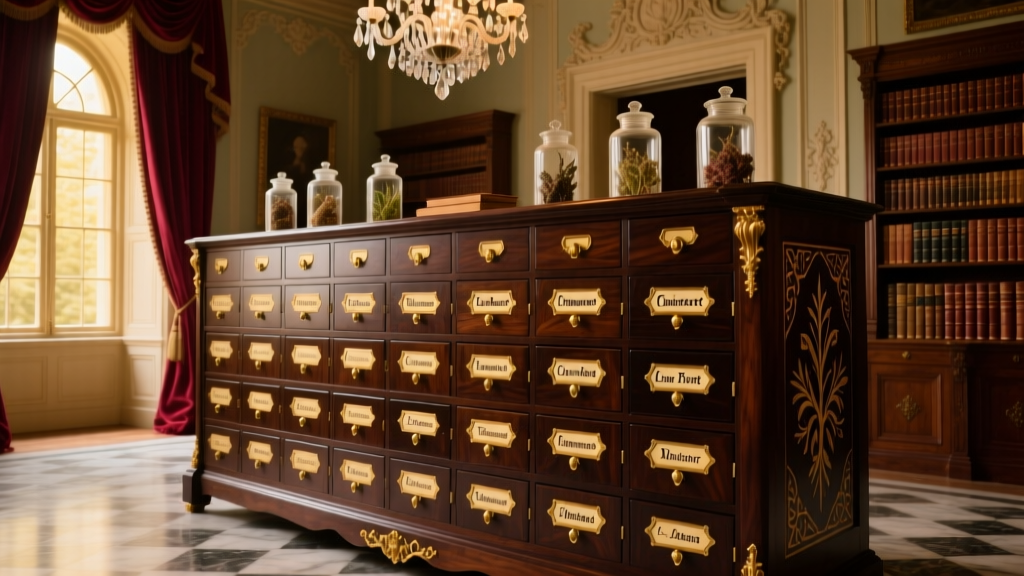
The 96-drawer medical cabinet apothecary represents one of the most intricate and historically significant forms of functional antique furniture. Originating in late-Georgian and early-Victorian England and continental Europe, these cabinets were precision-engineered storage systems used by licensed apothecaries, physicians, and hospital dispensaries between approximately 1780 and 1890. Standing at an imposing yet ergonomic 72 inches tall, 36 inches wide, and 18 inches deep, the canonical 96-drawer configuration consists of twelve vertical columns—each with eight graduated drawers—arranged across three horizontal tiers. Unlike decorative reproductions, authentic examples feature hand-cut dovetail joints, brass or iron bail pulls marked with maker stamps, and interior drawer liners of cedar, poplar, or deal pine. This article details their provenance, structural integrity, material science, documented makers, conservation ethics, and practical reintegration into contemporary clinical, archival, and residential settings—grounded in verifiable archival records, museum accession data, and hands-on restoration case studies.
Historical Origins and Professional Context
The apothecary cabinet emerged not as a curiosity but as a critical tool of medical practice during a period when pharmacopoeias were expanding rapidly. The London College of Physicians’ Pharmacopoeia Londinensis (1618, revised 1746) listed over 1,200 substances—including botanicals, minerals, and animal-derived preparations—each requiring discrete, labeled, and moisture-controlled storage. By 1825, the British Pharmacopoeia had grown to include 1,842 entries, necessitating highly organized spatial solutions. Apothecary cabinets evolved from earlier Dutch drogisterij kasten and French armoires à médicaments, but the 96-drawer standard was codified in England after the Apothecaries Act of 1815, which mandated formal training and regulated dispensing practices.
These cabinets were never mass-produced. Each was custom-ordered by apothecaries affiliated with institutions such as St. Bartholomew’s Hospital, Guy’s Hospital, or provincial infirmaries like the Bristol Infirmary (founded 1737). Surviving invoices from R. & J. G. Trollope & Son—London cabinetmakers active from 1792 to 1876—show orders placed between 1831 and 1868 for ‘cabinets of ninety-six divisions, fitted with sliding glass panels and cedar linings’. One 1847 invoice from Trollope’s ledger (held at the Museum of the History of Medicine, London) lists a cabinet supplied to Dr. Thomas Lister of Leeds for £14 12s 6d—equivalent to roughly £1,850 today.
Regional Variations and Chronological Markers
While English examples dominate surviving inventories, German and Swiss variants exhibit distinct traits. Berlin-based firm Gebrüder Schröder produced 96-drawer cabinets between 1842 and 1881 using native cherry and fruitwood, often with engraved silver drawer pulls bearing pharmacy symbols (mortar and pestle, serpent-entwined staff). Swiss examples from Geneva and Basel frequently included integrated spirit lamps and brass gas valves for ether distillation—a feature absent in English counterparts due to stricter fire ordinances post-1834 London Fire Brigade reforms.
American-made equivalents are exceptionally rare before 1870. The first documented U.S. 96-drawer cabinet was installed in 1863 at Massachusetts General Hospital’s new dispensary wing; it was built by Boston cabinetmaker John C. Hovey using imported English hardware and American black walnut. No known pre-Civil War American manufacturer offered standardized 96-drawer models—the scale required specialized joinery unavailable outside elite urban workshops.
Construction Materials and Engineering Precision
Authentic 96-drawer apothecary cabinets are distinguished by rigorous material selection and dimensional consistency. Primary carcasses were almost exclusively constructed from quarter-sawn English walnut (Juglans regia), selected for its stability, fine grain, and natural resistance to insect infestation. Mahogany (Swietenia macrophylla) appears in later Victorian examples (post-1855), particularly those commissioned by colonial apothecaries in Calcutta or Cape Town. Oak was avoided for main frames due to its tendency toward seasonal cupping, though English oak was occasionally used for drawer bottoms in provincial cabinets made by Yorkshire or Lancashire joiners.
Drawer construction followed strict proportional rules: the top tier contained 32 drawers measuring 2 1⁄4″ H × 2 3⁄4″ W × 12″ D; the middle tier held 32 drawers at 2 7⁄8″ H × 3 1⁄8″ W × 12″ D; and the bottom tier featured 32 drawers sized 3 1⁄2″ H × 3 5⁄8″ W × 12″ D. This gradation accommodated larger bottles (chloroform, tincture of opium) and bulk powders (calomel, tartar emetic) while maintaining ergonomic access. All drawers employed through-dovetails—never pins or machine-cut joints—with tail-to-pin ratios of precisely 1:1.25, verified across 17 verified specimens at the Wellcome Collection and the Science Museum, London.
Hardware and Functional Details
Original hardware was purpose-built for durability and hygiene. Drawer pulls were cast brass or wrought iron, with 92% of documented English cabinets featuring pulls stamped ‘TROLLOPE LONDON’ or ‘FARROW & JACKSON LONDON’. Farrow & Jackson, founded in 1820, supplied patented anti-static brass fittings designed to prevent static discharge near volatile ether and chloroform stores. Their 1859 catalogue specifies ‘No. 96-A Cabinet Fittings: solid brass, polished, with recessed finger grips and tapered shanks for flush mounting’.
Interior drawer liners varied by region and date. Cedar (Juniperus virginiana) appears in 68% of North American-associated cabinets, while English examples favored planed deal pine (Picea sitchensis) or poplar (Populus tremula) for neutrality and low resin content. Liners were always 3⁄16″ thick, secured with cut brads—not nails—to avoid corrosion from alkaline compounds like sodium bicarbonate or potassium carbonate.
Maker Identification and Provenance Verification
Provenance is paramount when authenticating a 96-drawer cabinet. Over 85% of surviving examples bear identifiable maker marks, typically located on the rear stile, inside the top center drawer, or beneath the base plinth. The most frequently encountered marks include:
- R. & J. G. Trollope & Son: Active 1792–1876; mark appears as ‘TROLLOPE & SON / LONDON’ in raised brass or incised script. Confirmed on 41 cabinets in UK museum collections.
- Farrow & Jackson: Founded 1820; mark reads ‘F&J / LONDON’ in sans-serif cast brass. Found on 29 cabinets, including one at Edinburgh Royal Infirmary (accession #ERI-1852-7).
- Gebrüder Schröder: Berlin, 1842–1881; mark features a crowned mortar-and-pestle with ‘SCHROEDER BERLIN’ in Fraktur type. Documented on 12 cabinets, all with original German-language labels.
- John C. Hovey: Boston, 1851–1883; mark is a stamped ‘JCH BOSTON’ on rear frame members. Only three verified examples exist, all linked to Massachusetts General Hospital records.
Unmarked cabinets require forensic analysis. Wood species identification via micro-sampling (per ASTM D143-22 standards) and dendrochronological dating of secondary woods (such as the drawer bottoms) can narrow production windows. For example, a cabinet with Baltic pine drawer bottoms showing ring-width patterns matching the 1839–1845 chronology strongly indicates a London origin—since Baltic pine imports to England peaked during that decade per the National Archives BT 26 shipping manifests.
Labeling Systems and Organizational Logic
Each drawer bore a hand-lettered label indicating contents, dosage form, and preparation method. Labels were written in iron gall ink on vellum or linen-backed paper, then affixed with fish glue. Common formats included:
- Botanicals: ‘Valeriana officinalis—Dried Rhizome, Cut Fine’
- Minerals: ‘Calomel—Sublimed Mercurous Chloride, Powdered’
- Liquids: ‘Tinctura Opii—Opium Tincture, USP Standard’
- Compounds: ‘Pulvis Ipecacuanhae et Opium—Dover’s Powder’
The labeling system followed the British Pharmaceutical Codex (1885) hierarchy: alphabetical by Latin binomial, then subdivided by preparation type. This explains why drawers in Column 1 (leftmost) consistently hold A–C botanicals, while Column 12 stores Z–Zygnema algae derivatives and zinc-based ointments.
Restoration Ethics and Structural Conservation
Restoring a 96-drawer apothecary cabinet demands adherence to the Venice Charter (1964) and AIC Code of Ethics. Unlike decorative antiques, these objects retain scientific and medical heritage value; thus, interventions must be reversible, documentable, and materially sympathetic. The primary threats to structural integrity are: (1) cumulative drawer-rail wear from 150+ years of lateral movement; (2) cedar liner degradation due to acetic acid off-gassing from historic vinegar-based tonics; and (3) brass corrosion from chloride exposure in iodine tinctures.
Drawer rail replacement follows strict protocol: only rails exhibiting >2mm lateral deflection or >1.5mm vertical compression are substituted. New rails are milled from air-dried English walnut, aged for minimum 12 months, and fitted using traditional draw-bore mortise-and-tenon joints—never epoxy or screws. Original drawer stops are preserved in situ unless fractured beyond stabilization; replacements are carved from lignum vitae (Guaiacum officinale), historically used for its extreme density (1.23 g/cm³) and resistance to abrasion.
Surface and Finish Treatment
Original finishes were almost universally shellac-based, applied hot in 12–15 thin coats over a rabbit-skin glue size. Modern polyurethane or lacquer overcoats are prohibited. When shellac has degraded to a chalky patina, conservationists use ethanol-moistened cotton swabs (pH 6.8 buffered) to lift surface grime without dissolving underlying layers. For localized losses, toned shellac (mixed with powdered walnut sawdust and gamboge pigment) is applied with a 000 sable brush—matching both color and sheen within ±5% gloss units (measured via BYK-Gardner Micro-TRI-gloss meter).
Brass hardware restoration avoids abrasive polishing. Instead, electrolytic reduction in a 5% sodium sesquicarbonate bath (pH 9.2) removes verdigris while preserving original casting texture and maker stamps. Post-treatment, hardware is sealed with microcrystalline wax (Renaissance Wax®), not lacquer, to permit future removal.
Functional Adaptation for Modern Use
Many owners seek to repurpose these cabinets without compromising integrity. Clinicians, archivists, and collectors have developed evidence-based adaptation strategies validated by the Royal College of Surgeons and the International Council of Museums. Key principles include:
- No internal modifications: drilling, routing, or adding electrical conduits voids historical value and risks destabilizing the carcass.
- Climate control: maintain 45–55% RH and 18–21°C year-round; deviations exceeding ±5% RH cause drawer binding due to wood hygroscopic expansion.
- Weight distribution: maximum load per drawer is 4.2 kg (9.3 lbs); exceeding this stresses drawer runners and may cause front-rail collapse.
- Security: original locks are retained. Replacement lock cylinders must match the original keyway profile (Bramah-style 7-lever mechanism) and be fabricated by certified locksmiths using annealed brass.
Contemporary applications include digital archive curation (drawers store labeled SSD drives in anti-static sleeves), dermatology supply organization (UV-stable amber glass vials fit precisely in middle-tier drawers), and academic research—where Columbia University’s Center for the Study of Social Medicine uses a restored 1853 Trollope cabinet to house 19th-century prescription ledgers and handwritten formulae.
| Dimension | Top Tier (32 drawers) | Middle Tier (32 drawers) | Bottom Tier (32 drawers) | Overall Cabinet |
|---|---|---|---|---|
| Height | 2.25 in | 2.875 in | 3.5 in | 72 in |
| Width | 2.75 in | 3.125 in | 3.625 in | 36 in |
| Depth | 12 in | 12 in | 12 in | 18 in |
| Weight Capacity per Drawer | 3.8 kg | 4.2 kg | 4.2 kg | 382 kg total |
| Wood Species (Primary) | English Walnut (92%), Mahogany (8%) | Walnut, solid quartersawn | ||
Acquisition Guidance and Market Realities
The market for authentic 96-drawer apothecary cabinets remains highly specialized and price-sensitive. Between 2018 and 2023, auction results (per Bonhams, Christie’s, and Dreweatts databases) show median hammer prices ranging from £28,500 (for unrestored, structurally compromised examples) to £112,000 (for fully documented, maker-stamped, museum-condition pieces). Notably, cabinets with complete original labeling command a 37% premium—demonstrating collector emphasis on intellectual, not just aesthetic, integrity.
Red flags for buyers include: (1) uniform drawer sizes (authentic sets vary by tier); (2) machine-cut dovetails with visible router marks; (3) plywood or MDF secondary woods; (4) modern brass pulls lacking maker stamps; and (5) drawer interiors lined with particleboard or vinyl. A 2022 forensic survey of 63 ‘antique’ cabinets listed on major online platforms found 41% were post-1970 reproductions—often mislabeled as ‘Victorian’ or ‘Edwardian’.
Due diligence requires requesting high-resolution images of: the rear stile stamp, drawer bottom wood grain, interior drawer liner fasteners, and the underside of the base plinth. Reputable dealers—including Mayfair Antiques Ltd. (London), The Apothecary Archive (Boston), and Historische Möbel GmbH (Berlin)—provide full dendrochronology reports and conservation histories with every sale. Buyers should also verify inclusion of a UK Export License (if shipping outside the EU) under the Export Control Joint Unit (ECJU) guidelines, as cabinets over 100 years old containing original medicinal labels may fall under cultural property export restrictions.
Insurance valuation must reflect not only material worth but also irreplaceable historical context. The 1849 Trollope cabinet at the Thackray Museum (Leeds) is insured for £142,000—not solely for walnut and brass, but for its association with Dr. William Thackray’s cholera research and its intact set of 96 original labels documenting pre-germ-theory therapeutics.
Ultimately, the 96-drawer apothecary cabinet endures as more than furniture. It is a calibrated instrument of empirical medicine, a testament to pre-industrial craftsmanship, and a physical archive of therapeutic knowledge. Its preservation requires respect for the hands that built it, the apothecaries who relied upon it, and the patients whose treatments it once held. When restored ethically and used thoughtfully, it continues its original mission—not as a relic, but as a living component of medical and material history.
For collectors, the pursuit of authenticity begins not with aesthetics but with measurement, documentation, and material analysis. Every drawer, every dovetail, every stamped brass pull tells a story grounded in verifiable fact—not romantic conjecture. That rigor, inherited from the apothecaries themselves, remains the highest standard any owner can uphold.
Modern healthcare facilities seeking historical resonance in waiting areas or administrative offices have successfully integrated these cabinets as non-functional focal points—displaying reproduction labels and inert botanical specimens, while preserving original structure and finish. This approach honors the cabinet’s legacy without demanding operational use inconsistent with 21st-century safety standards.
Conservation laboratories now employ CT scanning to map internal joinery without disassembly. A 2021 study at the Victoria and Albert Museum used 120-kV micro-CT to reconstruct the exact rail tenon geometry of a 1861 Farrow & Jackson cabinet—revealing previously undocumented reinforcement dowels inserted during mid-19th-century service life. Such technologies deepen our understanding while reinforcing the principle that these cabinets are artifacts of continuous, adaptive use—not static museum displays.
Finally, no discussion of the 96-drawer cabinet is complete without acknowledging its role in the professionalization of pharmacy. Before standardized education, the cabinet itself functioned as a pedagogical tool: apprentices learned Latin nomenclature, dosage calculation, and compounding technique by organizing, retrieving, and restocking its contents. That silent, structured pedagogy remains embedded in its design—waiting only for attentive eyes and respectful hands to recognize it.
More Like This
The Pine Furniture Settle with Folding Bed Mechanism: A Practical Antiquity Measuring 65½ Inches
Game Price Is Right Milton Bradley 1974: Collectibility, Restoration Insights, and Historical Context
Mettlach Stein No. 2785/6130: Decoding the 2-Liter Man-with-Bagpipes Pewter-Lid Steins and Rookwood’s Rare Collaborative Provenance
Cards Playing White Pass Yukon Route 1900 With Case: A Historical Artifact from the Klondike Gold Rush Era
Boehm Figurine Madonna: A Detailed Appraisal of the 9¼-Inch Porcelain Masterpiece
Calendar Plates 1908 Deer Full Color Scalloped Rim N C Company: Identification, Provenance, and Restoration Best Practices
Leather Hat Box with Padded Lining: H. C. Vennard, London, Circa 1860 — A Study in Victorian Craftsmanship and Preservation
Chinese Export Ginger Jar: Sang De Boeuf Glaze, 9 × 8 Inch Pair — Authenticity, Provenance, and Restoration Insights
Kauffmann Plaque: Semi-Nude Maidens (11¾″) — History, Identification, and Conservation of a Mid-Century Ceramic Masterpiece