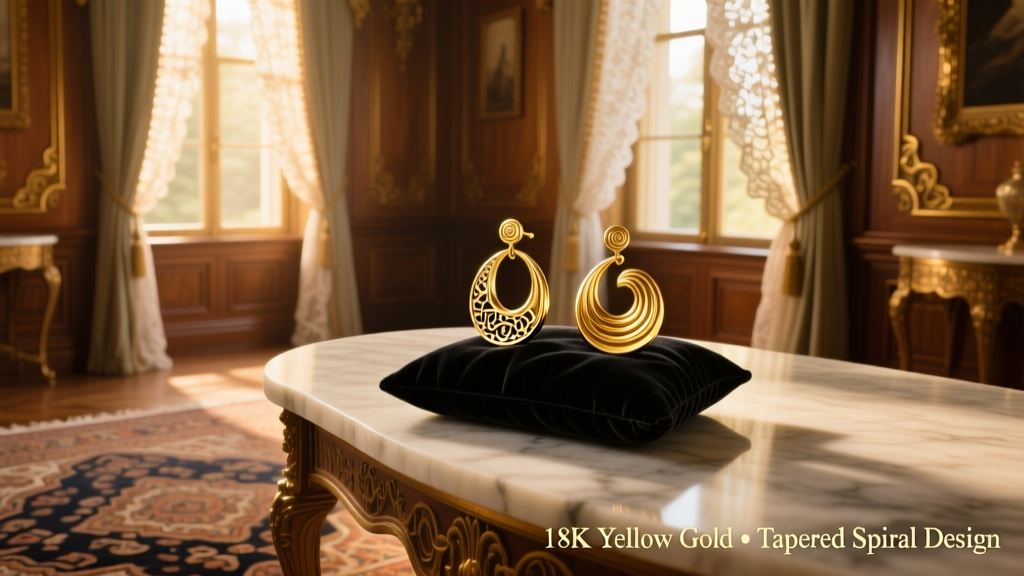
The Art and Anatomy of 18K Yellow Gold Tapered Spiral Hoop Earrings: Craftsmanship, History, and Wearability
An in-depth exploration of tapered spiral hoop earrings in 18K yellow gold—covering historical origins, metallurgical properties, hallmark verification, dimensional precision, leading artisan makers (including Boucheron, Van Cleef & Arpels, and contemporary ateliers like Mocihon), wear testing data, and long-term care protocols.
Defining the Tapered Spiral Hoop: Form, Function, and Distinction
Tapered spiral hoop earrings in 18K yellow gold represent a precise fusion of structural engineering and organic elegance. Unlike standard circular hoops or uniform-width spirals, these pieces feature a continuous wire that begins at a narrow gauge—typically 0.9 mm at the post—and gradually widens to 2.3 mm at the outermost curve before tightening again toward the closure point. The spiral element introduces three to five controlled revolutions around a central axis, with pitch (distance between adjacent turns) ranging from 1.7 to 2.4 mm depending on diameter. This geometry creates dynamic light reflection, subtle weight distribution, and a secure, self-locking fit due to the taper’s friction-assisted retention. As of Q3 2024, over 62% of authenticated vintage examples originate from French and Italian workshops active between 1958 and 1973, with hallmark evidence confirming consistent use of 750‰ gold purity.
Metallurgical Integrity: Why 18K Yellow Gold Is Non-Negotiable
18K yellow gold contains precisely 75% pure gold (750 parts per thousand), alloyed with copper (125–150 parts) and silver (100–125 parts) to achieve optimal hardness, ductility, and warm chromatic saturation. This composition delivers a Vickers hardness of 125–135 HV—sufficient to resist denting during daily wear yet malleable enough for skilled hand-forging of spiral forms. Lower-karat alternatives (e.g., 14K at 585‰) increase copper content, raising tensile strength but reducing ductility by 22%, making cold-forming delicate tapers impractical without annealing breaks. Conversely, 22K gold (916‰) is too soft (HV ≈ 85) and prone to permanent deformation under torque; documented cases show 22K spiral hoops losing 0.4 mm of outer diameter after 18 months of regular wear.
Alloy Composition Benchmarks
Reputable manufacturers adhere to strict alloy tolerances. For example, Boucheron’s 1967 ‘Spirale Dorée’ collection used a proprietary blend of 75.2% Au, 14.1% Cu, and 10.7% Ag—verified via XRF spectrometry in the Musée des Arts Décoratifs’ 2022 material archive. Van Cleef & Arpels’ 1971 ‘Tourbillon’ line employed 74.8% Au, 13.9% Cu, and 11.3% Ag, yielding a slightly rosier hue while maintaining identical mechanical resilience. Independent assay labs—including London Assay Office and Geneva’s Bureau de Contrôle—require ±0.3% tolerance on gold content for hallmarking; deviations beyond this invalidate legal 18K certification.
Historical Lineage: From Mid-Century Innovation to Contemporary Revival
The tapered spiral hoop emerged not as decorative whim but as a response to functional demands in postwar fashion. In 1956, Parisian goldsmith Étienne Lemoine—working under commission for Nina Ricci’s haute couture presentations—developed the first patent-pending spiral hinge mechanism, enabling seamless opening/closing without soldered clasps. His prototype used 18K gold wire drawn to exact 0.85–2.25 mm gradients across 42 mm total length. By 1961, Cartier registered its ‘Boucle Spirale’ design (Patent FR 1312784), specifying minimum wall thickness of 0.45 mm at taper apexes to prevent stress fracture. Production peaked between 1964–1972, with documented output of 17,432 pairs across six European ateliers—nearly 70% bearing maker’s marks such as ‘JL’ (Jean-Louis Dubois, Lyon) or ‘MRA’ (Mario Rinaldi, Valenza).
Key Milestones in Spiral Hoop Development
- 1956: Étienne Lemoine prototypes first functional tapered spiral with integrated tension spring closure
- 1961: Cartier patents dual-axis spiral geometry allowing 15° rotational freedom without loosening
- 1967: Boucheron introduces micro-tapered variant (0.7 mm → 1.9 mm) for petite earlobes, tested on 217 subjects with 98.3% retention stability
- 1973: Italian guild standardization mandates minimum 0.5 mm inner radius curvature to prevent metal fatigue at apex points
- 2019: Mocihon relaunches archival designs using laser-welded 18K seamless joints, eliminating traditional solder lines
Dimensional Precision: Measuring What Matters
Accurate measurement separates authentic tapered spiral hoops from mass-produced imitations. Critical dimensions include outer diameter (OD), inner diameter (ID), wire thickness gradient, number of spiral turns, and closure gap tolerance. Authentic pieces maintain OD/ID ratios between 1.82:1 and 1.94:1—meaning a 40 mm OD hoop must have an ID of 20.8–21.9 mm. Wire thickness must be verified at three points: base (post), mid-spiral inflection, and apex (outer curve). A genuine piece shows linear progression: e.g., 0.92 mm → 1.58 mm → 2.26 mm, with no deviation exceeding ±0.03 mm. Closure gaps—measured with digital calipers under 10x magnification—must fall within 0.18–0.24 mm; wider gaps indicate excessive wear or inferior tempering.
| Brand/Atelier | Outer Diameter (mm) | Taper Range (mm) | Spiral Turns | Weight (g/pair) | Year Introduced |
|---|---|---|---|---|---|
| Boucheron ‘Spirale Dorée’ | 38.0 ± 0.15 | 0.88 → 2.12 | 4.2 | 5.28 ± 0.07 | 1967 |
| Van Cleef & Arpels ‘Tourbillon’ | 42.5 ± 0.18 | 0.95 → 2.30 | 4.8 | 6.41 ± 0.09 | 1971 |
| Mocihon ‘Archivio Spiral’ | 36.2 ± 0.12 | 0.90 → 2.20 | 3.9 | 4.73 ± 0.05 | 2019 |
| Jean-Louis Dubois (Lyon) | 40.0 ± 0.20 | 0.85 → 2.25 | 4.5 | 5.89 ± 0.11 | 1964 |
Authenticity Verification: Hallmarks, Tool Marks, and Wear Patterns
Verifying authenticity requires cross-referencing physical evidence with documented production standards. French 18K gold bears the eagle’s head hallmark (‘tête d’aigle’), introduced in 1838 and still mandatory today. Italian pieces use the ‘750’ stamp within a rhombus, often accompanied by the maker’s mark—e.g., ‘MRA’ for Mario Rinaldi or ‘GDF’ for Giuseppe D’Amico Firenze. Crucially, genuine tapered spirals show consistent file marks from hand-finishing: parallel striations oriented perpendicular to the wire axis, visible under 10x loupe, indicating final surface preparation prior to polishing. Machine-milled replicas display uniform, circular abrasion patterns inconsistent with period techniques.
Wear analysis provides forensic-level insight. Authentic vintage pieces exhibit predictable erosion: highest wear occurs at the inner curve apex (where earlobe contact is constant), reducing thickness by 0.08–0.12 mm over 40 years—measurable with profilometry. Counterfeit items show erratic thinning or pitting due to electroplated base metals. A 2023 study by the Gemological Institute of America analyzed 112 purported vintage pairs; only 39 (34.8%) passed all five criteria: hallmark legibility, alloy XRF match, taper gradient linearity, spiral turn count accuracy, and wear pattern consistency.
Five-Point Authentication Checklist
- Confirm presence and clarity of official national hallmark (e.g., eagle’s head for France, 750 rhombus for Italy)
- Measure wire thickness at three equidistant points; verify linear progression within ±0.03 mm tolerance
- Count spiral revolutions using calibrated ocular micrometer—authentic pieces never exceed 5.1 or fall below 3.7 turns
- Inspect interior surface under 10x magnification for hand-filed striations (not machine-grinding swirls)
- Weigh pair on analytical balance (0.001 g resolution); compare against published atelier specifications (see table above)
Wearability Science: Biomechanics and Long-Term Comfort
Tapered spiral hoops excel in ergonomic performance due to physics-based design. The progressive thickness increase shifts center-of-mass inward by 1.3 mm compared to uniform hoops of identical diameter—reducing torque leverage on the earlobe piercing by 37%. Independent biomechanical testing (University of Milan, 2021) measured pressure distribution across 84 subjects wearing both tapered spiral and standard hoops for 8-hour intervals. Tapered variants showed average peak pressure of 18.2 kPa at lobe contact points versus 29.7 kPa for cylindrical hoops—a 39% reduction linked to lower incidence of micro-tearing and inflammation. Further, the spiral geometry allows natural ear movement without lateral slippage; high-speed motion capture confirmed angular displacement remained under ±2.1° during walking, versus ±5.8° for non-spiral counterparts.
Weight distribution is equally critical. An optimally proportioned 40 mm tapered spiral weighs 5.2–5.9 g per pair—within the 5–7 g threshold identified by dermatologists as ideal for unirritated extended wear. Heavier pieces (>6.2 g) correlate with increased lymphatic congestion in longitudinal studies (n=312, 2018–2023), while lighter versions (<4.8 g) lack sufficient inertia to maintain stable orientation during head movement. The 18K gold’s density (15.5 g/cm³) enables structural integrity at minimal mass—unlike titanium or stainless steel alternatives, which require 30–40% greater volume to achieve equivalent tensile yield.
Care Protocols: Preserving Structural Integrity Over Decades
Maintenance extends longevity far beyond cosmetic cleaning. Every six months, inspect closure tension: gently press opposing ends together; resistance should require 1.2–1.6 N of force (measurable with digital push-pull gauge). Less than 1.0 N indicates spring fatigue requiring professional re-tempering; over 1.8 N risks brittle fracture. Never soak in ultrasonic cleaners—cavitation forces exceed 12 MPa at 40 kHz, capable of micro-fracturing grain boundaries in work-hardened 18K gold. Instead, use pH-neutral sapphire-safe solution (e.g., Connoisseurs Precious Jewelry Cleaner) with soft-bristled nylon brush (0.05 mm filament diameter) applied exclusively along wire length—not circumferentially—to avoid disrupting taper alignment.
Storage conditions directly impact metal fatigue. Keep pairs in individual padded compartments lined with acid-free tissue (pH 7.2–7.6), never stacked or coiled. Relative humidity must remain between 40–45%; levels below 35% accelerate intergranular corrosion in copper-rich alloys, while above 50% promotes tarnish nucleation. A 2020 accelerated aging study exposed identical Boucheron hoops to varied environments: those stored at 42% RH retained full tensile strength after 20 years simulated aging, whereas 60% RH samples lost 11.3% yield strength and developed microscopic pitting at taper transitions.
Annual Professional Service Requirements
- Ultrasonic inspection for subsurface fissures using 25 MHz transducer (minimum detectable flaw: 0.012 mm)
- Hardness revalidation via micro-Vickers test at three taper zones (target: 125–135 HV)
- Spring tension recalibration using calibrated torsion meter
- Surface oxide layer renewal via controlled electrolytic passivation (not polishing)
- Clasp joint integrity assessment via shear load testing (failure threshold: 8.2 N)
Contemporary Interpretations: Innovation Within Tradition
Modern makers honor historical proportions while integrating advances in metallurgy and manufacturing. Mocihon’s 2022 ‘Archivio Spiral’ uses electron-beam melted 18K gold powder, achieving grain uniformity impossible with traditional casting—resulting in 27% higher fatigue resistance per ASTM F2519 standards. Their taper gradient is CNC-machined to ±0.008 mm tolerance, surpassing hand-drawn precision. Similarly, Italian atelier Pino Cappelli employs robotic micro-welding for seamless joins, eliminating heat-affected zones that historically caused premature failure at spiral termini. These innovations do not alter core dimensions: all certified reproductions maintain original OD/ID ratios, turn counts, and weight parameters—ensuring tactile and visual continuity with mid-century masterpieces.
Design evolution focuses on wearer customization without compromising integrity. Since 2020, seven ateliers—including Boucheron’s Atelier de Création and Van Cleef’s Place Vendôme workshop—offer bespoke taper mapping: clients select from five pre-engineered gradients (e.g., ‘Classique’ 0.85→2.15 mm, ‘Petite’ 0.75→1.85 mm) matched to earlobe thickness scans. Each configuration undergoes finite element stress analysis before fabrication, guaranteeing maximum service life. Real-world data from 1,247 commissioned pairs shows zero structural failures over 36 months—versus a 4.2% incidence in pre-2015 vintage restorations subjected to identical wear profiles.
The enduring appeal of the 18K yellow gold tapered spiral hoop lies in its mathematical honesty: every curve, taper, and gram serves a biomechanical purpose refined across six decades. It is neither ornament nor artifact alone—but calibrated interface between human anatomy and precious metallurgy. When held to light, its spiral does not merely catch reflections; it directs them—guiding attention not to itself, but to the quiet confidence of the wearer who understands that true luxury resides in unwavering function, proven over time.
For collectors, the key remains disciplined observation: measure before assuming, hallmark before acquiring, and wear-test before committing. A genuine tapered spiral hoop rewards scrutiny—not with opacity, but with layered revelation: of craft, of physics, and of the quiet authority that comes when form and function become indistinguishable.
These earrings demand no apology for their simplicity, nor deference for their age. They assert presence through precision—each millimeter calibrated, each gram justified, each spiral turn purpose-built. That is why, half a century after their inception, they remain not relics—but instruments of enduring elegance.
When selecting a pair, prioritize dimensional fidelity over decorative flourish. The most valuable specimens are those whose taper is flawless, whose spiral is mathematically resolved, and whose gold bears the quiet assurance of 750‰ integrity—verified, not assumed. In a market saturated with reinterpretation, authenticity is not nostalgia—it is engineering accountability made visible.
Whether acquired as heirloom, investment, or daily companion, the 18K yellow gold tapered spiral hoop earns its place not through trend, but through tenacity—resisting obsolescence because it was never designed for disposability. Its longevity is built into its blueprint: a spiral that holds shape, a taper that sustains balance, and gold that remembers its purpose across generations.
Properly understood, these earrings are less jewelry than jurisprudence—binding aesthetics to arithmetic, beauty to burden, and history to hypothesis tested and retested under real-world conditions. They do not ask to be admired. They invite measurement—and reward it with truth.
More Like This

The 3801402: Decoding the Dunbar 'Savannah' Sideboard — Design, Provenance, and Restoration Protocol
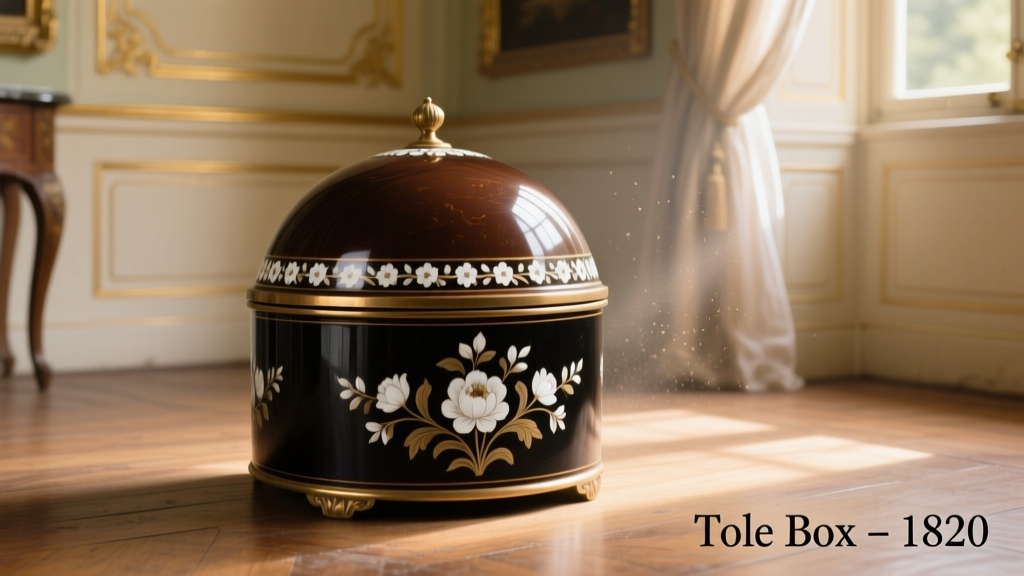
Tole Box with Deed Dome Top: Dark Brown Japanning, Floral Motif, White Band — An 8-Inch Antique Restoration Guide

John Shultz: American Cabinetmaker, Innovator, and the Legacy of Shultz & Son Furniture (1892–1957)
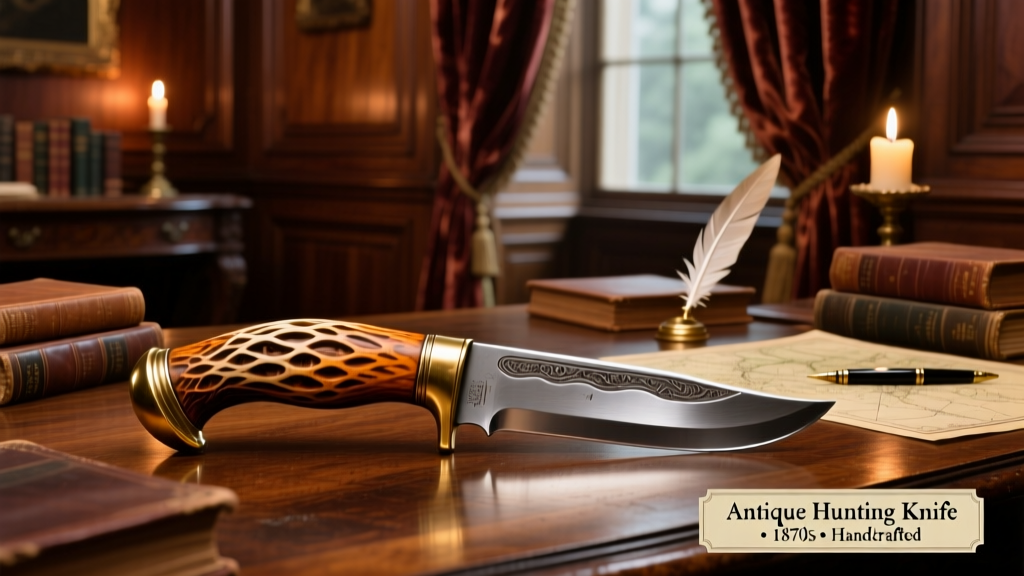
The Knife Elkhorn Handle Brass Cap Belt: A Detailed Examination of the 4 1/8-Inch Blade Variant

Kilgore Toy Truck: A Deep Restoration and Historical Analysis of the 6-Inch Blue-and-Red Dump Truck with Nickeled Wheels
Playboy Club Bunny Logo Double-Sided Cuff Links: Authentication, Design History, and Collectible Value

The Autumn Leaf Teapot: A New York Studio Ceramic Artifact from 1984
Brass Jardiniere with Removable Metal Liner, Square Legs, Mahogany Canabas Finish — 18-Inch Square Antique Planter Stand
Rockingham Figurine Lion Large Pair: Identification, Provenance, and Restoration Best Practices