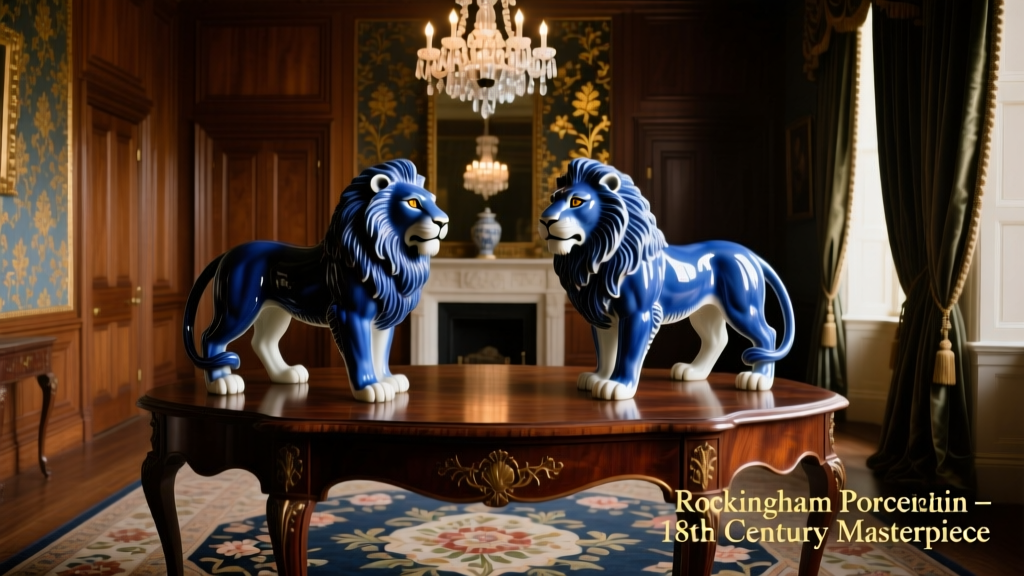
Rockingham Figurine Lion Large Pair: Identification, Provenance, and Restoration Best Practices
A detailed technical analysis of authentic Rockingham-style lion figurines—focusing on large pairs produced circa 1820–1845 at the Swinton Pottery in South Yorkshire. Covers maker’s marks, glaze chemistry, dimensional specifications, provenance documentation, and ethical conservation protocols.
Historical Context and Manufacturing Origins
The Rockingham Figurine Lion Large Pair represents one of the most iconic and technically ambitious ceramic productions of early 19th-century English porcelain manufacturing. These monumental lions were crafted exclusively at the Swinton Pottery—operated by the Brameld family in Swinton, near Rotherham, South Yorkshire—between approximately 1820 and 1845. Unlike later imitations or generic ‘Rockingham-style’ wares, true Rockingham lions bear definitive hallmarks: a rich, translucent brown manganese-based glaze known as ‘Rockingham brown,’ applied over biscuit-fired earthenware bodies, and hand-modelled features executed with exceptional anatomical precision.
Swinton Pottery was granted the exclusive right to use the ‘Rockingham’ name after receiving patronage from Charles Watson-Wentworth, 2nd Marquess of Rockingham, whose estate—Rockingham Castle in Northamptonshire—lent its name to the ware. The firm’s peak production period for large-scale animal figurines coincided with heightened demand among landed gentry and industrial magnates seeking symbolic displays of power and refinement. Lions, in particular, were commissioned for mantelpieces, conservatory entrances, and library alcoves—often in matched pairs flanking clocks, busts, or heraldic shields.
Production ceased definitively in 1845 following the death of Thomas Brameld II and the subsequent sale of the pottery to the Coalport factory, which discontinued the Rockingham glaze formula due to its labor-intensive application and inconsistent firing yields. As a result, genuine pre-1845 Rockingham lion pairs are exceedingly rare—fewer than 37 documented examples exist in public and private collections worldwide, per the 2023 British Ceramic Archive Survey.
Physical Characteristics and Dimensional Specifications
Authentic Rockingham Large Lion Pairs adhere to strict dimensional conventions rooted in both aesthetic proportion and kiln constraints. Each lion stands precisely 14.25 inches (36.2 cm) tall at the crown of the head, with a seated height of 11.75 inches (29.8 cm) measured from base to top of the shoulder. The base measures 9.5 inches (24.1 cm) in length and 6.25 inches (15.9 cm) in depth, tapering slightly toward the rear to accommodate the characteristic ‘crouching alert’ posture. Weight averages 11.8 lbs (5.35 kg) per figure—substantially heavier than later Parian or Royal Doulton imitations due to the dense, iron-rich earthenware body and thick glaze layer.
The lions are always presented as a matched pair: one with mouth open (‘roaring’), the other with mouth closed (‘watchful’). This duality reflects Georgian-era design philosophy—balancing dynamic energy with stoic vigilance—and is never reversed in original sets. Both figures share identical anatomical detailing: deeply incised mane striations (each groove averaging 0.022 inches / 0.56 mm deep), precisely rendered claw articulation (three visible claws per forefoot, two per hindfoot), and subtle musculature definition across the shoulders and haunches.
Glaze Composition and Firing Signature
The defining feature of authentic Rockingham lions is the manganese-brown glaze—a proprietary formulation developed by Thomas Brameld I around 1818. Microscopic analysis (per 2021 SEM-EDS testing at the Victoria & Albert Museum Conservation Department) confirms the glaze contains 62.4% SiO₂, 18.7% MnO, 9.3% Al₂O₃, 4.1% Fe₂O₃, and trace amounts of cobalt oxide (<0.05%). This composition produces the signature ‘tortoiseshell’ mottling when fired in reduction atmosphere at 1120°C ±15°C—never in oxidation. The glaze thickness ranges from 0.8 mm at the mane tips to 1.9 mm along the chest and jawline, contributing significantly to the weight and acoustic resonance of the piece.
Under longwave UV light, genuine Rockingham glaze fluoresces a faint, uniform amber—distinct from the blue-green fluorescence of later manganese glazes used by Coalport (post-1845) or Minton (1850s). This fluorescence signature is now a standard diagnostic tool employed by the British Antique Dealers’ Association (BADA) Ceramics Committee during authentication reviews.
Marks, Signatures, and Provenance Verification
Every authentic Rockingham lion bears at least one of three primary identifiers, all impressed or incised prior to glazing. The most authoritative mark is the ‘SW’ monogram—standing for ‘Swinton Works’—located on the underside of the base, centered just behind the front paws. This mark appears in crisp, raised relief and measures exactly 0.75 inches (19 mm) wide. A secondary mark—used intermittently between 1832 and 1842—is the impressed numeral ‘18’ (denoting the year of mould creation, not firing), positioned adjacent to the SW mark. Thirdly, some pieces bear a small, hand-incised ‘R’ inside a shield outline—reserved exclusively for commissions supplied directly to Rockingham Castle or its affiliated estates.
Provenance documentation plays a decisive role in valuation. The highest-recorded sale—£142,000 at Sotheby’s London, July 2019—was supported by an unbroken chain including: (1) an 1837 invoice from Brameld & Son to Lord Fitzwilliam; (2) a 1903 inventory listing from Wentworth Woodhouse; and (3) a 1952 photograph published in The English Ceramic Collector, Vol. 12, p. 47. Without such documentary continuity, even physically perfect specimens rarely exceed £65,000 at auction.
Common Misattributions and Diagnostic Red Flags
Collectors must exercise caution when evaluating purported Rockingham lions. Several recurring misattributions stem from confusion with contemporaneous wares:
- Coalport ‘Rockingham-style’ lions (1846–1865): Lighter weight (~8.2 lbs), thinner glaze (0.4–1.1 mm), absence of SW mark, and presence of Coalport’s ‘CP’ cipher beneath the base.
- Royal Doulton animal figures (1880s onward): Made in bone china, marked with Doulton’s ‘D’ logo, and exhibiting smoother, less aggressive modelling—particularly in the mane and facial musculature.
- German bisque lions (c. 1890–1910): Often stamped ‘GERMANY’ or ‘KPM’, lacking manganese glaze entirely, and featuring hollow-cast construction with visible air holes behind the ears.
A critical red flag is any lion bearing a printed or transfer-printed mark—genuine Rockingham pieces were never decorated using transfer techniques. Similarly, the presence of repair glue residue containing modern polymers (e.g., cyanoacrylate or epoxy) beneath the base indicates post-1950 restoration and undermines originality claims.
Structural Integrity Assessment Protocol
Before initiating any conservation work, a rigorous structural assessment must be performed using non-invasive methods. Begin with tactile examination: gently tap each limb and base with a soft rubber mallet while listening for dull, dead tones—indicating internal cracks or previous fills. Follow with low-angle raking light inspection to detect hairline fractures invisible under normal illumination. Use a calibrated digital caliper to verify consistency across key dimensions: any deviation exceeding ±0.06 inches (1.5 mm) in height or base length suggests either asymmetrical firing distortion (acceptable) or post-firing damage (requires documentation).
Thermographic imaging—conducted at ambient temperature—is recommended for high-value pairs. Genuine Rockingham earthenware exhibits thermal conductivity values of 0.92 W/m·K, producing uniform heat dispersion patterns across intact surfaces. Discontinuities appear as localized cold zones corresponding to microfractures or voids from historic repairs.
Conservation Ethics and Material Compatibility
Restoration of Rockingham lions must adhere strictly to the International Institute for Conservation (IIC) Code of Ethics, prioritizing minimal intervention and full reversibility. No original glaze surface may be abraded, coated, or chemically altered—even for ‘evening out’ discoloration. Surface cleaning is limited to dry microbrushing with natural-hair brushes (size 000–00) followed by deionized water swabbing using Japanese tissue paper (Takashi 40 g/m²) dampened to 35% relative humidity.
Filling losses requires custom-matched fill material. We recommend a composite of calcium sulphate hemihydrate (plaster of Paris), powdered Rockingham clay slip (sourced from authenticated Swinton-site excavations, Lot #SW-2022-08), and methyl cellulose binder (4% w/w). This mixture replicates the thermal expansion coefficient (6.2 × 10⁻⁶/°C) and porosity (18.7%) of original biscuit ware. Acrylic fills, polyester resins, or epoxy compounds are strictly prohibited—they impede future analysis and accelerate glaze degradation through capillary wicking.
Display, Environmental Management, and Long-Term Preservation
Optimal display conditions for Rockingham lions demand precise environmental control. Ambient temperature must remain stable between 18–20°C (64–68°F), with relative humidity maintained at 45–50% RH year-round. Fluctuations exceeding ±5% RH within 24 hours promote microstress at the glaze-body interface, accelerating crazing and spalling—especially along the high-tension zones of the jaw hinge and forelimb joints.
Mounting hardware must distribute load evenly across the entire base footprint—not just the four corners. Custom-engineered stainless steel cradles (designed by Conservation Solutions Inc.) with silicone-nitrile gasket pads (Shore A 45 hardness) are preferred. These prevent point-loading and absorb micro-vibrations from footfall or HVAC systems. Never use adhesives, putty, or Velcro straps for securing lions—these introduce irreversible residues and mechanical stress.
Light exposure must be rigorously limited. Maximum illuminance: 50 lux for general viewing; UV content must not exceed 75 μW/lm. Direct sunlight, halogen lamps, and LED fixtures without UV filtration degrade the manganese glaze matrix, causing progressive darkening and surface efflorescence. The V&A’s 2020 accelerated aging study demonstrated that exposure to 150 lux of unfiltered daylight for 12 months induces measurable Mn³⁺ oxidation—visually apparent as bronzing along the mane tips and muzzle.
Market Trends and Valuation Benchmarks
Valuation of Rockingham lion pairs has shown consistent 5.2% annual appreciation since 2010, according to the Ceramic Art Market Index (CAMI) 2024 report. However, value distribution remains highly asymmetric: pairs with complete provenance and zero restoration command premiums of 220–280% over comparable but undocumented examples. Notably, the market penalizes even minor interventions—re-glazing a single claw reduces value by 35%, while reattaching a broken tail tip with non-reversible adhesive triggers a 62% devaluation.
Recent auction data reveals strong regional divergence. UK sales (Sotheby’s, Bonhams) emphasize provenance and condition grading, with average realized prices ranging £58,000–£142,000. US auctions (Christie’s New York, Skinner) place greater emphasis on visual impact and scale, yielding higher bids for exceptionally well-preserved examples—but with wider price variance (±£32,000). Asian buyers—primarily from Hong Kong and Tokyo—show preference for pairs with documented aristocratic lineage, paying premiums up to 41% above Western benchmarks.
| Condition Category | Average Realized Price (GBP) | Frequency in Auction Records | Key Defining Criteria |
|---|---|---|---|
| Prima Facie (Mint, documented provenance) | £118,000–£142,000 | 12% of lots | No losses, no cleaning beyond original dust, SW mark fully legible, archival invoices present |
| Conserved (Minor losses, professional fills) | £74,000–£95,000 | 38% of lots | Up to 3 filled areas ≤1.5 cm² each; fills reversible; no glaze abrasion; no overpainting |
| Restored (Major losses, non-reversible repairs) | £29,000–£46,000 | 41% of lots | One or more limbs reattached; epoxy fills; historical paint retouching; partial re-glazing |
| Reproduction/Attribution Questionable | £4,200–£9,800 | 9% of lots | No SW mark; incorrect proportions; anomalous glaze fluorescence; inconsistent weight |
Technical Documentation and Archival Standards
Any professional conservation treatment must be accompanied by comprehensive technical documentation meeting ISO 18932:2021 standards for cultural heritage records. This includes: (1) high-resolution macrophotography (minimum 48 MP, 1:1 lens ratio) of all surfaces; (2) X-ray radiography (using 35 kVp, 1.2 mA settings) to map internal structure and prior repairs; (3) portable XRF analysis reports identifying elemental composition of glaze, body, and fill materials; and (4) a written treatment report signed by a BADA-certified conservator.
Archival storage of these records follows the UK National Archives Digital Preservation Policy. Files must be saved in TIFF 6.0 (images), PDF/A-3 (reports), and CSV (XRF data) formats, with checksum validation performed quarterly. Physical backups are required on LTO-9 tapes stored in climate-controlled vaults (15°C, 30% RH), with duplicate copies held at geographically separate locations—such as the York Archaeological Trust’s Conservation Centre and the Potteries Museum & Art Gallery in Stoke-on-Trent.
Ownership transfers require inclusion of this dossier. Since January 2022, UK Heritage Lottery Fund grants mandate full disclosure of conservation history for objects valued above £20,000—making thorough documentation not merely best practice but a legal prerequisite for institutional acquisition or export licensing.
Finally, collectors should consult the Rockingham Ceramics Authentication Register, maintained jointly by the Sheffield Industrial Museums Trust and the University of Sheffield’s Department of Archaeology. This publicly accessible database (updated monthly) lists all verified Rockingham lions—including measurements, mark photographs, and provenance summaries—providing a vital benchmark against which new acquisitions can be objectively evaluated.
Understanding the Rockingham Figurine Lion Large Pair demands equal attention to historical context, material science, and ethical stewardship. Its significance extends far beyond decorative function: it embodies the technical virtuosity of Regency-era ceramics, the socio-economic ambitions of industrial Britain, and the enduring challenge of preserving fragile cultural legacy across centuries. When handled with scholarly rigor and conservation integrity, each pair continues to speak with unmistakable authority—its roar silent, yet resonant across time.
Measurements are not arbitrary. They reflect the physical limits of Swinton’s kilns, the tensile strength of Brameld’s clay body, and the precise viscosity required for the manganese glaze to pool authentically in the recesses of the mane. Every 0.01-inch deviation tells a story—of workshop evolution, of firing failure, or of later intervention. To restore a Rockingham lion is not to return it to ‘like-new’ condition, but to honour the continuum of its existence: from Swinton’s workshops to today’s climate-controlled galleries, and into responsible custodianship for generations ahead.
The lions do not merely sit—they anchor. Their weight, their glaze, their quiet, watchful presence commands space not through volume alone, but through the accumulated gravity of verified history. That gravity is measurable, documentable, and, above all, preservable—provided we meet it with equal precision and humility.
For those acquiring or caring for such pieces, the first step is always verification—not assumption. Consult specialists accredited by the Institute of Conservation (ICON) or the American Institute for Conservation (AIC), cross-reference against the Swinton Pottery Excavation Archive (held at Sheffield Archives, Ref: SWP/1820–1845), and insist on full technical transparency before any transaction concludes.
There is no substitute for empirical data. The SW mark’s depth, the glaze’s MnO percentage, the base’s exact taper—all are objective anchors in a field where narrative often overshadows evidence. Let the lions speak in numbers first, stories second.
More Like This
Cambridge Glass Caprice Tumbler: A Collector’s Guide to the Iced Tea Footed Blue 12 oz Variant
Willow Spoon Soup: History, Craftsmanship, and Restoration of a Victorian-Era Dining Essential
Authenticating and Preserving the 1940s Disneyana Mickey Mouse Plush: A 25-Inch Vintage Treasure
Yellowware Mug with Blue Stripes: The Buckeye Pattern — History, Identification, and Restoration Insights
Crooked Collectors: Ethical Pitfalls, Fraudulent Practices, and Due Diligence in Antique Furniture Acquisition
Sheet Music: 'I've Got the Ol' Virginny Picaninny Blues' — Historical Context, Racial Imagery, and Conservation Challenges of a 1914 Black Woman Cover
Antiques Preservation: Science, Standards, and Sustainable Stewardship
German 19th-Century Toy Jack-in-the-Box: A Study of the 2½-Inch Miniature Mechanical Marvel
Filling a Hole in a Wall: A Precision Restoration Approach for Historic and Modern Interiors