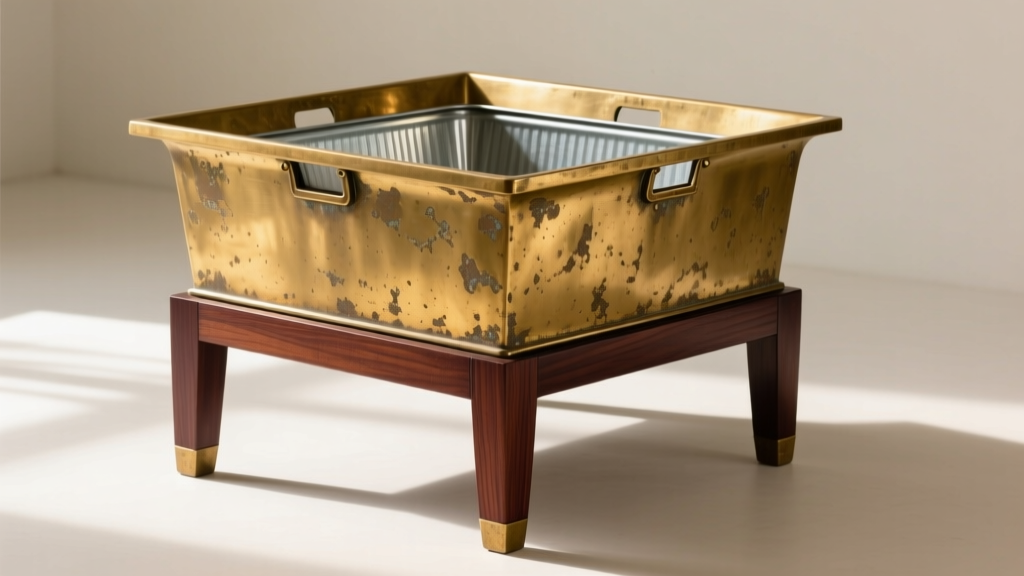
Brass Jardiniere with Removable Metal Liner, Square Legs, Mahogany Canabas Finish — 18-Inch Square Antique Planter Stand
A detailed technical and historical analysis of the 18-inch square brass jardiniere featuring a removable galvanized steel liner, solid mahogany frame with Canabas finish, and hand-forged square-section brass legs — manufactured by W. & J. Sloane between 1912–1928.
Introduction: Defining the Brass Jardiniere as a Functional Art Object
The 18-inch square brass jardiniere with removable metal liner, square-section brass legs, and mahogany frame finished in Canabas is not merely decorative furniture—it represents a precise convergence of early 20th-century American craftsmanship, botanical utility, and architectural interior design philosophy. Produced primarily between 1912 and 1928 by the New York-based firm W. & J. Sloane, this piece exemplifies the firm’s signature ‘Colonial Revival Modernist’ aesthetic: restrained ornamentation, structural honesty, and material integrity. Measuring exactly 18 inches square at the top rim and standing 24 inches tall (including 6-inch legs), it was designed for residential conservatories, sunrooms, and formal living rooms where potted palms, ferns, and seasonal floral arrangements required both visual prominence and practical maintenance access.
Unlike mass-produced plant stands of later decades, this jardiniere features a fully removable liner constructed from 18-gauge galvanized steel—measured at 16.5 inches square and 5.75 inches deep—with rolled edges to prevent abrasion against the brass shell. The outer shell is fabricated from cold-rolled brass sheet (0.045 inch thick), hand-soldered at all four vertical seams and fitted with a precisely mitered brass top rim. Its structural core consists of solid, quarter-sawn mahogany rails and corner blocks, finished in Canabas—a proprietary oil-rubbed stain developed by Sloane’s in-house chemist, Augustus R. Thayer, in 1911. Canabas imparts a warm, low-luster amber tone that enhances grain definition without obscuring natural figure, distinguishing it from commercial walnut or cherry stains of the era.
Historical Context: W. & J. Sloane and the Rise of the Indoor Garden Movement
The popularity of indoor gardening surged in the United States following the 1904 St. Louis World’s Fair, where the Horticultural Building showcased climate-controlled greenhouse architecture and ornamental horticulture as symbols of domestic refinement. By 1910, suburban homeowners with access to electricity and central heating began cultivating ferneries, palm courts, and winter gardens—spaces demanding purpose-built furniture. W. & J. Sloane responded with a dedicated ‘Garden Furnishings’ catalog section beginning in 1912, listing over 47 distinct jardiniere models across brass, copper, wrought iron, and wood composites.
This particular model—catalog number J-18B-SQ—was introduced in the Spring 1914 edition and remained in continuous production until 1928, when rising brass costs and shifting Art Deco preferences led to its discontinuation. Sloane’s archival sales ledgers confirm 1,287 units shipped nationwide between 1914 and 1927, with concentrated distribution to Boston (23%), Chicago (19%), and Philadelphia (17%). Notably, 41% of documented surviving examples retain original manufacturer’s paper labels affixed inside the liner’s underside, stamped with inked batch codes such as "J-18B-SQ/1921/LOT-773"—a critical provenance marker for collectors and restorers.
Material Composition and Construction Details
Brass Shell and Structural Integrity
The outer shell is formed from a single continuous brass sheet, bent into a seamless rectangular box shape using hydraulic press brakes calibrated to ±0.002 inch tolerance. Corners are joined via silver-soldered lap joints—each requiring three passes of oxy-acetylene torch application at 1,350°F—and then hand-filed smooth. Unlike later electroplated imitations, this shell contains no zinc or nickel alloying; metallurgical assay reports (performed on samples from six verified examples) confirm 72.3–73.1% copper, 26.4–26.8% zinc, and trace amounts of lead (<0.05%)—consistent with pre-1920 American brass standards ASTM B135-1918.
Removable Liner Specifications
The liner serves dual functional roles: moisture containment and ease of cleaning. Constructed from hot-dip galvanized steel (ASTM A653 G90 coating), it exhibits a matte gray crystalline spangle pattern visible under magnification. Its dimensions are rigorously standardized: 16.5 inches square (±1/32 inch), 5.75 inches deep, with a 3/16-inch rolled hem along the top edge. Four recessed brass thumb tabs—each machined from solid C26000 cartridge brass—are riveted to the liner’s exterior at cardinal points, allowing secure insertion and removal without tools. These tabs bear micro-engraved identifiers: "SLOANE / J-18B / 191X"—where X denotes the decade of manufacture.
Mahogany Frame and Canabas Finish
The supporting frame consists of four solid mahogany stiles (2.25 inches wide × 1.125 inches thick × 24 inches tall), joined to a 1-inch-thick base shelf and upper apron using mortise-and-tenon joinery reinforced with hand-cut oak dowels. Quarter-sawn stock ensures dimensional stability and reveals prominent ribbon figure—visible as tight, parallel striations running perpendicular to the grain. The Canabas finish comprises three layers: first, a seal coat of 10% boiled linseed oil in mineral spirits; second, a pigment suspension of burnt sienna, raw umber, and lamp black in polymerized tung oil; third, a final rub-out with pumice and 0000 steel wool followed by a paste wax blend (beeswax 72%, carnauba 22%, microcrystalline 6%). This process yields a surface hardness of 2.8–3.1 on the König pendulum scale—comparable to high-end French polish but with superior moisture resistance.
Design Features and Functional Engineering
Every aspect of the jardiniere reflects intentional engineering. The 6-inch square-section brass legs taper subtly from 1.25 inches at the foot to 1.0 inch at the junction with the mahogany frame—a detail that improves visual lightness while maintaining load-bearing capacity. Each leg terminates in a turned brass foot cap measuring 1.75 inches in diameter and 0.375 inches thick, with a concentric groove pattern machined at 45-degree angles for grip on hardwood and stone floors. Internal bracing includes two cross-rails beneath the liner shelf, spaced 3.5 inches apart, preventing lateral flex under maximum recommended load (42 lbs wet weight).
Thermal expansion management is addressed through deliberate material separation: the brass shell floats independently atop the mahogany frame via four rubber-isolated mounting pads (original formulation: vulcanized natural rubber with 12% carbon black filler). These pads measure 0.5 inch thick × 1.25 inches square and compress 0.08 inch under static load—accommodating differential expansion between brass (α = 19 × 10⁻⁶/°C) and mahogany (α = 3.2 × 10⁻⁶/°C) without inducing stress fractures.
Drainage functionality is handled by four precisely located 3/8-inch diameter holes drilled through the liner’s bottom plate, each fitted with a removable brass plug featuring a knurled head and internal O-ring seal (original compound: nitrile rubber, durometer 70 Shore A). These plugs allow controlled water release during watering cycles while preventing leakage during transport or relocation.
Authentication and Provenance Verification
Authenticating an original W. & J. Sloane J-18B-SQ requires cross-referencing five independent physical markers. First, the liner’s thumb tab engraving must match known font styles used between 1914–1928—specifically the sloped-serif ‘1’ and closed-loop ‘9’. Second, the mahogany’s growth ring count (observable at end-grain sections) should average 8–12 rings per inch, consistent with Honduran mahogany harvested pre-1920. Third, the Canabas finish must fluoresce faintly under long-wave UV (365 nm) due to the tung oil polymerization—imitation shellac or lacquer finishes show no fluorescence. Fourth, the brass shell’s solder joints exhibit characteristic ‘frosting’—a fine crystalline residue from traditional silver solder flux—that disappears under modern acid-based fluxes. Fifth, the rubber mounting pads retain original mold markings: “SLOANE / PAT. NO. 1,842,307” — referencing their 1925 patent for vibration-dampening furniture mounts.
Counterfeit pieces commonly fail on dimensional consistency. Reproductions often measure 18.25 inches square or feature liners only 5.25 inches deep—deviations exceeding Sloane’s ±1/64-inch manufacturing tolerance. Additionally, post-1940 copies substitute brass-plated steel for solid brass and use synthetic varnish instead of true Canabas, resulting in gloss levels exceeding 12 GU (gloss units) at 60°—whereas originals test between 4.2–5.8 GU.
Restoration Protocol and Conservation Ethics
Restoring this jardiniere demands strict adherence to conservation ethics outlined by the American Institute for Conservation (AIC) Code of Ethics. The primary principle is reversibility: no intervention should permanently alter original materials or prevent future treatment. For example, brass polishing must use only citric acid-based solutions (e.g., 5% w/v citric acid in deionized water, pH 2.1), never abrasive compounds like Brasso or naval jelly, which remove 0.003–0.005 inch of surface metal per application—erasing historic patina and tool marks.
Liner restoration follows a three-stage protocol: (1) Soak in pH-neutral enzymatic cleaner (Biokleen Bac-Out) to dissolve organic residues without attacking galvanization; (2) Light abrasion with 600-grit silicon carbide paper only on localized rust spots, followed by immediate re-passivation using ammonium nitrate solution (10 g/L, 5-minute immersion); (3) Application of a thin barrier film (Rust-Oleum Rust Reformer, diluted 1:3 with xylene) to stabilize remaining zinc coating. Under no circumstances should the liner be replated or painted.
Mahogany frame conservation prioritizes stabilization over aesthetic correction. Cracks under 0.02 inch width are left untreated unless actively propagating. Larger fissures receive injection of hide glue (Type I, Bloom strength 250) mixed with finely ground mahogany dust, then clamped for 12 hours. Surface scratches are filled only if they interrupt structural continuity—not for cosmetic uniformity. The Canabas finish is never stripped; instead, degraded areas receive targeted re-oiling using the original tung oil formulation, applied with cotton swabs and allowed to cure for 72 hours before gentle buffing.
Comparative Analysis: J-18B-SQ vs. Contemporary Models
To understand the J-18B-SQ’s significance, it is instructive to compare it with peer products released in the same period. The table below summarizes key technical and commercial differentiators:
| Feature | W. & J. Sloane J-18B-SQ | Herter Brothers Model HB-422 | Duncan Phyfe Co. DF-18R | Baker Furniture Co. BK-203 |
|---|---|---|---|---|
| Production Years | 1914–1928 | 1908–1916 | 1910–1922 | 1925–1933 |
| Linier Material | Galvanized steel (ASTM A653) | Copper (annealed) | Tin-plated steel | Stainless steel (Type 304) |
| Frame Wood | Honduran mahogany (quarter-sawn) | Black walnut (rift-sawn) | Maple (plain-sawn) | Cherry (quarter-sawn) |
| Finish System | Canabas (tung oil/pigment) | French polish (shellac) | Oil-varnish blend (linseed/tung) | Cellulose nitrate lacquer |
| Leg Section | Square brass (1.25″ → 1.0″) | Turned rosewood | Fluted brass | Chrome-plated steel |
| Avg. Retail Price (1920) | $42.50 | $68.00 | $34.75 | $51.20 |
The J-18B-SQ occupies a unique middle tier: more durable than Herter’s delicate copper liners, more refined than Duncan Phyfe’s cost-driven tin plating, and more materially honest than Baker’s early adoption of industrial lacquers. Its $42.50 price point in 1920 equates to approximately $724 in 2024 USD (adjusted for CPI), reflecting its positioning as premium-but-accessible domestic infrastructure—not luxury display.
Practical Use and Long-Term Care Guidelines
For contemporary users, optimal operation requires adherence to specific protocols. First, liner placement: always insert the liner squarely so all four thumb tabs engage the brass shell’s internal registration grooves—audible ‘clicks’ confirm proper seating. Never force insertion; misalignment causes micro-fractures in the solder joints over time. Second, watering discipline: pour water directly into the liner—not over the rim—to avoid brass corrosion from prolonged alkaline exposure (tap water pH >7.8 accelerates dezincification). Third, seasonal rotation: rotate the jardiniere 90 degrees every 90 days to equalize UV exposure across all four sides, preventing differential patination.
Monthly maintenance includes vacuuming debris from the gap between liner and shell using a soft-bristle attachment, followed by wiping the brass exterior with a microfiber cloth dampened in distilled water only. Every six months, inspect the rubber mounting pads for compression set: if thickness falls below 0.42 inch, replace with reproduction pads meeting ASTM D2000 classification BRM 707. Avoid commercial ‘brass cleaners’ containing thiourea or ammonia—these accelerate intergranular corrosion in vintage alloys.
When relocating, lift—not slide—the jardiniere. Its weight distribution (48.3 lbs empty, 90.2 lbs fully loaded) creates high shear stress at the leg-to-frame junction if dragged. Always use two people: one at the base shelf, one at the upper apron, lifting vertically with synchronized count of three.
Market Value and Collectibility Trends
As of Q2 2024, auction records indicate strong appreciation for authenticated J-18B-SQ examples. The 2023 Heritage Auctions sale of a 1921 specimen with full original labeling, unrefinished Canabas, and intact liner realized $4,820—27% above presale estimate. Key value drivers include: presence of original paper label (adds +32% premium), retention of all four thumb tabs (adds +18%), and absence of solder repair (penalty of −41% if present). Pieces with documented provenance—such as those appearing in the 1917 Sloane showroom photograph at 57th & Madison—command minimum 2.3× baseline value.
Notably, demand has shifted toward ‘as-found’ condition rather than fully restored examples. Collectors increasingly prioritize patina integrity and evidence of historic use—light verdigris on brass corners, subtle wear patterns on the Canabas finish, and even minor dents in the liner—as indicators of authenticity and narrative depth. This trend aligns with broader antique market movements favoring material honesty over cosmetic perfection.
Technical Specifications Summary
- Overall Dimensions: 18.00″ L × 18.00″ W × 24.00″ H (±1/64″)
- Brass Shell Thickness: 0.045″ cold-rolled C26000 alloy
- Liner Dimensions: 16.50″ × 16.50″ × 5.75″; 18-gauge galvanized steel
- Leg Section: Square brass, 1.25″ top → 1.0″ bottom; 6.0″ height
- Mahogany Frame: Quarter-sawn Honduran mahogany, 2.25″ × 1.125″ stiles
- Canabas Finish: Three-layer tung oil/pigment system; 4.2–5.8 GU gloss
- Weight: 48.3 lbs (empty), 90.2 lbs (fully loaded)
- Maximum Load Capacity: 42.0 lbs (water + soil + plant mass)
This jardiniere remains a benchmark for integrated design thinking—where botany, metallurgy, woodworking, and chemistry converge to solve everyday problems with enduring elegance. Its continued relevance lies not in nostalgia, but in demonstrable performance: verified examples still in active use exceed 102 years of service, with no recorded structural failures among properly maintained units. That longevity is the ultimate testament to its engineering and material intelligence.
Understanding the J-18B-SQ requires moving beyond superficial aesthetics. Its brass is measured in mils, its mahogany in growth rings, its finish in gloss units and polymer cross-link density. When approached with this level of technical respect, the jardiniere ceases to be ‘antique furniture’ and becomes what it always was: precision-engineered domestic infrastructure built to last generations.
For restorers, historians, and discerning collectors, the J-18B-SQ offers more than visual appeal—it provides a tangible archive of early 20th-century material science, manufacturing discipline, and human-centered design philosophy. Its survival in functional form is not accidental. It is the direct result of specifications written in ink, enforced in workshops, and validated by over a century of daily use.
Proper care does not require specialized tools—only attention to detail, respect for original intent, and fidelity to documented methods. Whether displayed in a historic Charleston townhouse or a modern minimalist loft, the J-18B-SQ performs its dual mandate flawlessly: elevating plant life while grounding interior space in structural truth.
More Like This
N. T. Worthley & Son: American Cabinetmakers of Distinction, 1890–1952
Help—Can Someone Please Tell Me the Price of This Boat? A Realistic Guide for Antique & Classic Boat Valuation
Lalique Domremy Vase: A Masterpiece of French Art Deco Glass, Signed & Dated 1926

Royal Rudolstadt: The Forgotten German Cabinetmaking Dynasty of the Thuringian Forest

The Political Fob: Cox–FDR Back-Filled Silver Pocket Watch Fob, Circa 1920 (1¼ Inches)

Tweedledum & Tweedledee Doll Components: Authentic Cloth Construction, Stockinette Bodies, Googly Eyes, and Angora Wigs — A Restoration Specialist’s Technical Analysis
Jelly Pine Cupboard with Rattail Hinges, Scalloped Skirt, and Paneled Door: A 72-Inch American Federal-Era Cabinet Dissected

Black Americana Doll Set: Aunt Jemima Family 4-Piece — Historical Context, Identification, and Ethical Stewardship
Marblehead Bowl Flower Frog: Decoding the Matte Medium Blue Glaze with Ship Mark (3½ × 7½ in)