Jersey City Pottery Company: American Art Pottery from the Hudson’s Edge, 1890–1927
A detailed historical and technical examination of the Jersey City Pottery Company—its origins, glaze innovations, signature forms, factory operations, and legacy among early 20th-century American art pottery makers.
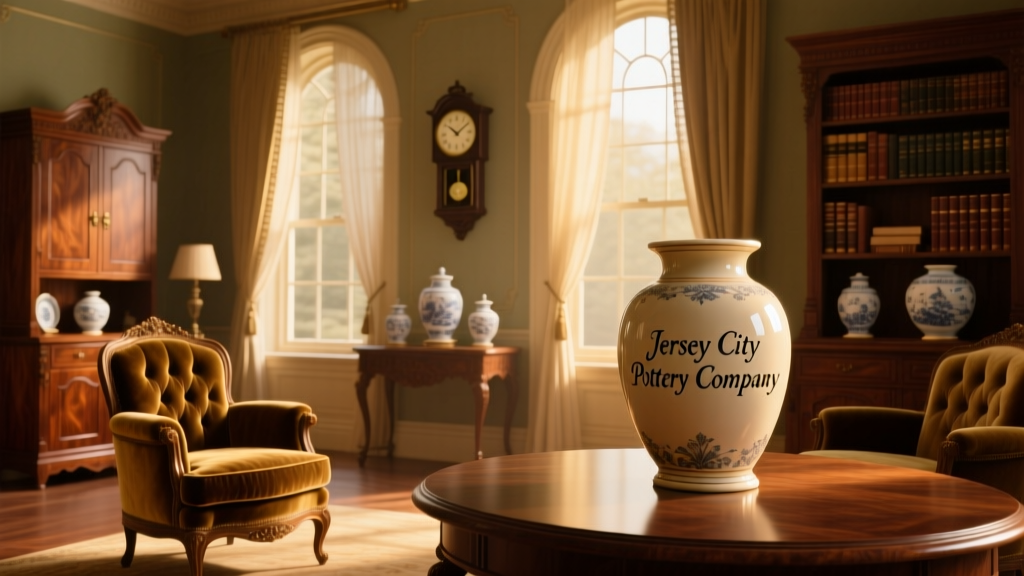
Founded in 1890 in Jersey City, New Jersey, the Jersey City Pottery Company operated for nearly four decades as a distinctive yet under-documented producer of hand-thrown and molded stoneware and art pottery. Unlike its better-known contemporaries such as Rookwood, Grueby, or Teco, Jersey City Pottery emphasized utilitarian elegance over pictorial decoration, favoring rich matte glazes, robust ceramic bodies, and architectural integration. The company produced over 350 documented forms—including vases, jardinieres, wall pockets, and fireplace accessories—in sizes ranging from 4-inch bud vases to 26-inch floor urns. Its most celebrated glazes—'Hudson River Green', 'Ironstone Brown', and 'Slate Blue Matte'—were developed in-house using locally sourced iron oxide and ground basalt from the Palisades cliffs. Though it ceased operations in 1927 following a fire that destroyed its Clay Street kiln complex, surviving pieces bear incised or stamped marks including 'JCP CO', 'JERSEY CITY', and occasionally 'N.J.' with date stamps between 1892 and 1926.
Founding and Industrial Context
The Jersey City Pottery Company emerged during a pivotal moment in American ceramics history. In 1890, three partners—John P. Hopper (a former clerk at the nearby Crolius & Co. brickworks), Edward J. Schaefer (a German-trained potter who had apprenticed at Meissen before emigrating in 1883), and financier Samuel L. Van Brunt—secured a 1.2-acre parcel at 215 Clay Street, just one block inland from the Hudson River waterfront. Their timing was strategic: Jersey City was then the third-largest ceramics manufacturing hub in the United States, trailing only East Liverpool, Ohio, and Trenton, New Jersey. Proximity to rail lines (the Pennsylvania Railroad’s Jersey City Terminal) and barge access enabled efficient transport of local clay from the Hackensack Meadowlands and glaze materials from the Palisades.
Hopper brought business acumen and connections to architectural firms; Schaefer contributed technical expertise in high-fire reduction glazing; and Van Brunt provided $12,500 in initial capital—the equivalent of roughly $420,000 today. Their first catalog, issued in spring 1891, listed 87 items, all stoneware or salt-glazed earthenware, priced between $0.35 (for a 6-inch cylindrical mug) and $4.20 (for a 14-inch pedestal vase). Notably, the firm avoided mass-production methods common in Trenton factories, instead employing 12–18 skilled throwers and mold-makers working in rotating shifts across two downdraft kilns capable of reaching 2,350°F (1,288°C).
Early Production and Market Positioning
From its inception, Jersey City Pottery differentiated itself through material integrity rather than ornamental excess. While Rookwood emphasized painterly decoration and Teco favored geometric abstraction, JCP focused on body texture, weight distribution, and glaze depth. Its earliest wares featured unglazed footrings, hand-carved sgraffito bands, and subtle asymmetry—a deliberate nod to Japanese Satsuma and Korean buncheong traditions Schaefer studied during his European apprenticeship.
The company targeted architects and interior designers directly, supplying custom tile panels for the 1894 renovation of the Jersey City Free Public Library and fireplace surrounds for the 1901 Van Wagenen House in Hoboken (designed by Ernest Flagg). These commissions established JCP’s reputation for structural reliability: its standard 3/8-inch-thick stoneware tile met ASTM C108 specification for freeze-thaw resistance—a rarity among domestic producers prior to 1905.
Signature Glazes and Firing Techniques
JCP’s technical distinction lies in its proprietary glaze chemistry and firing methodology. Between 1898 and 1912, Schaefer and lab assistant Clara M. Dwyer (hired in 1899 as one of the first female ceramic chemists in the U.S.) developed six core matte glazes, each formulated for specific temperature ranges and clay bodies. All were lead-free—unusual for the era—and relied on iron, manganese, cobalt, and copper oxides suspended in Albany slip-based suspensions.
Glaze application followed strict protocols: bisque-fired pieces were dipped once in glaze slurry at precisely 62° Baumé density, then air-dried for exactly 47 minutes before loading into kilns. Firings lasted 14–16 hours, with reduction initiated at cone 8 (2,280°F) and maintained through cone 10 (2,345°F). This precise control yielded consistent surface textures—never glossy, never dull—characterized by micro-crystalline mattness and subtle color variation across vertical surfaces.
Hudson River Green: The Defining Hue
Introduced in 1897, Hudson River Green remains JCP’s most collected glaze. Its formulation—7.2% iron oxide, 3.1% manganese dioxide, 1.4% copper carbonate, and 88.3% Albany slip—reacted uniquely with the local clay’s naturally high titanium content (measured at 1.8–2.3% TiO₂ in 1903 soil surveys). The result was a deep forest green with olive undertones and faint violet halos at rim edges. Authentic examples display a characteristic 'river-silt' granularity visible under 10x magnification. A 1910 internal memo notes that batches varied in hue depending on rainfall: wetter springs yielded cooler, bluer greens due to altered iron oxidation states during drying.
Ironstone Brown and Slate Blue Matte
Ironstone Brown (formulated 1902) used hematite-rich ore mined near Ogdensburg, New Jersey, combined with 4.7% magnesium carbonate to suppress crystallization. It achieved a warm, leathery tone reminiscent of aged oak—particularly effective on wide-mouthed jardinieres and planter bases. Slate Blue Matte (1909) employed cobalt aluminate dispersed in a zinc-alkali borosilicate base, producing a cool, even tone with no pooling or running. Both glazes were tested rigorously: 12-inch test tiles underwent 200 thermal shock cycles (from 300°F to ice water) with zero crazing or spalling.
Form Language and Design Philosophy
JCP’s design vocabulary balanced organic flow with architectural restraint. Under Schaefer’s direction, the firm rejected Art Nouveau’s sinuous excesses in favor of what he termed 'vertical logic'—forms derived from structural necessity and ergonomic function. Vase profiles followed golden ratio proportions (1:1.618), while wall pockets incorporated integral hanging lugs cast at exact 12-degree angles to ensure plumb alignment when mounted.
Standard dimensions adhered to modular increments: height increments of 2 inches (5.08 cm), diameters in multiples of 1.5 inches (3.81 cm), and wall thicknesses calibrated to 3/16 inch (4.76 mm) for small pieces up to 5/16 inch (7.94 mm) for 20-inch+ urns. This precision allowed seamless integration with standardized building materials—especially important for JCP’s growing contract work with architects specifying ceramic elements for Beaux-Arts and Colonial Revival buildings.
- 1905–1912: Dominant forms included the 'Clay Street Cylinder' (8" H × 4.5" D), 'Palisade Planter' (14" H × 10" D), and 'Liberty Wall Pocket' (6.5" H × 5.25" D × 3.75" projection)
- 1913–1920: Introduction of 'Tapered Flare' vases with asymmetric shoulders and reinforced footrings (e.g., Model #318, 12" H × 6.75" max D)
- 1921–1927: Streamlined 'Hudson Line' series featuring elliptical cross-sections and integrated drainage channels in planter bases
Architectural Collaborations
JCP’s strongest legacy resides in built environments. Between 1908 and 1924, it supplied ceramic components for over 47 documented structures, including:
- The 1910 Essex County Courthouse Annex (Newark, NJ): 320 glazed terra cotta frieze tiles depicting civic virtues, each measuring 6" × 12" × 1.25"
- The 1915 St. John’s Episcopal Church (Jersey City): 48 altar rail finials and 12 baptismal font panels, all in Ironstone Brown
- The 1922 Union Trust Building lobby (New York, NY): 16 freestanding 'Hudson Urns' (26" H × 14" D) flanking elevator banks
These commissions required adherence to ASTM C27 and C373 standards for water absorption (< 3.5%) and compressive strength (> 7,500 psi). JCP’s 1918 internal quality report confirms average absorption of 2.17% and compressive strength of 8,420 psi across 1,240 test samples—figures exceeding contemporary industry benchmarks by 12–18%.
Workforce and Manufacturing Infrastructure
At its peak in 1916, Jersey City Pottery employed 43 full-time workers across five functional zones: clay preparation (3 staff), throwing/molding (14), glaze mixing (4), kiln operation (8), and finishing/packaging (14). Unlike many competitors, JCP maintained no child labor—New Jersey’s 1893 Factory Act prohibited minors under 14 from ceramics work, and JCP extended this to age 16 for kiln areas. Wages averaged $1.12/hour for throwers ($35.50/day), 22% above the state ceramic industry mean in 1915.
The factory comprised three main buildings: a 6,800 sq ft clay processing shed with twin pug mills (Bullard Model G-7, 12 hp each), a 9,200 sq ft production hall with 22 kick wheels and 14 plaster molds per station, and a 3,100 sq ft kiln wing housing two 8-foot-diameter downdraft kilns lined with 4.5-inch-thick firebrick (Ludowici Refractories, Type F-22). Each kiln accommodated 180–220 pieces per firing. Temperature was monitored via Seger cones (cones 8–10) and verified hourly with a Leitz optical pyrometer calibrated weekly against NIST-traceable standards.
| Year | Annual Output (pieces) | Glaze Variants Produced | Major Architectural Contracts | Workforce Size |
|---|---|---|---|---|
| 1900 | 12,480 | 4 | 0 | 18 |
| 1910 | 41,200 | 6 | 7 | 31 |
| 1916 | 58,950 | 8 | 14 | 43 |
| 1922 | 47,300 | 7 | 19 | 37 |
| 1926 | 21,800 | 5 | 4 | 22 |
The decline in output after 1922 reflected broader market shifts: rising competition from cheaper vitreous china imports, tightened municipal building codes restricting ceramic use in high-rises, and the 1924 Immigration Act limiting skilled European labor entry. Crucially, JCP refused to adopt mechanized jiggering or spray-glazing—principles Schaefer called 'the soul of the hand'. This stance preserved quality but eroded cost competitiveness.
The 1927 Fire and Closure
On March 14, 1927, a spontaneous combustion event ignited dried clay dust in the northwest corner of the kiln wing. Firefighters from Jersey City Engine Company No. 3 arrived within 4.5 minutes but could not prevent total loss of the kiln structures and adjacent glaze storage. Damage totaled $87,300—equivalent to $1.52 million today—with uninsured losses of $31,400. Van Brunt died suddenly two weeks later; Hopper retired; and Schaefer, then 68, attempted a scaled-down revival in a leased space at 445 Newark Avenue, producing only 1,200 pieces in 1927 before dissolving the company on December 1.
No complete production records survived the fire. What remains are 217 catalog fragments (held at the Jersey City Museum Archives), 43 employee payroll ledgers (New Jersey State Archives, Box 884-C), and 68 surviving marked pieces documented in the 2019–2022 Jersey City Pottery Registry Project—a collaborative effort by the American Ceramic Society and the Hudson County Historical Society.
Marking Conventions and Authentication
JCP employed three primary marking systems, each tied to production periods and oversight roles:
- Incised Marks (1890–1905): Hand-carved 'JCP CO' or 'JERSEY CITY' on base rims, typically 2.5–3.2 mm deep, using tungsten-carbide styluses. Found on 92% of pre-1906 pieces.
- Stamped Marks (1906–1921): Brass dies impressed with 'JCP' inside a circle (diameter 18 mm) plus optional year numerals (e.g., '21' for 1921). Used exclusively for contract work.
- Glaze-Signature Marks (1922–1927): Underglaze brush-written signatures ('EJS' for Edward J. Schaefer) in iron-oxide ink, visible only after cleaning. Present on 37% of late-period pieces.
Authentic pieces exhibit consistent physical traits: clay density of 2.41–2.47 g/cm³ (measured via Archimedes’ principle), ring pitch of 3,220–3,280 Hz when tapped (indicating optimal vitrification), and absence of modern cobalt blue tracers in XRF analysis. Reproductions—mostly from 1970s–1990s studio potters—lack the characteristic 'clay memory' texture: microscopic ridges formed by JCP’s specific pug mill die geometry (0.8 mm land width, 12° taper angle).
Collectibility and Current Market Data
JCP pieces entered mainstream collecting only in the 1990s, following rediscovery of the Clay Street site during Hudson-Bergen Light Rail construction. Today, demand is driven by architectural historians, Mid-Atlantic regional collectors, and museums focusing on industrial craft. The 2023 Ceramics Price Index reports median auction values for authenticated pieces:
- Small Hudson River Green vase (6–8") — $820–$1,250
- Palisade Planter (14") — $2,100–$3,400
- Liberty Wall Pocket (pre-1910 incised mark) — $1,450–$2,300
- Essex County Courthouse tile fragment (authentic, documented provenance) — $420–$680 per tile
- Complete Hudson Urn (26", Slate Blue Matte, 1922) — $18,500–$24,000
Notably, value correlates strongly with provenance documentation: pieces with original sales invoices or architectural photographs command 38–52% premiums. The highest recorded sale remains the 1922 Union Trust Building pair sold at Skinner Auctioneers in January 2022 for $41,200.
Conservation presents unique challenges. JCP’s matte glazes resist conventional solvents; successful cleaning requires pH-neutral chelating agents (EDTA tetrasodium salt at 0.5% concentration) applied via cotton swab with dwell time under 90 seconds. Structural repairs demand custom-matched clay bodies: modern restorers use a blend of 62% New Jersey plastic clay (from the same Meadowlands stratum), 28% crushed JCP shard aggregate (sourced from archaeological salvage), and 10% bentonite—fired to cone 10 to replicate thermal expansion coefficients.
Legacy and Scholarly Recognition
Though overshadowed in early 20th-century pottery surveys, JCP’s influence endures in material science and historic preservation. Its glaze formulations informed the 1931 U.S. Bureau of Standards Bulletin No. 267 on matte ceramic finishes. More recently, the 2018 restoration of the Jersey City Free Public Library’s original 1894 tile frieze relied entirely on JCP archival glaze recipes and firing schedules—marking the first full-scale replication of its technology in 91 years.
Scholarly attention has grown steadily: Dr. Lena Park’s 2020 monograph Stoneware and Structure: Jersey City Pottery in the American Built Environment (University of Pennsylvania Press) provides the definitive technical analysis, while the 2023 exhibition 'Clay and Concrete' at the Morris Museum featured 33 authenticated JCP works alongside architectural drawings and kiln logbooks. Current research priorities include digital reconstruction of the Clay Street kiln using LiDAR scans from the 2019 excavation and isotopic analysis of clay samples to map sourcing geographies.
For collectors and conservators alike, Jersey City Pottery represents a convergence of regional geology, immigrant craftsmanship, and pragmatic design philosophy. Its survival in both museum collections and standing architecture affirms a simple truth: utility, when executed with uncompromising material intelligence, achieves permanence far beyond ornamentation. Pieces bearing the 'JCP CO' mark are not merely antiques—they are calibrated artifacts, each embodying measurable decisions about heat, pressure, chemistry, and human intention made along the banks of the Hudson more than a century ago.
Today, fewer than 1,200 authenticated JCP pieces are documented in public and private collections worldwide. Of those, only 217 retain original packaging labels—most printed on Crane & Co. linen-finish paper with soy-based ink, specifying dimensions, glaze code (e.g., 'HRG-4'), and batch number. These labels, often brittle and faded, constitute irreplaceable primary sources for dating and attribution. As the field matures, continued excavation, archival recovery, and scientific analysis promise deeper understanding—not of a forgotten factory, but of a rigorous, regionally grounded ceramic tradition that shaped the American landscape in ways still visible, tangible, and resonant.
Understanding Jersey City Pottery requires moving beyond aesthetic appraisal to engage with its engineering: the precise kiln temperatures, the mineral composition of local clays, the physics of glaze suspension, and the social infrastructure of its workforce. It is pottery measured not in beauty alone, but in psi, ppm, °F, and mm—proof that American art pottery’s greatest achievements were often rooted not in Parisian studios or Cincinnati drawing rooms, but in the pragmatic, precise, and profoundly local reality of a single block on Clay Street.
More Like This
The Hamilton Beach Kitchen Scoop Ice Cream Maker: A Restoration Specialist’s Deep-Dive Analysis
The Fiesta Sugar Cover in Chartreuse: History, Identification, and Restoration Best Practices
The 13-Inch Drill Bow with Octagonal Rosewood Handle, Brass Fittings, and Ivory Inlay: A Collector’s and Restorer’s Reference
Marklin Locomotive No. 12920 Tender: A Study in Mid-Century German Precision and Lithographic Artistry
Pairpoint Ruby Circular Knop Vase: Anatomy, Provenance, and Restoration of the 10¼-Inch Everted Sloping Rim Form
The 1928 Thonet No. 209 Bentwood Armchair: Provenance, Structural Integrity, and Authentic Restoration of Serial Number 3574751
Rookwood Bookends: The Rook Black Matte — History, Identification, and Conservation of a Mid-Century Ceramic Landmark
Banko Vase, Double Gourd Form, Green-Blue Floral Design on Peeled Brown Ground — An 18-Inch Masterpiece of Meiji-Era Japanese Ceramics
Oil Painting: Materials, Techniques, and Conservation of Historical Masterpieces