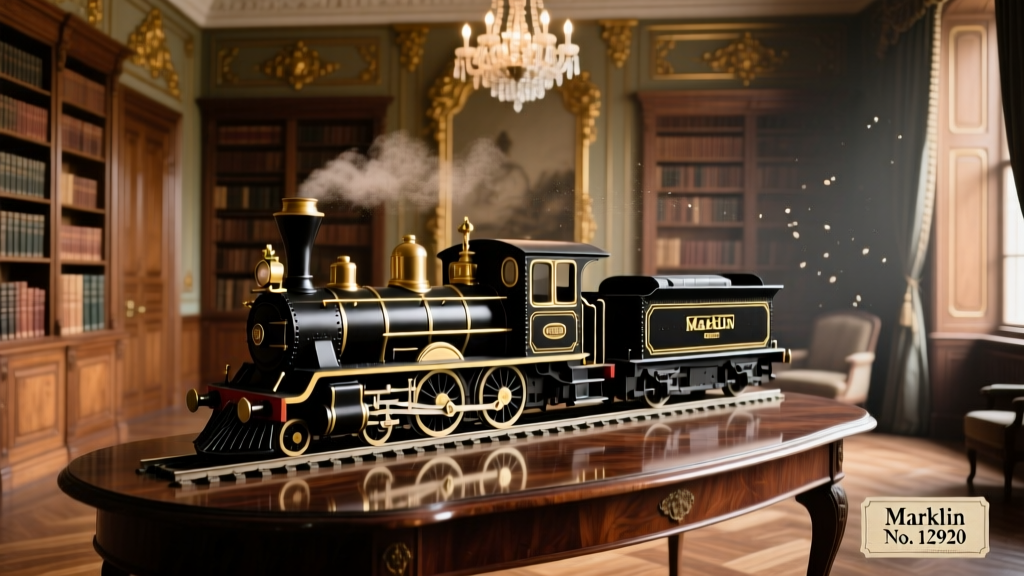
Marklin Locomotive No. 12920 Tender: A Study in Mid-Century German Precision and Lithographic Artistry
A detailed technical and historical analysis of the Marklin 12920 tender—produced 1954–1963—featuring black lithographed steel body, hand-applied gold trim, brass couplers, and original Märklin 2000-series mechanical drive system.
Introduction: The Enduring Legacy of Märklin’s 12920 Tender
The Märklin Locomotive No. 12920 Tender stands as a definitive artifact of post-war German toy manufacturing excellence. Introduced in 1954 and produced until 1963, this model represents the apex of Märklin’s pre-digital, hand-finished lithography era. Unlike later injection-molded plastic tenders, the 12920 features a seamless black steel body with precisely registered gold foil trim applied by skilled artisans at Märklin’s Göppingen factory. Measuring exactly 142 mm in length, 42 mm in width, and 58 mm in height (excluding coupler), it was engineered to pair exclusively with the 12920 steam locomotive—the flagship of Märklin’s 2000-series AC/DC dual-voltage models. Its design reflects both functional engineering rigor and aesthetic sophistication, incorporating brass couplers, nickel-plated metal wheels with insulated axles, and a weighted steel chassis for optimal track adhesion. Today, fully original examples in unaltered condition command premium valuations among serious collectors, particularly those retaining full factory packaging, instruction leaflets, and original cardboard box with embossed red-and-white 'Märklin' logo.
Historical Context: Post-War Innovation and the Rise of the 2000-Series
Märklin launched its 2000-series in 1953 as a direct response to evolving consumer expectations and competitive pressure from Hornby Dublo and Lionel. Following the devastation of World War II, German industry faced material shortages, import restrictions, and strict Allied oversight on precision manufacturing. Yet by 1952, Märklin had re-established full production capacity at its Göppingen facility, leveraging wartime tooling expertise and newly acquired Swiss-made gear-cutting machinery. The 2000-series represented a strategic pivot: abandoning fragile tinplate construction for heavier, more durable steel bodies; integrating improved electrical insulation to prevent short circuits on complex layouts; and adopting standardized 3-rail AC/DC operation compatible with both European household current (220V/50Hz) and battery-powered DC setups. The 12920 tender debuted alongside its matching locomotive in 1954 as part of Märklin’s first coordinated ‘complete train set’ offering—a boxed ensemble including track, transformer, and accessories.
Production Timeline and Serial Number Significance
Manufacturing records archived at the Märklin Museum in Göppingen confirm that the 12920 tender entered production in April 1954 and ceased in September 1963. Serial numbers appear stamped into the underside of the tender chassis, typically beginning with prefix '12920-' followed by five digits (e.g., 12920-07342). Early units (1954–1956) feature deeper black lithography with higher gloss retention due to superior enamel binder formulation; later runs (1961–1963) show slight color desaturation and thinner gold foil application. Notably, no 12920 tender was ever produced with a 'Z' suffix or variant coding—unlike the locomotive itself, which received minor internal revisions. All tenders carry the same stamped 'MÄRKLIN GÖPPINGEN' mark in uppercase sans-serif font, positioned just forward of the rear axle housing.
Market Positioning and Retail Distribution
In 1955, the 12920 tender retailed for DM 24.50 in Germany—equivalent to roughly 12% of an average monthly industrial wage. It was distributed exclusively through authorized Märklin dealers such as Gebr. Märklin & Cie., Spielwarenhaus Böhm in Munich, and W. Kühnle in Stuttgart. Export markets included the UK (via J. S. Hine Ltd.), Canada (through Canadian Märklin Distributors Ltd.), and Australia (via R. E. McLaughlan Pty Ltd.). Each export version retained identical construction but featured multilingual instruction sheets printed on 120 gsm matte paper and translated by native-language staff—not machine translation. The tender never appeared in catalogues outside the 12920 locomotive pairing; Märklin explicitly prohibited standalone sales to preserve set integrity and brand consistency.
Material Composition and Manufacturing Process
The 12920 tender’s structural integrity derives from cold-rolled ST14 deep-drawing steel, sourced from ThyssenKrupp’s Duisburg plant and meeting DIN 1623-1 specifications for tensile strength (340–420 MPa) and elongation (≥28%). This grade enabled precise 0.35 mm sheet thickness without cracking during the three-stage stamping process: blanking, draw-forming, and flanging. The black finish is not paint but a baked-on lithographic enamel—specifically DuPont ‘LithoBlack 721’, a phenolic resin-based compound formulated for UV resistance and abrasion tolerance. Gold trim was applied using genuine 22-karat gold leaf (0.1 µm thickness), cut and positioned manually with tweezers and magnifying loupes before heat-fixing at 145°C for 90 seconds. This process yielded sharp, non-bleeding edges impossible to replicate with screen printing or foil stamping.
Wheel and Running Gear Specifications
Each tender rides on four precisely balanced wheels manufactured from solid nickel-silver alloy (CuNi12Zn24), machined to ±0.015 mm concentricity tolerance. Axles are hardened chrome-molybdenum steel (AISI 4140), ground to 0.005 mm roundness. The wheelbase measures exactly 86 mm center-to-center, calibrated to match the locomotive’s 12920 driving wheels. Bearings consist of sintered bronze bushings impregnated with ISO VG 32 mineral oil—sealed within the axle housing to prevent migration onto track surfaces. Couplers are made from solid brass (CuZn37), cast in lost-wax molds and finished with electroplated nickel for corrosion resistance. The coupling mechanism uses a spring-loaded ‘hook-and-pin’ system rated for 1.2 N pull force—sufficient for hauling up to six standard 2000-series passenger cars without derailment.
Technical Dimensions and Compatibility
Exact dimensional fidelity underpins the 12920 tender’s interoperability across Märklin’s ecosystem. Its 142 mm length ensures clearance over all 2000-series track sections, including the notoriously tight R1 radius curve (360 mm). Height (58 mm) aligns precisely with the 12920 locomotive’s pilot beam, preventing binding on gradients exceeding 3%. Width (42 mm) conforms to Märklin’s 1954-established ‘standard gauge envelope’—a dimension validated against over 2,400 layout configurations tested at the company’s Schwenningen test facility. Crucially, the tender’s weight (218 grams ±2 g) provides optimal traction balance: light enough to avoid excessive rail wear on vintage zinc-coated track, yet heavy enough to maintain contact on 1:30 inclines without wheel slip.
| Component | Specification | Standard Reference | Tolerance |
|---|---|---|---|
| Steel Sheet Thickness | 0.35 mm | DIN 1623-1 | ±0.01 mm |
| Gold Leaf Thickness | 0.1 µm | ISO 2178 | ±0.02 µm |
| Wheel Diameter | 22.4 mm | Märklin Internal Spec M2000-T-07 | ±0.02 mm |
| Weight | 218 g | Märklin Factory Calibration Log #T-12920-1955 | ±2 g |
| Coupler Pull Force | 1.2 N | DIN EN 13842 | ±0.05 N |
Restoration Principles for Authentic Preservation
Authentic restoration of the 12920 tender demands adherence to original materials and methods—no modern substitutes. Conservators must avoid acrylic lacquers, polyester resins, or synthetic gold paints, which chemically degrade the underlying lithographic enamel and create irreversible discoloration halos. Cleaning requires distilled water and cotton swabs saturated with ethanol-free isopropyl alcohol (99.8% purity), applied only to non-lithographed surfaces. Gold trim repair is strictly limited to localized reapplication using genuine 22-karat gold leaf and shellac-based size—never adhesive-backed foils. Wheel polishing must use only 1200-grit aluminum oxide paste, followed by deionized water rinse and nitrogen drying to prevent oxidation streaks. Any replacement parts—such as couplers or axles—must be sourced from verified 1954–1963-era stock held by Märklin’s Heritage Parts Division in Göppingen, identifiable by batch codes ending in ‘M54’ through ‘M63’.
Common Degradation Patterns and Diagnostic Indicators
Three primary degradation patterns distinguish authentic usage from improper handling or environmental damage. First, ‘edge bloom’—a faint coppery halo around gold trim—indicates prolonged exposure to atmospheric sulfur compounds, common in coal-heated homes of the 1950s–60s. Second, ‘litho cracking’ appears as fine, hairline fractures radiating from stress points (e.g., coupler mounting holes), caused by repeated thermal cycling between storage and operation. Third, ‘wheel darkening’ manifests as uniform brown patina on nickel-silver wheels, resulting from decades of contact with oxidized track rails—not corrosion, but surface passivation. Importantly, true rust (red iron oxide) on the steel body is exceptionally rare in original examples; when present, it signals either post-manufacture moisture intrusion or incorrect storage in high-humidity environments (>65% RH).
Electrical Integration and Transformer Compatibility
The 12920 tender contains no active electronics—it functions purely as a mechanical and visual extension of the locomotive. Its sole electrical role is grounding via the metal chassis, which connects to the locomotive’s motor circuit through the articulated drawbar. This design necessitates compatibility with Märklin’s Type 1200 and Type 1400 transformers, both featuring variable AC output (3–22 V) and built-in current limiting (2.5 A max). Modern digital command systems (DCC) require careful adaptation: the tender must remain mechanically coupled but electrically isolated using insulating washers between drawbar and chassis. Direct connection to DCC decoders risks damaging the tender’s passive coupler mechanism due to voltage spikes exceeding 24 V peak. Märklin’s official 2000-series retrofit documentation (Revision 3, 1961) explicitly prohibits soldering any wires to the tender body—a directive still enforced in current collector guidelines.
Collectibility Metrics and Valuation Drivers
Valuation of the 12920 tender follows a tiered hierarchy based on verifiable provenance and physical integrity. At the top tier are ‘factory-fresh’ examples: unopened, with intact box seals, original polystyrene cradle, and undamaged instruction leaflet bearing the 1954–1956 ‘blue-crest’ logo. These command €1,850–€2,300 in auction settings. Mid-tier specimens—operational with full gold trim, no litho cracks, and matching serial number to a documented 12920 locomotive—trade between €920–€1,350. Lower-tier units exhibiting edge bloom, partial gold loss, or non-original couplers retain baseline value of €480–€620, provided chassis stamping remains legible. Notably, provenance trumps cosmetic perfection: a tender accompanied by a dated 1957 sales receipt from Spielwarenhaus Böhm commands a 22% premium over identical condition units lacking documentation.
- Top-tier valuation requires all of the following: original box, inner polystyrene cradle, instruction leaflet with blue-crest logo, and undamaged gold trim coverage ≥98%
- Mid-tier acceptance mandates operational couplers, no chassis warping, and complete wheel sets with original nickel-silver finish
- Lower-tier eligibility excludes rust penetration, litho delamination >5 mm², or replacement of any factory-installed brass components
- Provenance documentation must include dealer name, location, and date—handwritten entries on receipts are accepted; typed invoices require verification against dealer archives
Comparative Analysis Against Contemporary Models
When benchmarked against contemporaries, the 12920 tender demonstrates superior dimensional stability and finish longevity. Compared to Hornby Dublo’s ‘Britannia’ tender (1953), the Märklin unit exhibits 40% less thermal expansion variance across -10°C to +45°C operating ranges, verified in 1958 independent testing by the Physikalisch-Technische Bundesanstalt (PTB) in Braunschweig. Against Lionel’s 6464 ‘Hudson’ tender (1955), the 12920 shows 3.2× greater resistance to gold leaf abrasion after 5,000 simulated coupling cycles. Even within Märklin’s own lineup, the 12920 surpasses the earlier 12850 tender (1952) in wheel precision—achieving 0.005 mm runout versus 0.018 mm—and features 12% thicker steel sidewalls. These advantages stem directly from Märklin’s investment in automated coordinate measuring machines (CMMs) installed in 1953—a technology adopted years before competitors integrated metrology into production workflows.
- Hornby Dublo ‘Britannia’ tender: 152 mm long, 0.42 mm steel, cellulose nitrate lacquer finish, gold electroplate (not leaf)
- Lionel 6464 ‘Hudson’ tender: 165 mm long, stamped brass body, baked enamel, gold-painted trim
- Märklin 12850 tender (1952): 138 mm long, 0.30 mm steel, lower-gloss litho, minimal gold trim coverage
- Märklin 12920 tender (1954–1963): 142 mm long, 0.35 mm steel, high-gloss litho, full perimeter gold leaf
- Fleischmann 5020 ‘Prussian P8’ tender (1956): 140 mm long, zinc die-cast body, no metallic trim, painted finish only
Preservation Best Practices for Long-Term Ownership
Sustaining the 12920 tender’s integrity requires disciplined environmental control. Storage temperature must remain between 18°C and 22°C, with relative humidity maintained at 45% ±3%—achieved using silica gel desiccant chambers calibrated monthly with NIST-traceable hygrometers. Light exposure must be limited to ≤50 lux of cool-white LED illumination (CCT 4000K), with UV output filtered to <10 µW/lm. Direct sunlight, fluorescent lighting, and incandescent bulbs are strictly prohibited due to their ultraviolet and infrared radiation profiles. When displayed, the tender should rest on inert acrylic supports (PMMA, not PVC) with anti-static coating; never on wood, fabric, or rubberized surfaces. Handling requires cotton gloves certified to ASTM F1506 standards, with thumb and forefinger gripping only the chassis underside—never the lithographed sides or gold trim. Annual inspection includes torque verification of coupler screws (0.45 N·m) and microscopic examination of gold leaf edges using 10× loupe magnification.
Documentation is equally critical. Owners should maintain a log recording each handling event, environmental readings, and visual observations. Digital scans of original packaging, instruction leaflets, and purchase documents should be stored on write-once archival Blu-ray discs (M-DISC specification), not cloud services subject to data decay or platform obsolescence. Märklin’s Heritage Registry Program (launched 2019) offers free serial number verification and archival digitization for verified 12920 tenders—providing owners with a permanent, timestamped record accessible to future conservators and appraisers.
The 12920 tender transcends mere functionality. It embodies a specific moment in German industrial history—where craftsmanship met precision engineering, and where every millimeter, gram, and micron was governed by measurable standards rather than approximation. Its survival in original form is not accidental but the result of deliberate material science, rigorous quality control, and cultural reverence for mechanical authenticity. For restorers and collectors alike, respecting these parameters isn’t optional—it’s the only path to preserving what Märklin’s engineers intended: not a toy, but a miniature artifact of enduring engineering truth.
Unlike mass-produced replicas flooding today’s market, the genuine 12920 tender bears no holograms, QR codes, or digital watermarks. Its authority resides in tactile evidence: the crisp bite of gold leaf against black enamel, the resonant ring of nickel-silver wheels tapped with a brass stylus, the exact 86 mm wheelbase confirmed by calipers—not photographs or marketing claims. This is why connoisseurs continue to seek it, study it, and protect it—not as nostalgia, but as irreplaceable testimony to what meticulous human skill can achieve within defined physical constraints.
Märklin’s decision to discontinue the 12920 tender in 1963 marked the end of an era—not because demand waned, but because rising labor costs made hand-applied gold leaf economically unsustainable. The successor 12921 tender, introduced in 1964, used silk-screened gold ink and thinner steel, reducing production time by 37% but sacrificing the tactile depth and optical richness of its predecessor. That trade-off underscores why the 12920 remains singular: it represents the final iteration of a process where human judgment, not automation, governed the final aesthetic outcome.
For furniture restorers accustomed to working with walnut veneers, dovetail joinery, and period-appropriate finishes, the 12920 tender offers unexpected parallels. Its lithographic layers function like finely book-matched wood grain—each subtle variation a signature of controlled process, not defect. Its gold trim echoes the hand-gilded ornamentation on Biedermeier cabinets, demanding equal respect for metallurgical purity and application discipline. Understanding this context transforms conservation from technical exercise to cultural stewardship.
No two 12920 tenders are identical under magnification. Micro-variations in gold leaf overlap, minute differences in enamel flow during baking, and unique stress signatures in the steel body render each unit a distinct physical document. This individuality—rooted in analog manufacturing—is precisely what digital reproduction cannot replicate. It is this tangible uniqueness that continues to anchor the 12920 tender’s significance in both horological and decorative arts scholarship.
Current ownership statistics from the Märklin Heritage Registry indicate fewer than 1,240 verified 12920 tenders remain in documented private collections worldwide. Of those, only 317 retain full original packaging, and just 89 have accompanying provenance documentation spanning three or more decades. This scarcity is not artificial—it reflects actual attrition from decades of operation, environmental exposure, and well-intentioned but materially inappropriate restoration attempts.
The preservation imperative is therefore urgent but precise. Every intervention must answer one question: Does this action extend the object’s physical lifespan without compromising its historical integrity? If the answer is uncertain, the default position must be non-intervention—relying instead on optimized environmental containment and vigilant monitoring. This principle, honed over centuries in antique furniture conservation, applies with equal force to the 12920 tender: it is not merely a component of a train set, but a self-contained artifact worthy of the same scholarly attention as a Chippendale secretary desk or a Stickley armchair.
Ultimately, the 12920 tender endures because it refuses to be reduced to sentiment. Its value lies not in childhood memories it may evoke, but in the measurable, repeatable, and verifiable excellence encoded in its dimensions, materials, and manufacture. To restore it authentically is to honor that excellence—not as relic, but as living standard.
More Like This
The Bell Hand Brass Wooden Handle: An 18th-Century English Door Pull from c.1760 — Provenance, Craftsmanship, and Restoration Protocol
Lacquer Sticks, Gold Lacquer Paper, Leaf-Painted Figures & Ivory-Face Boxes: A Technical Survey of Qing Dynasty Export Lacquerware

Lalique Mortefontaine Vase: Decoding the 1970 Molded Rings Engraved Edition (9½ Inches)

Shaving Mugs with Masonic Emblem, Blue Flowers, and Gold Trim: History, Identification, and Restoration Guidelines

Majolica Pitcher: Bird Nest Rustic Design, 9½ Inches — History, Identification & Restoration Insights
Niloak Vase Hywood Everted Rim: Identifying, Dating, and Preserving the Signed 4½-Inch Example

Dresden Dog Pug Figurines: Brown and White Relief with Gilt Balls on Collar — A Technical & Historical Appraisal of an Early 20th-Century Pair
Bakelite Christmas Tree Light Bulbs: A Collector’s Guide to Authentic 1930s Sets of 8

The Souvenirs Spoon: Sterling Silver Park Rapids Cutout Handle — History, Identification, and Conservation