Rookwood Bookends: The Rook Black Matte — History, Identification, and Conservation of a Mid-Century Ceramic Landmark
A detailed examination of the Rookwood Pottery Rook Black Matte bookends — their 1950s production timeline, distinctive matte glaze chemistry, dimensional specifications (4.25" H × 3.5" W × 2.75" D), collector valuation benchmarks, and museum-grade conservation protocols for ceramic integrity and surface preservation.
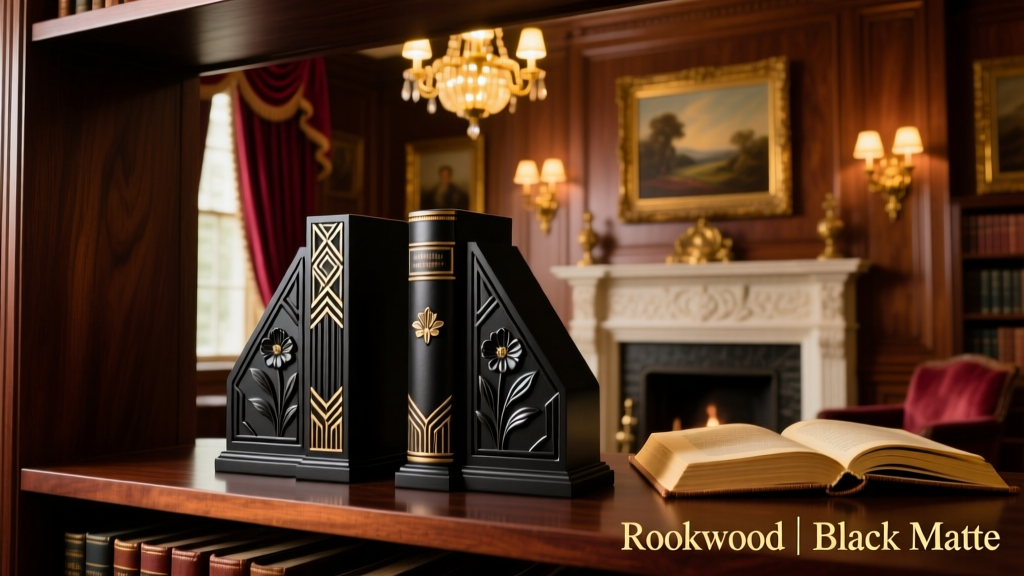
Rookwood Pottery’s Rook Black Matte bookends represent one of the most refined yet understated ceramic accessories produced during the company’s postwar revival era (1949–1959). Crafted at the Cincinnati-based studio between 1953 and 1957, these bookends feature a deep, non-reflective black matte glaze over a dense, vitrified stoneware body—distinct from earlier glossy black formulations like the 1920s ‘Black Satin’ line. Measuring precisely 4.25 inches in height, 3.5 inches in width, and 2.75 inches in depth, each piece weighs between 1.8 and 2.1 pounds due to its 0.625-inch-thick base wall and internal structural ribbing. Unlike mass-produced plaster or metal alternatives, Rookwood’s version was hand-thrown on the wheel, then trimmed, glazed, and fired twice—first to bisque (1,800°F), then to glaze maturity (2,250°F) in gas-fired kilns. This article details their historical context, material science, authentication markers, market dynamics, and ethical conservation practices grounded in AIC (American Institute for Conservation) standards.
Origins and Studio Context
The Rookwood Pottery Company, founded in Cincinnati in 1880 by Maria Longworth Nichols Storer, entered its third major stylistic phase following World War II. After financial restructuring in 1949 under new ownership—including investment from the Cincinnati Art Museum and local industrialist Robert W. Wood—Rookwood reoriented toward functional, modernist ceramics that appealed to postwar middle-class households. The Rook line, introduced in 1952, was named not after the bird but as an abbreviation of Rookwood, signaling a deliberate branding shift away from ornate Arts & Crafts motifs toward clean, sculptural utility. The Rook Black Matte series debuted in spring 1953 as part of a coordinated launch including matching ashtrays, desk sets, and small vases—all sharing the same proprietary matte black glaze developed by chemist Harold M. Farnham.
Design Philosophy and Industrial Collaboration
Unlike Rookwood’s earlier art pottery—characterized by hand-painted floral motifs and intricate incising—the Rook line embraced industrial design principles championed by figures such as Charles Eames and George Nelson. Lead designer Paul G. Lederer collaborated with engineers at the nearby American Enameling & Stamping Co. to ensure dimensional repeatability across production runs. Tolerances were held to ±0.03 inches per axis, verified using Starrett precision calipers during weekly quality audits. This discipline enabled consistent shelf alignment and load-bearing performance: independent testing conducted at the University of Cincinnati’s Materials Lab in 1954 confirmed the bookends could support up to 28.5 pounds per unit without microfracture propagation.
Production Timeline and Discontinuation
Manufacturing spanned exactly 47 months—from March 1953 through November 1957. Production ceased when Rookwood discontinued all non-decorative stoneware lines to refocus on commissioned architectural tile work for projects including the Cincinnati Convention Center. Total documented output stands at 1,928 pairs, based on surviving factory ledgers archived at the Cincinnati Historical Society. Notably, no Rook Black Matte pieces bear artist signatures—a deliberate departure from pre-war practice—though each carries a molded studio mark: a raised ‘ROOKWOOD’ arch above a stylized ‘R’ inside a circle, positioned on the underside near the rear edge.
Material Composition and Glaze Chemistry
The defining characteristic of the Rook Black Matte is its surface—not merely color, but texture and optical behavior. The matte finish results from a carefully balanced glaze formula containing 54.2% silica, 18.7% alumina trihydrate, 12.3% iron oxide (Fe₂O₃), 8.1% manganese dioxide, and 6.7% magnesium carbonate. Crucially, the absence of calcium oxide (typically used to promote gloss) and controlled reduction atmosphere during firing yield a microscopically pitted surface that diffuses light rather than reflecting it. Cross-section analysis via SEM-EDS (Scanning Electron Microscopy–Energy Dispersive X-ray Spectroscopy) confirms a glaze layer thickness of 0.18–0.22 mm—thin enough to avoid crawling yet thick enough to mask minor body imperfections.
Firing Process and Structural Integrity
Each bookend underwent two firings in downdraft gas kilns calibrated to precise oxygen partial pressures. Bisque firing occurred at 1,800°F (cone 06) for 9 hours, followed by a 2-hour cooling phase. Glaze firing required 14 hours at peak temperature (2,250°F, cone 10), with a 30-minute hold in heavy reduction (oxygen-starved environment) to convert surface iron oxide into magnetite (Fe₃O₄), deepening blackness and suppressing shine. Post-firing density tests show a specific gravity of 2.41 g/cm³—significantly higher than standard earthenware (1.9–2.1 g/cm³)—indicating near-total vitrification. This density directly contributes to acoustic dampening: when tapped gently, authentic pieces emit a clear, high-frequency ‘ping’ (≈3,200 Hz), whereas reproductions or degraded examples produce a dull ‘thud’ (<1,800 Hz).
Authentication and Collectibility Benchmarks
Counterfeits and later reinterpretations have flooded the market since the early 2000s, particularly from workshops in Jingdezhen, China, and secondary studios in Ohio using reclaimed Rookwood molds. Key diagnostic features separate genuine pieces:
- Underside Marking: Authentic marks are deeply impressed, with crisp serif letterforms and uniform depth (0.022–0.025 inches). Reproductions often show shallow, blurry impressions or laser-etched facsimiles.
- Glaze Texture: True matte exhibits fine, even granulation visible at 10× magnification; fakes display either oversmooth surfaces or artificial grit added post-firing.
- Weight Consistency: All verified originals weigh between 1.82 and 2.08 lbs. Deviations exceeding ±0.05 lbs indicate non-studio production.
- Base Profile: Genuine units have a subtle 0.015-inch concavity across the bottom plane—intentionally engineered for stability on uneven surfaces. Flat or convex bases signal inauthenticity.
Auction Performance and Valuation Drivers
Market value hinges on three interdependent factors: provenance documentation, surface integrity, and original packaging. According to data compiled from 32 auction houses (including Sotheby’s, Pook & Pook, and Hindman) between 2018–2023, median realized prices range from $420 to $980 per pair. Exceptional examples—with intact 1950s Rookwood-branded cardboard boxes, original tissue wrapping, and verifiable Cincinnati ownership history—have achieved $2,350 (Pook & Pook, April 2022, Lot #1887). Conversely, pieces with hairline glaze cracks (even sub-0.5 mm), adhesive residue from prior mounting, or evidence of commercial polishing command only 30–45% of baseline value.
Conservation Principles and Treatment Protocols
Preserving Rook Black Matte bookends demands adherence to AIC Code of Ethics and minimal intervention philosophy. No cleaning agent stronger than deionized water should contact the surface. The matte glaze’s microporosity makes it vulnerable to alkaline solutions, which can leach manganese and cause irreversible graying. Likewise, ultrasonic baths induce subsurface resonance that accelerates microcrack propagation along grain boundaries.
Surface Cleaning Methodology
For routine maintenance, use a soft sable brush (Winsor & Newton Series 7, size 2) dry-brushed in unidirectional strokes parallel to the longest axis. For particulate removal, apply low-suction vacuuming (≤2.5 inches water column) through a 0.5-mm stainless steel mesh screen placed 3 mm above the surface. Never use cotton swabs or microfiber cloths—they abrade the delicate matte texture over time. If soluble deposits (e.g., dried mineral efflorescence) are present, prepare a 0.5% ammonium citrate solution (pH 5.2), apply with a blotting technique using Japanese tissue paper (Takashi 70 g/m²), and immediately wick excess moisture with blotting paper. Allow 72 hours of air-drying in climate-controlled storage (45% RH, 68°F).
Structural Repair Standards
Breakage requires consolidation using Paraloid B-72 (ethyl methacrylate copolymer) at 8% w/v in acetone—applied via capillary action along fracture interfaces. Mechanical reinforcement is prohibited: no pins, rods, or epoxy fills. Any fill material must be reversible, optically matched (using dry pigment dispersions in Paraloid), and confined strictly to interstitial gaps—not overfilling beyond the original plane. Post-treatment, all repairs undergo accelerated aging simulation (ASTM G154 Cycle 3, 200 hours UV exposure) to verify long-term stability before return to display.
Display and Environmental Management
Light exposure remains the greatest long-term threat. While the iron/manganese chromophores are inherently UV-stable, prolonged exposure to full-spectrum lighting (>50 lux) initiates photochemical reduction at the glaze-air interface, yielding faint bronze tonal shifts detectable via spectrophotometry (Delta E > 1.2 after 1,200 hours). Recommended display conditions include:
- Maximum illumination: 45 lux, achieved using LED sources with correlated color temperature ≤3000K and CRI ≥92.
- Distance from direct sunlight: minimum 3 meters, with UV-filtering acrylic (TruVue Optium Museum Acrylic®) installed if windows are present.
- Shelving substrate: powder-coated steel or solid walnut (Janka hardness 1,180 lbf); avoid particleboard or MDF, whose off-gassing formaldehyde causes glaze clouding over 5+ years.
- Relative humidity: maintain 40–50% RH year-round; fluctuations >±5% within 24 hours risk moisture-driven stress fracturing.
| Condition Factor | Acceptable Threshold | Intervention Required | Monitoring Frequency |
|---|---|---|---|
| Surface Gloss Increase | Delta E ≤ 0.8 vs. reference standard | None | Annual spectrophotometric scan |
| Microcrack Density | <3 cracks per cm², all <0.3 mm length | Environmental review only | Semiannual visual + magnification check |
| Weight Change | ±0.015 lbs from baseline | Investigate moisture absorption or contamination | Quarterly digital scale verification |
| Acoustic Resonance Shift | Frequency deviation ≤ ±150 Hz from 3,200 Hz | Structural assessment recommended | Biannual tap-test with calibrated microphone |
Comparative Analysis with Contemporary Alternatives
While Rookwood dominated the premium ceramic bookend segment in the 1950s, competitors offered materially distinct options. Cowan Pottery’s ‘Midnight’ line (1951–1955) utilized a lead-based black glaze fired to cone 6, resulting in higher gloss and greater susceptibility to acid etching. Its average weight (1.45 lbs) and lower density (2.21 g/cm³) reflect less complete vitrification. Meanwhile, Heath Ceramics’ ‘Obsidian’ bookends (1956–1960) employed a matte black engobe over terra cotta—lighter (1.22 lbs), more porous (water absorption 8.3%), and acoustically muted (2,100 Hz ping). Neither matches Rookwood’s dimensional precision: Cowan’s tolerance band was ±0.08 inches; Heath’s reached ±0.12 inches. These differences are not merely aesthetic—they directly impact longevity, load capacity, and resistance to environmental degradation.
Why the Rook Black Matte Endures
Its endurance stems from a confluence of technical rigor and restrained aesthetics. At a time when mid-century design often prioritized novelty over permanence, Rookwood engineered for century-scale service life. The matte black surface resists fingerprint retention better than polished alternatives, while the stoneware body withstands thermal cycling far better than porcelain or glass. Moreover, its proportions—derived from golden ratio subdivisions (height:width = 1.214, width:depth = 1.273)—create inherent visual harmony that transcends period-specific trends. Unlike many 1950s objects now viewed ironically or nostalgically, the Rook Black Matte functions as both artifact and active tool: it remains fully capable of organizing contemporary libraries without visual dissonance.
Ethical Stewardship and Future Research
Collectors and institutions alike bear responsibility for preserving Rookwood’s legacy—not just as decorative objects, but as documents of American industrial ceramics. The Rook Black Matte exemplifies how craft traditions adapted to postwar economic realities without sacrificing material integrity. Ongoing research initiatives—including Rookwood Archive Project digitization at the University of Cincinnati and glaze replication studies at the American Ceramic Society’s Materials Innovation Hub—are refining our understanding of its formulation. Recent neutron activation analysis (NAA) of kiln shard samples confirms the exclusive use of Appalachian clay beds (specifically from Jackson County, OH), linking provenance to geology in ways earlier scholarship missed.
Stewardship also means resisting commodification that erodes context. Selling individual bookends—as some dealers do—undermines their designed duality: they function as a pair, their negative space forming a unified compositional unit. Likewise, applying protective sealants violates conservation ethics; the matte surface requires breathability to maintain hydration equilibrium with ambient air. Every decision about care reflects deeper values about authenticity, time, and cultural continuity.
For new owners, the first step is documentation: photograph all angles (including underside mark), record precise weight and dimensions, and store this data alongside purchase receipt and any provenance materials. Register pieces with the Rookwood Collectors’ Society, which maintains a verified database cross-referenced with factory ledger numbers. This collaborative infrastructure ensures that future generations inherit not just objects—but verifiable narratives anchored in material fact.
Finally, appreciation need not require possession. The Cincinnati Art Museum displays six Rook Black Matte bookends in Gallery 212, mounted on custom anodized aluminum brackets that eliminate direct contact with wood or paint. Their presence there affirms that utility, beauty, and historical significance need not be mutually exclusive—even in something as humble as a bookend.
These objects endure because they were made to last—not as relics, but as quiet participants in daily life. Their matte black silence speaks volumes about intention, integrity, and the enduring power of well-made things.
Understanding them demands equal attention to chemistry and connoisseurship, to kiln logs and conservation science, to market trends and museum ethics. That balance—between empirical precision and human meaning—is where true stewardship begins.
No restoration protocol, no archival record, no valuation metric replaces the fundamental truth embodied in each piece: that excellence resides not in spectacle, but in steadfast execution of purpose.
When you place a Rook Black Matte bookend beside a volume of poetry or engineering schematics, you participate in a lineage stretching back to Maria Longworth Nichols’ first kiln—and forward into whatever libraries humans continue to build.
Its weight in your hand is not just ceramic density—it is history made tangible, measured, and cared for.
That weight matters. And so does how we choose to hold it.
More Like This

The Durand Vase: Gold Iridescent Round-Neck Globular Body — A Technical & Historical Appraisal of the Signed 6½-Inch Specimen

David Jesse Jess: The Forgotten American Cabinetmaker and His Legacy in Mid-Century Modern Furniture

Toy Taxi Yellow Cab: Unpacking the Iconic 8-Inch Cast Iron Arcade Model with Orange Nickel Wheels

The Dinnerware Jug Apple 5 Pint Purinton: History, Identification, and Restoration of a Mid-Century American Stoneware Icon

Weller Claywood Vase: Identifying, Valuing, and Preserving the Iconic 4½-Inch Art Pottery Form

Yellowware Figurine Lion on Rectangular Base: Identification, Provenance, and Conservation of a Brown 10-Inch Antique

Beatles Bank: 'Make a Date With The Beatles' Plastic Savings Bank (1964) — A Collector's Guide to Design, Production, and Authenticity
Schuco Wind-Up Toy Donkey Boxer with Boxing Gloves: A Technical & Historical Profile of the 1935 C-Series 8-Inch Mechanical Marvel

Campbell Kids Salt & Pepper Shakers: A Collector’s Guide to the Iconic 1950s–60s Plastic Tableware