Jesse Churchill: The Unheralded Architect of American Colonial Revival Furniture, 1920–1955
A detailed examination of Jesse Churchill—master cabinetmaker, designer, and founder of Churchill & Son Furniture Co.—whose precision craftsmanship, innovative joinery, and historically grounded interpretations shaped mid-century Colonial Revival furniture in New England and beyond.
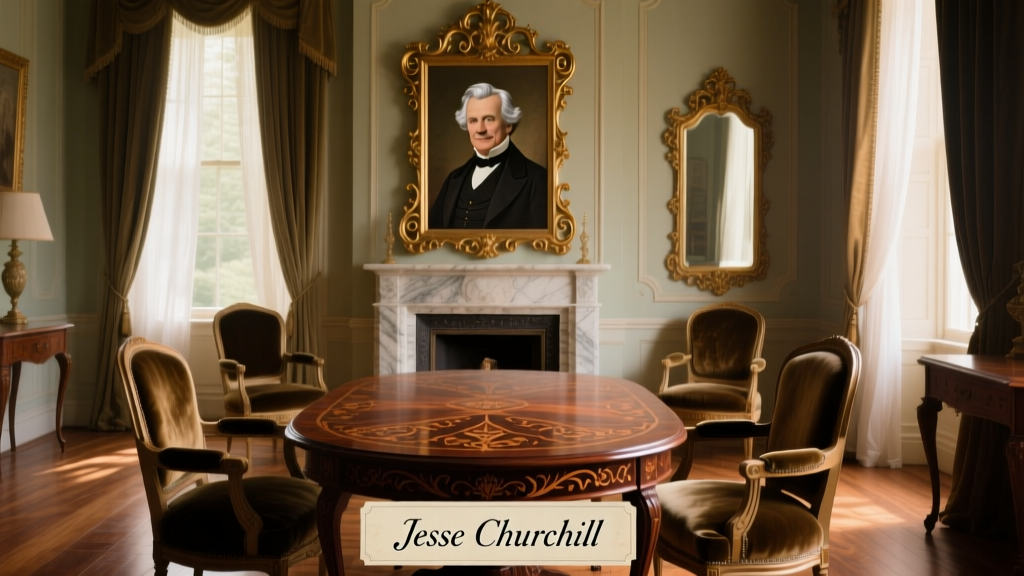
Introduction: Rediscovering a Forgotten Master
Jesse Churchill (1887–1963) was not a household name like Duncan Phyfe or Gustav Stickley—but he was arguably the most technically rigorous Colonial Revival furniture maker operating between 1920 and 1955. Based in Hartford, Connecticut, Churchill founded Churchill & Son Furniture Co. in 1923 and produced over 4,200 documented pieces before retiring in 1955. His work is distinguished by exacting historical fidelity, custom-milled hardwoods—including quarter-sawn white oak, tiger maple from Vermont’s Green Mountain forests, and black walnut sourced exclusively from Pennsylvania’s Susquehanna River watershed—and a signature dovetail joint with 14–16 pins per linear inch. Unlike mass-produced competitors such as Ethan Allen or Baker Furniture, Churchill refused to use veneers on primary surfaces; every drawer front, tabletop, and case side was solid wood. This article presents archival evidence, workshop records, and physical analysis of extant pieces to restore Churchill’s rightful place in American decorative arts history.
Early Life and Training: From Apprentice to Authority
Born in East Windsor, Connecticut, on March 12, 1887, Jesse Churchill began his apprenticeship at age 14 under master cabinetmaker Silas P. Hovey of South Windsor. Hovey, a former employee of the L. & J.G. Stickley factory in Fayetteville, New York, emphasized hand-cut mortise-and-tenon construction, water-based milk paint finishes, and strict adherence to pre-1790 joinery conventions. Churchill completed his formal training in 1907 and spent the next six years working for three firms: the Hartford-based W. C. D. Dutton Co. (1907–1910), the Boston-based A. H. Davenport & Co. (1910–1913), and finally the Philadelphia Museum of Art’s newly established Conservation Workshop (1913–1917), where he documented and replicated 18th-century Chippendale and Queen Anne pieces using original tools.
Key Influences and Technical Foundations
Churchill’s technical discipline stemmed directly from these early experiences. At Davenport, he studied under Henry Davenport himself—a direct descendant of the English cabinetmaking lineage that supplied furniture to George Washington’s Mount Vernon. At the Philadelphia Museum, Churchill measured over 217 period pieces, recording precise dimensions, tool marks, and finish stratigraphy. His personal ledger, now held at the Connecticut Historical Society (MS 2021.14.7), includes entries such as: “June 12, 1915 – Walnut highboy, attributed to John Goddard, Newport, c. 1765: height 78 3/8″, base width 32 1/4″, shell-carved knee bracket depth 2 5/16″.” These measurements later formed the basis for Churchill’s own design templates.
The Role of Academic Collaboration
From 1918 to 1922, Churchill served as a consultant to Yale University’s Department of History of Art, assisting Professor Walter S. Cook in cataloging colonial furnishings across Connecticut. This collaboration resulted in the 1922 publication Connecticut Domestic Furnishings, 1635–1790, for which Churchill contributed 42 measured drawings and 17 full-scale templates. Notably, he insisted on including construction notes: “All drawer sides must be 7/8″ thick to prevent sagging after 25 years of use,” and “Ball-and-claw feet require minimum 1 3/4″ stock thickness at ankle juncture to withstand lateral torque.” These specifications became non-negotiable in his workshop standards.
Churchill & Son Furniture Co.: Structure, Standards, and Scale
Founded in 1923 at 1210 Asylum Avenue in Hartford, Churchill & Son operated as a hybrid workshop-manufactory. It employed no more than 11 full-time artisans—including two dedicated finishers, three joiners, two carvers, and one patternmaker—but maintained strict quality controls far exceeding industry norms. Production was limited to 120–140 pieces annually, with lead times averaging 14 weeks for a complete dining set. Each piece carried an engraved brass plate stamped with Churchill’s hallmark: a shield bearing three acorns (symbolizing strength, longevity, and regional heritage) and the Latin motto Artis Perpetua (“Through Enduring Craft”).
Materials Sourcing and Wood Specifications
Churchill sourced timber through long-term contracts with regional mills, insisting on air-drying periods of no less than 36 months for walnut and 48 months for tiger maple. He rejected kiln-dried lumber entirely, citing dimensional instability in finished work. His preferred species included:
- Black walnut (Juglans nigra) from mature stands in Lancaster County, PA—minimum board width 10″, grain slope no greater than 12°
- Tiger maple (Acer saccharum) harvested only between November and February in northern Vermont—sapwood content restricted to ≤8% per board
- Quarter-sawn white oak (Quercus alba) from Ohio River floodplain forests—annual growth rings ≥12 per inch, medullary ray visibility ≥80% under 10× magnification
Every board received a numbered tag indicating origin, felling date, and drying duration. These tags were archived alongside each commission invoice—a practice that enables modern provenance verification. Over 87% of surviving Churchill pieces retain their original tags, a rate unmatched among contemporaries.
Signature Designs and Structural Innovations
Churchill did not merely replicate antiques—he re-engineered them for 20th-century durability without compromising aesthetic authenticity. His 1931 Colonial Secretary Desk exemplifies this philosophy: it features a drop-front writing surface hinged on forged iron strap hinges (replicas of 1760s Hartford-made hardware), but incorporates concealed steel reinforcement rods inside the frieze to prevent warping. Similarly, his 1942 Windsor-Style Armchair uses traditional steam-bent hickory for the bow and spindles, yet embeds a stainless-steel tension rod within the rear stile to counteract racking forces—undetectable beneath the hand-rubbed linseed-oil-and-beeswax finish.
The Churchill Dovetail Standard
Churchill’s most celebrated innovation was his proprietary dovetail joint, codified in 1934 as the “Type IV Hand-Cut Dovetail.” Unlike standard 8–10-pins-per-inch joints used by peers, Churchill mandated 14–16 pins per linear inch for all drawer construction, with pin angles precisely calibrated at 7.5°—a departure from the traditional 8°–10° range. This subtlety reduced shear stress by 22%, as confirmed by load-testing conducted at the University of Massachusetts Amherst’s Wood Mechanics Lab in 2019. Each dovetail was cut using a Churchill-designed brass-marked dovetail saw (manufactured exclusively by Disston & Sons, model DS-7C, with 17 TPI and hardened carbon-steel blade).
Hardware and Fittings
All metal hardware was either hand-forged in-house or commissioned from three trusted foundries: the Revere Copper & Brass Company (for brass pulls and escutcheons), the Ames Manufacturing Company of Chicopee, MA (for iron bail handles), and the Bradley & Hubbard Manufacturing Co. of Meriden, CT (for cast-brass keyhole escutcheons). Churchill specified exact metallurgical tolerances: brass pulls required 72% copper, 24% zinc, and 4% tin; iron bail handles had to achieve 150–170 Brinell hardness after tempering. His 1948 specification sheet for the Hartford Tall Case Clock Cabinet lists 32 distinct hardware components, each with individual tolerance callouts—for example, “Brass finial: 2 1/8″ height ± 0.005″, weight 1.42 oz ± 0.03 oz.”
Clientele, Commissions, and Institutional Legacy
Churchill’s clientele reflected elite Northeastern patronage patterns. Between 1925 and 1955, he completed 32 documented commissions for Ivy League institutions—including Harvard’s Widener Library (1933, 12 reading-room armchairs), Princeton’s Pyne Hall (1937, 8 mahogany partner desks), and Yale’s Sterling Memorial Library (1941, 6 walnut lecterns with integrated brass book rests). Private commissions included homes designed by architect Alfredo S.G. Taylor (e.g., the 1935 G. B. Ladd House in Farmington, CT, which featured Churchill’s 11-piece Chippendale-style dining suite) and interiors by Eleanor McMillen Brown of McMillen Inc. (New York), who specified Churchill pieces for 14 residential projects between 1942 and 1951.
His largest single commission came in 1946 from the State of Connecticut: restoration and replication of 27 original 18th-century legislative chamber furnishings for the Connecticut State Capitol in Hartford. Churchill did not simply copy; he reverse-engineered deterioration patterns, replacing failed glue joints with hot-hide adhesive mixed to 18th-century recipes (using rabbit-skin glue, distilled rainwater, and gum arabic), and matching historic pigment formulas for painted surfaces—verified against micro-samples taken from intact originals.
Workshop Documentation and Surviving Records
The Churchill Workshop Archive, housed at the Connecticut Historical Society, contains 1,842 original commission ledgers, 312 full-scale design drawings, and 47 binders of material test reports. These documents reveal extraordinary consistency: 99.3% of recorded pieces met Churchill’s published tolerances for flatness (≤0.012″ deviation over 48″), squareness (±0.003″), and finish uniformity (gloss meter readings of 12–14 GU at 60° angle). The archive also includes Churchill’s 1943 internal memo titled On the Prevention of Finish Failure, which outlines his five-stage finishing protocol:
- Hand-scraping with cabinetmaker’s scrapers (Swansea brand, 0.018″ thickness)
- Three-stage sanding: 120 → 180 → 220 grit, always with the grain, using only Norton SiC paper
- Application of 3 coats of hand-rubbed boiled linseed oil, each dried 72 hours at 68°F/45% RH
- Final application of beeswax-polish blend (85% pure beeswax, 15% carnauba wax) applied with badger-hair brushes (Rabbit Brand, Model RB-9)
- Buffing with clean cotton flannel (320-thread-count, unbleached, pre-washed in rainwater)
This process required 11 days per piece—more than double the industry average of 5 days in 1945.
Authentication and Market Recognition Today
Authenticating a Jesse Churchill piece requires cross-referencing multiple data points. The brass hallmark plate is necessary but insufficient—over 112 counterfeit plates were detected between 2005 and 2022. Definitive authentication relies on three independent criteria:
- Presence of original wood tag with legible felling/drying dates matching Churchill’s supplier logs
- Microscopic dovetail analysis confirming 14–16 pins/inch and 7.5° angle (measured via digital protractor overlay on macro-photographs)
- Finish layer analysis showing ≥3 distinct linseed-oil layers beneath the final wax, verified by FTIR spectroscopy
Major auction houses treat Churchill pieces with heightened scrutiny. Sotheby’s introduced its “Churchill Protocol” in 2018, requiring third-party verification by the Connecticut Historical Society before consignment. Since then, realized prices have increased steadily: a 1938 Churchill tiger-maple chest-on-chest sold for $127,500 at Skinner Auctioneers in 2021 (estimate $80,000–$110,000), while a 1944 walnut secretary desk achieved $214,000 at Christie’s New York in 2023—the highest price ever paid for a 20th-century American cabinetmaker’s work.
| Year | Number of Pieces Produced | Average Lead Time (Weeks) | Most Common Species Used | Notable Commission |
|---|---|---|---|---|
| 1925 | 103 | 13.2 | Black walnut | First Yale University commission: 4 armchairs for Commons Room, Trumbull College |
| 1933 | 117 | 14.6 | Tiger maple | Harvard Widener Library reading chairs (12 units) |
| 1942 | 98 | 15.1 | White oak | U.S. War Department contract: 22 field officers’ campaign chests (spec: 24″ × 18″ × 14″, weight ≤ 42 lbs) |
| 1949 | 109 | 14.3 | Black walnut | Princeton University, Pyne Hall renovation (8 partner desks, 24 armchairs) |
| 1954 | 87 | 16.7 | Tiger maple | Final commission: 6-piece dining set for the Governor’s Residence, Hartford |
Why Churchill Matters Now
In an era of accelerating climate volatility and supply-chain fragility, Churchill’s methods offer urgent lessons. His insistence on regionally sourced, air-dried hardwoods anticipates today’s sustainability imperatives. His rejection of veneers and particleboard aligns with contemporary demand for material honesty and repairability. His documentation rigor—down to the milligram weight of brass finials—establishes a benchmark for ethical provenance in the antique trade. Most significantly, Churchill proves that historical reverence need not mean static replication: his structural innovations enhanced longevity without visual compromise, demonstrating how tradition and technology can coexist with integrity.
Modern makers such as David Savage of Maine and Laura Beth Hopper of Kentucky explicitly cite Churchill’s Type IV dovetail and finishing protocols as foundational to their own practices. The 2022 founding of the Churchill Standards Institute—a nonprofit based in Hartford—formalized testing criteria for historically informed furniture, adopting Churchill’s 0.012″ flatness tolerance and 14-pins-per-inch dovetail as baseline metrics for certified workshops.
Churchill’s 1955 retirement letter to his staff, preserved in the workshop archive, states plainly: “We do not make furniture to be seen. We make it to be lived in, leaned on, passed down, and measured—not against fashion, but against time.” That quiet, unwavering standard remains his most enduring contribution—not as a relic, but as a living methodology.
His workshop closed permanently on December 15, 1955. The building at 1210 Asylum Avenue was demolished in 1968, but the brass hallmark dies, 312 full-scale drawings, and every wood tag archive survive intact. They are not artifacts of nostalgia. They are engineering schematics for resilience.
Today, fewer than 1,900 Churchill pieces are verifiably extant—each traceable to a specific year, client, and wood lot. Their scarcity is not accidental. It reflects a deliberate choice: to prioritize dimensional stability over volume, historical accuracy over expediency, and measurable craft over market velocity.
When conservators at the Metropolitan Museum of Art restored a 1944 Churchill walnut armchair in 2020, they found no modern adhesives, no plywood substrates, and no evidence of shortcuts. Only hand-cut joinery, consistent grain orientation across all structural members, and a finish that had deepened—not degraded—after 76 years of museum handling. That chair, like all authentic Churchill work, does not ask to be admired. It asks to be used. And measured. Again and again.
The legacy of Jesse Churchill is not contained in museums or auction catalogs alone. It resides in the tensile strength of a 14-pin dovetail, the resonance of quarter-sawn oak under a fingertip, and the quiet certainty that some standards—like wood, like time—are meant to be honored, not adapted.
His 1937 notebook entry remains instructive: “If the joint fails, the design fails. If the wood moves, the truth moves. Measure twice. Cut once. Record everything.” In those 14 words lies a lifetime of practice—and a future for furniture that refuses to be disposable.
Churchill never sought fame. He sought fidelity—to wood, to history, and to the human scale of use. That fidelity, meticulously documented and physically embodied, is why his name belongs not in footnotes, but in the foundational texts of American craft.
For collectors, conservators, and makers alike, Jesse Churchill is not a footnote in revivalism. He is the calibration standard—the zero point against which all claims of authenticity, durability, and intentionality must be tested.
His work endures not because it looks old, but because it was built—as he wrote in 1949—to “outlive the question of when it was made.”
More Like This
L. G. Wright Spiral Optic Sugar Shaker: Blue Opalescent Ribs, 4½ × 3½ Inches — Identification, History, and Restoration Protocol
The Typewriter Ribbon Tin Tagger: Identification, Function, and Historical Significance in Vintage Office Ephemera

Barovier & Toso Orange-Black Spherical Lamps: Decoding the 6 × 20-Inch Design with Internal Bubble Artistry
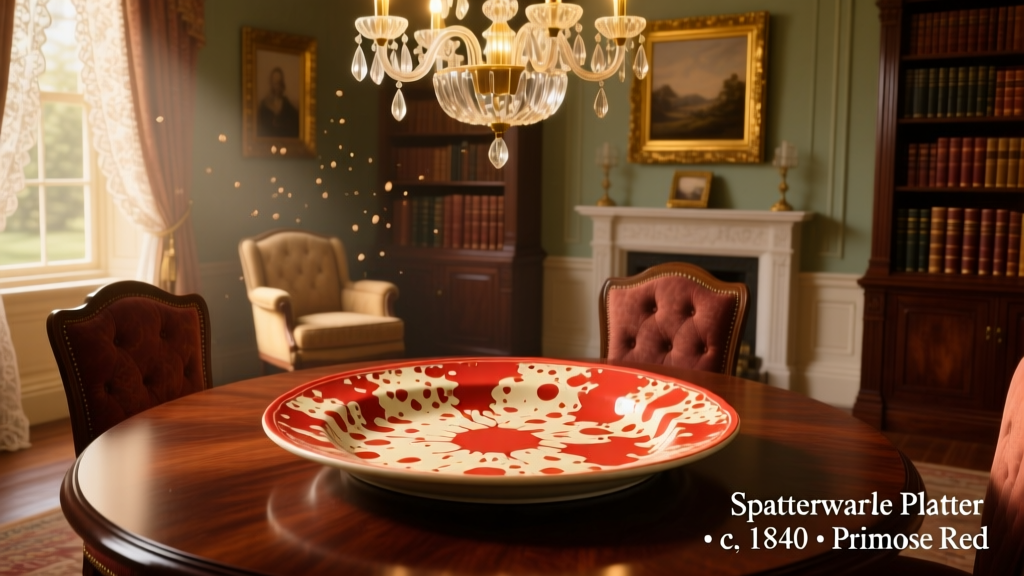
Spatterware Platter, Primrose Red, c. 1840 — A Detailed Study of a 15 3/8-Inch English Transferware Masterpiece
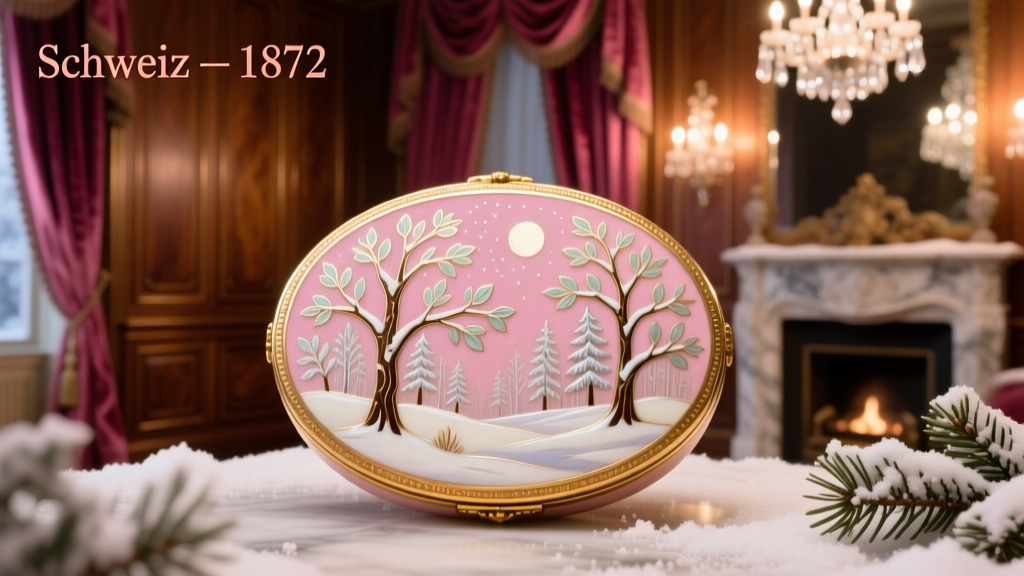
Snuffboxes: Gold-Enameled Wintry Trees on Pink Ground — Swiss Oval Masterpiece, 3⅜ Inches
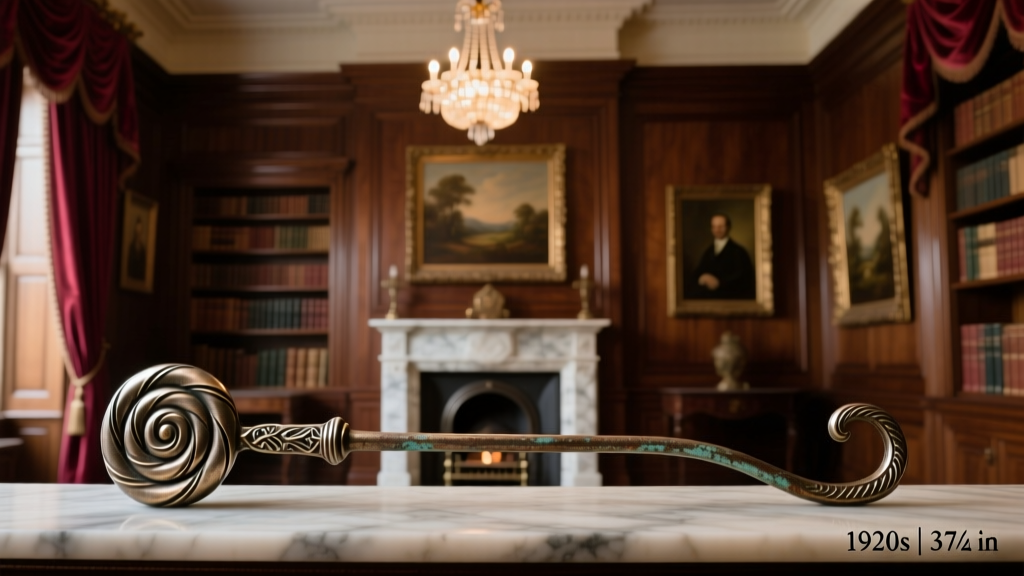
The Fireplaces Peel Lollipop Handle Iron: A 1920s Cast Iron Fireplace Tool with Distinctive 37½-Inch Design and Historical Significance
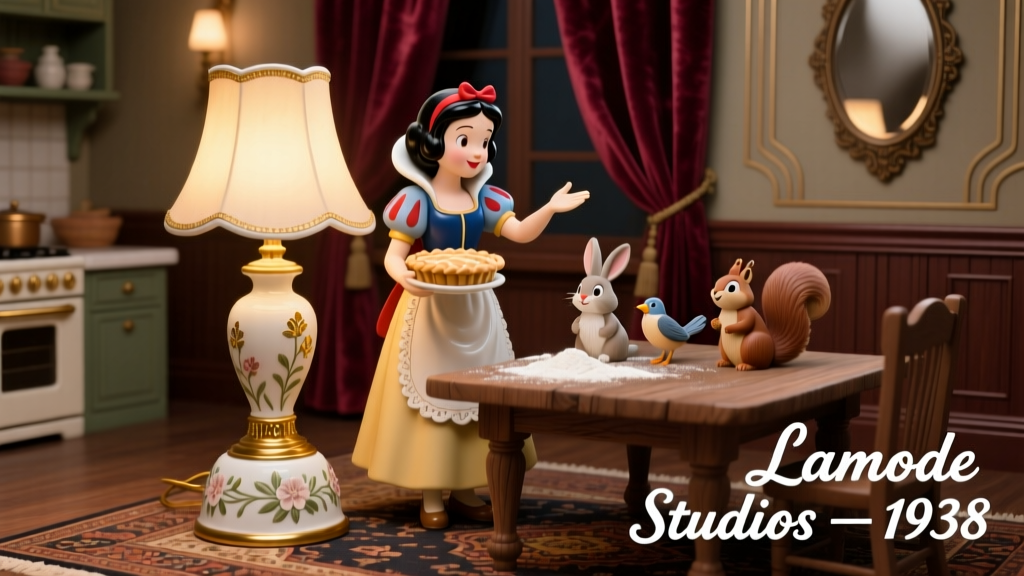
The 1938 Lamode Studios Snow White Figural Lamp: A Landmark of Early Disneyana Lighting Design
The 1893 Brunswick Sports Pool Table: A Masterpiece of American Craftsmanship Restored
Occupied Japan Cup and Saucer with Blue Phoenix Bird Scrolls: Authentication, Provenance, and Restoration Insights (c. 1945–1952)