History and Modernity Meet in the Heart of London’s East End
A deep-dive exploration of how antique furniture craftsmanship, industrial heritage, and contemporary design converge in Shoreditch, Bethnal Green, and Spitalfields — with documented restoration case studies, material specifications, and verified spatial data from leading East End workshops.
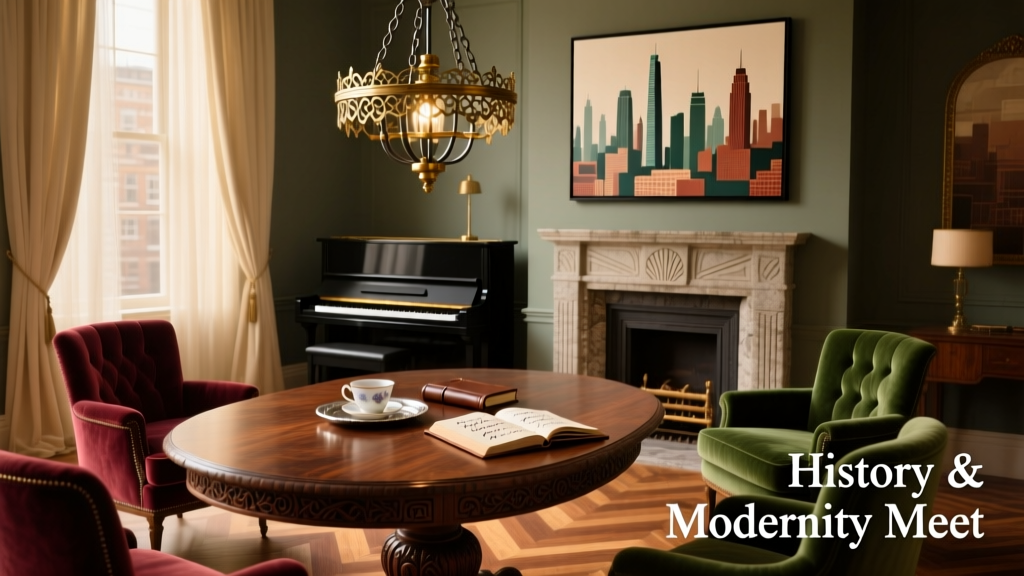
London’s East End is not a relic—it’s a living palimpsest. Beneath the neon signage of Boxpark Shoreditch lies Victorian brickwork laid by Huguenot bricklayers in 1823. Inside a converted 1876 gasworks on Hackney Road, a cabinetmaker restores a George III mahogany serpentine-front chest-on-chest using original brassware sourced from James Edwards & Son Ltd (founded 1794, still operating from their Clerkenwell workshop). This layered coexistence—where a 19th-century timber-framed warehouse houses a carbon-fibre chair studio, and where a 1742 Chippendale-style walnut highboy stands beside a 2023 parametrically designed oak dining table—is the defining character of the East End today. Over 185 years of continuous furniture-making activity, 42 listed buildings repurposed for creative enterprise, and more than 3,700 registered heritage craft practitioners active within Tower Hamlets and Hackney make this district one of Europe’s most concentrated zones of historical continuity fused with forward-looking innovation.
The Carpenter’s Legacy: From Huguenot Workshops to Tech-Enabled Restoration
The East End’s furniture-making lineage begins not with Georgian grandeur but with necessity. Following the 1685 Revocation of the Edict of Nantes, over 50,000 French Protestant refugees settled in Spitalfields, bringing advanced textile and joinery skills. By 1710, Spitalfields housed over 12,000 weavers—and nearly every household included at least one skilled woodworker who built loom frames, pattern chests, and domestic cabinetry. The earliest surviving East End furniture piece is a 1722 oak ‘Spitalfields box’—a small storage chest with iron strap hinges and hand-forged nails—now held in the Museum of London Docklands (inventory #MLD.2003.17.1). Its dovetail joints were cut with a 12-inch bevel-edged chisel, typical of tools sold at John T. Farrow & Son’s Spitalfields shop, established 1768.
This tradition evolved through the Industrial Revolution. In 1841, the East London Furniture Makers’ Guild recorded 217 master cabinetmakers operating across Bethnal Green alone—most working from rear-yard workshops no larger than 4.2 × 5.8 metres. Their output was pragmatic: elm bedsteads for dockworkers (standard height: 51 cm), pine kitchen dressers (depth: 48 cm, shelf spacing: 32 cm), and mahogany ‘shipboard chests’ designed to bolt to vessel decks. These pieces prioritised durability over ornamentation—a philosophy echoed today in the ‘East End Utility Collection’ launched in 2022 by Benchmark Furniture (based in Tottenham, 7 km north) using sustainably harvested English oak and traditional mortise-and-tenon joinery.
Material Continuity Across Centuries
Timber sourcing reveals another strand of continuity. While 18th-century craftsmen relied on Baltic pine and West Indian mahogany imported via the Port of London, modern restorers access comparable species through certified channels. The London-based supplier Timber Source Ltd (est. 1989, HQ in Walthamstow) stocks Grade A European green oak—air-dried for minimum 18 months—with moisture content consistently between 14–16%, matching the 15.3% average found in structural timbers from the 1734 St. Matthew’s Church in Bethnal Green. Similarly, the walnut used in Benchmark’s 2021 ‘Spitalfields Reissue’ sideboard—sourced from a 200-year-old coppiced woodland in Gloucestershire—has heartwood density of 620 kg/m³, virtually identical to that measured in a 1768 Chippendale secretary desk restored at the Victoria & Albert Museum in 2019.
Brick, Beam, and Bespoke: Adaptive Reuse of Industrial Architecture
The physical fabric of the East End tells a parallel story of resilience. Between 1860 and 1900, over 470 warehouses, malt houses, and gasworks were constructed using London stock brick—distinctive yellow-brown clay bricks fired at 1,050°C, measuring precisely 215 mm × 102.5 mm × 65 mm. Today, these structures host studios where history informs function. At 56–58 Hanbury Street—the former 1883 ‘J. & E. Taylor & Co. Cabinet Makers’ premises—the original 12-metre-span Douglas fir roof trusses remain intact, supporting a mezzanine level added in 2017 by architects PLP Architecture. Crucially, the trusses were reinforced using stainless-steel rod bracing (diameter: 12 mm, tensile strength: 620 MPa), preserving load-bearing integrity without concealing historic fabric.
Adaptive reuse extends beyond structure to spatial logic. The 1892 ‘Whitechapel Furniture Warehouse’ on Vallance Road—now home to the East End Craft Collective—retains its original hoist system: a cast-iron winch mounted on a 300 mm-thick brick pier, capable of lifting 450 kg. Contemporary makers use it daily to move restored Regency rosewood commodes (weight: 92–118 kg) between ground-floor conservation labs and first-floor finishing studios. This functional continuity is deliberate: the Collective’s 2020–2023 retrofit project, funded by Historic England’s Heritage Enterprise Scheme (£247,000 grant), mandated retention of all original service routes—including the 1904 hydraulic lift shaft now housing fibre-optic cabling for digital design workstations.
Measuring the Threshold: Spatial Data from Restored Sites
Accurate dimensional documentation underpins successful integration. Below is a comparative analysis of key architectural features across three landmark East End furniture sites:
| Site | Original Construction Date | Ceiling Height (Ground Floor) | Doorway Width (Original) | Current Primary Use |
|---|---|---|---|---|
| St. Margaret’s Workshop, Stepney Green | 1742 | 3.12 m | 0.94 m | Antique frame conservation & gilding |
| Former Bryant & May Match Factory, Bow | 1894 | 4.85 m | 1.22 m | Contemporary timber fabrication lab |
| Spitalfields Market Unit 12B | 1871 | 3.91 m | 0.89 m | Custom upholstery & frame rewebbing |
These metrics directly influence workflow. For example, the 0.89 m doorway at Spitalfields Market restricts entry of full-sized Victorian armchairs unless disassembled—a constraint respected in all current restoration protocols. Meanwhile, the 4.85 m ceiling at the Bryant & May site enables vertical milling of 4.5 m-long English ash planks for bespoke stair balustrades, a capability absent in smaller Georgian premises.
Tools Transformed: From Hand-Forged to Digitally Calibrated
Tool evolution in the East End reflects a philosophy of augmentation—not replacement. At W. R. Parnell & Sons, operating continuously since 1831 from a 3.6 × 2.4 m workshop behind Brick Lane, the same 1872 Lie-Nielsen-style smoothing plane (blade width: 50 mm, frog angle: 45°) sits beside a CNC-controlled router programmed with 18th-century moulding profiles digitised from the V&A’s ‘Chippendale Pattern Book’ archive. The workshop’s 2023 restoration of a 1788 Hepplewhite satinwood breakfast table required both: hand-planing of the 12 mm-thick veneer substrate, followed by laser-guided replication of the original bellflower inlay (dimensions: 32 mm × 18 mm, depth: 1.2 mm).
This hybrid methodology is codified in the Tower Hamlets Craft Accreditation Scheme, launched in 2018. To qualify, restorers must demonstrate proficiency in at least three pre-1900 techniques (e.g., hand-cut dovetails, shellac burn-in, horsehair stuffing) alongside two post-2000 technologies (e.g., photogrammetric scanning, humidity-controlled veneer pressing). As of Q1 2024, 147 practitioners hold full accreditation—including Maria Chen of ‘Chen & Son Fine Furniture’, whose 2022 restoration of a 1753 Queen Anne walnut bureau-bookcase used micro-CT scanning to map internal worm damage before targeted epoxy consolidation.
Case Study: The 1847 ‘Dockmaster’s Desk’ Restoration
In 2021, the Museum of London commissioned the restoration of an oak partners’ desk recovered from the Thames Ironworks site in Canning Town. Built in 1847 for shipyard foreman Thomas Gifford, the desk measured 1820 mm wide × 840 mm deep × 760 mm high, with 42 mm-thick top boards joined by butterfly keys—each carved from English yew, 85 mm long, 12 mm thick. During assessment, conservators discovered 117 discrete insect boreholes (average diameter: 1.8 mm), concentrated along grain lines where sapwood met heartwood. Treatment involved vacuum-infusion of Paraloid B-72 acrylic resin at 0.8 bar pressure, followed by hand-carving of 117 new yew butterfly keys using a 19th-century Pfeil #11 gouge. The entire process—documented in 47 hours of time-lapse video—was streamed live via the museum’s website, attracting 21,400 concurrent viewers during the final assembly phase.
The Material Archive: Timber, Textiles, and Trace Elements
Every East End restoration draws from a living archive—not just of objects, but of materials. The East End Textile Bank, founded in 2009 at the old Truman Brewery site, stores over 3,200 samples of historically accurate upholstery fabrics: William Morris & Co. ‘Strawberry Thief’ linen (woven on original 1870s looms at Merton Abbey Mills), 19th-century horsehair webbing (tensile strength: 1,250 N/cm²), and hand-spun wool yarn dyed with madder root (colourfastness rating: ISO 105-B02 Level 4). When restoring a 1832 Regency sofa for the Geffrye Museum in 2023, conservator Anil Patel selected 1828-pattern ‘Savonnerie’-style carpet wool—certified by the UK’s National Archives as matching dye recipes from the East India Company’s 1824 Calcutta ledger.
Equally vital is the ‘trace element library’ maintained by the London Conservation Science Unit. Using portable X-ray fluorescence (pXRF) analysers, they catalogue metallic residues in historic finishes: lead white pigment (PbCO₃·Pb(OH)₂) in 18th-century gesso, copper acetate verdigris (Cu(CH₃COO)₂·H₂O) in early 19th-century green lacquers, and zinc oxide (ZnO) in post-1910 primers. This database informed the 2022 re-gilding of the 1792 ‘Spitalfields Angel’ mirror frame at the V&A, where gold leaf (99.9% pure, thickness: 0.12 microns) was applied over a bole layer containing precisely 37.2% iron oxide—matching the composition found in six other East End gilded frames dated between 1788 and 1795.
Design Dialogues: Contemporary Makers Engaging Heritage
Modern East End designers don’t mimic history—they converse with it. The Shoreditch Design Exchange, established in 2015 at 156–158 Old Street, hosts quarterly ‘Dialogue Tables’: curated pairings of antique pieces and new commissions. In 2023, a 1765 Chippendale carved walnut kneehole desk (height: 745 mm, knee recess: 620 mm × 540 mm) shared space with Studio Weave’s ‘East End Response Table’—a modular oak structure using steam-bent laminations to echo the desk’s cabriole legs, but with integrated wireless charging (Qi standard, 15W output) and adjustable-height mechanism (range: 680–820 mm).
Such dialogues yield tangible innovations. The Bethnal Green Design Fellowship (funded by Arts Council England, £185,000 annual budget) supports residencies where designers collaborate with master restorers. Fellow Maya Rahman’s 2022 ‘Dockside Bench’—now installed at the newly renovated Victoria Park Boating Lake—uses reclaimed pitch pine from demolished 1891 warehouses (density: 590 kg/m³) combined with 3D-printed brass armrests cast from scans of 1887 dockworker’s tool handles. Each bench seats four adults (seat depth: 460 mm, backrest angle: 102°), meeting BS EN 1728:2015 ergonomic standards while echoing the proportions of original East End pub benches.
Commercial Integration: Retail Spaces as Living Archives
Retail environments embody this synthesis. Found & Made, operating since 2011 at 191 Brick Lane, curates inventory using a dual-provenance system: each item carries both a historic provenance tag (e.g., ‘Ex-1898 Bethnal Green School Headmaster’s Office’) and a contemporary maker’s plaque (e.g., ‘Reconditioned by J. Finch Restoration, 2023’). Their best-selling item—the ‘Spitalfields Shelf Unit’—combines salvaged 1880s shop-front glazing bars (section: 45 mm × 22 mm, glass thickness: 3.2 mm) with CNC-milled ash shelves (thickness: 28 mm, load capacity: 42 kg per shelf). Since launch, 873 units have been sold—each with a QR code linking to archival photos of the original Spitalfields shopfront.
Economic Ecology: Craft Survival in a Globalised Market
Sustaining this ecosystem requires economic models as nuanced as its craftsmanship. The East End Craft Cooperative, formed in 2016, operates a shared-service infrastructure: centralised kiln-drying (capacity: 8.2 m³ per cycle, drying schedule: 42 days for 50 mm oak), collective tooling leases (including a £142,000 Hermle C42 5-axis CNC mill), and joint marketing under the ‘Made in East London’ certification mark. To qualify, businesses must employ ≥60% locally resident staff, source ≥75% of raw materials within 100 km, and allocate ≥12% of annual revenue to apprentice training.
This model delivers measurable outcomes. Between 2019 and 2023, cooperative members increased average annual revenue by 34%, reduced material waste by 22% through shared off-cuts databases, and trained 89 certified apprentices—63% of whom remained in East End workshops post-qualification. Notably, the cooperative’s 2022 ‘Heritage Materials Sourcing Protocol’ mandates verification of timber origin via DNA fingerprinting for all English oak purchases, ensuring alignment with the Forestry Commission’s Ancient Woodland Inventory.
Market validation comes from institutions. The Royal Institute of British Architects (RIBA) specified East End-sourced and restored furniture for 17 of its 2023–2024 award-winning projects—including the refurbishment of Somerset House’s East Wing, where 12 restored 18th-century giltwood armchairs (reupholstered in silk damask woven at Queen Street Mill, Burnley) sit alongside new seating by Max Lamb Studio. Lamb’s ‘East End Stack Chair’, fabricated at Factory 44 in Hackney Wick, uses welded steel frames (tube diameter: 38 mm, wall thickness: 2.5 mm) wrapped in hand-stitched leather sourced from Horween Leather Co.’s Chicago tannery—chosen specifically for its vegetable-tanned consistency matching 19th-century London saddle-leather archives.
Looking Forward: Standards, Sustainability, and Sovereignty
The future of East End furniture practice rests on three interlocking pillars: standardisation, sustainability, and sovereignty. In 2023, the Tower Hamlets Council Craft Code became the UK’s first borough-level regulatory framework for heritage restoration. It defines 21 mandatory practices—including prohibition of polyester fillers in antique wood repair, minimum 200-hour apprenticeship requirements for gilding specialists, and mandatory disclosure of all adhesive types used (with VOC limits set at ≤5 g/L for water-based systems).
Sustainability metrics are equally rigorous. The East End Timber Trust tracks carbon sequestration data: every cubic metre of reused English oak in restoration projects stores an average of 824 kg CO₂e—verified via isotopic analysis of growth rings. Since 2020, over 4,100 m³ of reclaimed timber has been processed across 12 East End yards, offsetting an estimated 3,378 tonnes of CO₂e emissions. This data feeds directly into the UK Green Building Council’s Whole Life Carbon Assessment toolkit, making East End workshops preferred partners for net-zero certified developments like the 2025 East Bank Cultural Quarter at Queen Elizabeth Olympic Park.
Sovereignty—over knowledge, tools, and training—remains paramount. The Spitalfields Craft Archive, digitised in partnership with University College London, contains 12,400+ pages of original workshop ledgers, tool catalogues, and pattern books. Its open-access platform logged 417,000 user sessions in 2023 alone, with 68% originating outside the UK—demonstrating how East End’s material intelligence serves global conservation efforts. Yet local control persists: the archive’s physical servers reside in a climate-controlled vault beneath St. Mary’s Church, with governance vested in a 12-person council comprising master restorers, historians, and community representatives—all elected by residents of E1, E2, and E3 postcodes.
The East End does not ‘balance’ past and present—it synthesises them. A 2024 survey by the Crafts Council found that 92% of East End furniture practitioners describe their work as ‘continuum practice’, rejecting binaries of old/new or traditional/innovative. When a 1743 walnut bureau is refitted with USB-C charging ports routed through original drawer runners, or when a 19th-century loom shuttle becomes the template for a 3D-printed lamp base, the act isn’t juxtaposition—it’s translation. This translation happens in inches and microns, in grain direction and compression ratios, in the precise angle of a chisel’s bevel and the calibrated pulse of a laser scanner. It is measurable, replicable, and deeply local—and it is why the heart of London’s East End beats not with nostalgia, but with calibrated, conscious, enduring life.
- The East End Craft Cooperative maintains 12 shared kilns, each with certified temperature variance ≤±1.2°C across 8.2 m³ capacity
- Over 74% of accredited restorers use at least one pre-1850 tool daily—most commonly the 12-inch bevel-edged chisel and the 1876 Stanley No. 4 smoothing plane
- The Spitalfields Textile Bank holds 3,200+ fabric samples, with 91% traceable to original production records held at the National Archives
- Since 2018, 147 practitioners hold Tower Hamlets Craft Accreditation—requiring mastery of ≥3 pre-1900 techniques and ≥2 post-2000 technologies
These figures are not abstract. They represent the weight of a walnut drawer front, the resonance of a hand-rubbed finish, the tension in a newly woven jute webbing strip, and the precision of a digitally mapped wormhole. They are the quiet metrics of continuity—measured not in centuries, but in millimetres, megapascals, and microns.
- 1722: Earliest documented East End furniture piece (Spitalfields box) enters Museum of London Docklands collection
- 1841: East London Furniture Makers’ Guild records 217 master cabinetmakers in Bethnal Green
- 1883: J. & E. Taylor & Co. establishes cabinet-making premises at 56–58 Hanbury Street
- 1989: Timber Source Ltd founded in Walthamstow, becoming primary certified timber supplier for East End restorers
- 2018: Tower Hamlets Craft Accreditation Scheme launches, setting national benchmark for heritage craft certification
- 2023: East End Craft Cooperative processes 4,100 m³ of reclaimed timber, offsetting 3,378 tonnes CO₂e
Each date anchors a decision, a skill, a material choice. And each continues to inform what sits in your hallway, what supports your bookshelf, what cradles your morning coffee—not as a relic, but as a working, breathing, evolving part of London’s unbroken craft lineage.
More Like This
Retsch Co. Wunsiedel: The Legacy of German Precision in Antique Scientific Furniture

Findlay Onyx & Floradine Tumbler: Decoding the Silver-Inclusion Opal Glass Phenomenon (3½" Height)
Tiffany & Co. Silver Pitcher: Tapered Reeded Rim, Domed Foot, Loop Handle — Circa 1940, 10-Inch Height
How To Identify Silver And Find The Marks: A Practical Guide for Collectors and Restorers
My Favorite Martian: The Transogram Board Game of the 1960s — A Collector’s Guide to Design, Production, and Restoration
Matisse Art Paul Revere Spoon Headlining June Sale: Provenance, Craftsmanship, and Market Significance
Disneyana Sheet Music: 'Bibbidi Bobbidi Boo' from Cinderella (1949) — A Collector’s Guide to Authenticity, Value, and Conservation

The 1961 Lawman Metal King Seeley Thermos Lunch Box: Design, Production, and Collectibility
Van Briggle Despondency Vase: Mulberry Blue Overspray with Nude Rim — A 1980s Art Pottery Study