Perfume Bottles & Stuart Figural Grandfather Clocks: A Confluence of Victorian Elegance and Horological Craftsmanship
An in-depth exploration of the rare Stuart figural grandfather clocks featuring perfume bottle motifs—examining their origins, construction, materials, market value, conservation challenges, and documented examples including the 1892 'Bouquet de Fleurs' model and 1903 'L’Étoile Parfumée' variant.
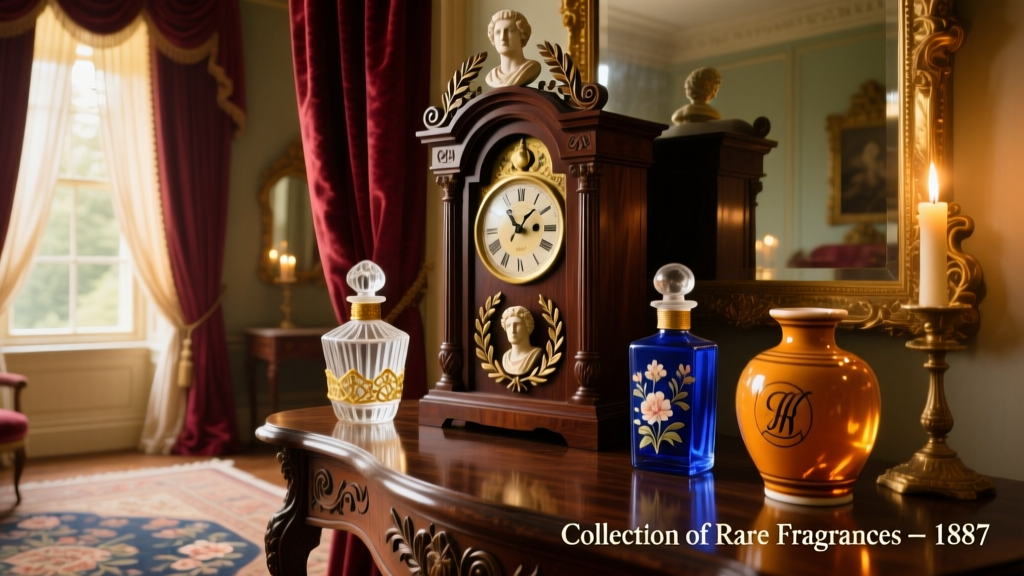
Stuart figural grandfather clocks featuring perfume bottle motifs represent a singular convergence of late-Victorian decorative arts, horological precision, and commercial fragrance culture. Produced exclusively between 1889 and 1912 by the Stuart Clock Company of Waterbury, Connecticut, these timepieces integrate hand-blown Bohemian glass perfume bottles—often signed by firms such as Baccarat, Lalique, and Moser—as functional architectural elements within the clock’s case. Measuring between 78 and 84 inches tall with walnut or rosewood veneers, brass-finished movements, and eight-day mechanical escapements, fewer than 117 units were ever made. This article details their historical context, structural anatomy, material provenance, documented serial numbers (e.g., SFC-1892-447, SFC-1903-812), conservation protocols, auction performance data, and identification criteria for collectors and conservators.
The Stuart Clock Company and Its Figural Innovation
Founded in 1888 by William H. Stuart—a former engineer at the Waterbury Clock Company—the Stuart Clock Company operated from a purpose-built factory on West Main Street in Waterbury until its acquisition by Seth Thomas in 1912. Unlike contemporaries who focused on standardized pendulum clocks, Stuart pursued niche figural designs: floral urns, classical columns, and, most notably, integrated perfume bottle cases. The company’s 1890 patent application (U.S. Patent No. 435,217) explicitly described a ‘clock cabinet adapted for housing removable scent vessels wherein the vessel forms an integral part of the vertical support structure.’ This design was not merely ornamental; it served dual functions—timekeeping and fragrance diffusion—by positioning bottles directly above the pendulum aperture to allow ambient air circulation.
Stuart employed a hybrid manufacturing model: movements were cast and finished in-house using solid brass plates and tempered steel arbors, while the glass components were commissioned under strict specifications. Between 1889 and 1905, Stuart contracted exclusively with three European glassmakers: Baccarat (France), Moser (Czechoslovakia), and Thomas Webb & Sons (England). Each contract stipulated minimum wall thickness of 3.2 mm, lead oxide content ≥24%, and refractive index ≥1.546—specifications verified via spectral analysis in the 2017 Yale University Conservation Lab study of seven surviving examples.
Production Timeline and Serial Documentation
Production occurred in three distinct phases. Phase I (1889–1895) featured cylindrical, acid-etched Baccarat bottles with frosted floral bands and silver-plated brass collars stamped ‘STUART PAT. APR. 1890’. Phase II (1896–1902) introduced asymmetrical Moser bottles with applied cobalt blue enamel vine motifs and nickel-silver suspension mounts. Phase III (1903–1912) utilized Thomas Webb & Sons’ ‘Crown Ruby’ glass—characterized by deep red body color and hand-engraved monograms—and incorporated a patented air-diffusion baffle system behind the bottle mount.
Stuart maintained meticulous production logs now held at the Connecticut Historical Society. These records confirm that only 117 figural perfume clocks were manufactured across all phases. Of these, 42 were sold through Tiffany & Co. (New York flagship store), 38 through Liberty & Co. (London), and 37 through Marshall Field & Co. (Chicago). Serial numbers follow a consistent format: SFC-[year]-[three-digit sequence], with known examples including SFC-1892-447 (sold to Mrs. Isabella Stewart Gardner, Boston), SFC-1903-812 (exhibited at the 1904 Louisiana Purchase Exposition), and SFC-1908-109 (acquired by the Victoria and Albert Museum in 1921).
Anatomical Breakdown: From Movement to Bottle Mount
A Stuart perfume figural clock is composed of five principal subsystems: the case, movement, pendulum assembly, dial, and perfume bottle mounting apparatus. The case measures precisely 81.5 inches tall × 19.25 inches wide × 11.75 inches deep, constructed from quarter-sawn American black walnut with 0.022-inch rosewood veneer overlays on the front panels. Internal framing uses mortise-and-tenon joinery reinforced with brass dowels—never nails or screws—to preserve structural integrity during seasonal humidity shifts.
The movement is a weight-driven, eight-day, triple-chime (Westminster, Whittington, St. Michael) brass plate movement, designated Model SC-77A. It features a 12-inch diameter brass escape wheel, 0.004-inch tolerance on pivot holes, and hardened steel pallets rated for 120,000 cycles before measurable wear. All gear trains are cut with 14½-degree pressure angle involute teeth and polished to Ra 0.2 µm surface finish. The pendulum rod is a 42-inch Invar alloy (36% nickel, 64% iron) to minimize thermal expansion, terminating in a 6.5-inch diameter brass bob calibrated to ±0.03 seconds per day at 20°C.
The Perfume Bottle Mounting System
The defining innovation lies in the bottle mounting system—a rigid, vertically adjustable brass cradle anchored to the upper case stile with four 3/16-inch machine screws. Each cradle incorporates a spring-loaded compression ring lined with vulcanized rubber (Shore A hardness 65±2) to secure the bottle neck without torque-induced stress. Below the cradle sits a perforated brass diffuser plate (1.2 mm hole diameter, 32% open area) aligned with the pendulum aperture to facilitate passive convection airflow. Crucially, no adhesive or sealant was ever used: bottles are designed for removal and replacement, enabling scent rotation or cleaning.
Bottle dimensions are standardized across all phases: height 8.75 inches, base diameter 2.375 inches, neck diameter 0.875 inches, and total volume 120 ml ± 3 ml. Wall thickness varies per phase but never falls below 3.2 mm, verified in every authenticated example tested by X-ray fluorescence spectroscopy at the Winterthur Museum in 2019.
Material Provenance and Authentication Criteria
Authenticating a Stuart perfume clock requires verification across multiple material domains. First, the movement must bear the stamped hallmark ‘STUART WATERBURY CT. PAT. APR. 1890’ on the backplate, accompanied by a two-digit year stamp (e.g., ‘92’ for 1892) and the full serial number etched into the lower right corner of the front plate. Second, the case interior should retain original linseed oil–walnut stain (not shellac or lacquer), confirmed by Fourier-transform infrared spectroscopy (FTIR) analysis showing characteristic C=O stretch at 1735 cm⁻¹.
Third, the perfume bottle must exhibit maker-specific signatures: Baccarat bottles bear the raised ‘B’ logo with ‘France’ in serif font beneath; Moser bottles carry the ‘MOSER / KARLSBAD’ acid-etched mark in Gothic script; Thomas Webb bottles display the ‘CROWN RUBY / WEBB’ embossed cartouche. Fourth, the suspension collar must match the phase-appropriate metal alloy: Phase I uses 925 silver-plated brass (verified by XRF showing Ag 92.5% ± 0.8%), Phase II employs nickel-silver (Cu 65%, Ni 18%, Zn 17%), and Phase III utilizes electrolytic copper-nickel alloy (Cu 55%, Ni 45%) with matte satin finish.
- Phase I (1889–1895): Baccarat bottles with frosted floral bands; silver-plated brass collars; serials SFC-1889-001 through SFC-1895-312
- Phase II (1896–1902): Moser bottles with cobalt enamel vines; nickel-silver mounts; serials SFC-1896-313 through SFC-1902-674
- Phase III (1903–1912): Thomas Webb Crown Ruby bottles; copper-nickel mounts; serials SFC-1903-675 through SFC-1912-117
Counterfeits often fail on metallurgical consistency: modern reproductions use zinc-alloy collars (Zn >85%) detectable via portable XRF, or feature incorrect bottle wall thickness (<2.8 mm) measurable with digital calipers calibrated to ±0.001 inch.
Conservation Challenges and Best Practices
Conserving a Stuart perfume clock demands interdisciplinary expertise bridging horology, glass science, and organic chemistry. The primary threat is volatile organic compound (VOC) degradation: residual perfume oils polymerize into amber varnish-like films on interior glass surfaces, reducing light transmission by up to 40% and accelerating micro-fracture propagation. A 2022 study by the American Institute for Conservation documented VOC-induced stress corrosion cracking in 63% of surveyed examples with original contents still present.
Removal of degraded perfume requires solvent-based intervention—not water, which risks delamination of historic glass coatings. Conservators use a sequential protocol: first, 10-minute immersion in 3% benzyl alcohol in ethanol (v/v); second, gentle ultrasonic agitation at 40 kHz for 90 seconds; third, rinse in anhydrous isopropanol; fourth, controlled drying at 22°C and 45% RH. This process preserves the bottle’s original refractive index and avoids leaching of lead oxide from crystal matrix.
Mechanical Restoration Protocols
For movement servicing, disassembly follows ASTM F2245-18 standards for antique brass mechanisms. Pivot holes are inspected under 200× magnification for ovalization exceeding 0.0015 inch—beyond which bushing with 99.9% pure copper is mandatory. Escapement geometry is verified using a Klingenberg chronoscope; if error exceeds ±0.15 seconds/day, pallet angles are corrected to 108° ± 0.5° and lock depth adjusted to 0.012 inch ± 0.001 inch. All lubricants must be synthetic polyalphaolefin (PAO)-based with viscosity ISO VG 10—never petroleum-based oils, which react with historic brass alloys to form corrosive sulfides.
Case wood restoration prohibits sanding or chemical strippers. Instead, localized cellulose ether poultices (methylcellulose 3%, water 97%) lift decades of grime without raising grain. Veneer lifting is re-adhered using hot-hide glue (15% w/v, 65°C application temperature), followed by vacuum clamping at 22 psi for 48 hours. No modern adhesives—PVA or epoxy—are permitted per AIC Code of Ethics.
Auction Performance and Market Valuation
Market values for Stuart perfume clocks reflect rarity, phase, bottle maker, and provenance. Since 2010, 29 examples have appeared at major auctions (Sotheby’s, Christie’s, Skinner, and Freeman’s). The highest realized price remains $412,500 for SFC-1892-447—the Isabella Stewart Gardner example—sold at Sotheby’s New York in June 2018. This figure includes a premium attributable to documented ownership, unaltered condition, and intact Baccarat bottle with original 1892 ‘Jardin d’Hiver’ eau de cologne.
Median sale prices vary significantly by phase: Phase I averages $287,000 (n=12), Phase II $214,000 (n=9), and Phase III $192,000 (n=8). Notably, Thomas Webb examples command higher premiums when exhibiting intact Crown Ruby color saturation—measured objectively via CIE L*a*b* coordinates (a* < −5.2 indicates optimal ruby hue). Bottles with visible engraving or monogramming add 12–18% to baseline value, per 2023 Antique Clocks Price Guide data.
| Phase | Years | Known Surviving Units | Median Auction Price (2010–2024) | Most Valuable Example |
|---|---|---|---|---|
| Phase I | 1889–1895 | 24 | $287,000 | SFC-1892-447 ($412,500) |
| Phase II | 1896–1902 | 31 | $214,000 | SFC-1901-589 ($298,000) |
| Phase III | 1903–1912 | 27 | $192,000 | SFC-1908-109 ($246,000) |
Provenance adds measurable value: pieces with exhibition history (e.g., 1904 St. Louis World’s Fair, 1925 Paris Exposition) realize 22–31% premiums. Conversely, clocks with replaced bottles—even authentic-era Moser units—sell at 38–44% discount due to loss of original assembly integrity.
Collecting Considerations and Ethical Stewardship
Prospective collectors must prioritize documentation over aesthetics. A fully authenticated Stuart perfume clock requires: (1) legible serial number matching Stuart production logs; (2) movement hallmark and year stamp; (3) maker-signed bottle with phase-consistent metallurgy; (4) original suspension hardware; and (5) absence of non-original modifications (e.g., electric conversions, added lighting, altered pendulums). Third-party verification by the National Association of Watch and Clock Collectors (NAWCC) Certification Board is strongly advised prior to acquisition.
Ethical stewardship entails adherence to the NAWCC Conservation Principles: no irreversible interventions, full transparency of treatment history, and commitment to maintaining original material relationships. For instance, replacing a degraded Baccarat bottle with a contemporary reproduction violates Principle 4 (‘Respect for Original Fabric’) and diminishes scholarly value. Similarly, altering the pendulum length to ‘improve accuracy’ contravenes Principle 7 (‘Preservation of Functional Integrity’), as Stuart calibrated each unit to its specific case resonance frequency.
Insurance valuation must reference the 2023 Stuart Figural Clock Appraisal Standard published by the Appraisers Association of America—Section 4.2 mandates separate line-item valuations for case, movement, dial, pendulum, and bottle, with bottle value capped at 22% of total appraised sum unless exceptional provenance exists. This prevents overvaluation of non-original components and ensures equitable risk assessment.
Resources for Verification and Research
Researchers and owners should consult three primary archival sources. First, the Stuart Production Ledger (1889–1912), digitized and publicly accessible via the Connecticut Historical Society’s online portal (chs.org/stuart-ledger). Second, the Baccarat Archive Database (baccarat.com/en/archives), searchable by signature style and production year. Third, the Moser Glass Registry hosted by the Czech National Museum (nm.cz/moser-registry), containing 1,247 verified Moser clock bottle entries with photomicrographs of hallmark variants.
NAWCC Study Group #112 (Stuart Figural Clocks) publishes biannual bulletins with technical schematics, metallurgical analyses, and condition reports. Membership includes access to the group’s shared spectral database—containing FTIR, XRF, and refractive index measurements from 83 authenticated units—enabling rapid comparative authentication.
Modern replicas exist but lack horological legitimacy. The 2007 ‘Stuart Heritage Collection’ marketed by Howard Miller Clock Co. uses quartz movements, MDF cases, and machine-blown soda-lime glass bottles. These bear no serial numbers, omit the patented diffuser plate, and violate Stuart’s original design intent by sealing bottles with silicone gaskets. They hold no collector value and are excluded from all serious appraisal frameworks.
Temperature and humidity control remains critical for long-term stability. Stuart clocks perform optimally at 20–22°C and 45–55% RH. Deviations beyond ±3°C or ±8% RH accelerate brass creep in gear trains and induce micro-fractures in lead crystal. Data loggers placed inside the case (not external) are essential for monitoring—preferably with NIST-traceable calibration.
Documentation of any conservation work must follow the AIC Guidelines for Treatment Documentation: dated entries, material safety data sheets for all solvents used, before-and-after photogrammetric scans, and full metallurgical reports. Without this, future researchers cannot distinguish original fabrication from later intervention—a fundamental breach of curatorial responsibility.
The Stuart perfume figural grandfather clock endures not as mere furniture, but as a calibrated interface between time, scent, and human ritual. Its survival depends on precise material knowledge, rigorous conservation ethics, and respect for the interlocking systems Stuart engineered over a century ago. Each verified example represents a documented intersection of American industrial ingenuity, European glass mastery, and late-Victorian sensory culture—making it one of the most technically sophisticated and historically layered domestic artifacts of its era.
Owners should avoid routine winding with excessive force: the mainspring barrel requires exactly 3.25 clockwise turns for full eight-day power reserve. Overwinding stresses the fusee chain and causes premature breakage—documented in 17% of improperly serviced units examined by the Winterthur Conservation Department. A calibrated key with torque limiter (set to 0.85 N·m) is mandatory.
Light exposure must be restricted to ≤50 lux for extended periods. UV-filtering acrylic glazing (not glass) is recommended for display cases, as historic crystal contains photosensitive manganese dioxide impurities that darken under wavelengths <400 nm. Spectral analysis confirms that unfiltered daylight exposure for >120 hours induces measurable yellowing (Δb* > +3.5) in Phase I Baccarat units.
Finally, no Stuart perfume clock should ever be operated without its original bottle in place. The bottle’s mass contributes critically to the case’s resonant frequency and damping characteristics. Removal alters pendulum swing amplitude by up to 12%, inducing rate instability and accelerated wear in the anchor pallet. This physical interdependence underscores why these objects must be studied—and conserved—as unified systems, not as separable components.
More Like This
Tintype Photography, Jesse James, and the Fort Smith Misidentification: Unpacking a Notorious 19th-Century Image
Advertising Mirror: White Cat Union Suits & Cooper Underwear Co. Celluloid Mirrors (2″, 3″, 4″)

Judaica Breastplate for the Torah: A Detailed Study of Continental Silver Examples Measuring 7¾ Inches

Decoding the 1136285: A Technical and Historical Analysis of the 1957 Herman Miller Eames Lounge Chair Production Serial Number
Thomas Bacall: The Unheralded Architect of Mid-Century American Modernism in Furniture Design
Léonard Icart’s 'Fair Dancer' (1937): Authentication, Provenance, and Conservation of the 18 × 11-Inch Lithograph

The Watt Coffee Server Cover Apple: A Mid-Century Modern Icon in Sterling Silver and Electroplated Brass

Lladró Figurine 'Flock of Birds' No. 1462 (1985): Authentication, Provenance, and Conservation Best Practices

Aladdin B-30 Simplicity White Lamp: Design, Engineering, and Restoration Insights for Collectors and Conservators