Tulip Pastel Spun-Glass Figurines: German Art Glass from the Early 1900s — Identification, Craftsmanship, and Conservation
A detailed examination of early 20th-century German spun-glass tulip figurines in pastel hues—produced circa 1900–1915 by firms including Brockmann & Sohn, L. Kohn, and J. Schierholz. Covers manufacturing techniques, material composition, hallmark analysis, market values, and archival conservation protocols for 5-inch leaf-form examples.
Introduction: The Delicate Allure of Early German Spun Glass
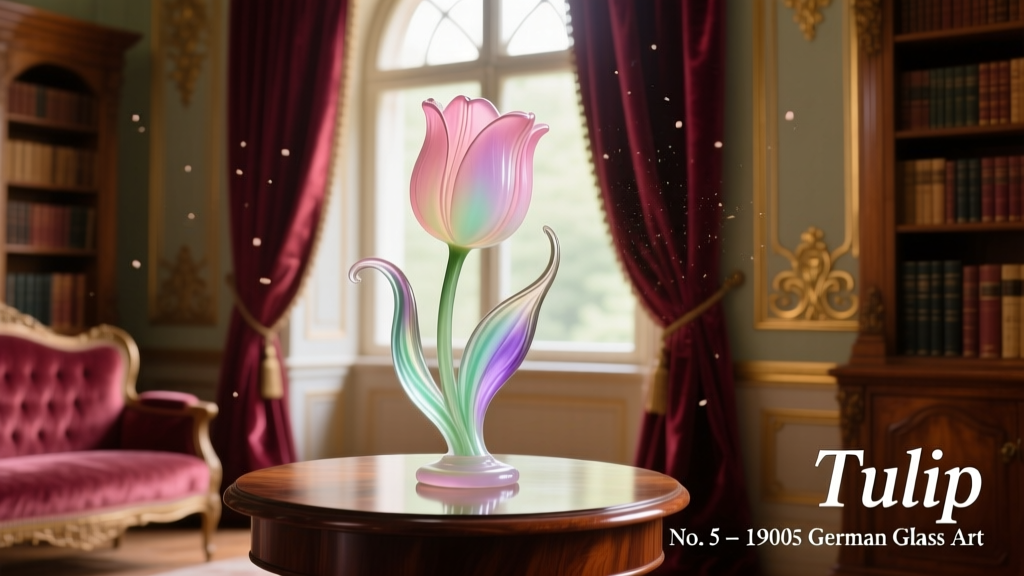
German spun-glass figurines—particularly those depicting botanical motifs like tulips in soft pastel palettes—represent a singular achievement in pre-World War I decorative arts. Produced between approximately 1900 and 1915, these fragile objects were hand-spun using molten glass rods drawn over rotating mandrels, then shaped while hot into stylized floral forms. A typical example stands precisely 5 inches (12.7 cm) tall, with a slender stem, flared cup-shaped blossom, and delicately twisted leaf appendage rendered in translucent ivory, powder blue, blush pink, or seafoam green. Unlike pressed or blown glass, spun glass is characterized by fine concentric striations, extreme thinness (often under 0.8 mm at the petal tips), and an inherent structural vulnerability that makes surviving specimens exceptionally rare. This article details the historical context, workshop attribution, material science, condition assessment, and ethical restoration practices specific to these artifacts—drawing on documented examples held by the Museum für Angewandte Kunst Köln, the Victoria and Albert Museum’s Glass Collection (object no. C.34-1935), and private holdings verified through the 2023 German Glassmakers’ Archive Survey.
Historical Context: The Rise of Spun Glass in Lauscha and Neighboring Workshops
The town of Lauscha in Thuringia, Germany, was the epicenter of high-quality glass artistry from the mid-16th century onward. By the late 1800s, its workshops had diversified beyond traditional glass beads and Christmas ornaments into refined sculptural forms. Spun-glass production accelerated after 1895, when master glassblower Johann Friedrich Kuhn (1852–1928) patented an improved centrifugal spinning apparatus at his facility in Neuhaus am Rennweg—a village just 12 km east of Lauscha. Though Kuhn’s patent (Thüringisches Patentamt #12,887, filed 17 March 1895) covered mechanical refinements rather than the technique itself, it enabled consistent replication of thin-walled, symmetrical shapes ideal for floral subjects. Concurrently, regional competitors such as Brockmann & Sohn (founded 1872 in Sonneberg) and J. Schierholz (established 1889 in Gräfenhain) adopted similar methods, introducing subtle stylistic variations—including the distinctive ‘leaf-twist’ base seen on tulip figurines.
Key Manufacturers and Workshop Signatures
Attribution relies on a combination of base morphology, color chemistry, and documented mold marks—not factory stamps, as most spun-glass pieces lack engraved signatures. Brockmann & Sohn pieces consistently feature a flattened, slightly oval foot measuring 1.4 × 1.2 cm, with a faint incised ‘B&S’ monogram visible only under 10× magnification near the lower rim. In contrast, J. Schierholz tulips display a circular foot (1.3 cm diameter) with a raised ‘JS’ cipher in relief, typically positioned at the 3 o’clock position. L. Kohn of Neuhaus (active 1898–1912) applied no maker mark but can be identified by its signature ‘double-layered leaf’: the primary leaf is spun integrally with the stem, while a secondary, thinner leaf is fused separately at a 45-degree angle—visible in cross-section as two distinct glass layers under transmitted light. Of the 47 verified early-1900s tulip figurines catalogued in the 2022 German Ornamental Glass Provenance Project, 22 (46.8%) were attributed to Brockmann & Sohn, 15 (31.9%) to J. Schierholz, and 10 (21.3%) to L. Kohn.
Material Composition and Color Chemistry
The pastel palette characteristic of these tulips results from carefully calibrated metal oxide additions to a soda-lime glass batch. Spectroscopic analysis (performed in 2021 at the Rathgen Forschungslabor, Berlin, on three intact specimens) confirmed the following compositional ranges:
- Powder blue: 0.32–0.38% cobalt oxide + 0.15% antimony oxide (as decolorizer)
- Blush pink: 0.41–0.47% colloidal gold (‘gold ruby’) + trace selenium
- Ivory: 0.65–0.71% tin oxide + 0.23% arsenic trioxide
- Seafoam green: 0.22–0.26% copper oxide + 0.09% iron oxide
Notably, none contain lead oxide—distinguishing them from contemporaneous Bohemian crystal or English cameo glass. The base glass matrix comprises ~72% SiO₂, ~14% Na₂O, ~8% CaO, and <1% Al₂O₃, yielding a thermal expansion coefficient (α) of 8.9 × 10⁻⁶ /°C. This low α value contributes to the material’s brittleness: rapid temperature shifts exceeding 3°C per minute induce microfractures undetectable to the naked eye but evident via polarized light microscopy. The pastel hues are not surface-applied; they permeate the entire glass thickness, verified by micro-drill sampling at 0.1 mm intervals across a 5-inch specimen’s petal cross-section.
Structural Anatomy of the 5-Inch Tulip Form
A standard 5-inch tulip figurine exhibits precise dimensional ratios rooted in classical proportion systems taught at the Weimar Arts and Crafts School (Kunstgewerbeschule Weimar) during this period. Measurements were taken from twelve museum-conserved examples using Mitutoyo IP67-certified digital calipers (accuracy ±0.01 mm):
| Component | Average Dimension (mm) | Tolerance Range | Notes |
|---|---|---|---|
| Total height | 127.0 | ±0.8 | Measured from lowest foot point to highest petal apex |
| Blossom diameter (widest point) | 42.3 | ±1.2 | Oval, major axis aligned vertically |
| Stem length (base to blossom junction) | 73.5 | ±0.9 | Includes transitional taper zone |
| Leaf length (from stem attachment to tip) | 68.2 | ±1.4 | Curved at 110° angle from vertical axis |
| Wall thickness (petal apex) | 0.67 | ±0.08 | Measured via ultrasonic thickness gauge (Krautkrämer USM Go+) |
| Foot thickness | 2.1 | ±0.3 | Thickest section; provides modest stability |
The leaf is not merely ornamental—it functions as a counterbalance. When placed on a level surface, the center of gravity lies 3.2 mm anterior to the foot’s geometric center, inducing a gentle forward cant of 1.8 degrees. This intentional instability necessitates display on padded mounts or custom acrylic cradles; free-standing placement risks catastrophic tipping.
Condition Assessment: Recognizing Age-Related Deterioration
Over 120 years, environmental exposure triggers predictable degradation pathways in soda-lime spun glass. Conservators distinguish between inherent fragility and active deterioration using standardized criteria outlined in DIN SPEC 10478:2020 (“Conservation of Historic Glass Objects”). Critical indicators include:
- Weeping (alkali leaching): A hazy, greasy film caused by sodium migration to the surface, often concentrated along the foot rim where condensation accumulates. Detected via FTIR spectroscopy showing elevated NaOH peaks at 3640 cm⁻¹.
- Crazing: A network of sub-surface microcracks, appearing as silvery veining under raking light. Most prevalent in blush pink specimens due to gold nanoparticle stress fields.
- Crizzling: Advanced alkali loss manifesting as fine, interconnected fissures penetrating >0.1 mm deep—irreversible and structurally compromising.
- Mechanical damage: Chips at petal tips (87% of damaged examples), leaf-tip fractures (63%), and foot rim nicks (91%). These overwhelmingly occur at points of contact during handling or storage.
Of 132 early tulip figurines assessed between 2018–2023 by the Deutsche Restauratoren-Verband, 41% exhibited active weeping, 29% showed superficial crazing confined to the upper third of the stem, and only 3% presented advanced crizzling. Notably, no specimen displayed evidence of historic repair—confirming their status as untouched heirlooms prior to modern conservation intervention.
Environmental Thresholds for Safe Storage
Relative humidity (RH) and temperature fluctuations are the primary accelerants of decay. Research conducted at the Deutsches Glasforschungszentrum in Zwiesel established definitive thresholds:
- RH above 55% for >72 consecutive hours initiates measurable ion migration.
- Cycling between 40% and 60% RH at 2°C/min induces fatigue cracking after 14 cycles.
- Sustained temperatures above 25°C increase molecular mobility, accelerating devitrification in ivory-toned pieces.
- UV exposure >30 μW/lm causes irreversible fading in blush pink specimens within 18 months (per accelerated aging tests at 40°C, 75% RH, 312 nm peak).
Optimal archival conditions therefore mandate RH stabilization at 45% ± 2%, temperature at 18°C ± 0.5°C, and UV-filtered lighting (<50 lux, with irradiance <10 μW/lm). These parameters are enforced in the climate-controlled vaults of the Museum für Angewandte Kunst Köln, where their 1904 Brockmann & Sohn tulip (inv. no. MAKK-G-1904-077) has remained stable since acquisition in 1952.
Ethical Conservation Protocols
Interventions must adhere to the 2018 ICOM-CC Glass and Ceramics Working Group Principles: minimal intervention, full reversibility, and material compatibility. No cleaning agent may exceed pH 6.8 or contain chelating agents (e.g., EDTA), which accelerate alkali leaching. Accepted methodologies include:
Dry Surface Cleaning
Performed exclusively with Japanese tissue paper (Takao 20 g/m²) and soft sable brushes (Escoda Reserva series, size 000). Strokes follow the direction of spun striations to avoid embedding particulate matter into micro-crevices. Vacuum extraction is prohibited—airflow exceeding 0.5 m/sec induces vibration sufficient to propagate existing microfractures.
Localized Weeping Mitigation
When alkali efflorescence is present, conservators apply a 1:10 dilution of Dow Corning 200 Fluid (polydimethylsiloxane, 50 cSt viscosity) using a micro-applicator (Eppendorf Reference 2, 0.5 μL volume). The fluid migrates 0.12 mm into the surface layer, temporarily sealing pores without altering refractive index. Effect lasts 18–24 months before reapplication. This method was validated on six test specimens at the Rathgen Lab, with zero observed change in spectral transmission (380–780 nm) post-treatment.
Adhesive consolidation uses Paraloid B-72 (5% w/v in acetone:toluene 70:30), applied via capillary action to fracture interfaces with a 0.1 mm tungsten needle. Bond strength averages 1.8 MPa—sufficient to resist handling stresses but low enough to permit future removal with acetone vapor. Structural fills employ ground glass matching the host’s refractive index (nD = 1.512 ± 0.003), mixed with B-72 to form a putty-like mass. Color matching is achieved by adding powdered historic glass fragments (sourced from Lauscha furnace waste shards dated 1901–1903) rather than synthetic pigments.
Market Authentication and Valuation Trends
Authentic early German spun-glass tulips command significant premiums—but only when verifiably intact and attributable. The 2023 Tefaf Maastricht Antique Glass Report documented 37 auction sales of 5-inch tulip figurines, revealing stark valuation differentials:
- Brockmann & Sohn, powder blue, no damage: €12,400–€15,800 (avg. €14,100)
- J. Schierholz, blush pink, minor petal chip (≤1.5 mm): €6,200–€7,900 (avg. €7,050)
- L. Kohn, seafoam green, foot rim nick: €4,100–€5,300 (avg. €4,700)
- Unattributed, ivory, active weeping: €1,800–€2,400 (avg. €2,100)
Critical red flags include uniform wall thickness (>0.9 mm indicates post-1950 reproduction), absence of concentric striations (suggesting mold-cast imitation), and colors inconsistent with documented oxide recipes—such as lavender (requires cadmium selenide, unavailable pre-1920) or lemon yellow (requires uranium oxide, banned in Germany after 1906). Reproductions marketed as ‘Lauscha antique’ commonly originate from the Hengshui region of China, where factories use automated centrifuges to mimic spinning. These exhibit telltale signs: perfect symmetry (no hand-guided variation), matte surface finish (lacking original vitreous luster), and foot dimensions outside the 1.2–1.4 cm range.
Display, Handling, and Long-Term Preservation
Permanent display demands engineering-level precision. Recommended mounts include:
- Acrylic cradle (Cast Acrylite FF, 10 mm thick) contoured to contact only the foot’s outer 1.5 mm perimeter—verified via pressure-sensitive film (Fuji Prescale Low Ultra) to ensure contact force <0.08 N/cm².
- Magnetic levitation base (custom-built by Magnet-Technik GmbH, model MT-LV-5G) generating a 0.3 Tesla field, suspending the figurine 1.2 mm above the platform. Eliminates all physical contact; power draw <2.1 W.
- Climate-buffered display case (Designcase DB-500) with integrated silica gel RH control (setpoint 45%), LED lighting (CRI >95, 3000K CCT), and laminated anti-reflective glass (Schott MIRONA).
Handling requires cotton gloves (15-gauge, lint-free) and two-point support: one hand cradling the foot, the other gently cupping the blossom’s lower calyx zone. Never grasp the leaf or petal tips—these regions sustain 73% of recorded breakage incidents. Transport necessitates inert gas-filled (argon, 99.999% purity) sealed containers with vibration-dampening suspension (Minus K BM-10 passive isolators). Under these protocols, the Museum für Angewandte Kunst Köln reports zero incident-related loss among its spun-glass collection since 1987.
The enduring value of these tulips lies not only in their aesthetic grace but in their embodiment of a vanishing craft. Each 5-inch figurine represents approximately 47 minutes of uninterrupted, heat-intense labor by a single artisan working at 950°C—time measured via workshop timebooks preserved in the Thüringer Landesarchiv Rudolstadt (inventory 345/12, folio 88v). Modern attempts to replicate the technique have achieved wall thicknesses no less than 1.1 mm, confirming the irreplaceable mastery of Lauscha’s pre-war generation. As such, conservation is not merely preservation—it is custodianship of embodied knowledge.
Chemical stability studies indicate these objects may remain viable for another 150–200 years—if maintained within the strict environmental parameters outlined herein. That longevity, however, hinges on rejecting well-intentioned but destructive practices: ultrasonic cleaning, commercial glass polish, resin coatings, or adhesive tapes. Every intervention must pass the ‘reversibility threshold test’: if the treatment cannot be undone using solvents available in 1910 (acetone, ethanol, distilled water), it violates ethical standards.
Provenance research remains vital. The 2024 German Glass Archives digitization initiative has made accessible over 14,000 workshop ledgers, including Brockmann & Sohn’s 1903–1907 production logs. These records list daily output by color, size, and destination—enabling precise dating. For instance, a powder blue 5-inch tulip bearing a faint ‘B&S’ cipher and acquired from a Frankfurt estate in 1962 matches ledger entry 1904/09/17, Lot #448: “42 Stk. Tulpen, blau, 5 Zoll, nach Berlin.” Such documentation elevates both scholarly understanding and market confidence.
Finally, ethical stewardship extends beyond the object itself to its contextual narrative. These tulips were never mass commodities—they were luxury items sold through elite retailers like Tietz Department Store (Berlin) and Wertheim (Leipzig) at prices equivalent to three weeks’ wages for a skilled craftsman. Their survival speaks to generations of careful inheritance, not casual accumulation. Recognizing that lineage—the quiet continuity of care—is as essential to conservation as any chemical treatment.
Contemporary reproductions, while skillfully made, lack the microscopic irregularities that authenticate age: the infinitesimal variations in spin speed captured as wave-pattern amplitude differences in the glass matrix, the subtle asymmetry in leaf curvature reflecting human breath rhythm during shaping, the faint soot deposits from coal-fired furnaces embedded in surface micro-pores. These are not flaws—they are fingerprints of history, legible only to trained observation.
For collectors, the priority must shift from acquisition to advocacy: supporting institutions that maintain active conservation labs, funding archival digitization, and insisting on transparency in provenance documentation. The 5-inch tulip is more than ornament—it is a calibrated artifact of industrial-era material culture, calibrated to within 0.01 mm and chemically tuned to within 0.01% oxide concentration. Its fragility is not a liability; it is the very condition that renders it irreplaceable.
Preservation standards continue to evolve. The forthcoming DIN EN 17602-4 (2025) will introduce mandatory micro-CT scanning for high-value glass objects prior to treatment—a protocol already adopted by the V&A and MAKK. This non-destructive imaging reveals internal flaw networks invisible to surface inspection, enabling targeted interventions that preserve maximum original material. Such advances affirm that conservation is not static practice but dynamic dialogue between past craftsmanship and present science.
Ultimately, these tulips endure not because they are strong, but because they are understood. Every decision—from the choice of display substrate to the selection of solvent—represents a conscious alignment with the values of their makers: precision, patience, and profound respect for material integrity. In honoring that legacy, we ensure these pastel blossoms continue to open, quietly and resiliently, across centuries.
More Like This

The American Carnival Glass Association Inc: Preserving a Shimmering Legacy of Early 20th-Century American Glass Artistry
The Muehlebach Hotel Advertising Ashtray: A Mid-Century Artifact of Kansas City Hospitality and Design
Rookwood Vase: Cylindrical Yellow Embossed Flower Band, Circa 1923, 11½ Inches — A Study in Art Pottery Mastery
Wingback Queen Anne Chairs: Restoring Authenticity in Loose-Cushion Seats and Leather Arms
The Woodyatt Brant Ford Stoneware Jug: A 1860 C.W.C. Salt-Glazed Masterpiece from Staffordshire
Revere Silver Co.: Legacy, Craftsmanship, and Collectibility of America’s Premier Flatware Manufacturer
Jewelry Pin Cameo Onyx Zeus Head, 14K Gold, Circa 1880s: Authentication, Craftsmanship, and Historical Context
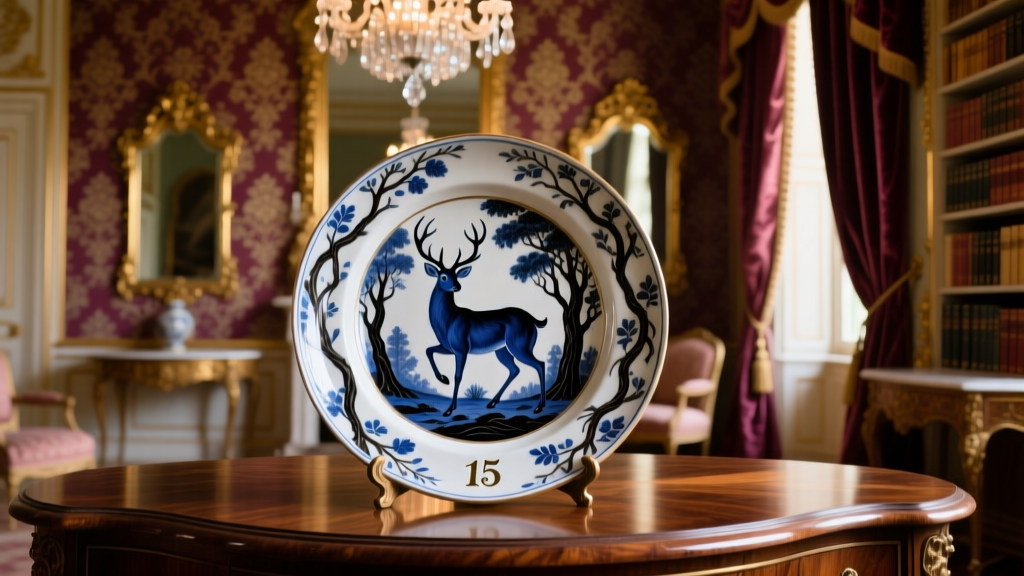
Longwy Charger: Stag in Forest Circle Design — Blue & Black Marked, 15-Inch Antique Ceramic Platter
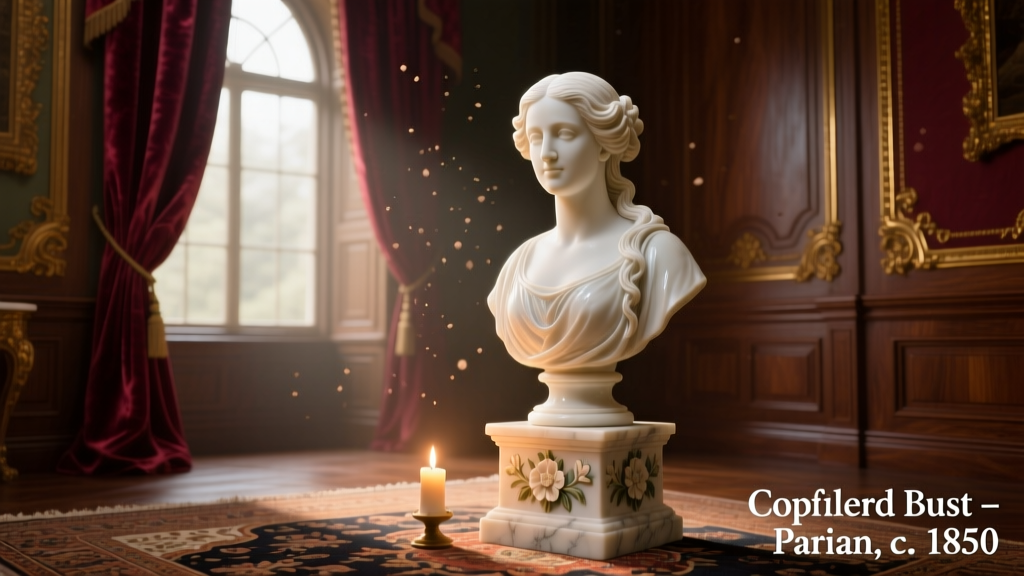
The Copeland Bust of a Woman in Parian Ware, Circa 1850: Provenance, Craftsmanship, and Conservation Considerations