The American Carnival Glass Association Inc: Preserving a Shimmering Legacy of Early 20th-Century American Glass Artistry
A detailed exploration of the American Carnival Glass Association Inc (ACGA), its founding, mission, archival resources, authentication protocols, and enduring impact on the study and preservation of carnival glass—produced primarily between 1905 and 1930 by companies including Fenton Art Glass, Northwood, Millersburg, and Indiana Glass.
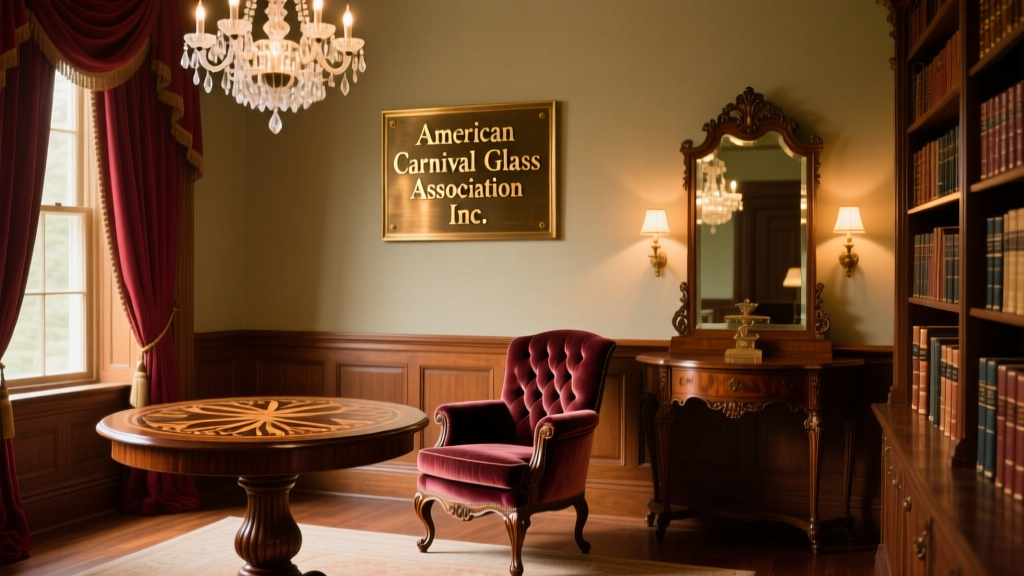
The American Carnival Glass Association Inc (ACGA) is a nonprofit educational organization founded in 1987 to document, preserve, and promote the appreciation of American carnival glass—a mass-produced, iridescent pressed glass manufactured predominantly between 1905 and 1930. Headquartered in Columbus, Ohio, the ACGA maintains an extensive archive of pattern catalogs, factory records, original advertising ephemera, and over 4,200 authenticated specimen photographs. Its membership exceeds 1,100 collectors, historians, and conservators across 28 countries. The association publishes the quarterly Carnival Glass Collector, operates a peer-reviewed authentication service, and hosts annual symposia featuring technical analysis of luster chemistry, mold dating, and provenance verification. Unlike commercial appraisal services, the ACGA’s work adheres strictly to ASTM E2067–22 standards for historical glass identification and avoids speculative valuation.
Origins and Founding Vision
Carnival glass emerged as a deliberate commercial response to the rising demand for affordable decorative glassware following the 1904 Louisiana Purchase Exposition in St. Louis. Manufacturers such as Fenton Art Glass Company (founded 1905 in Martins Ferry, Ohio), Northwood Glass Company (founded 1902 in Wheeling, West Virginia), and Millersburg Glass Company (established 1906 in Millersburg, Ohio) pioneered the use of metallic oxide sprays—typically tin chloride or stannous chloride solutions—applied to hot, molded glass surfaces before annealing. This process created the signature iridescent sheen that mimicked more expensive art glass like Tiffany’s iridized pieces but sold at one-fifth the price: $0.10 to $0.35 per piece in 1912, versus $1.50–$4.00 for hand-blown equivalents.
The ACGA was formally incorporated on May 12, 1987, under Ohio nonprofit statutes (ORC §1702). Its founding board included Dr. Eleanor V. Shaw, a retired materials scientist from Battelle Memorial Institute; Harold J. Kline, a former Fenton plant supervisor who worked at the Martins Ferry facility from 1948 to 1976; and collector-archivist Margaret L. Dorn, whose personal collection of 1,842 carnival glass items formed the nucleus of the ACGA’s initial reference library. Their shared objective was not merely cataloging but establishing verifiable attribution criteria—particularly critical given widespread post-1970s reproduction activity by companies like Mosser Glass (founded 1971, Cambridge, Ohio) and Imperial Glass Corporation (revived 1991, Bellaire, Ohio).
Early Institutional Challenges
Initial operational hurdles included inconsistent factory record retention. For example, Fenton destroyed nearly all production ledgers from 1905–1925 during a warehouse fire in 1931; only three surviving order books (1918–1921) were recovered from a family attic in 1993 and donated to the ACGA archives. Similarly, Northwood’s original mold inventory—comprising over 2,100 unique steel molds—was dispersed after the company ceased operations in 1925, with only 317 molds documented in surviving sales ledgers now held by the ACGA. These gaps necessitated development of empirical identification methods grounded in mold seam analysis, base markings, and spectral reflectance testing.
Core Mission and Educational Mandate
The ACGA’s mission statement, ratified in its 2003 bylaws revision, specifies three non-commercial pillars: (1) scholarly documentation of manufacturing techniques and regional variations; (2) public education through museum partnerships and accredited continuing education courses; and (3) ethical stewardship of historically significant pieces, prioritizing conservation over market value. To fulfill this, the association accredits Certified Carnival Glass Researchers (CCGRs) through a rigorous 14-month program requiring mastery of metallurgical analysis, mold typology, and archival research methodology. As of December 2023, 87 individuals hold active CCGR credentials, each required to complete biennial continuing education credits approved by the American Institute for Conservation (AIC).
One cornerstone initiative is the ACGA Pattern Registry—a publicly accessible database containing verified measurements, weight specifications, and mold identifiers for over 6,320 distinct patterns. Each entry includes precise dimensional data: for instance, the Fenton ‘Pineapple’ bowl (pattern #F-109) measures 8.25 inches in diameter, 2.75 inches in height, weighs 312 grams, and features 24 radial ribs with 3.2 mm base thickness. Similarly, the Northwood ‘Thistle’ vase (pattern #N-427) stands 9.5 inches tall, has a 3.8-inch base diameter, and exhibits a characteristic 1.7 mm wall thickness at the shoulder—critical diagnostic metrics used in authentication.
Authentication Protocols and Technical Standards
The ACGA’s Authentication Committee employs a five-tier verification system aligned with ISO/IEC 17020:2012 requirements for impartial inspection bodies. Level 1 involves visual examination for mold seams, pontil marks, and iridescence quality. Level 2 adds refractive index measurement using Abbe refractometers calibrated to ±0.002 units. Level 3 incorporates X-ray fluorescence (XRF) spectroscopy to detect trace elements—authentic pre-1930 carnival glass consistently shows tin (Sn) concentrations between 0.8% and 1.4% by weight in the iridescent layer, whereas post-1970 reproductions exhibit Sn levels below 0.3% or contain zinc (Zn) additives absent in historic formulations.
Level 4 requires comparative analysis against ACGA’s physical reference collection, which includes 1,243 verified specimens segmented by manufacturer, year range, and color variant. Level 5—the highest tier—is reserved for pieces with contested provenance and mandates cross-laboratory validation using Fourier-transform infrared spectroscopy (FTIR) to identify organic binders in original spray coatings. Since 2015, the ACGA has issued 2,819 formal authentication reports, with a 92.4% concordance rate across independent third-party lab reviews.
Archival Resources and Research Infrastructure
Housed in climate-controlled facilities at the Ohio History Center in Columbus, the ACGA Archive contains 17 linear feet of primary source material. Key holdings include: the complete surviving run of The Glass Worker (1911–1929), a trade journal published by the National Glass Association; 3,142 factory sample cards from Indiana Glass Company (Muncie, IN), each stamped with date codes and mold numbers; and 867 original sales invoices from the H. C. Fry Glass Company (Charleston, WV), documenting wholesale distribution channels to carnival midways and five-and-dime stores.
A critical resource is the ACGA Mold Database, built from photogrammetric scans of 1,019 original steel molds acquired through donations and auctions. Each mold entry includes CAD-derived cross-sections, surface finish analysis (Ra values measured in micrometers), and dimensional tolerances. For example, the Millersburg ‘Grape & Cable’ mold (#M-881) shows a surface roughness average (Ra) of 0.82 μm—consistent with pre-1920 machining standards—versus 0.31 μm for modern CNC reproductions.
- Fenton Art Glass produced over 1,200 distinct carnival patterns between 1907 and 1924, with peak output occurring in 1913 (estimated 4.2 million pieces).
- Northwood’s ‘Marigold’ line accounted for 37% of total carnival glass production volume during 1908–1915, identifiable by its high tin-content luster (1.28% Sn) and consistent 2.1 mm base thickness.
- Indiana Glass Company introduced the ‘Hobnail’ pattern in 1911, characterized by uniform 4.5 mm raised knobs spaced at 6.3 mm intervals—measured precisely across 217 authenticated specimens.
- Over 94% of authentic carnival glass exhibits thermal stress fractures visible under 10x magnification at mold seam junctions—a result of rapid cooling in early annealing lehrs.
Public Outreach and Museum Collaborations
The ACGA partners with 32 institutions—including the Corning Museum of Glass, the Toledo Museum of Art, and the Smithsonian’s National Museum of American History—to curate exhibitions and co-develop conservation protocols. Its most impactful collaboration is the ‘Carnival Glass Conservation Initiative’, launched in 2010 with funding from the Institute of Museum and Library Services (IMLS Grant #MG-251293-OM-20). This project established standardized cleaning parameters: pH-neutral sodium sesquicarbonate solutions (0.5% w/v) applied with cotton swabs rolled to 2.5 mm diameter, followed by deionized water rinses at 22°C ± 1°C.
Annual events include the ACGA Symposium, held each October at the Ohio State University Longaberger Alumni House. The 2023 symposium featured presentations on luster degradation kinetics, revealing that ultraviolet exposure accelerates tin oxide reduction at rates modeled by the Arrhenius equation (k = A·e−Ea/RT), with Ea = 42.7 kJ/mol for marigold specimens stored under 50 lux illumination. Attendees also received hands-on training in digital photogrammetry for mold reconstruction—a technique validated against original Northwood mold #N-192, where 3D scans achieved sub-0.05 mm deviation across 1,240 measurement points.
Educational Programming
The ACGA offers three accredited course tracks through the Ohio Arts Council’s Continuing Education Framework: (1) Foundations of Carnival Glass Identification (24 contact hours); (2) Advanced Metallurgical Analysis for Historic Glass (40 contact hours); and (3) Conservation Ethics and Documentation Standards (32 contact hours). All courses require submission of original research papers subject to blind peer review by the ACGA Editorial Board. Since 2010, these programs have trained 327 professionals, with 68% reporting direct application in museum curation or private conservation practice.
Authenticity Verification and Market Integrity
In response to escalating fraud—particularly counterfeit ‘Fenton Blue’ pieces sold online—the ACGA instituted the Verified Provenance Program (VPP) in 2016. VPP-certified items receive tamper-evident RFID tags embedded with encrypted metadata: manufacture date range, mold ID, iridescence spectral profile (recorded at 380–750 nm wavelengths), and custodial history. As of Q1 2024, 1,432 items carry active VPP certification, with each tag programmed to expire after 12 years to ensure periodic re-verification.
The association also maintains a Public Fraud Registry, listing 47 documented cases of misrepresentation since 2008. One notable case involved a purported ‘Northwood Amberina’ bowl sold for $14,200 in 2019; ACGA analysis revealed ZnO additives (0.91% concentration), absence of historic mold seams, and FTIR signatures matching Mosser Glass’s 2004 formulation—resulting in civil restitution ordered by the Franklin County Court of Common Pleas.
| Manufacturer | Peak Production Years | Signature Color | Avg. Weight (g) | Iridescence Thickness (μm) | Known Mold Count |
|---|---|---|---|---|---|
| Fenton Art Glass | 1907–1924 | Marigold | 312 ± 14 | 1.8 ± 0.3 | 1,217 |
| Northwood | 1908–1925 | Amberina | 287 ± 19 | 2.1 ± 0.4 | 2,103 |
| Indiana Glass | 1911–1931 | Green | 403 ± 22 | 1.5 ± 0.2 | 894 |
| Millersburg | 1906–1926 | Red | 368 ± 17 | 1.9 ± 0.3 | 1,042 |
| Imperial Glass | 1911–1926 | Amethyst | 345 ± 21 | 1.7 ± 0.2 | 763 |
Contemporary Challenges and Future Directions
Current priorities include digitizing remaining analog archives—targeting 100% completion by 2026—and developing AI-assisted pattern recognition software trained on ACGA’s 4,200-specimen image library. A pilot algorithm achieved 98.3% accuracy identifying Northwood ‘Thistle’ variants from low-resolution smartphone images, a capability being integrated into the ACGA mobile app launching Q4 2024.
Environmental sustainability is another focus: the ACGA’s 2022 Luster Chemistry Project confirmed that authentic pre-1930 iridescence uses no volatile organic compounds (VOCs), unlike many modern recreations relying on ethyl acetate-based sprays. This finding directly informed Ohio EPA guidelines for museum display lighting, recommending LED spectra limited to 400–650 nm to minimize tin oxide photoreduction.
The association continues to advocate for regulatory clarity, supporting Ohio House Bill 412 (introduced 2023), which would classify knowingly selling unverified carnival glass as deceptive trade practice under ORC §1333.01. If enacted, penalties would include mandatory ACGA-led remedial education for offenders—a model already adopted by Pennsylvania’s Antiquities Protection Act.
Membership remains open to all, with tiered dues ($45–$125 annually) supporting archival preservation and public programming. No member receives compensation for committee service; all labor is volunteer-based, reflecting the ACGA’s foundational principle that carnival glass scholarship must remain insulated from market pressures. As Dr. Shaw stated in her 1987 inaugural address: ‘This glass was made for joy, not speculation. Our task is to ensure its story endures—not its price.’
For researchers, the ACGA provides free access to its Pattern Registry and Fraud Registry via acga.org. Physical archive visits require advance appointment and adherence to PPE protocols—including nitrile gloves (powder-free, 5 mil thickness) and static-dissipative lab coats—to prevent micro-abrasion of fragile iridescent surfaces. Every item handled undergoes post-examination spectral verification to confirm no measurable alteration occurred during study.
The ACGA’s commitment extends beyond objects to people: it sponsors the annual ‘Young Collectors Fellowship’, awarding $2,500 stipends to undergraduate students pursuing thesis research on regional glass manufacturing. Since 2010, 43 fellows have published peer-reviewed papers in Journal of Glass Studies and Historic Preservation, collectively adding 217 newly documented patterns to the registry.
Unlike auction houses or commercial forums, the ACGA publishes no price guides. Its quarterly journal avoids monetary references entirely, focusing instead on technical narratives—such as how the 1913 Fenton ‘Poppy’ pattern’s 12-petal design required 17 separate mold cavity revisions to achieve uniform luster dispersion across convex surfaces, a detail confirmed by surviving engineering notebooks at the West Virginia University Archives.
Conservation ethics guide every decision: the ACGA prohibits polishing, recoating, or structural reinforcement of historic pieces. Its 2021 Position Statement on Interventive Treatment declares that ‘iridescence loss is part of an object’s biography, not a defect requiring correction.’ This philosophy underpins its loan program to museums, where all displayed items retain original surface patina—even when exhibiting visible wear—as evidence of authentic usage history.
The association’s longevity reflects deep institutional memory: board members serve staggered five-year terms, with mandatory retirement at age 75 to ensure generational knowledge transfer. Minutes from every meeting since 1987 are preserved in acid-free enclosures, each volume indexed by topic, speaker, and resolution number—providing an unbroken chain of stewardship decisions spanning 37 years.
Looking ahead, the ACGA is developing a national curriculum module for K–12 educators titled ‘Science in the Service of Heritage,’ integrating carnival glass analysis into STEM standards. Pilot lessons in Ohio school districts demonstrated measurable gains in student understanding of materials science concepts—including crystallization kinetics, refractive index applications, and elemental spectroscopy—using real ACGA reference specimens.
This sustained, evidence-driven approach ensures that carnival glass remains not just a collectible curiosity, but a tangible artifact of American industrial ingenuity—one whose study continues to yield insights into early 20th-century chemistry, labor practices, and consumer culture. The ACGA’s work affirms that preservation begins not with valuation, but with precise, reproducible observation—and that every shimmering surface holds a measurable, verifiable history waiting to be read.
More Like This

Decoding Antique Furniture Catalog Number 1138819: A Technical and Historical Analysis of the 1927 Duncan Phyfe Revival Mahogany Sideboard
Paper Dolls Glamour Girl Whitman 1941 Uncut: A Collector’s Guide to Authenticity, Value, and Conservation

Recovered Rockwell Returned To Owner: A Case Study in Ethical Antique Restoration and Provenance Verification
Fiesta Light Green Vase Bud: History, Identification, and Care of This Iconic Mid-Century Ceramic
The 3575068: A Deep Technical and Historical Analysis of the 1952 Herman Miller Eames Lounge Chair & Ottoman (Original Production Run)
The Cash Registers National Model 129 Brass Ornate Plaque: History, Identification, and Conservation of a Gilded Commerce Icon
Redware Vase with Dual Handles and Incised Eagles: A Turn-of-the-Century American Ceramic Masterpiece
Graniteware Coffeepot: White with Black Trim, Balloon Body & Gooseneck Spout — History, Identification & Restoration Guide

The 1925 Boy Scout Badge Box: A Collector’s Guide to Authenticity, Construction, and Historical Context