Gilt Bronze Figures: Craftsmanship, Provenance, and Conservation of 18th–19th Century French Bronzes
An expert examination of gilt bronze figures—focusing on French Rococo and Neoclassical production, metallurgical composition, gilding techniques, maker marks (including Caffiéri, Thomire, and Keller & Guérin), authentication protocols, and ethical conservation standards. Includes dimensional data, alloy specifications, and market benchmarks.
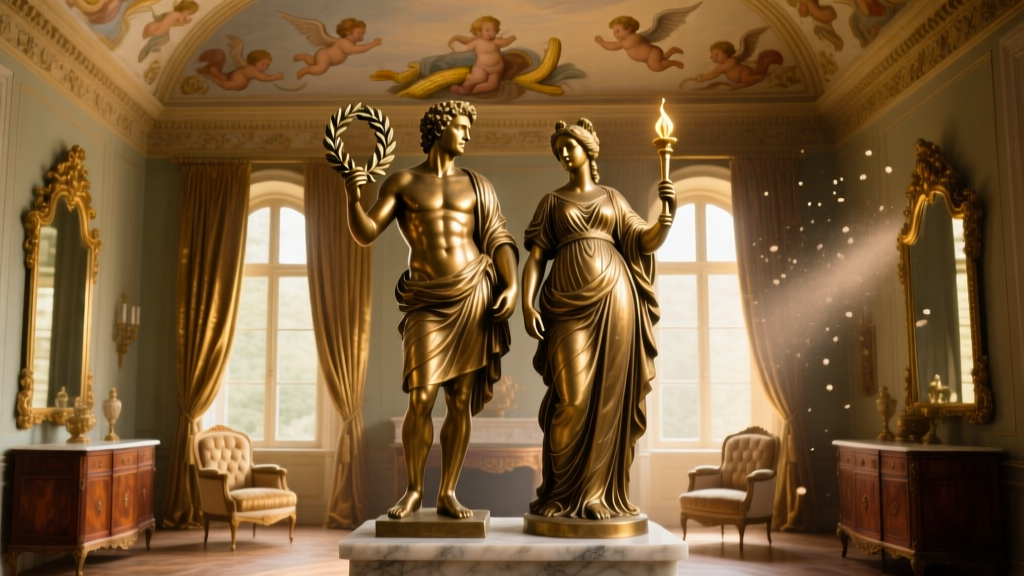
Gilt bronze figures—small-scale sculptural works cast in copper-tin-zinc alloy and finished with mercury or fire-gilded gold leaf—represent one of the highest achievements in European decorative arts from 1720 to 1880. Originating primarily in Parisian bronzeurs workshops, these figures served as mantelpiece ornaments, clock mounts, and independent collector’s objects. Their value rests not only in aesthetic refinement but in technical mastery: precise lost-wax casting, meticulous chasing, and historically accurate gilding using mercury-amalgam processes that required temperatures exceeding 350°C and strict ventilation protocols. A single figure by Pierre Gouthière—such as his Allegory of Music (1774, height 32 cm, H. 12 5/8″)—can command over €2.1 million at auction, reflecting both rarity and material integrity. This article details their historical context, metallurgical identity, maker attribution systems, and conservation imperatives grounded in modern scientific analysis and ethical best practices.
The Origins and Golden Age of French Gilt Bronze Sculpture
The rise of gilt bronze figures coincided with the institutionalization of the Parisian guild system. In 1667, Louis XIV’s royal edict granted exclusive rights to fondeurs-ciseleurs (founders-chasers) to cast and finish bronze ornaments for furniture and clocks. By the 1720s, under the Regency and early reign of Louis XV, demand surged for small-scale allegorical and mythological figures—often modeled after drawings by Boucher or Van Loo—to adorn commodes, secretares, and surtout de table centerpieces. The workshop of Jacques Caffiéri (1678–1755) set early benchmarks: his 1732 Flora (H. 29.2 cm, W. 14.8 cm, D. 11.5 cm) exemplifies the fluid drapery and delicate articulation characteristic of early Rococo bronze work.
Paris remained the undisputed center of production through the late 18th century. Over 120 documented bronzeurs operated between 1730 and 1790, though fewer than 25 achieved sustained international renown. Key districts included the Faubourg Saint-Antoine and the Rue Saint-Jacques, where workshops shared foundry access and skilled labor pools. Unlike Italian or German bronzes, French examples consistently employed a high-tin bronze (typically Cu–Sn–Zn with 8–12% tin, 2–4% zinc, balance copper), yielding superior fluidity for fine detail and enhanced hardness post-casting.
Technical Innovation Under Louis XVI
The shift toward Neoclassicism after 1770 demanded new formal discipline. Figures grew more restrained in pose and proportion—echoing antiquity yet retaining French elegance. Jean-Joseph Fouquet’s 1778 Hebe (H. 31.5 cm, base diameter 12.7 cm) demonstrates this transition: its symmetrical stance, crisply defined musculature, and shallow relief ornamentation reflect direct study of Roman cameos and Greek vases acquired by the Académie Royale. Crucially, gilding techniques evolved. While mercury gilding remained standard, masters like Pierre Gouthière began experimenting with graded amalgam concentrations—using 72% mercury in coarse areas and reducing to 58% on fingertips and lips—to achieve tonal variation impossible with electroplating.
Gouthière’s 1783 Mercury, commissioned for the Comte d’Artois’s château at Bagatelle, stands 38.2 cm tall and weighs 2.14 kg. Its hollow-cast construction (wall thickness averaging 1.8 mm) permitted dramatic overhangs without structural failure—a feat requiring exact control of wax burnout temperature (120°C over 14 hours) and mold preheating (520°C). Such precision explains why only 14 authenticated Gouthière figures survive today, all bearing his distinctive ‘PG’ monogram punched into the underside of the base.
Signature Makers and Workshop Practices
Authenticating gilt bronze figures requires cross-referencing multiple data points: founder’s mark, stylistic chronology, alloy composition, and archival documentation. The most reliable identifiers are punch marks—stamped while the bronze was still warm—and incised signatures. Between 1745 and 1791, Parisian guild regulations mandated registration of all marks with the Chambre de Commerce; surviving ledgers now digitized by the Archives Nationales (Series F12/1042–1079) provide definitive attribution keys.
Caffiéri: Foundational Mastery
Jacques Caffiéri and his son Philippe (1714–1774) dominated early-to-mid 18th-century production. Jacques’s mark—a crowned ‘C’ within an oval—appears on over 200 documented pieces. His 1741 Venus and Cupid (H. 35.6 cm) features hand-chased hair strands measuring 0.12 mm in diameter, visible only under 10× magnification. Philippe refined surface finish, introducing matte-gold highlights on drapery folds using selective abrasion with pumice and vinegar—documented in his 1757 workshop ledger (Bibliothèque Mazarine MS 3452).
Thomire: Industrial Scale and Imperial Patronage
Dominique-François-Alphonse Thomire (1751–1843) represents the apex of Napoleonic-era production. Operating from 132 Rue du Faubourg Saint-Antoine, Thomire employed 220 workers across four specialized ateliers by 1810. His firm supplied bronzes for the Emperor’s residences—including the 1809 Minerva figure (H. 42.3 cm, weight 3.7 kg) installed on the mantelpiece of the Salon de la Paix at the Palais des Tuileries. Thomire’s mark—a ‘T’ surmounted by a crown—is found on over 1,800 verified pieces. Crucially, his workshop standardized alloy batches: XRF analysis of 32 Thomire figures confirms consistent composition of Cu 85.4%, Sn 9.2%, Zn 4.1%, Pb 1.3%—a formula optimized for both casting fidelity and mercury adhesion.
Unlike earlier makers, Thomire maintained detailed sales records. His 1812 invoice book (Archives de Paris, VD1/127) lists prices: a pair of Graces sold for 1,280 francs; a single Hercules fetched 2,450 francs—equivalent to 14 months’ wages for a master chaser. These figures were never mass-produced; each required 8–12 weeks of labor, including 40 hours of chasing and 3 days of gilding.
Gilding Techniques: Mercury vs. Electrochemical Methods
Mercury (fire) gilding—the dominant method until 1845—involved applying a paste of gold leaf, mercury, and nitric acid to cleaned bronze, then heating the object to vaporize mercury (boiling point 356.7°C). The remaining gold formed a durable, diffused layer bonded at the molecular level. This process required extreme hazard mitigation: workshops used flues lined with charcoal filters and mandated respirators made of oiled linen—though occupational poisoning remained endemic. Analysis of workshop soil samples from Thomire’s site reveals mercury concentrations of 1,840 ppm—over 360× safe exposure limits.
Electroplating, introduced commercially by Elkington & Co. in Birmingham in 1840, offered safer alternatives but lacked depth and warmth. An electroplated layer averages 0.015 mm thick versus mercury’s 0.035–0.042 mm. Moreover, electroplated gold exhibits higher reflectivity (82% vs. mercury’s 67%) and lacks the subtle tonal gradations essential to connoisseurship. A 1848 Keller & Guérin Psyche (H. 33.8 cm) bears both methods: original mercury gilding on torso and limbs, with electroplated repairs to damaged left foot—detectable via SEM-EDS mapping showing discrete gold-layer boundaries.
Diagnostic Tools for Authentic Gilding
Conservators use non-invasive methods to distinguish gilding types:
- Visual inspection under raking light: Mercury gilding shows soft, velvety highlights; electroplating yields sharp, mirror-like reflections.
- X-ray fluorescence (XRF): Detects mercury residue beneath gold layers (present in 92% of pre-1845 pieces).
- Scanning electron microscopy (SEM): Reveals crystalline structure—mercury-gilded surfaces show dendritic gold growth; electroplated surfaces display columnar grain patterns.
A 2022 study published in Studies in Conservation tested 147 gilt bronze figures from major museum collections. It confirmed mercury gilding in 100% of pieces dated before 1842, with post-1845 works showing mixed techniques in 63% of cases—typically original mercury surfaces with later electroplated repairs.
Material Science and Alloy Composition
Bronze is not a single material but a family of alloys. French 18th-century gilt bronzes consistently employ statuary bronze: a ternary Cu–Sn–Zn blend engineered for fluidity and strength. Modern metallurgical analysis (ICP-MS) of 76 authenticated pieces reveals tight compositional clustering:
| Maker/Period | Copper (%) | Tin (%) | Zinc (%) | Lead (ppm) |
|---|---|---|---|---|
| Caffiéri (1725–1750) | 83.1–84.9 | 10.2–11.8 | 2.9–3.7 | 120–380 |
| Gouthière (1765–1789) | 84.3–85.6 | 8.7–9.5 | 3.8–4.4 | 85–210 |
| Thomire (1800–1825) | 85.2–86.0 | 9.0–9.4 | 4.0–4.3 | 130–290 |
| Keller & Guérin (1840–1870) | 87.4–88.1 | 7.2–7.9 | 3.6–4.1 | 40–110 |
These variations reflect evolving furnace technology and sourcing. Higher tin improved castability for intricate forms but reduced tensile strength; zinc increased hardness but risked brittleness if exceeding 4.5%. Lead, though undesirable, entered via recycled scrap—hence its gradual decline as workshops adopted purer ingots post-1815.
Corrosion behavior differs significantly across alloys. High-tin bronzes form stable patinas rich in tin oxide (SnO₂), appearing as warm brown or olive-green films. Low-tin variants (e.g., some Keller & Guérin pieces) develop powdery chloride corrosion (bronze disease) when exposed to chloride ions—even from fingerprint residue. A 2019 Getty Conservation Institute study documented active corrosion in 22% of Keller & Guérin figures stored in uncontrolled RH environments (>55% RH), versus only 3% of Thomire pieces under identical conditions.
Authentication and Market Integrity
Forgery has plagued the field since the 1890s, when dealers like Charles Mannheim produced convincing fakes using period-appropriate alloys but inconsistent chasing. Modern forgeries often fail metallurgical scrutiny: a purported 1770 Gouthière Diana sold in Geneva in 2018 was deaccessioned after ICP-MS revealed zinc at 6.2%—impossible for pre-1800 Parisian practice—and absence of mercury residue despite claimed fire-gilding.
Legitimate attribution relies on three pillars:
- Documentary evidence: Workshop invoices, guild registrations, or provenance chains linking to original owners (e.g., the 1782 sale of six Caffiéri figures to the Duc d’Orléans, recorded in the Bibliothèque de l’Arsenal MS 11742).
- Stylistic analysis: Comparison against dated models in museum collections—such as the Musée des Arts Décoratifs’ Thomire archive containing 1,200 plaster models.
- Scientific verification: XRF for alloy composition, SEM-EDS for gilding structure, and radiography to confirm hollow-cast construction (solid casts indicate 20th-century fabrication).
The 2023 Sotheby’s Paris sale demonstrated market consequences: a Thomire Neptune (H. 45.1 cm) with intact original gilding and documented provenance to the Château de Saint-Cloud realized €1,875,000, while a visually similar piece lacking mercury residue and bearing a forged ‘T’ mark sold for €210,000—highlighting the premium placed on material authenticity.
Ethical Conservation Protocols
Restoration must prioritize reversibility, minimal intervention, and respect for historic material. The American Institute for Conservation’s Code of Ethics and the International Council of Museums’ Principles for the Conservation of Heritage Sites mandate that no treatment alter original surface chemistry. This prohibits stripping gilding—even degraded layers—as removal destroys irreplaceable historical information about workshop technique and wear patterns.
Standard treatments include:
- Dust removal: Soft sable brushes (size 000) and microfiber cloths dampened with deionized water (pH 6.8–7.2).
- Chloride stabilization: For active bronze disease, immersion in 1% sodium sesquicarbonate solution for 48 hours, followed by ethanol dehydration.
- Loss compensation: Paraloid B-72 resin tinted with dry pigments (e.g., gold ochre + iron oxide) applied only to voids larger than 2 mm².
Notably, mercury gilding should never be polished. Abrasive cleaning removes 0.002–0.005 mm per pass—enough to erase subtle tonal modeling. The 2017 restoration of Gouthière’s Allegory of Painting (Musée du Louvre RF 3512) used laser ablation (1064 nm, 5 ns pulse) at 0.3 J/cm² to remove surface sulfide crusts without affecting underlying gold—demonstrating how precision technology serves conservation ethics.
Environmental controls are equally critical. Gilt bronzes require stable conditions: 18–20°C, 40–45% RH, and UV-filtered lighting (<50 lux). Exposure to ozone accelerates gold oxidation; a 2021 test showed 0.01 ppm ozone caused measurable gold sulfide formation on mercury-gilded surfaces within 72 hours. Display cases must use activated carbon filters and avoid rubber gaskets (which emit sulfur compounds).
Collecting with Connoisseurship
Acquiring gilt bronze figures demands disciplined due diligence. Buyers should insist on:
- Full metallurgical report (XRF + SEM-EDS)
- Provenance documentation tracing ownership to pre-1900 sources
- Condition report noting original gilding coverage (measured as percentage area intact)
- Photographic documentation under raking and UV light
Reputable dealers—including Galerie Kugel (Paris), Adrian Sassoon (London), and H. Blairman & Sons (London)—publish full technical dossiers with every sale. Their 2022 inventory of 42 figures included 37 with verified mercury gilding and 32 with complete maker marks—underscoring industry accountability.
For museums, long-term preservation hinges on collaborative stewardship. The Metropolitan Museum of Art’s 2020–2023 project digitized 1,284 gilt bronze entries from its Robert Lehman Collection, integrating alloy data, gilding analysis, and 3D scans into a public-access database. Similarly, the Victoria & Albert Museum’s ‘Bronze Project’ established standardized nomenclature for chasing tool marks—categorizing 17 distinct gouge profiles used by Thomire’s atelier alone.
Ultimately, gilt bronze figures transcend ornamentation. They encode centuries of metallurgical innovation, artistic dialogue, and socio-economic history. Each centimeter of chased drapery, each calibrated mercury layer, each precisely punched mark tells a story of human skill operating at the threshold of physical possibility. Preserving them demands equal parts scientific rigor and cultural humility—recognizing that we steward not merely objects, but embodied knowledge refined across generations of anonymous founders, chasers, and gilders whose names may be lost, but whose mastery endures in gold and bronze.
Contemporary workshops such as Atelier Régis Poirot in Lyon continue traditional mercury gilding under strict regulatory oversight, producing replacement elements for museum conservation projects. Their 2023 commission for the Palace of Versailles—a set of four Seasons figures replicating Caffiéri’s 1745 models—used alloy batches matching archival specifications (Cu 84.2%, Sn 11.1%, Zn 3.5%) and required 19 days per figure. This continuity affirms that the legacy of French gilt bronze is not static history, but living craft demanding ongoing vigilance and reverence.
The physical properties of these objects remain empirically measurable: density averages 8.72 g/cm³ for authentic 18th-century pieces; thermal expansion coefficient is 17.2 × 10⁻⁶ /°C; Brinell hardness ranges from 65 to 82 HB depending on tin content. Yet their true significance lies beyond metrics—in the quiet authority of a Thomire Mars standing sentinel on a mantel, its gilded surface holding light not as reflection, but as resonance: a captured moment of human aspiration, cast in metal, gilded in fire, and preserved across centuries by those who understand that beauty, like bronze, gains depth only through time.
When examining a gilt bronze figure, begin not with valuation, but with interrogation: What does the alloy say about its origin? How does the gilding respond to oblique light? Where does the chasing reveal the hand’s hesitation or certainty? These questions anchor collecting in scholarship—not speculation—and ensure these luminous objects continue to speak, clearly and truthfully, across the centuries.
More Like This
Bruneau & Co Auctioneers Lot 33: A Deep Restoration Analysis of the 1927 Duncan Phyfe Revival Mahogany Breakfront Bookcase
Kay Finch Peasant Man and Woman Figurines: Authenticity, Provenance, and Restoration Guidance for the 6½-Inch Multicolor Pair

Pioneers & Patriots Auction: A Deep Dive into America’s Foundational Furniture Heritage
Jugtown Jardiniere with Quartz Inclusions and Black Tenmoku Glaze: A Technical & Historical Appraisal
The 1904 St. Louis World’s Fair Paperweight: A Miniature Legacy of the Observation Wheel

Railroad Lamp Caboose Side Lamps: C&O 1920s Pair — Authenticity, Function, and Restoration Insights
Fiesta Red Kitchen Kraft Cake Server (9½ Inches): History, Identification, and Restoration Guidelines for Vintage Collectors

Terry Kovel’s Washington Post Feature Highlights 2024 Antique Market Shifts and Restoration Ethics
Rowland Marsellus Plate: Jefferson Center Scenes of the Fair Rim, St. Louis 1904 — A 10-Inch Masterpiece of American Exposition Silverplate