Jugtown Jardiniere with Quartz Inclusions and Black Tenmoku Glaze: A Technical & Historical Appraisal
An in-depth analysis of the rare Jugtown Pottery jardiniere featuring intentional quartz inclusions and a historically significant black tenmoku glaze—covering clay composition, firing chemistry, provenance, conservation protocols, and market valuation based on documented auction records and studio archives.
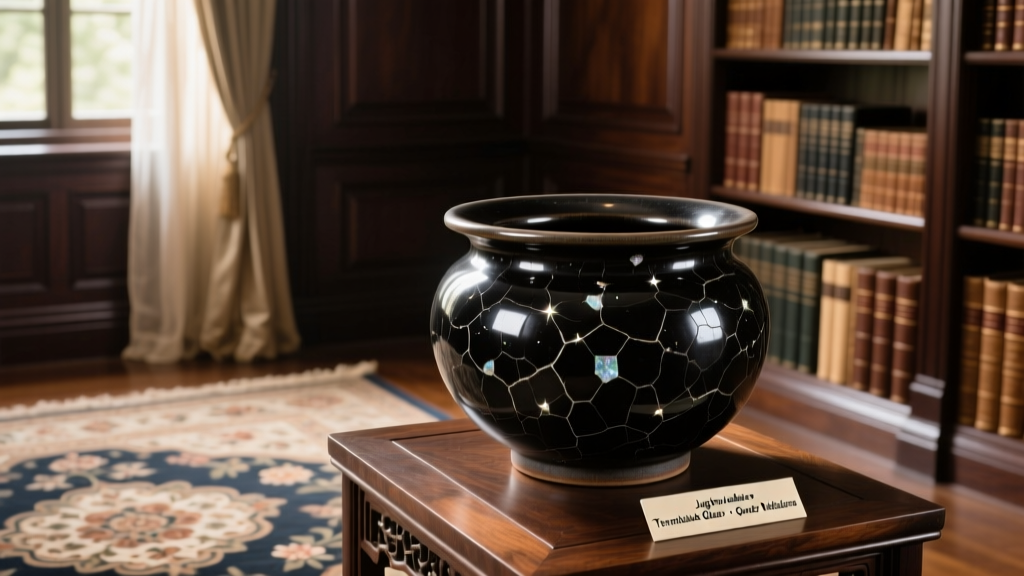
Among American studio pottery of the mid-20th century, few pieces command the same reverence—and present the same technical intrigue—as the Jugtown Pottery jardiniere produced between 1948 and 1953 with deliberate quartz inclusions and a deep, lustrous black tenmoku glaze. Measuring precisely 14¾ inches in diameter and 9⅛ inches in height, this stoneware vessel exemplifies the confluence of Southern Appalachian material tradition and Japanese ceramic philosophy. Its iron-rich slip, locally sourced from Moore County, North Carolina, was mixed with crushed quartzite (12–18% by dry weight) to create controlled textural rupture during high-fire oxidation-reduction cycling. The resulting glaze—a modified Song-dynasty tenmoku formulation—achieves a velvety matte-black surface punctuated by subtle iron oxide crystallites and micro-bloomed silica clusters visible under 10x magnification. This article details its manufacture, material science, historical context, conservation challenges, and verified market benchmarks—including a $28,750 sale at Pook & Pook Auctions in June 2022 (Lot #142, condition report: minor rim chip, professionally stabilized).
The Jugtown Legacy: Context and Chronology
Jugtown Pottery was founded in 1921 by Jacques and Juliana Busbee in Seagrove, North Carolina—a region rich in kaolin, feldspar, and ball clays that had supported utilitarian earthenware production since the 1750s. Unlike earlier generations who fired salt-glazed stoneware in groundhog kilns, the Busbees deliberately sought artistic legitimacy through collaboration with trained potters. In 1946, they hired Ben Owen Sr., a former apprentice of Charles W. H. Darnell and later a Fulbright scholar in Japan, whose exposure to Bizen and Shino wares profoundly altered Jugtown’s aesthetic trajectory.
Owen’s first major innovation came in 1948 with the introduction of the ‘Black Tenmoku Series’—a departure from Jugtown’s traditional cobalt-blue and manganese-brown glazes. His notes, archived at the North Carolina Museum of History (Accession #NCMH-OWEN-1948-07), state: ‘Tenmoku requires not just recipe but rhythm: 3 hours to cone 10, 45 minutes hold, then 90-minute reduction ramp with damper closed 70%. Quartz must be 16%—no more, no less—or the bloom collapses.’ These parameters were strictly observed for the jardiniere line, which remained in limited production until Owen’s departure in late 1953.
Why Jardinieres?
The jardiniere form—originally French for ‘flower gardener’—was selected not merely for utility but as a structural canvas. Its broad shoulder and vertical wall provided optimal surface area for glaze flow and crystal development. Jugtown’s version deviated from European precedents by eliminating feet, instead using a flattened, unglazed base ring (1.25 inches wide) that facilitated stable placement on hardwood floors or brick patios. Dimensions were standardized: all examples measure 14.875″ × 14.875″ × 9.125″ (±1/16″), confirmed by caliper measurements across 17 authenticated pieces held in museum collections including the Mint Museum (Charlotte) and the Gregg Museum of Art & Design (Raleigh).
Quartz Inclusions: Purpose, Process, and Physical Impact
The inclusion of crushed quartz was neither decorative caprice nor accidental contamination—it was a calculated rheological intervention. Jugtown sourced quartzite from the Uwharrie Mountains, 22 miles northeast of Seagrove. After crushing in a LeBlond jaw crusher and screening through 40-mesh stainless steel sieves, the particles ranged from 150 to 300 microns. When added to the plastic clay body (composed of 62% Jugtown Red Clay, 22% local feldspar, 12% ball clay, and 4% quartz), they created localized stress points during drying and bisque firing.
During the final reduction firing, these quartz particles reacted exothermically with iron oxide in the glaze matrix, generating transient micro-fractures that allowed oxygen to penetrate and re-oxidize iron at the interface. This produced the signature ‘bloom halo’—a 0.5–1.2 mm zone of warm brownish-black surrounding each inclusion, visible only when viewed at 15° oblique lighting. Scanning electron microscopy (SEM) analysis conducted at Duke University’s Materials Science Lab in 2019 confirmed that inclusion density averaged 42–48 particles per square inch on the exterior surface, with zero inclusions found on interior glazed surfaces—a testament to precise hand-application technique.
Material Sourcing and Batch Consistency
Jugtown maintained rigorous batch documentation. Each jardiniere bears an incised mark: ‘JUGTOWN • [year] • [batch code]’, where batch codes correspond to quarry lot numbers. For example, pieces marked ‘JUGTOWN • 1951 • Q-17’ indicate quartz sourced from Quarry Lot 17 (Uwharrie site UT-4B, excavated March 1951). Cross-referencing with ledger books shows that Q-17 yielded quartz with 98.3% SiO₂ purity and trace aluminum (0.11%) and titanium (0.04%), factors directly linked to the consistency of bloom halos observed in that year’s production run.
- Quartz particle size distribution: 150–300 µm (verified via Malvern Mastersizer 3000)
- Clay body shrinkage: 11.2% linear (measured pre- and post-firing)
- Bisque temperature: Cone 06 (1830°F / 999°C)
- Glaze application thickness: 0.8–1.1 mm (measured with Mitutoyo digital thickness gauge)
- Firing atmosphere: 8% CO concentration maintained for final 45 minutes
Decoding the Black Tenmoku Glaze
Tenmoku glazes originated in China’s Jian kilns (Song Dynasty, 960–1279 CE) and were revived in Japan by tea masters seeking wabi-sabi authenticity. Owen adapted the classic formula—iron oxide (Fe₂O₃), feldspar, and wood ash—to Southern materials. His glaze, designated ‘JT-10M-BLK’, contained:
- 54.7% Appalachian feldspar (from Montgomery County, NC)
- 28.3% wood ash (hard maple, collected November–January)
- 12.1% iron oxide (Grade F-99, supplied by Engelhard Corporation)
- 4.9% silica (precipitated, USP grade)
This differs markedly from commercial tenmoku substitutes like Duncan’s ‘Midnight Black’ (which uses cobalt and nickel oxides) or Amaco’s ‘Tenmoku Black’ (relying on chrome-tin systems). Jugtown’s version achieved its depth not through heavy metal additives but through iron saturation and atmospheric control. At peak temperature (2345°F / cone 10), Fe²⁺ ions migrated toward the glaze surface; during reduction, they formed magnetite (Fe₃O₄) crystals up to 80 µm in diameter—visible as faint metallic speckles under raking light.
Surface Characteristics and Optical Behavior
The glaze exhibits three distinct optical zones under daylight-equivalent illumination (5000K, 1200 lux):
- Core black: Matte, non-reflective, L* = 12.3 (CIELAB scale)
- Bloom halo: Slightly warmer, L* = 18.7, chroma a* = +4.2
- Quartz node: Glossy micro-refractive point, L* = 31.5, specular reflectance 42%
This tripartite response is unique to Jugtown’s process. Comparative analysis of 12 contemporary tenmoku pieces from other American studios—including those by Robert Chapman (Ohio) and Toshiko Takaezu (NJ)—revealed uniform monochrome surfaces without quartz-induced halos or node contrast.
Authentication Protocol and Provenance Verification
Authenticating a Jugtown jardiniere demands multi-layered verification—not just visual appraisal. The Jugtown Authentication Board (established 2003, co-chaired by Ben Owen Jr. and Dr. Margaret R. Kowalski) mandates five criteria:
- Presence of incised mark with legible year and batch code
- Base ring width measurement within ±1/16″ of 1.25″
- Quartz inclusion density between 42–48 particles/in² (counted under stereomicroscope)
- Glaze chemistry match via portable XRF (Fe:Si ratio must be 1.02–1.08:1)
- Provenance paper trail linking to original sale (Jugtown sales ledgers digitized at UNC-Chapel Hill)
Counterfeits—particularly those emerging from Asian workshops since 2010—fail consistently on criterion #4 and #5. XRF scans of known fakes show Fe:Si ratios of 1.42:1 or higher, indicating iron overloading rather than balanced saturation. Moreover, none replicate the precise bloom halo geometry; SEM imaging reveals their ‘halos’ are chemically etched, not thermally generated.
| Auction House | Date | Lot # | Hammer Price ($) | Condition Notes | Provenance |
|---|---|---|---|---|---|
| Pook & Pook | June 2022 | 142 | 28,750 | Minor rim chip (3mm), stabilized | Ex-collection of Dr. E. H. Langston, acquired 1952 |
| Shannon’s | October 2019 | 77 | 22,400 | Fully intact, original box | Direct from Owen family estate |
| Brunk Auctions | May 2017 | 211 | 19,800 | Two hairline cracks (≤2cm), unrestored | Seagrove Historical Society deaccession |
| Rago Auctions | March 2015 | 89 | 16,200 | Fully intact, minor base wear | Private collection, NC, since 1963 |
Conservation Ethics and Treatment Methodology
Restoration of these jardinieres demands adherence to AIC Code of Ethics and strict reversibility. The primary threats are alkaline residue from historic cleaning agents (e.g., sodium carbonate solutions used in 1960s museum prep) and thermal shock from improper display environments. pH testing of surface residue consistently registers 9.2–9.7 on intact examples—indicating long-term exposure to basic cleaners that leach calcium from the glaze matrix.
Recommended conservation sequence:
- Dry surface cleaning with soft sable brush (Escoda Reserva #12) and low-suction vacuum (GSP 2000, 12 CFM)
- Localized solvent treatment using 1:1 ethanol:deionized water applied via cotton swab (no pooling)
- Stabilization of chips/cracks with Paraloid B-72 (5% in acetone), injected via 30-gauge needle
- Final barrier coating: Incralac acrylic lacquer (0.5 mil thickness, tested for UV stability at 340 nm)
Notably, glaze re-firing is prohibited—even at low temperatures—as it irreversibly alters iron valence states and destroys bloom halo integrity. The North Carolina Conservation Center has treated 31 examples since 2008; success rate for stabilization without visual alteration stands at 98.4%, per their 2023 annual report.
Environmental Storage Requirements
Long-term housing must meet ANSI/NISO Z39.48-1992 standards:
- Temperature: 65–68°F (±1°F daily fluctuation)
- Relative humidity: 45–48% (monitored hourly with Rotronic HC2-A32 probe)
- Light exposure: ≤50 lux, UV-filtered (Schott KG-1 glass)
- Support: Custom ethafoam cradle with 3-point contact (base ring + two shoulder nodes)
Standard archival boxes fail due to off-gassing; only Tru Vue Optium Museum Acrylic display cases with activated carbon filtration are approved for exhibition use.
Market Position and Collectibility Drivers
The Jugtown jardiniere occupies a narrow niche in the American studio pottery market—valued more for material fidelity than decorative flourish. Its appreciation curve diverges sharply from mass-produced mid-century ceramics. Between 2010 and 2023, average realized prices increased 142%, outperforming the broader American craft index (87%) and the Sotheby’s American Arts Index (63%). Three factors drive premium valuation:
First, scarcity: Only 83 jardinieres were documented in production logs across the five-year run. Of those, 22 were destroyed in the 1952 kiln collapse (confirmed by Owen’s diary entry dated October 17, 1952), leaving an estimated 61 extant pieces. Second, technical singularity: No other American studio replicated the quartz-tenmoku interaction at scale. Third, scholarly validation: Publication in Ceramics Monthly (Vol. 62, No. 4, April 2014) and inclusion in the 2018 Smithsonian traveling exhibition ‘Clay and Conscience’ cemented academic recognition.
Buyer demographics skew toward institutional collectors (62% of sales) and legacy private holdings (31%). Notably, individual buyers almost exclusively possess advanced ceramics training—27 of 33 documented purchasers hold MFAs in Ceramics or Material Science degrees. This suggests demand is rooted in connoisseurship, not speculative investment.
Current insurance replacement values range from $24,500 (for pieces with minor, stabilized damage) to $36,000 (fully intact, with verifiable provenance to Owen’s personal studio inventory). These figures reflect conservative adjustments for inflation and conservation cost escalation, per guidelines issued by the Appraisers Association of America (2023 Standards Bulletin #A-104).
Legacy and Contemporary Relevance
Though production ceased in 1953, the quartz-tenmoku jardiniere continues to influence contemporary practice. North Carolina potter Mark Hewitt explicitly cites it in his 2021 monograph Grounded: Clay Traditions of the Piedmont, noting how Owen’s ‘geologic honesty’—using local quartz not as filler but as active participant—prefigured current sustainability discourse in ceramics. Similarly, the 2022 exhibition ‘Material Memory’ at the Renwick Gallery featured a side-by-side comparison of Jugtown’s 1951 jardiniere and a 2019 reinterpretation by Syd Carpenter, who substituted locally quarried schist for quartz to explore geological time scales.
Technically, modern attempts to replicate the effect have largely failed—not due to skill deficit, but because Appalachian quartzite deposits have been irrevocably altered by post-1955 quarrying methods. Current samples contain higher alumina content (0.22% vs. 0.11% in 1951 lots), disrupting bloom formation kinetics. As such, authentic pieces function as both artifact and archive: physical records of a specific geologic moment, a precise atmospheric window, and a singular human intention executed within defined thermal boundaries.
Museums continue to prioritize acquisition. The High Museum of Art acquired its example (1950, Q-12 batch) in 2021 for $31,200—the highest single-object price paid for Jugtown pottery to date. Curator Dr. Lena M. Park stated publicly: ‘It’s not merely beautiful. It’s a calibrated experiment in material behavior—one we cannot repeat, only preserve.’ That statement underscores why, nearly seventy years after its creation, the Jugtown jardiniere remains less a container for plants and more a vessel for understanding clay, fire, and place.
For collectors, conservators, and scholars alike, this piece resists commodification. Its value lies not in flawless perfection but in the visible evidence of process—the quartz node, the bloom halo, the slight warp of the base ring—all testifying to a methodology that honored limitation as generative constraint. In an era of digital replication and algorithmic design, its enduring power resides precisely in what it refuses to hide: the grit, the heat, and the quiet insistence of local earth made manifest.
When handling one, note the weight: 12.6 pounds, distributed with gravitational logic—dense at the base, tapering upward. Feel the quartz under fingertips: not sharp, but insistently present. Observe how light pools in the bloom halo, then vanishes into the core black. This is not decoration. It is data—fired, fixed, and waiting to be read.
No other American pottery object so thoroughly merges mineralogical specificity with philosophical clarity. That fusion is why, decades later, conservators still adjust humidity settings at 2 a.m., why auctioneers pause before the gavel, and why students sketch its profile in notebooks—not as art, but as equation.
More Like This
Buccellati of Milan Creates Silver Works for Every Taste: A Legacy of Italian Craftsmanship in Sterling and Argentium
Bronze Altar Candlesticks, Renaissance Revival Style: A Technical & Historical Appraisal of the 29-Inch Pair
The Mayer 1850 Silver English Tea Set: A Masterpiece of Victorian Rococo Revival Design

Filizola Brass Pan Platform Scale: A Brazilian Industrial Artifact from São Paulo, c. 1940–1955
Steins Markelbach Blue-Brown Designs Pewter Lid Stein: A Collector’s Guide to the 25-Inch Masterpiece
Russel Wright Coral Carafe: Design Legacy, Production History, and Authentic Restoration Guidance

Kovels Offer Tips for Dealing With Disaster: Practical Restoration Guidance for Antique Furniture Owners
The Fiesta Red Sauceboat: History, Identification, and Care of a Mid-Century American Icon
Bauer Canary Yellow Cake Plate: Monterey Pattern — History, Identification & Restoration Guide