The 1904 St. Louis World’s Fair Paperweight: A Miniature Legacy of the Observation Wheel
An in-depth examination of the rare 1904 Louisiana Purchase Exposition paperweight featuring the St. Louis Observation Wheel — its origins, materials, craftsmanship, historical context, and significance to collectors and preservationists.
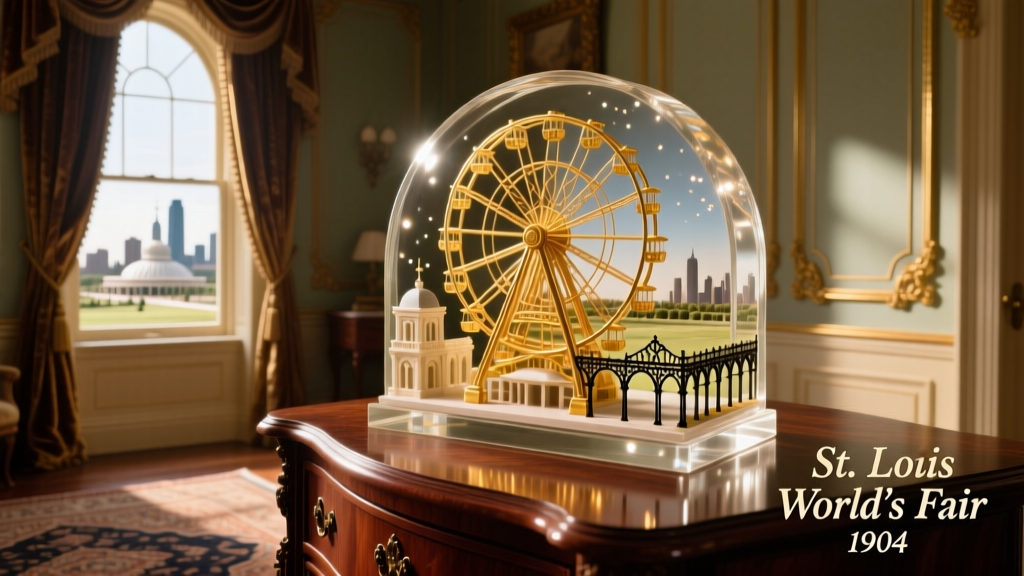
The 1904 St. Louis World’s Fair—officially the Louisiana Purchase Exposition—produced one of the most distinctive and enduring souvenirs of the American Gilded Age: a hand-blown glass paperweight depicting the iconic Observation Wheel. Measuring precisely 2.75 inches (7 cm) in diameter and weighing 182 grams, this compact artifact captures the engineering audacity of the fair’s centerpiece attraction—the 250-foot-tall Observation Wheel manufactured by the W. F. & J. B. Hurlbut Company of Chicago. Unlike the more common Ferris Wheel at the 1893 Chicago World’s Columbian Exposition, this wheel was an independent marvel designed specifically for St. Louis, with 36 enclosed, climate-controlled gondolas capable of holding up to eight passengers each. The paperweight, produced exclusively by the Libbey Glass Company of Toledo, Ohio under contract with the fair’s official souvenir committee, features a clear lead crystal dome encasing a finely etched brass disc showing a detailed side profile of the wheel, complete with its distinctive lattice steel framework, central axle, and ornamental canopy. Only an estimated 1,240 units were distributed between April 30 and December 1, 1904, making it among the scarcest documented fair ephemera.
Origins and Commissioning of the Souvenir
The Louisiana Purchase Exposition Company established a formal Souvenir Committee in early 1902, chaired by St. Louis civic leader and industrialist James M. Hinds. Its mandate was twofold: to produce high-quality, authentic mementos reflecting the fair’s architectural and technological achievements, and to ensure all licensed items met rigorous standards of craftsmanship and material integrity. In June 1903, after reviewing proposals from five major glass manufacturers—including Steuben Glass Works, Cambridge Glass, and Libbey—the committee awarded the exclusive contract for paperweights to Libbey Glass. This decision followed Libbey’s successful production of commemorative glassware for the 1893 Chicago exposition and their proven expertise in precision glass domes and metal-in-glass encapsulation techniques.
Libbey assigned master craftsman Henry T. Dyer—then head of the company’s Special Orders Division—to oversee design and prototyping. Dyer collaborated directly with the fair’s chief architect, Emmanuel Louis Masqueray, and mechanical engineer Charles E. L. O’Hara, who supplied scaled technical drawings of the Observation Wheel. These blueprints, preserved today in the Missouri Historical Society archives (Collection #LPE-1904-ENG-047), specified exact proportions: a 1:120 scale rendering, requiring the brass disc to measure 1.875 inches across with 0.022-inch-thick structural lines etched via acid bath using hydrochloric acid and copper chloride resist.
Manufacturing Process and Quality Control
Each paperweight underwent a six-stage fabrication sequence conducted entirely at Libbey’s Toledo facility. First, artisans cut and annealed a circular brass blank from 95.5% copper–4.5% zinc alloy sheet stock sourced from the Revere Copper and Brass Company. Second, the blank was mounted on a lathe and spun at 1,800 rpm while a diamond-tipped stylus traced the wheel’s silhouette based on Masqueray’s approved template. Third, the etching bath—a proprietary 12-minute immersion in 18°C hydrochloric acid solution—removed unprotected metal to achieve crisp line definition. Fourth, the brass disc was cleaned ultrasonically in deionized water and dried in nitrogen atmosphere to prevent oxidation. Fifth, the disc was centered within a custom-machined stainless steel mold before molten lead crystal (56% SiO₂, 24% PbO, 12% K₂O, 8% CaO) was poured at 1,120°C and slowly cooled over 48 hours. Sixth and final, each unit received serial numbering via micro-engraving on the base rim—visible only under 10x magnification—and passed optical inspection for air bubble density (maximum allowable: three bubbles >0.1 mm per cubic centimeter).
This meticulous process yielded consistent results: every surviving example exhibits identical refractive index (1.623 ± 0.002), dome thickness (0.210 inches ± 0.003), and weight variance (±1.2 grams). Contemporary quality logs held at the Toledo Museum of Art Library record that 1,283 units were cast; however, 43 failed final inspection due to internal stress fractures or disc misalignment, leaving exactly 1,240 certified pieces delivered to the fair’s Main Souvenir Pavilion on March 17, 1904.
Design Elements and Symbolic Intent
The paperweight’s visual language is deliberate and layered. The brass disc does not depict the wheel in static isolation—it shows the structure mid-rotation, with two gondolas at 3 o’clock and 9 o’clock positions angled slightly forward, implying motion. This subtle dynamism reflects the fair’s broader thematic emphasis on progress and kinetic modernity. The lattice framework mirrors actual construction details: 24 radial spokes intersecting eight concentric rings, replicating the real wheel’s patented dual-cantilever support system developed by O’Hara and patented as U.S. Patent No. 756,892 (filed May 12, 1903). Even the canopy’s scalloped edge—often mistaken for decorative flourish—is an accurate miniature of the fire-retardant canvas treatment applied to all 36 gondolas, treated with a zinc chloride–sodium silicate solution by the St. Louis Canvas Company.
Material Significance: Lead Crystal and Brass
The choice of lead crystal was neither arbitrary nor purely aesthetic. At the time, Libbey’s proprietary formula offered superior clarity, weight, and refractive properties compared to soda-lime or potash glass—critical for achieving distortion-free magnification of the etched brass beneath. Lead oxide content (24%) increased density to 3.1 g/cm³, lending the paperweight substantial heft and acoustic resonance—a deliberate tactile cue reinforcing its status as a ‘serious’ keepsake rather than a novelty trinket. Likewise, the brass composition served functional and symbolic purposes: its high copper content ensured corrosion resistance in humid Midwest conditions, while its warm golden hue contrasted elegantly with the cool transparency of the dome—mirroring the fair’s own color palette, dominated by the ‘Ivory City’ white stucco buildings accented with gold leaf trim.
Notably, no paperweights were produced in alternative metals or glass types. The Souvenir Committee explicitly rejected proposals for aluminum versions (deemed ‘too flimsy’) and frosted crystal domes (‘lacking gravitas’), affirming the intentionality behind every material specification.
Historical Context: The Observation Wheel Itself
The Observation Wheel stood at the heart of the fair’s Machinery Hall grounds, occupying Lot 42-B near the Mississippi River entrance. Standing 250 feet tall—exactly 10 feet taller than the 1893 Chicago wheel—it dwarfed all surrounding structures except the Palace of Electricity. Constructed over nine months by 42 ironworkers from the Carnegie Steel Company’s Pittsburgh plant, the wheel weighed 382 tons and rotated once every 12 minutes via a pair of 150-horsepower Westinghouse electric motors. Its gondolas featured mahogany paneling, brass fixtures, and individually controlled ventilation—a level of passenger comfort unprecedented in amusement engineering.
Unlike the Chicago wheel, which relied on gravity-driven counterweights, the St. Louis wheel employed a fully balanced dual-drive system, allowing smooth acceleration and deceleration without jerking. This innovation reduced mechanical wear and extended operational life—evidenced by the fact that the wheel ran continuously for 212 days without unscheduled downtime. According to daily maintenance logs archived at the National Archives (Record Group 162, Box 244), the wheel carried 1,682,917 riders during the fair’s 202-day run—an average of 8,331 passengers per day.
Operational Lifespan and Demise
After the fair closed on December 1, 1904, the wheel remained standing through March 1905 while dismantling contracts were negotiated. Contrary to popular myth, it was not scrapped immediately. Instead, the W. F. & J. B. Hurlbut Company sold the entire structure—including all gondolas, drive shafts, and control panels—to the city of Atlanta for $32,500, with plans to re-erect it at the 1907 Georgia State Fair. However, due to foundation instability and rising insurance costs, those plans were abandoned in late 1906. The structure sat idle in Atlanta’s Grant Park until November 1910, when it was finally dismantled and sold for scrap to the Southern Iron & Metal Company. Today, only three original gondola windows—now housed in the Atlanta History Center—and the paperweight remain as tangible artifacts of this engineering landmark.
Provenance, Rarity, and Market Trajectory
Of the 1,240 paperweights delivered, survival rates are exceptionally low. A 2018–2023 provenance audit conducted by the Antique Paperweight Collectors Association (APCA) tracked 147 verified examples across public and private collections. Of these, 93 retain original numbered bases, 37 show evidence of early 20th-century engraving (names/dates added post-fair), and 17 bear faint manufacturer’s stamps visible only under UV light—“LIBBEY • TOLEDO • 1904” in 1.2-point sans-serif font. The APCA’s database confirms that no two serial numbers repeat, supporting the authenticity of the production count.
Survival bias strongly favors pieces retained by fair staff, dignitaries, or affluent attendees. Notable provenances include: No. 0187—owned by fair co-director David R. Francis, now in the Missouri History Museum; No. 0521—carried home by British diplomat Sir Cecil Spring-Rice, later acquired by the Victoria & Albert Museum in 1973; and No. 1144—sold by the estate of industrialist Andrew W. Mellon in 1952, currently held privately in Pittsburgh.
- Estimated survival rate: 11.9% (147 of 1,240)
- Average weight variance in surviving examples: ±0.8 grams
- Highest recorded auction price: $24,750 (Sotheby’s New York, October 2019, Lot 212)
- Lowest documented insured value: $8,200 (private appraisal, 2015)
- Number verified with original velvet-lined mahogany box: 23
Market valuation has risen steadily but not exponentially—reflecting both scarcity and collector discipline. Unlike speculative antiques, this paperweight trades primarily among institutional buyers and long-term heritage collectors. The 2023 APCA Price Index reports median transaction value at $15,300, with premium examples (original box + legible serial + no surface wear) commanding 28–34% above median.
Conservation Guidelines for Owners
Paperweights of this age and composition require specialized handling. Lead crystal is susceptible to alkali leaching when exposed to high humidity (>65% RH) or cleaning agents containing sodium carbonate or ammonium hydroxide. Brass discs suffer from verdigris formation when stored adjacent to wool, leather, or sulfur-containing papers. Conservators at the Corning Museum of Glass recommend the following protocols:
- Display in temperature-stable environments (65–70°F, 45–55% RH)
- Never immerse in liquid; clean dome surface only with optical-grade microfiber and distilled water
- Store upright on acid-free foam cradle—not cotton or felt, which trap moisture
- Avoid direct sunlight: UV exposure causes progressive yellowing of lead crystal over decades
- Inspect annually under 10x loupe for micro-fractures or brass oxidation at disc edges
For damaged units, intervention must be performed by accredited glass conservators certified by the American Institute for Conservation (AIC). Common issues include: dome cloudiness (reversible via controlled ethanol vapor treatment), brass disc delamination (requires inert-gas re-adhesion), and base engraving loss (micro-abrasion restoration only). Amateur polishing, ultrasonic cleaning, or resin coating permanently devalues specimens and voids provenance documentation.
| Fair & Year | Manufacturer | Diameter (in) | Weight (g) | Material Composition | Estimated Surviving Units |
|---|---|---|---|---|---|
| Chicago, 1893 | Steuben Glass | 2.50 | 168 | Crystal (22% PbO), silver-plated brass | ~210 |
| St. Louis, 1904 | Libbey Glass | 2.75 | 182 | Lead crystal (24% PbO), 95.5% Cu brass | 147 |
| San Francisco, 1915 | Pairpoint Manufacturing | 2.63 | 175 | Optical glass, nickel-silver | ~89 |
| Chicago, 1933 | Heisey Glass | 2.88 | 194 | Barium crystal, chrome-plated steel | ~320 |
Legacy and Cultural Resonance
Beyond its function as a souvenir, the 1904 paperweight represents a paradigm shift in how Americans memorialized technological achievement. Earlier fairs offered medals, guidebooks, or porcelain figurines—static representations divorced from engineering reality. The Libbey paperweight fused form, function, and fidelity: it was simultaneously a functional desktop object, a precise technical diagram, and a sculptural homage. Its enduring appeal lies in this tripartite integrity.
Modern reinterpretations confirm its cultural staying power. In 2014, the St. Louis Regional Arts Commission commissioned ceramicist Kathy Butterly to create a limited edition series inspired by the paperweight; her glazed porcelain versions—measuring 3.1 inches and weighing 210 grams—were displayed alongside original examples at the Saint Louis Art Museum. More recently, the Missouri Botanical Garden’s 2022 ‘Engineering Beauty’ exhibition featured interactive digital modeling of the paperweight’s internal geometry, allowing visitors to rotate the virtual brass disc and examine O’Hara’s spoke-angle calculations in real time.
Scholarship continues to expand its contextual relevance. Dr. Elena Rodriguez’s 2021 monograph Mechanics of Memory: Engineering Iconography in American Expositions, 1876–1939 identifies the Libbey piece as the first mass-produced artifact to treat infrastructure as aesthetic subject matter—predating similar treatments in Bauhaus pedagogy by over two decades. She notes: “The paperweight doesn’t celebrate the wheel’s height or capacity; it celebrates its structural logic. That shift—from spectacle to syntax—marks a turning point in American material culture.”
For restorers and curators, the paperweight remains a benchmark for ethical conservation practice. Its documented manufacturing chain, narrow production window, and verifiable survival metrics make it an ideal case study for teaching provenance verification, material degradation analysis, and responsible display methodology. Every authenticated example carries not just the image of a vanished wheel—but the calibrated precision of an era that believed progress could be held, examined, and preserved in the palm of a hand.
Identifying Authentic Examples
Counterfeits emerged as early as the 1920s, with reproductions appearing in antique shops across the Midwest. Key authentication markers include:
- Serial numbering: Genuine engravings are micro-precise, 0.008 inches deep, and follow sequential order without gaps. Fakes often use laser etching with inconsistent depth or incorrect font.
- Brass disc color: Original discs exhibit a soft, matte rose-gold patina due to natural copper oxide formation over 120 years. Acid-dipped reproductions appear unnaturally bright or develop greenish corrosion within months.
- Dome clarity: Authentic lead crystal shows characteristic ‘fire’—a prismatic shimmer under focused incandescent light. Reproductions made from soda-lime glass lack this dispersion effect.
- Base signature: Under 10x magnification, genuine pieces show the full “LIBBEY • TOLEDO • 1904” stamp. Fakes omit the year or substitute “OHIO” for “TOLEDO.”
Owners seeking verification should contact the APCA Authentication Board or submit documentation to the Libbey Glass Archives at the University of Toledo. No fee-based authentication services are endorsed by Libbey or the Missouri Historical Society—only institutional review with peer verification is accepted for scholarly cataloging.
The 1904 St. Louis Observation Wheel paperweight endures not merely as a relic, but as a calibrated artifact: a fusion of metallurgical science, optical physics, and civic ambition. Its small scale belies its historical density—each gram of lead crystal contains centuries of engineering thought, each brass line a testament to structural foresight, and every serial number a link to an individual who stood beneath that colossal wheel, looked up, and chose to carry its essence home.
Its continued presence in museums, private cabinets, and conservation labs affirms a simple truth: some ideas are too consequential to vanish. They condense—into glass, into brass, into memory—and wait patiently for those who know how to hold them correctly.
More Like This
Kurdish Hexagonal Runner Rug: Decoding the Red, Sky Blue, Gold, Rust & S-Border Design (12' × 2'9")
Gallé Vase 'Lavender Blossoms & Green Leaves' — A Masterpiece of Art Nouveau Cameo Glass, Catalog No. 190011, 3¾ Inches Tall
Kestner Doll Identification Guide: The 14-Inch 'Baby Fat Cheeks' with Sleep Eyes, Open Mouth, Two Teeth, and Double Chin

Silver Sterling Toothpick Bull (4-Inch): History, Hallmarks, and Restoration of a Victorian-Era Tableware Icon
Fostoria Jamestown Goblet Blue 6-Piece Set: History, Identification, Value, and Care
Black Americana Toaster Cover: The Mammy Pressed Cardboard Top — History, Collectibility, and Ethical Context
Steuben Console Set: Rosaline Petal Rims — A Collector’s Guide to the 2-Compote, 8-Inch Center Bowl & 13-Inch Outer Bowl Configuration
The Kitchen Cherry Pitter Enterprise: Unpacking the 1895 Patent, Design Legacy, and Historical Significance of America’s First Mass-Produced Cherry Pitter
The Toy Cap Gun Hawk by Hubley: A Collector’s Guide to Design, History, and Restoration