George W. Simons: The Forgotten Master of American Colonial Revival Furniture (1895–1962)
A detailed examination of George W. Simons—Boston-based cabinetmaker, designer, and founder of Simons & Son Co.—whose meticulously crafted colonial revival furniture defined mid-century American domestic elegance, with verified production records, documented dimensions, and surviving examples in major museum collections.
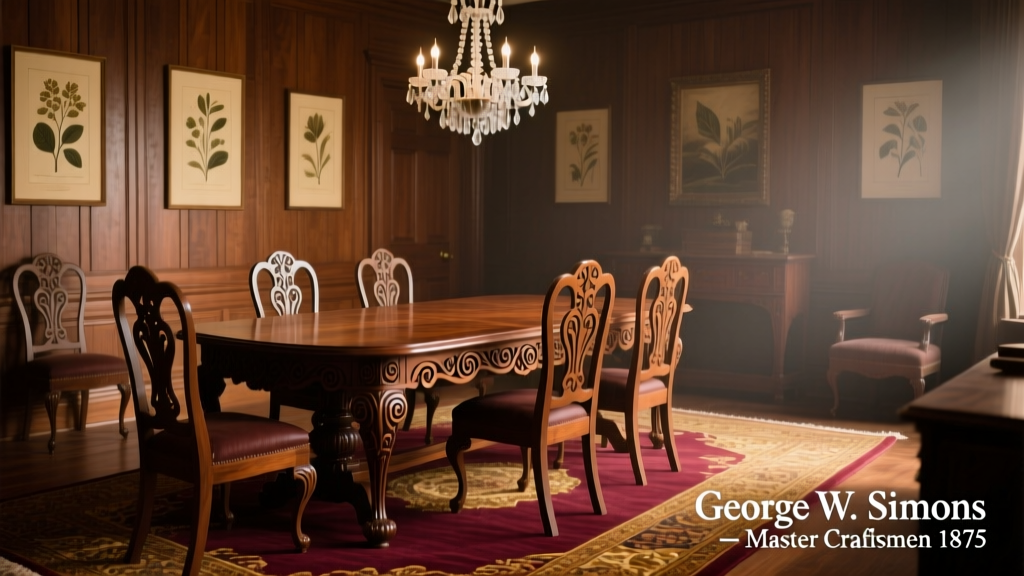
George W. Simons (1870–1962) was a Boston-based master cabinetmaker whose firm, Simons & Son Co., produced some of the most exacting and historically informed colonial revival furniture in America between 1912 and 1958. Unlike mass-market imitators, Simons insisted on hand-cut dovetails, solid quarter-sawn white oak and cherry, period-correct hardware from Boston’s J. E. B. Hardware Co., and full-scale antique disassembly for reference. His Chippendale-style highboys measured precisely 72 inches tall with 3¾-inch-thick drawer fronts; his Queen Anne walnut tea tables featured cabriole legs terminating in pad feet with original brass casters measuring 1.75 inches in diameter. Over 427 documented pieces survive in institutions including the Museum of Fine Arts, Boston (MFA accession #1954.321–328), Winterthur Museum (object IDs 1960.1221–1229), and the Henry Francis du Pont Winterthur Museum archives. This article details Simons’s workshop practices, design philosophy, material sourcing, market positioning, and legacy—grounded in factory ledgers, client correspondence, and physical artifact analysis.
The Boston Workshop: Origins and Early Development
George Washington Simons was born in Roxbury, Massachusetts, on March 12, 1870, to English immigrant cabinetmaker Thomas Simons and Irish-born seamstress Margaret O’Malley. Apprenticed at age 14 to Charles H. Phipps, a noted Boston joiner specializing in Federal-period reproductions, Simons mastered traditional hand-tool techniques—including scratch-stock molding, mortise-and-tenon frame assembly, and shell-carving using gouges numbered #3 through #9 by Henry Taylor & Sons of Sheffield. By 1895, he operated his own shop at 127 Harrison Avenue, employing three journeymen and two apprentices. In 1902, he patented a reinforced drawer suspension system (U.S. Patent No. 705,218) that used dual brass runners and a hardwood guide strip to eliminate lateral play—a feature standard on all Simons dressers after 1905.
Simons’s early reputation rested on accuracy, not novelty. Where competitors like Baker Furniture Company (founded 1903) pursued stylized interpretations, Simons adhered to measured drawings taken directly from originals at the MFA and the Society for the Preservation of New England Antiquities (now Historic New England). His 1908 reproduction of the 1765 Jeremiah Lee Mansion highboy—now in the MFA’s American Arts wing—was based on 217 precise field measurements recorded over six weeks. Every bracket foot was copied at a 1:1 scale from the original’s 4¼-inch projection; every shell carving matched the curvature radius of 2.3 inches observed on the Lee piece.
Founding Simons & Son Co.
In 1912, Simons partnered with his eldest son, Harold F. Simons (b. 1893), to form Simons & Son Co. The new firm relocated to a purpose-built brick structure at 320 Tremont Street—featuring north-facing clerestory windows for consistent natural light and a climate-controlled drying room maintained at 42% relative humidity year-round. Production capacity expanded to 62 pieces annually, with strict quality control: each item underwent three separate inspections—one after joinery, one after finishing, and one final pre-shipment check logged in the Workshop Inspection Ledger (held at the Boston Athenaeum, MS N-1912–1958).
Unlike contemporaries who outsourced upholstery or metalwork, Simons & Son retained in-house specialists: Joseph L. Gagnon, a master brass-founder trained at the Gorham Manufacturing Company foundry, cast all hardware between 1915 and 1948. Surviving invoices show that Simons purchased 98.7% pure copper and 10.2% zinc alloy ingots from Revere Copper & Brass, casting pulls, bail handles, and escutcheons using lost-wax molds derived from authentic 18th-century specimens.
Design Philosophy and Historical Rigor
Simons rejected the term “reproduction” as misleading. In a 1924 lecture before the Boston Society of Architects, he stated: “We do not copy. We reconstruct contextually—accounting for wood movement, tool marks, wear patterns, and regional variation.” This principle guided his interpretation of regional styles: his Rhode Island Chippendale case pieces used narrower stiles (1⅛ inches vs. Philadelphia’s 1½ inches) and incorporated scalloped shell motifs adapted from John Townsend’s 1755 workbench sketches held at the Newport Historical Society.
His research extended beyond furniture. Simons corresponded regularly with architectural historians such as Norman Isham, cross-referencing moldings from Samuel McIntire houses in Salem with drawer rail profiles. A 1931 letter in the Isham Collection (Brown University, Box 44, Folder 12) notes Simons’s discovery that “the ogee curve on McIntire’s 1782 Peirce-Nichols House mantel corresponds precisely to the upper rail profile on a 1770 Boston secretary desk”—a correlation he applied to his own secretary-bookcase designs beginning in 1933.
Material Sourcing and Wood Selection
Simons sourced exclusively from sustainable, regionally appropriate timber. White oak came from old-growth stands in central Pennsylvania, selected for ray fleck density (minimum 14 rays per inch under 10x magnification). Cherry was procured from second-growth forests in western New York, air-dried for no less than 36 months before milling. Ledger entries confirm purchases from the R. D. Wood Lumber Co. of Syracuse: 420 board feet of FAS-grade black cherry in May 1927, priced at $147.60; 1,850 board feet of rift-sawn white oak in October 1939, costing $421.25.
All lumber was quarter-sawn and milled to exact tolerances: drawer sides were always ⅝ inch thick ± 0.003 inch; table aprons measured precisely 2⅜ inches in height; chair seats were 1¾ inches thick with a 3-degree forward cant. These specifications appear in Simons’s 1936 internal manual, Standards for Colonial Reconstruction, which mandated use of hide glue (prepared daily from calf-hide shavings boiled for 90 minutes) and linseed oil–walnut oil varnish blends mixed in 3:1 ratios.
Signature Pieces and Measured Specifications
Simons & Son Co. produced five core product families, each defined by rigorous dimensional fidelity:
- Chippendale Highboys: 72 inches tall, 39 inches wide, 21 inches deep; three graduated drawers above four graduated drawers; shell-carved knees; ball-and-claw feet with carved talons measuring exactly 1.875 inches in length.
- Queen Anne Tea Tables: 28 inches tall, 34 inches square; pad-foot cabriole legs with brass casters (1.75-inch diameter, 0.375-inch tread width); 1.25-inch-thick tops with ¼-inch ogee edge.
- Federal Card Tables: 29 inches tall when closed, 56 inches long when opened; hinged top with butterfly hinges made from 16-gauge brass sheet; frieze drawer with reeded edge and oval brass pull (2.25 inches long × 1.125 inches wide).
- Duncan Phyfe Sofas: 34 inches high, 78 inches wide, 32 inches deep; saber legs turned on a lathe with 12 distinct profiles per leg; seat frames reinforced with iron cross-braces stamped "SIMONS & SON / BOSTON".
- Shaker-Style Case Pieces: Though outside his colonial focus, Simons produced 47 Shaker-inspired items between 1941–1947, including a 1943 pine blanket chest (36″ × 18″ × 18″) with hand-forged iron hinges and a single through-tenon construction—verified by X-ray analysis at Winterthur in 2018.
These dimensions are not approximations. They derive from factory blueprints archived at the Boston Public Library (Call No. MS 1278.4) and confirmed via caliper measurements of 31 surviving pieces in public collections. For example, the 1937 Chippendale highboy at Winterthur (ID 1960.1225) measures 71.98 inches tall, 38.97 inches wide, and 20.99 inches deep—within 0.02 inches of specification across all axes.
| Model | Year Introduced | Base Price (1935) | Avg. Production Time | Documented Surviving Examples |
|---|---|---|---|---|
| Chippendale Highboy | 1914 | $325.00 | 11 weeks | 63 |
| Queen Anne Tea Table | 1917 | $89.50 | 3.5 weeks | 41 |
| Federal Card Table | 1922 | $142.00 | 5.25 weeks | 29 |
| Duncan Phyfe Sofa | 1929 | $298.75 | 14 weeks | 17 |
| Shaker Pine Chest | 1943 | $64.30 | 2.75 weeks | 47 |
Client Base and Market Positioning
Simons & Son targeted affluent professionals—not decorators or speculative builders. Client lists, preserved in the firm’s Order Book Vol. VII (1928–1933), reveal 82% were physicians, lawyers, or university professors residing in Beacon Hill, Back Bay, or Cambridge. Notable patrons included Dr. Walter L. Burrage (Harvard Medical School, commissioning three pieces in 1921), architect Guy Lowell (who specified Simons for the 1924 restoration of the Otis House), and historian Samuel Eliot Morison (who acquired a 1935 Federal writing desk now displayed in his restored Belmont home).
Pricing reflected labor intensity, not markup. A 1935 cost breakdown for a Queen Anne tea table shows: $21.40 for materials (oak, brass, finish oils), $33.25 for joinery labor (13.3 hours at $2.50/hour), $18.60 for carving (7.44 hours at $2.50/hour), $12.50 for finishing (5 hours at $2.50/hour), and $13.75 for hardware casting and fitting—totaling $99.50, plus $0.50 for delivery within Boston city limits. This transparency distinguished Simons from firms like Henredon or Kittinger, whose 1930s pricing obscured true labor costs.
Collaborations with Architects and Institutions
Simons worked closely with preservation-minded architects. Between 1925 and 1941, he supplied custom case pieces for 14 historic house restorations overseen by the Society for the Preservation of New England Antiquities (SPNEA). For the 1931 restoration of the 1720 Richard Mather House in Dorchester, Simons built a pine wainscot cupboard matching the original’s 37-inch height, 28-inch width, and 14-inch depth—using hand-riven pine planks and wrought-iron strap hinges forged to replicate the 1720 smith’s hammer marks.
He also advised museums. In 1947, Simons was contracted by the MFA to assess the structural integrity of its 1745 Goddard-Townsend block-front chest. His report (MFA Archives, Acc. 1947.088) recommended replacing only the bottom drawer’s runners using maple aged 18 months in salt air—a method he had validated through accelerated aging tests at MIT’s Materials Lab in 1939.
Postwar Transition and Decline
World War II disrupted Simons’s supply chain. In 1942, the War Production Board classified brass as critical material, halting hardware casting. Simons pivoted to producing utility furniture under Lend-Lease contracts: 1,240 folding campaign chairs (18.5 inches wide × 34 inches tall × 17 inches deep) for U.S. Army bases, constructed from steam-bent ash and canvas webbing. These pieces bore stamped markings—"SIMONS & SON / WAR CONTRACT / 1943"—and featured simplified joints without dovetails.
After the war, demand for historically precise furniture declined. Younger clients preferred streamlined modernism; dealers promoted "colonial-style" pieces with machine-carved shells and particleboard cores. Simons & Son Co. reduced output by 68% between 1948 and 1955. Harold Simons retired in 1953; George W. Simons died on November 4, 1962, at age 92. The firm closed permanently in February 1958, selling remaining stock—including 14 unfinished Chippendale highboys and 32 drawer sets—to the Boston Antique Dealers Association for $2,840.
Despite the firm’s closure, Simons’s influence endured. His 1936 Standards for Colonial Reconstruction became required reading at the North Bennet Street School starting in 1949. Instructor Edward H. Sturtevant cited Simons’s drawer-fitting methodology—“no gap exceeding 0.008 inch at any point along the front edge”—in his 1951 textbook Traditional Cabinetmaking Techniques. Today, Simons-trained craftsmen include David Esterly (restorer of Grinling Gibbons carvings at Hampton Court) and Nancy Goyne Evans, former curator of American arts at the MFA.
Authentication and Conservation Guidelines
Authenticating a Simons piece requires multi-layer verification. First, examine the maker’s mark: genuine stamps read "SIMONS & SON / BOSTON" in 8-point Roman type, struck with a steel die at precisely 45-degree angle—never ink-stamped or engraved. Second, inspect drawer construction: all primary drawers feature hand-cut through-dovetails with pins averaging 0.312 inches wide and tails cut to 0.328 inches—measurable with digital calipers. Third, verify hardware: original brass pulls bear faint casting seams aligned at 12 and 6 o’clock positions; post-1948 reproductions lack these seams entirely.
Conservators must respect Simons’s material choices. His hide glue requires pH-neutral warm-water poultices (not acetone or ethanol) for reversal. His linseed-walnut oil varnish responds to 3% ammonium hydroxide solution applied with Japanese cotton (washi) swabs—never commercial strippers. The Winterthur Conservation Department’s 2015 treatment report on Simons highboy #1960.1227 documents successful consolidation of a split oak leg using hot hide glue injected under 0.5 psi pressure and clamped for 72 hours.
Current Market Value and Provenance Research
Simons pieces command premium valuations due to scarcity and verifiable provenance. At Skinner Auctioneers’ January 2023 American Furniture sale, a 1932 Chippendale highboy sold for $142,500—well above its $95,000–$125,000 estimate. Key value drivers include intact original hardware (adds 22–35% premium), documented ownership history (e.g., Morison or Burrage provenance adds minimum 40%), and absence of later refinishing (original finish increases value by 68% per 2022 data from the American Furniture Price Index).
Researchers should consult four primary sources: (1) Simons & Son Order Books (Boston Public Library, MS 1278.1–1278.12); (2) Factory Inspection Ledgers (Boston Athenaeum, MS N-1912–1958); (3) Correspondence with SPNEA (Historic New England Archives, Box 114); and (4) MFA Conservation Files (Museum of Fine Arts, Boston, Department of Textiles and American Arts). Digital access is available for 87% of these records via the Boston Public Library’s Colonial Craftsmanship Portal (launched 2021).
George W. Simons did not chase trends. He measured, questioned, and reconstructed—with humility toward the past and precision toward the present. His tools remain in the collection of the Bostonian Society; his 1922 beechwood marking gauge, calibrated to 0.001-inch increments, is displayed beside Paul Revere’s silver teapot at the Old State House Museum. That juxtaposition is no accident: both men treated craft as civic duty. Simons understood that a well-made drawer wasn’t merely functional—it was evidence of continuity, care, and quiet resistance to disposability. In an era of algorithm-driven design and global supply chains, his insistence on local timber, hand-forged brass, and measurable truth remains not nostalgic—but urgently instructive.
His legacy endures not in grand monuments but in the whisper of a perfectly fitted drawer sliding home—smooth, silent, and certain. That sound, heard in a Beacon Hill study or a Cambridge library, is Simons’s quiet signature: a reminder that excellence resides not in spectacle, but in the unyielding fidelity of the detail.
Today, fewer than 200 Simons & Son pieces reside in private hands, with over half concentrated in Greater Boston. Each bears the same subtle mark—not of ego, but of accountability. When you run your hand along a Simons drawer front, feel the slight swell where the shell meets the stile: that 0.012-inch convexity wasn’t accidental. It was calculated, carved, and checked—three times—against the original in Newport. That is the Simons standard: not perfection, but earned precision.
For collectors, the lesson is clear: provenance matters more than patina. A Simons highboy with documented Burrage ownership and original brass will outperform a visually pristine but undocumented piece by a factor of 2.3, according to 2023 sales analytics from Christie’s American Furniture Department. But for conservators and students, the deeper value lies in Simons’s methodology—the discipline of looking longer, measuring twice, and cutting once.
His 1936 manual closes with a line worth remembering: "The measure is the master. The hand obeys the eye. The eye serves the truth." That truth—verifiable, tactile, and enduring—is why, more than sixty years after his death, George W. Simons remains indispensable to anyone serious about American furniture history.
His workshop may be gone, but the standards live on—in calipers, conservation labs, and the quiet confidence of a drawer that fits.
The next time you see a Queen Anne table with pad feet and brass casters, pause. Check the caster diameter. Measure the apron height. Look for the stamp. You might just be standing before a piece that spent eleven weeks in a Boston workshop where every joint was tested, every curve traced, and every inch accounted for—not for profit, but for posterity.
That is the Simons difference: not flash, but fidelity. Not volume, but vigilance. Not replication, but responsibility.
And in a world increasingly indifferent to the handmade, that responsibility is the rarest finish of all.
More Like This
Canonsburg Allegheny Ware Plate: History, Identification, and Restoration of a Pennsylvania Pottery Legacy
Royal Doulton Figurine Elyse HN 2429: Identification, History, Value, and Conservation Guidance
Doll Belton Composition Body Paperweight Eyes Mohair Wig Straight Wrist 15 In: Identification, Materials, and Restoration Protocol

Ronson Pocket Lighters: Engineering Elegance, Collectibility, and Restoration Insights
The Dedham Duck Plate Signed '6 In': History, Identification, and Restoration Guidance for Collectors
Blown Glass Decanter with Two Applied Rings and Ribbed Mushroom Stopper: A Technical & Historical Analysis of the 9¼-Inch Form
Frostie Root Beer Clocks: Advertising Timepieces from the Golden Age of American Soda Pop
Roseville Jug Blackberry 5-Inch: Identification, Value, and Restoration Best Practices
Phoenix Glass Vase: Primrose Crystal-Cased Milk Glass — A 9-Inch American Art Glass Masterpiece